Showing posts with label U.S. Dollar Devaluation. Show all posts

Sunday, November 11, 2012

China and Russia are Acquiring Gold, Dumping US Dollars


Global Research
Michel Chossudovsky
Central Banks are Acquiring Gold, Dumping US Dollars
There is evidence that central banks in several regions of the World are building up their gold reserves. What is published are the official purchases.

A large part of these Central Bank purchases of gold bullion are not disclosed. They are undertaken through third party contracting companies, with utmost discretion. 

US dollar holdings and US dollar denominated debt instruments are in effect being traded in for gold, which in turn puts pressure on the US dollar.  

In turn, both China and Russia have boosted domestic production of gold, a large share of  which is being purchased by their central banks:

It has long been assumed that China is surreptitiously building up its gold reserves through buying local production. Russia is another major gold miner where the Central bank has been purchasing gold from another state entity, Gokhran, which is the marketing arm and central repository for the country’s mined gold production. Now it has been reported by Bloomberg that the Venezuelan Central Bank director, Jose Khan, has said that country will boost its gold reserves through purchasing more than half the gold produced from its rapidly growing domestic gold mining industry.
In Russia, for example, Gokhran sold some 30 tonnes of gold to the Central Bank in an internal accounting exercise late last year. In part, so it was said at the time, the direct sale was made rather than placing the metal on the open market and perhaps adversely affecting the gold price.

China is currently the world’s largest gold producer and last year it confirmed it had raised its own Central Bank gold holdings by more than 450 tones over the previous six years. Mineweb.com – The world’s premier mining and mining investment website Venezuela taking own gold production into Central Bank reserves – GOLD NEWS | Mineweb

The 450 tons figure corresponds to an increase in the gold reserves of the central bank from 600 tons in 2003 to 1054 tons in 2009. If we go by official statements, China’s gold reserves are increasing by approximately 10 percent per annum.

China has risen to now be the largest gold producing nation in the world at around 270 tonnes. The amount bought in by the government initially looks like 90 tonnes per annum or just under, 2 tonnes a week. Before 2003 the announcement by the Chinese central bank that gold reserves had been doubled to 600 tonnes, accounted for similar purchases before that date. Why so small an amount you may well ask? We think local and national issues clouded the central bank’s view as it was the government that bought the gold since 2003 and have now placed it on the central bank’s Balance Sheet. So we would conclude that the government has ensured central bank gold purchasing must continue. “How will Chinese Central Bank Gold Buying affect the Gold Price short & Long-Term?” by Julian Phillips. FSO Editorial 05/07/2009
Russia
Russia’s Central bank holdings are in excess of 20 million troy ounces (January 2010)
click to enlarge
Russia’s Central Bank reserves have increased markedly in recent years. The RCB reported in May 2010 purchasing 34.2 tons of gold in a single month. Russian Central Bank Gold Purchases Soar In May – China Too? | The Daily Gold

The diagram below shows a significant increase in monthly purchases by the the RCB since June 2009.
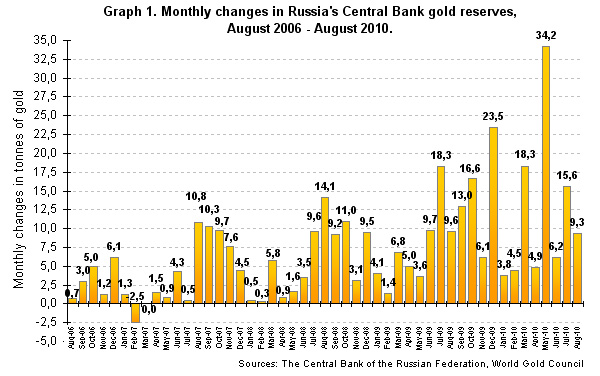
(click on chart to enlarge)

Central Banks in the Middle East are also building up their gold reserves, while reducing their dollar forex holding.

Gold reserves of GCC states is less than 5 percent:

Dubai International Financial Centre Authority economists released a report yesterday calling for local countries to build gold reserves, according to The National.

Despite a high interest in gold, GCC states maintain less than 5 percent of their total reserves in gold. Compared to the ECB, which holds 25 percent of reserves in gold, that leaves a lot of room for growth. http://www.businessinsider.com/gcc-boost-gold-holdings-2010-12#ixzz18FEqpTy3

GCC states should boost their foreign reserve holdings of gold to help shield their billions of dollars of assets from turbulence in global currency markets, say economists at the Dubai International Financial Centre Authority (DIFCA).

Diversifying more of their reserves from US dollars to the yellow metal would help to offer central banks in the region higher investment returns, said Dr Nasser Saidi, the chief economist of DIFCA, and Dr Fabio Scacciavillani, the director of macroeconomics and statistics at the authority.

“When you have a great deal of economic uncertainty, going into paper assets, whatever they may be – stocks, bonds, other types of equity – is not attractive,” said Dr Saidi. “That makes gold more attractive.”

Declines in the dollar during recent months have dented the value of GCC oil revenues, which are predominantly weighted in the greenback. GCC urged to boost gold reserves
According to a report in People`s Daily;

The latest rankings of gold reserves show that, as of mid-December, the United States remains the top country and the Chinese mainland is ranked sixth with 1,054 tons of reserves, the World Gold Council announced recently.

Russia climbed to eighth place because its gold reserves increased by 167.5 tons since December 2009. The top ten in 2010 remains the same compared to the rankings of the same period of last year. And Saudi Arabia squeezed to the top 20.
Developing countries and regions, including Saudi Arabia and South Africa, have become the main force driving the gold reserve increase. … .

The International Monetary Fund (IMF) and the European central bank are the major gold sellers, and the IMF’s gold reserves decreased by 158.6 tons. (China’s gold reserves rank 6th worldwide – People’s Daily Online

It should be understood that actual purchases of physical gold are not the only factor in explaining the movement of gold prices. The gold market is marked by organized speculation by large scale financial institutions.

The gold market is characterised by numerous paper instruments, gold index funds, gold certificates, OTC gold derivatives (including options, swaps and forwards), which play a strong role, particularly in short-term movement of gold prices. The recent increase and subsequent decline of gold prices are the result of manipulation by powerful financial actors.

Friday, November 2, 2012

Iran vs the Empire: Fighting dollarization


PressTV
Eric Walberg


The West's attempts to destroy the Iranian economy through heightened sanctions-including most imports, oil exports and use of banks for trade operations-is having its affect. According to Johns Hopkins University Professor Steve Hanke, Iran is facing hyperinflation, with a monthly inflation rate of nearly 70% per month and its national currency, the rial, plummeting in value against western currencies. Iran is the latest casualty to be placed on his Hanke-Krus Hyperinflation Index, which includes France (1795), Germany (1922), Chile (1973), Nicaragua (1986), Argentina (1990), Russia (1992), Ecuador (1999) and Zimbabwe (2007), countries which experienced price-level increases of at least 50% per month.

Hanke, relishing his role as the world’s expert on this nightmarish phenomenon, has "played a significant role in stopping more hyperinflations than any living economist, including 10 of the 57 episodes" on his Index. He writes that Iran has three options: spontaneous dollarization (people unloading rials on the black-market for dollars, as happened in Zimbabwe), official dollarization (the government withdrawing the currency in favor of dollars, as in Ecuador), or a currency board issuing a new domestic currency backed 100% by-you guessed it-dollars. Hanke insists that the foreign currency does not have to be US dollars. Pitcairn Island, for instance, uses New Zealand dollars.

The inflation doctor admits vaguely that there are "foreign factors," without a hint of criticism of not only the sanctions, but the active subversion of Iran through everything from support of Iranian terrorists, assassinations of leading scientists, right up to war (the US encouraged Iraq to invade Iran in 1980). He emphasizes "Iran's complex system of subsidies, capital controls, and multiple exchange rates," but most of all "massive overprinting of money," though he complains that "the Central Bank of The Islamic Republic of Iran has not reported any such statistics for some time." As if a country living through a state of emergency is likely to divulge such sensitive information.

He coolly dismisses consumers' expectations influencing prices, since "fear surrounding military tensions is nothing new for Iranians". Indeed, the US has been targeting Iran for destruction ever since it threw off its colonial chains in 1979-a dangerous example for other, especially Muslim countries. It is miraculous that Iran has done so well economically since the revolution, given the unremitting victimization it has experienced. One can only marvel at the stubborn courage it has shown to build an Islamic society in the teeth of opposition by the world empire and even by other Muslim nations allied to the empire.

We indeed may ask why Iran's inflation rate has jumped so dramatically precisely in recent times. Of course, it is because of the sanctions. And why the sanctions? Is it really fears that Iran will develop a nuclear bomb, despite professions to the contrary and membership in the IAEA? No. Besides Iran’s role in inspiring the current 'Islamic Reawakening' in the Middle East, there is another very important reason, one which flies in the face of Hanke's 'three options' for Iran.

Those ‘options’ all amount to one: accept US-dollar dictatorship. Iran has been trying to trade oil in non-US dollar currencies since 2008, when it opened its Oil Bourse. Iraq did this in 2000, and the US reaction was invasion-dollarization at gunpoint. The point of the sanctions today is a last-ditch attempt by the US to force Iran to comply with the US world order, as epitomized by continued acceptance of the US dollar as the world’s reserve currency.

Hanke insists it is not necessary for Iran to use US dollars as its substitute currency, which in any case would be ridiculous under the circumstances. However, the alternative of using, say, New Zealand dollars finesses the reality that all currencies are tied to the US dollar, as the de facto international reserve currency. This has been the case in reality since the 1930s, when the world abandoned the gold standard. Acknowledging this fact, over 20 countries call their legal tender 'dollars'.

Whether the government moves quickly to raise the white flag, as in Ecuador, or belatedly, as in Zimbabwe, or insists on printing pretty new paper scrip tied 100% to the US dollar through an exchange board, as did Argentina, merely confirms the obvious. In past cases, such as Chile, Nicaragua and Zimbabwe, the message was, ‘your socialist policies are unacceptable.’ In Iran's case, the message is, ‘take dollars for your oil.’

Hanke's monetarist credo-printing money causes inflation-ignores the underlying causes of inflation. As he admits, Iranians have faced war fears for over three decades. The exchange controls and subsidies, "government monopolies, price controls, and Soviet-style economic planning," which Hanke calls "wrong-headed," are not the cause of inflation, but a way for the government to keep it under control. However, at a certain point, the "foreign factors" become so egregious that even such measures fail. That is what has happened now, as sanctions have created extreme pain for the average Iranian. Bare shelves and panic in the face of invasion threats means that the currency will devalue, however many rials the government prints.

This is what happened in Germany in 1922, when it was forced to export everything to buy the gold to pay the extortionate reparations. It ended by resorting to Hanke’s currency board and marks issued against gold, but the underlying cause-the extortion practiced by Britain and France-only ended when Hitler took power and canceled the reparations. The devastation cause by "foreign factors" led in that instance to the rise of fascism.

Friday, October 5, 2012

QE Infinity: What Is It Really About?


QE3, the Federal Reserve’s third round of quantitative easing, is so open-ended that it is being called QE Infinity.  Doubts about its effectiveness are surfacing even on Wall Street.  The Financial Times reports:
Among the trading rooms and floors of Connecticut and Mayfair [in London], supposedly sophisticated money managers are raising big questions about QE3 — and whether, this time around, the Fed is not risking more than it can deliver.
Which raises the question, what is it intended to deliver?  As suggested in an earlier article here, QE3 is not likely to reduce unemployment, put money in the pockets of consumers, reflate the money supply, or significantly lower interest rates for homeowners, as alleged.  It will not achieve those things because it consists of no more than an asset swap on bank balance sheets.  It will not get dollars to businesses or consumers on Main Street.
So what is the real purpose of this exercise?  Catherine Austin Fitts recently posted a revealing article on that enigma.  She says the true goal of QE Infinity is to unwind the toxic mortgage debacle, in a way that won’t bankrupt pensioners or start another war:
The challenge for Ben Bernanke and the Fed governors since the 2008 bailouts has been how to deal with the backlog of fraud – not just fraudulent mortgages and fraudulent mortgage securities but the derivatives piled on top and the politics of who owns them, such as sovereign nations with nuclear arsenals, and how they feel about taking massive losses on AAA paper purchased in good faith.
On one hand, you could let them all default. The problem is the criminal liabilities would drive the global and national leadership into factionalism that could turn violent, not to mention what such defaults would do to liquidity in the financial system. Then there is the fact that a great deal of the fraudulent paper has been purchased by pension funds. So the mark down would hit the retirement savings of the people who have now also lost their homes or equity in their homes. The politics of this in an election year are terrifying for the Administration to contemplate.
How can the Fed make the investors whole without wreaking havoc on the economy?  Using its QE tool, it can quietly buy up toxic mortgage-backed securities (MBS) with money created on a computer screen.
Good for the Investors and Wall Street, But What about the Homeowners and Main Street?
 The investors will get their money back, the banks will reap their unearned profits, and Fannie and Freddie will get bailed out and wound down.  But what about the homeowners?  They too bought in good faith, and now they are either underwater or are losing or have lost their homes.  Will they too get a break?  Fitts says we’ll have to watch and see.  Perhaps there was a secret agreement to share in the spoils.  If so, we should see a wave of write-downs and write-offs aimed at relieving the beleaguered homeowners.
A nice idea, but somehow it seems unlikely.  The odds are that there was no secret deal.  The banks will make out like bandits as they have before.  The never-ending backdoor bailout will keep feeding their profit margins, and the banks will keep biting the hands of the taxpayers who feed them.
How can Wall Street be made to play well with others and share in their winnings?  In a July 2012 article in The New York Times titled “Wall Street Is Too Big to Regulate,” Gar Alperovitz observed:
With high-paid lobbyists contesting every proposed regulation, it is increasingly clear that big banks can never be effectively controlled as private businesses.  If an enterprise (or five of them) is so large and so concentrated that competition and regulation are impossible, the most market-friendly step is to nationalize its functions. . . .
Nationalization isn’t as difficult as it sounds.  We tend to forget that we did, in fact, nationalize General Motors in 2009; the government still owns a controlling share of its stock.  We also essentially nationalized the American International Group, one of the largest insurance companies in the world, and the government still owns roughly 60 percent of its stock.

Bailout or Receivership?

Nationalization also isn’t as radical as it sounds.  If nationalization is too loaded a word, try “bankruptcy and receivership.”  Bankruptcy, receivership and nationalization are what are SUPPOSED to happen when very large banks become insolvent; and if the toxic MBS had been allowed to default, some very large banks would have wound up insolvent.
Nationalization is one of three options the FDIC has when a bank fails.  The other two are closure and liquidation, or merger with a healthy bank.  Most failures are resolved using the merger option, but for very large banks, nationalization is sometimes considered the best choice for taxpayers.  The leading U.S. example was Continental Illinois, the seventh-largest bank in the country when it failed in 1984.  The FDIC wiped out existing shareholders, infused capital, took over bad assets, replaced senior management, and owned the bank for about a decade, running it as a commercial enterprise.  In 1994, it was sold to a bank that is now part of Bank of America.
Insolvent banks should be put through receivership and bankruptcy before the government takes them over.  That would mean making the creditors bear the losses, standing in line and taking whatever money was available, according to seniority.  But that would put the losses on the pension funds, the Chinese, and other investors who bought supposedly-triple-A securities in good faith—the result the Fed is evidently trying to avoid.
How to resolve this dilemma?  How about combining these two solutions?  The money supply is still SHORT by $3.9 trillion from where it was in 2008 before the banking crisis hit, so the Fed has plenty of room to expand the money supply.  (The shortfall is in the shadow banking system, which used to be reflected in M3, the part of the money supply the Fed no longer reports.  The shadow banking system is composed of non-bank financial institutions that do not accept deposits, including money market funds, repo markets, hedge funds, and structured investment vehicles.)
Rather than a never-ending windfall for the banks, however, these maneuvers need to be made contingent on some serious quid pro quo for the taxpayers.  If either the Fed or the banks won’t comply, Congress could nationalize either or both.  The Fed is composed of twelve branches, all of which are 100% owned by the banks in their districts; and its programs have consistently been designed to benefit the banks—particularly the large Wall Street banks—rather than Main Street.  The Federal Reserve Act that gives the Fed its powers is an act of Congress; and what Congress hath wrought, it can undo.
Only if the banking system is under the control of the people can it be expected to serve the people.  As Seumas Milne observed in a July 2012 article in the UK Guardian:
Only if the largest banks are broken up, the part-nationalised outfits turned into genuine public investment banks, and new socially owned and regional banks encouraged can finance be made to work for society, rather than the other way round.  Private sector banking has spectacularly failed – and we need a democratic public solution.
_______________________

Ellen Brown is an attorney and president of the Public Banking Institute.  In Web of Debt, her latest of eleven books, she shows how a private cartel has usurped the power to create money from the people themselves, and how we the people can get it back. Her websites are http://WebofDebt.comhttp://EllenBrown.com, andhttp://PublicBankingInstitute.org.

Saturday, September 29, 2012

Dollar Hegemony in the Empire of the Damned


Global Research
Colin Todhunter


Many commentators and economists wonder if the US is able to turn its ailing economy around. The reality is that it is bankrupt. However, as long as the dollar remains the world currency, the US can continue to pay its bills by simply printing more money. But once the world no longer accepts the dollar as world reserve currency, the US will no longer be able to continue to pay its way or to fund its wars by relying on what would then be a relatively valueless paper currency.

And the US realises this. Today, more than 60 per cent of all foreign currency reserves in the world are in US dollars, and the US will attempt to prevent countries moving off the dollar by any means possible. It seems compelled to do this simply because its economic infrastructure seems too weak and US corporate cartels will do anything to prevent policies that eat into their profits or serve to curtail political influence. They serve their own interests, not any notional ‘national interest’.

Pail Graig Roberts, former Assistant Secretary of the US Treasury, notes that much of the most productive part of the US economy has been moved offshore in order to increase corporate profits. By doing so, the US has lost critical supply chains, industrial infrastructure, and the knowledge of skilled workers. According to Roberts, the US could bring its corporations back to America by taxing their profits abroad and could also resort to protective tariffs, but such moves would be contrary to the material interests of the ruling oligarchy of private interests, which hold so much sway over US politics.

So, with no solution to the crisis in site, the US is compelled to expand its predatory capitalism into foreign markets such as India and to wage imperialist wars to maintain global allegiance to the dollar and US hegemony. And this is exactly what we are seeing today as the US strategy for global supremacy is played out.

Over the past two decades, the US has extended its influence throughout Eastern Europe, many of the former Soviet states in central Asia and, among other places, in the former Yugoslavia, Libya, Iraq, Yemen, Afghanistan, Syria and Pakistan. But with each passing year and each new conflict, the US has been drawing closer and closer to direct confrontation with Russia and China, particularly as it enters their backyards in Asia and as China continues to emerge as a serious global power.

Both countries are holding firm over Syria. Syria plays host to Russia’s only naval base outside of the former USSR, and Russia and China know that if the US and its proxies topple the Assad government, Tehran becomes a much easier proposition. Ideally, the US would like to install compliant regimes in Moscow and Beijing and exploiting political and ethnic divisions in the border regions of Russia and China would be that much easier if Iran fell to US interests.

A global US strategy is already in force to undermine China’s growth and influence, part of which was the main reason for setting up AFRICOM: US Africa Command with responsibility for military operations and relations across Africa. But China is not without influence, and its actions are serving to weaken the hegemony of the US dollar, thereby striking at a key nerve of US power.

China has been implementing bilateral trade agreements with a number of countries, whereby trade is no longer conducted in dollars, but in local currencies. Over the past few years,China and other emerging powers such as Russia have been making agreements to move away from the US dollar in international trade. The BRICS (Brazil, Russia, India, China,South Africa) also plan to start using their own currencies when trading with each other. Russia and China have been using their own national currencies when trading with eachother for more than a year.

A report from Africa’s largest bank, Standard Bank, recently stated:

“We expect at least $100 billion (about R768 billion) in Sino-African trade – more than the total bilateral trade between China and Africa in 2010 – to be settled in the renminbi by 2015.”

Under Saddam, Iraq was not using the dollar as the base currency for oil transactions, neither is Iran right now. Even Libya’s Muammar Gadhaffi was talking about using a gold backed dinar as the reserve currency for parts of Africa. Look what happened to Libya and Iraq as a result.

In 2000, Iraq converted all its oil transactions to euros. When U.S. invaded Iraq in 2003, it returned oil sales from the euro to the dollar. Little surprise then that we are currently watching the US attempt to remove the Iranian regime via sanctions, destabilization, intimidation and the threat of all out war.

In the meantime, though, Iran is looking east to China, Pakistan and central Asia in order to counteract the effects of US sanctions and develop its economy and boost trade. In order to sustain its empire, US aggression is effectively pushing the world into different camps and a new cold war that could well turn into a nuclear conflict given that Russia, China and Pakistan all have nuclear weapons.

The US economy appears to be in terminal decline. The only way to prop it up is by lop-sided trade agreements or by waging war to secure additional markets and resources and to ensure the dollar remains the world reserve currency. Humankind is currently facing a number of serious problems. But, arguably, an empire in decline armed to the teeth with both conventional and nuclear weapons and trapped in a cycle of endless war in what must surely be a futile attempt to stave off ruin is the most serious issue of all.

Originally from the northwest of England,  Colin Todhunter has spent many years in India. He has written extensively for the Deccan Herald (the Bangalore-based broadsheet), New Indian Express and Morning Star (Britain). His articles have also appeared in various other publications. His East by Northwest website is at http://colintodhunter.blogspot.com

Saturday, September 15, 2012

Dollar no longer primary oil currency as China begins to sell oil using Yuan

The Examiner
Kenneth Schortgen Jr.

On Sept. 11, Pastor Lindsey Williams, former minister to the global oil companies during the building of the Alaskan pipeline, announced the most significant event to affect the U.S.dollar since its inception as a currency. For the first time since the 1970's, when Henry Kissenger forged a trade agreement with the Royal house of Saud to sell oil using only U.S. dollars, China announced its intention to bypass the dollar for global oil customers and began selling the commodity using their own currency.
Lindsey Williams: "The most significant day in the history of the American dollar, since its inception, happened on Thursday, Sept. 6. On that day, something took place that is going to affect your life, your family, your dinner table more than you can possibly imagine."
"On Thursday, Sept. 6... just a few days ago, China made the official announcement. China said on that day, our banking system is ready, all of our communication systems are ready, all of the transfer systems are ready, and as of that day, Thursday, Sept. 6, any nation in the world that wishes from this point on, to buy, sell, or trade crude oil, can do using the Chinese currency, not the American dollar. - Interview with Natty Bumpo on the Just Measures Radio network, Sept. 11
This announcement by China is one of the most significant sea changes in the global economic and monetary systems, but was barely reported on due to its announcement taking place during the Democratic convention last week. The ramifications of this new action are vast, and could very well be the catalyst that brings down the dollar as the global reserve currency, and change the entire landscape of how the world purchases energy.

Ironically, since Sept. 6, the U.S. dollar has fallen from 81.467 on the index to today's price of 79.73. While analysts will focus on actions taking place in the Eurozone, and expected easing signals from the Federal Reserve on Thursday regarding the fall of the dollar, it is not coincidence that the dollar began to lose strength on the very day of China's announcement.

Since China is not a natural oil producing nation, the question most people will ask is how will the Asian economic power get enough oil to affect dollar hegemony? That question was also answered by Lindsey Williams when he pointed out a new trade agreement that was signed on Sept. 7 between China and Russia, in which the Russian Federation agreed to sell oil to China in any and all amounts they desired.
Lindsey Williams: "This has never happened in the history of crude oil. Since crude oil became the motivating force behind our (U.S.) entire economy, and everything in our lives revolves around crude oil. And since crude oil became the motivating factor behind our economy... never, ever has crude oil been sold, bought, traded, in any country in the world, without using the American dollar." 
"Crude oil is the standard currency of the world. Not the Yen, not the Pound, not the Dollar. More money is transferred around the world in crude oil than in any other product."
"On Friday, Sept. 7, Russia announced, that as of today, we will supply China with all of the crude oil that they need, no matter how much they want... there is no limit. And Russia will not sell or trade this crude oil to China using the American dollar." -Interview with Natty Bumpo on the Just Measures Radio network, Sept. 11
These duo actions by the two most powerful adversaries of the U.S. economy and empire, have now joined in to make a move to attack the primary economic stronghold that keeps America as the most powerful economic superpower. Once the majority of the world begins to bypass the dollar, and purchase oil in other currencies, then the full weight of our debt and diminished manufacturing structure will come crashing down on the American people.

This new agreement between Russia and China also has serious ramifications in regards to Iran, and the rest of the Middle East. No longer will U.S. sanctions against Iran have a measurable affect, as the rogue nation can simply choose to sell its oil to China, and receive Yuan in return, and use that currency to trade for the necessary resources it needs to sustain its economy and nuclear programs.

The world changed last week, and there was nary a word spoken by Wall Street or by politicians who reveled in their own magnificence as this event took place during the party conventions. A major blow was done on Sept. 6 to the American empire, and to the power of the U.S. dollar as the world's reserve currency. And China, along with Russia, are now aiming to become the controllers of energy, and thus, controllers of a new petro-currency.

For more on finance and economics, you can follow Ken Schortgen Jr on Twitter, and listen to the weekly economic roundup segment of the Angel Clark radio show from 6-7p.m. est on Friday evenings.

Friday, September 14, 2012

How Quantitative Easing Helps the Rich and Soaks the Rest of Us

And why the Occupy movement should be up in arms.

Anthony Randzzo

The decision is in: Unlimited quantitative easing. That was the announcement from the Federal Open Market Committee this afternoon, launching a third round of purchases of securities in a bid to boost the economy and reduce unemployment. This time, Federal Reserve Chairman Ben Bernanke and crew are pledging to buy $40 billion per month until the economy improves. The Fed's policy committee also extended its zero-interest rate policy until “at least mid-2015.” If QE3 lasts that long, the Feds will be printing at least another $800 billion to buy mortgage-backed securities.

It won’t be a surprise to read conservatives lambasting this as unconventional monetary policy meant to help re-elect President Obama. And inflation hawks have already started screeching. But the loudest cry of “for shame” should be coming from the Occupy Wall Street movement.

Quantitative easing—a fancy term for the Federal Reserve buying securities from predefined financial institutions, such as their investments in federal debt or mortgages—is fundamentally a regressive redistribution program that has been boosting wealth for those already engaged in the financial sector or those who already own homes, but passing little along to the rest of the economy. It is a primary driver of income inequality formed by crony capitalism. And it is hurting prospects for economic growth down the road by promoting malinvestments in the economy.

How is the Federal Reserve contributing to regressive redistribution, income inequality, and manipulated markets? Let’s flesh this out a bit.

Last month, Bernanke said that quantitative easing had contributed to the rebound in stock prices over the past few years, and suggested this was a positive outcome. “This effect is potentially important, because stock values affect both consumption and investment decisions,” he argued, apparently under the belief that the Fed has a third mandate to support rising stock prices.

This is ironically a trickle down monetary policy theory, where rising stock prices mean more wealth and more consumption that trickles down the economic ladder. One problem with this idea is that there is a gigantic mountain of household debt—about $12 trillion worth—that is diverting away any trickle down. An even worse assumption is that the stock market really reflects what is going on in the real economy.
Where the Occupy movement should really be teed off is when you consider that most equity shares in America are owned by the wealthiest 10 percent. That is not inherently a problem—wealthier individuals with more disposable income will have more ability take ownership stakes in companies than those in lower income brackets. And it is not a call for class warfare. However, it does mean that when the Fed engages in quantitative easing it is providing a benefit to a very narrow segment of society at the expense of others (either through future inflation or through the cost of raising taxes to pay for increased federal debts). That is the definition of crony capitalism.

At the same time, all Americans have seen the prices of basic goods increase over the past few years in large part due to rising commodities prices. The whole idea of QE is to drive investors out of lower risk investments like mortgage backed securities and government debt and get them to put that money in “more productive” use—lend it, build skyscrapers, invest in technology, etc. Since there is little confidence about the future of the economy, many investors have crowded into the stock market with their money, and still others have invested in commodities.

The problem is that investing in commodities can push up prices on things like gas, meat (because of feed corn prices), bread (because of wheat prices), and even orange juice. There certainly have been other contributors to commodities prices going up, but if the Fed has boosted stocks, they've boosted commodities too. So not only are the cronies gaining from quantitative easing, there is a negative wealth effect too.

The cronyism doesn’t end there. In a Dallas Fed paper released in August, OPEC chief economist William White points out that easy monetary policy favors “senior management of banks in particular.” And even Bernanke himself suggested (as if it was a good thing) that quantitative easing purchases “have been found to be associated with significant declines in the yields on both corporate bonds and MBS.” Translation: the Federal Reserve has made it artificially cheaper for corporations to borrow money and has pushed up the prices of houses (benefiting homeowners but hurting homebuyers).

Correct me if I’m wrong, but I thought cheap loans allowing businesses to leverage up and juiced housing prices were key parts of what got us into this mess?

All of this might be acceptable to some if quantitative easing was helping the American economy recover. The reality is that quantitative easing has made it cheaper for the government to borrow, has artificially propped up the housing market (making it take longer to recover), and has dramatically manipulated the distribution of capital in financial markets. And the economy has not been in recovery.
The plans announced today will exacerbate pre-existing malinvestment and income inequality. What is this continuous round of purchases going to do? It won’t get banks lending any more than they already are. And even if it did, households and small business still have a lot of debt that will keep them in a deleveraging state for a while. It won’t help the housing market bottom out, clear away toxic debt, and end the wave of foreclosures that need to process. It is not going to push up incomes, create new jobs, or change the technological revolution that is altering the face of employment in America.

To put it simply: More quantitative easing is not going to move the dial much on the growth meter.
Taken together, the crony capitalism and negative wealth effects of quantitative easing should clearly give pause. The fact that QE promotes activities that led to the housing bubble should have stopped its progression as an idea a long time ago, especially since these problems are greater than any gain that would come from this now perpetual pace of money creation.

If there is a time to head down to Zuccotti Park and raise some cardboard in opposition to the continuation of such a devastatingly failed policy, it is now.


Tuesday, March 20, 2012

Iran presses ahead with dollar attack

The Telegraph
Garry White

Last week, the Tehran Times noted that the Iranian oil bourse will start trading oil in currencies other than the dollar from March 20. This long-planned move is part of President Mahmoud Ahmadinejad’s vision of economic war with the west. 


“The dispute over Iran’s nuclear programme is nothing more than a convenient excuse for the US to use threats to protect the 'reserve currency’ status of the dollar,” the newspaper, which calls itself the voice of the Islamic Revolution, said.
“Recall that Saddam [Hussein] announced Iraq would no longer accept dollars for oil purchases in November 2000 and the US-Anglo invasion occurred in March 2003,” the Times continued. “Similarly, Iran opened its oil bourse in 2008, so it is a credit to Iranian negotiating ability that the 'crisis’ has not come to a head long before now.”
Iran has the third-largest oil reserves in the world and pricing oil in currencies other than dollars is a provocative move aimed at Washington. If Iran switches to the non-dollar terms for its oil payments, there could be a new oil price that would be denominated in euro, yen or even the yuan or rupee.
India is already in talks with Iran over how it can pay for its oil in rupees.
Even more surprisingly, reports have suggested that India is even considering paying for its oil in gold bullion. However, it is more likely that the country will pay in rupees, a currency that is not freely convertible.

Tuesday, August 16, 2011

A First Ever Default? Closing the Gold Window, Forty Years On

Triple Crisis
Gerald Epstein

During the recent “Debt Ceiling” debacle, many warned that the failure to lift the debt ceiling would lead to a “first ever” US default and to numerous financial catastrophes, including the demise of the U.S. dollar as the world’s reserve currency.

“First Ever Default?” Think again.

Forty years ago this month, on August 15, 1971, President Nixon “closed the gold window”, refusing to let foreign central banks redeem their dollars for gold, facilitating  the devaluation of the U.S dollar which had been fixed relative to gold for almost thirty years. While not strictly a default on a US debt obligation, by closing the gold window the US government abrogated a financial commitment it had made to the rest of the world  at the Bretton Woods Conference in 1944  that set up the post-war monetary system. At Bretton Woods, the United States had promised to redeem any and all U.S. dollars held by foreigners – later limited to just foreign central banks — for $35 dollars an ounce. This promise explains why the Bretton Woods monetary system was called a “gold exchange standard” and why many believed the US dollar to be “as good as gold”.  When Nixon refused to let foreign central banks turn in their dollars for gold, and encouraged the devaluation of the dollar which reduced the value of foreign central bank holdings of dollars, the Nixon administration effectively “defaulted” on the United States’ long-standing obligations ending once and for all the Bretton Woods System. (See the useful history by Benjamin Cohen and Fred Block’s masterful history of Bretton Woods, The International Economic Disorder published University of California, Berkley Press.)


The move by Nixon was designed to restore US competitiveness that had been harmed by the reconstruction of Europe and Japan in the decades following the Second World War, and to improve his re-election chances by increasing employment, profits and exports.  By the cunning of history, though, while the Nixon “default” was designed to restart the American manufacturing machine, instead it set into motion the forces that would lead to the dominance of finance, the hollowing out of American manufacturing, the massive destruction of decent employment — and eventually to the Crash of 2008.

The dominance of finance resulted from the dramatic political and economic changes engendered by, as Naomi Klein puts it, the rise of disaster capitalism, which took a very specific financial form. The oil “shocks” and stagflation of the 1970’s brought about the rise of Volckerism, Thatcherism and Reaganism, leading to the policies of sky high interest rates, which undermined the New Deal structures of finance.  The extraordinarily high and unstable interest rates created enormous need for new hedging instruments and opportunities for new speculative financial practices. They also imposed enormous losses on financial institutions and financial elites.  But the rentiers and financiers did not just sit there and take it: they fought back (see Gerald Epstein and Arjun Jayadev in Financialization and the World Economy) and  pushed for financial de-regulation to let them compete in the new environment. One financial crisis led to another, from the third world debt crisis to Long Term Capital Management. After each crisis, finance pushed for more bail-outs and more financial de-regulation and won.

Monday, July 18, 2011

Central Banks Choose Gold Over Paper

The Street
Jeff Nielson

NEW YORK (Bullion Bulls Canada) -- After the Western banking cabal engineered the "crash" of the global gold market in 1980, Western central banks spent more than a quarter-century perpetrating the lie that gold was a "barbarous relic" -- which was supposedly "inferior" to the worthless, un-backed paper they were cranking out (in record amounts) on their privately-owned printing presses.

Their incentive was obvious. In getting the entire world to believe that lie, they were able to enrich themselves by tens of trillions of dollars. This was done by creating those tens of trillions ("out of thin air"), pretending that this paper actually represented real wealth -- and then getting people all over the world to give them trillions more paying interest on worthless paper which never represented any real wealth in the first place.

While it was the largest fraud (and theft) in the history of the world (by a factor of more than 1,000), it was by no means an original act of fraud -- being nothing more than the same scam which all bankers always perpetrate, whenever they are (foolishly) granted the privilege of inventing "money" out of thin air, going back a thousand years.

During the first 25 years of this institutionalized fraud/theft, the bankers supported their fraud by dumping their vast hoards of gold onto the market (in the largest quantities in history). "Look," they would say, pointing with their evil talons, "Even we bankers, the greediest creatures ever hatched on this planet, have no use for this archaic, yellow metal -- so why would any of you want to own it?"

It was a very successful strategy. The price of gold was pushed to an all-time low (in real dollars), so low that more than 90% of the world's gold mines were forced to close since they couldn't manage to break even at those fraud-induced prices. And individual holdings of gold (especially in the West) fell to their lowest level in history.

Obviously, with that privilege to print money not having been revoked yet (a literal "license to steal"), their incentive to continue this fraud/theft is as strong as ever. However, over the past five years a funny thing has occurred. First these central banks rapidly slowed their dumping of gold, then they stopped it altogether, and now they are the single largest bloc of gold-buyers on the planet.

Recent statistics released by the World Gold Council allow us to go even further. Over the past two years, the world's central banks have demonstrated a 100% unanimous preference for gold over their own banker-paper (i.e., all those un-backed "fiat currencies"). During that span of time, only three nations have been modest "net sellers" of gold -- and all three instances were related to "long term sales agreements" (i.e. old obligations). During the past two years, not one single central bank on the face of the Earth has chosen to be a net seller of gold over that time.

Let me construct an analogy here. A person goes shopping for a car. He goes to a Ford dealership, and after getting the full "sales pitch" on what wonderful vehicles all Ford products are, the shopper asks the salesman "what kind of car do you drive?" And the salesman answers "I drive a Toyota."

The car-shopper then goes to a GM dealership, a Chrysler dealership, a Volkswagen dealership, and every other auto dealership he can find. At each dealership, the salesman tells the shopper what "wonderful vehicles" they make, but when the shopper asks each one what car they drive themselves, every one replies "Toyota." The obvious question to ask is that, armed with such data, is there a single (rational) auto-buyer who would buy anything other than a Toyota?

Sunday, July 10, 2011

Why QE2 Failed: The Money All Went Offshore

Global Research
Ellen Brown

On June 30, QE2 ended with a whimper.  The Fed’s second round of “quantitative easing” involved $600 billion created with a computer keystroke for the purchase of long-term government bonds.  But the government never actually got the money, which went straight into the reserve accounts of banks, where it still sits today.  Worse, it went into the reserve accounts of FOREIGN banks, on which the Federal Reserve is now paying 0.25% interest.

Before QE2 there was QE1, in which the Fed bought $1.25 trillion in mortgage-backed securities from the banks.  This money too remains in bank reserve accounts collecting interest and dust.  The Fed reports that the accumulated excess reserves of depository institutions now total nearly $1.6 trillion.   

Interestingly, $1.6 trillion is also the size of the federal deficit – a deficit so large that some members of Congress are threatening to force a default on the national debt if it isn’t corrected soon.

So here we have the anomalous situation of a $1.6 trillion hole in the federal budget, and $1.6 trillion created by the Fed that is now sitting idle in bank reserve accounts.  If the intent of “quantitative easing” was to stimulate the economy, it might have worked better if the money earmarked for the purchase of Treasuries had been delivered directly to the Treasury.  That was actually how it was done before 1935, when the law was changed to require private bond dealers to be cut into the deal. 

The one thing QE2 did for the taxpayers was to reduce the interest tab on the federal debt.  The long-term bonds the Fed bought on the open market are now effectively interest-free to the government, since the Fed rebates its profits to the Treasury after deducting its costs. 

But QE2 has not helped the anemic local credit market, on which smaller businesses rely; and it is these businesses that are largely responsible for creating new jobs.  In a June 30 article in the Wall Street Journal titled “Smaller Businesses Seeking Loans Still Come Up Empty,” Emily Maltby reported that business owners rank access to capital as the most important issue facing them today; and only 17% of smaller businesses said they were able to land needed bank financing.    

How QE2 Wound Up in Foreign Banks

Before the Banking Act of 1935, the government was able to borrow directly from its own central bank.  Other countries followed that policy as well, including Canada, Australia, and New Zealand; and they prospered as a result.  After 1935, however, if the U.S. central bank wanted to buy government securities, it had to purchase them from private banks on the “open market.”  Former Fed Chairman Marinner Eccles wrote in support of an act to remove that requirement that it was intended to keep politicians from spending too much.  But all the law succeeded in doing was to give the bond-dealer banks a cut as middlemen. 

Worse, it caused the Fed to lose control of where the money went.  Rather than buying more bonds from the Treasury, the banks that got the cash could just sit on it or use it for their own purposes; and that is apparently what is happening today.

In carrying out its QE2 purchases, the Fed had to follow standard operating procedure for “open market operations”: it took secret bids from the 20 “primary dealers” authorized to sell securities to the Fed and accepted the best offers.  The problem was that 12 of these dealers – or over half -- are U.S.-based branches of foreign banks (including BNP Paribas, Barclays, Credit Suisse, Deutsche Bank, HSBC, UBS and others); and they evidently won the bids. 

Thursday, May 26, 2011

Spiraling debt points to dollar free fall; 'there won’t be anyone to bail out US'

IBTimes

The Republicans and the Democrats are united about the need to rein in government deficits that threaten to overwhelm the economy, but they are sharply divided over how to do it.

The Republicans want to cut benefits and overhaul the health program whereas the Democrats, led by Vic-President Joe Biden, have presented a plan under which $1 trillion can be saved by trimming spending over a period of ten years.

However, there are some experts who are not convinced by either plan to address the serious crisis the nation is plunging into. There are some who think the fiscal shape of the US is worse than that of debt-plagued countries like Italy or Spain.

"The financial condition of the United States is much worse than advertised," said David M. Walker, former chief of the U.S. Government Accountability Office, according to the Wealth Daily.
In 2006, when the federal debt was only $8.5 trillion, Walker had warned that the fiscal path was unsustainable. Currently the debt has ballooned to $14 trillion, which is an increase of about 40 percent.

Walker now warns that the unsustainable debt is pushing the country into a danger zone. He warns that the worsening of the debt crisis means dramatic hike in interest rates, a free fall of the dollar and higher inflation. The negative impact of this scenario will be felt across the world, bedeviling economic recovery everywhere.

And there won't be anyone to bail out America, he says. ”This ship, in other words, is one that can be easily sunk."

"Today, the mammoth U.S. Government spends $6 billion a day more than it brings in, causing the nation to slam into the $14.294 trillion debt ceiling. That's over $45,000 for every man, woman, and child in America," Steve Christ wrote in Wealth Daily.

The piling debt then takes a toll on dollar. The government borrows more and more to bridge the gap and prints dollars to finance its entitlement-oriented budget. In this process, U.S. securities lose the sheen over a period of time and critics argue that there will be a time when international investors refuse to have anything with U.S. government debt. This will cause a nosedive in dollar's value.
The critics accuse the Federal Reserve mandarins of engaging in the outright destruction of the dollar. The Fed's Quantitative Easing policy has caused the rapid deterioration of the country's stability, says Luke Burgess.

"... With an additional $80 billion flooding the money supply every month, the price of everything inevitably skyrockets... It's a Mad Hatter monetary system that's literally crippling our very livelihoods," he adds.

He reasons that since 1971, the dollar hasn't been backed by anything other than the fact that it is the world's reserve currency. "The need for dollars to buy international goods is the only thing that gives the dollar any strength at all." However, as billions of dollars are pushed on to the market through the Quantitative Easing program, its value suffers.

"...it's the Fed's constant devaluation of your dollar — killing your purchasing power with each passing day," Burgess writes. He says that the dollar dropped 10 percent in value since the Fed began its second round of money pumping.

Monday, May 23, 2011

The Real Reason for NATO Attacking Libya?


Some believe it is about protecting civilians, others say it is about oil, but some are convinced intervention in Libya is all about Gaddafi's plan to introduce the gold dinar, a single African currency made from gold, a true sharing of the wealth.

"It's one of these things that you have to plan almost in secret, because as soon as you say you're going to change over from the dollar to something else, you're going to be targeted," says Ministry of Peace founder Dr James Thring. "There were two conferences on this, in 1986 and 2000, organized by Gaddafi. Everybody was interested, most countries in Africa were keen."

Wednesday, May 4, 2011

David McWilliams: EU now being threatened by its own central bank

Independent
David McWilliams

IN the late 1980s, while studying at the College of Europe in Bruges, I was struck by just how pragmatic the European project appeared to be.

Many of the lecturers and professors were deep EU "insiders" -- distinguished academics from all over Europe who had excelled in their own fields. They seemed to be the pinnacle of cosmopolitan sophistication, enlightened and aware of the various strands that had to be pulled together carefully to make the EU work.

Back then, any moves towards more European power were characterised by patience and prescience -- a little move here, a pull back there, never overplaying the hand and, above all, the entire process seemed to be non-ideological.

Over the past 10 years, this has changed. European wisdom has been replaced by EU dogma; lateral thinking exchanged for tunnel vision. The ECB is to blame.

Those who, during the boom, pointed out that there was a central problem at the heart of the euro were dismissed as cranks. Now there appears to be a realisation that, from Ireland's point of view, the entire euro project might not have been the smartest thing to do. And from an economic perspective, it is becoming apparent that we can't get out of this mess quickly in a single currency with low inflation.
Historically, when a country has been hit by the bursting of a property bubble, a bank crisis and the destruction of the national balance sheet, this has been followed by a massive devaluation of the currency.

This allows three things to happen. First, the country becomes internationally competitive quickly and the exporting sector -- not only the multinational sector but also the domestic exporting sector - gets an immediate boost. Second, the subsequent inflation allows a drop in public sector salaries and the wage bill without huge pay cuts -- which is politically easier to achieve. And third, the same inflation begins the process of inflating away the huge debts built up in the boom, reducing the need for debt forgiveness and reducing the likelihood of default.

That's the way the economy works. It is what happened in the Asian Tigers in the late 1990s and Finland and Sweden in the early 1990s. It is not that complicated really.

However, in a currency union, this process can't happen. What happens instead of the currency falling is that people's wages are supposed to fall. It is important to remember that we are flying blind here. We are in a trial and error process because there has never been a currency union without political union, so we don't know for sure where this will end. But what looks likely is that the dogma of the ECB will cause successive Irish governments to try to grind down wages and prices in order to be competitive. This will take years and much strife.

What does this "drawn out" grinding process do to an economy? In an economy that is facing a balance sheet meltdown -- where the middle classes' balance sheet is bust -- such an approach will result in more financial insecurity, causing people to spend less, not more and result in higher unemployment.

Higher unemployment results in a higher social welfare bill, which combined with less taxes causes the budget deficit to explode. This increases the default risk. This is exactly what the financial markets are saying to us. The rate of interest on Irish bonds is over 10pc because the market thinks that the "ECB" approach will make default more, not less, likely.

Unfortunately, our deep establishment -- the political, the academic and the media -- has adopted a position which sees any questioning of the euro project as being "unpatriotic" and "dangerous". Therefore, debate on the currency and the likely trajectory for the Irish economy and people is being actively quashed because to question the wisdom of European central bankers is being seen as unpatriotic. When did questioning a German or French banker's motives and intelligence become anti-Irish?

But this is what has happened. The ECB -- which is only a central bank after all -- has a veto on Irish economic policy. Isn't it time for all of us to question just who are these people, who has mandated them and who are they to dictate anything to anybody?

These guys are there to represent the banking industry, not the people. If the banks' interests and the people's interests move in tandem, then the ECB's world view might reflect our world. But when that changes, as is the case now, we should change and they should listen. But will that happen? Not likely.

Anyone who actually cared to think about it and had any experience with European central bankers would have known that giving a faceless bunch of central bankers the veto over economic policy might have resulted in problems. In the boom, the legates of the ECB in Ireland -- top brass of the Irish Central Bank and the Regulator -- failed miserably and the ECB did nothing. In fact, the ECB presided over a financial crack house with banks in the core lending recklessly to banks on the periphery.

Now the ECB is behind the policy of paying bank bondholders every cent, while the real people of countries like Ireland have to endure deep reductions in their living standards. The logic is that all this austerity will somehow lead to economic growth.

But we know that the Irish economy is shrinking, bank lending falling, insolvencies rising and unemployment rising. This is not growth; it is the opposite of growth. The problem with the ECB is that it seems to believe that there is no economic problem that cannot be answered by austerity.
So, for example, when the economy is growing and in danger of overheating, the solution is cuts in public expenditure and increases in taxes. But when the economy is moribund and in danger of depression, the answer is again, more cuts and increased taxation.

When there is inflation, the answer is austerity and when there is deflation the answer is austerity and when there is stagflation the answer is -- yes, you guessed it, austerity!

So these guys are stuck in an intellectual cul de sac. They have only one policy solution for every economic problem.

For Ireland, the end of the cul de sac is a sovereign default. In addition, by reducing people's wages we involve ourselves in a race to the bottom. If every peripheral euro country cuts wages as the way to growth, we will cannibalise each other. This would truly be a one-way ticket back to poverty on the periphery of Europe -- which was precisely what the EU regional funds and years of regional policy were supposed to arrest.

The EU is waltzing up a financial, economic and ultimately political cul de sac. It is now threatened, not by the likes of Ireland and Greece, but by its own central bank. Students of the 1920s and 1930s, when overly powerful and ultimately stupid central bankers helped destroy the world economy, might not be too surprised by this.

But what was that they said about history: "Those who don't learn from it are destined to repeat it".

www.davidmcwilliams.ie

- David McWilliams