Friday, April 29, 2011

Libya and the Imperial Re-Division of Africa The Imperialist Powers' Odyssey of “Return” into Africa

Global Research
Mahdi Darius

PART I

Plans to attack Libya have been longstanding. The imperial war machine of the United States, Britain, France, Italy, and their NATO allies is involved in a new military adventure that parallels the events that led to the wars against Yugoslavia and Iraq. The war machine has been mobilized under the cover of “humanitarian intervention.”

In fact what the Pentagon and NATO have done is breach international law by intervening on the side of one of the combating parties in Libya in a civil war that they themselves have encouraged and fuelled. They have not protected civilians, but have launched a war against the Libyan regime in Tripoli and actively assisted the Benghazi-based Transitional Council in fighting the Libyan military.

Before the rapprochement with Colonel Qaddafi, for years the U.S., Britain, France, and their allies worked to destabilize Libya. Confirmed by U.S. government sources, Washington attempted regime change in Tripoli several times.[1] According to General Wesley Clark, former NATO commander, the Pentagon had active plans for launching a war against Libya.

The U.S. and its NATO allies are now embroiled in a new war that has the patented characteristics of the wars and invasions of Iraq and the former Yugoslavia.

A large naval armada off the shores of Libya has been bombing Libya for weeks with the declared objective of ousting the Libyan regime. At the same time, Libyan internal divisions are being fueled.

Misinformation is systematically being spewed. Like Saddam Hussein before him, the U.S. and the E.U. have armed and helped Colonel Qaddafi. It is, therefore, important to hold the U.S. and the E.U. accountable for these weapon sales and the training of Libyan forces.

Also, like in Iraq, another Arab dictator was befriended by the U.S., only to be subsequently betrayed.

Prior to Iraq’s rapprochement with the U.S., at the outset of the Iraq-Iran War, Saddam Hussein was a Soviet ally and considered an enemy by Washington.

The case of Colonel Qaddafi is in many regards similar. Ironically, Qaddafi had warned Arab leaders in 2008 at a meeting in Damascus under the auspices of the Arab League about regime change. He pointed to the U.S. government’s “bad habit” of betraying its Arab dictator friends:

   Why won’t the [U.N.] Security Council investigate the hanging of Saddam Hussein? How could the leader of an Arab League state be hanged? I am not talking about Saddam Hussein’s policies or our [meaning the other Arab leaders] animosity towards him. We all had our disagreements with him. We all disagree with one another. Nothing unites us except this hall. Why is there not an investigation about Saddam Hussein’s execution?

   An entire Arab government is killed and hung on the gallows – Why?! In the future it is going to be your turns too! [The rest of the Arab officials gathered start laughing] Indeed!

   America fought alongside Saddam Hussein against Khomeini [in the Iraq-Iran War]. He was their friend. Cheney was a friend of Saddam Hussein. Rumsfeld, the [U.S.] defence secretary during the bombing of Iraq [in 2003], was a close friend of Saddam Hussein.

   At the end they sold him out. They hung him. Even you [the Arab leaders] who are the friends of America – no I will say we – we, the friends of America, America may approve of our hanging one day. [2]

At the end of the 1991 Gulf War, the U.S. deliberately encouraged open revolt against Saddam Hussein’s regime, but stood back and watched as Saddam Hussein put down the Iraqi revolts by force.

In 2011, they have done the same thing against Qaddafi and his regime in Libya. Not only was the revolt in Libya instigated by Washington and its allies, the rebels have been supplied with weapons and military advisers.

When the U.S. and its allies triggered the anti-Saddam revolts in Baghdad in the wake of the Gulf War, “no-fly zones” over Iraq were established by the U.S., Britain, and France under the pretext of protecting “the Iraqi people from Saddam.” For years Iraq was systematically attacked. The Iraqi Republic was bombed and its capabilities to defend itself were eroded.

Today, the U.S. and its allies have imposed a no-fly zone over Libya with the pretext of protecting “the Libyan people from Qaddafi.” If they wanted to protect the Libyan people from Qaddafi, why did they arm Qaddafi in the first place? Why did they enter into business transactions in the wake of the 2006 and 2008 anti-government riots in Libya? There is much more to this narrative, which is part of a broader march to war.

A New Imperial Re-Division of Africa: The London Conference

The London Conference on Libya reveals the true colours of the coalition formed against Libya. In a clear breach of international law, the U.S., Britain, France, Germany, and their allies are making decisions about the future of Libya ahead of any changes on the ground. [4] Democracy is a bottom-up process and Libyan governance is an internal matter to be decided upon by the Libyans themselves. These decisions can not be made by foreign powers that have been the staunch supporters of some of the worst dictatorships.

The nations gathered at the conference table in London have no right whatsoever to decide on whether Qaddafi must stay or go. This is a sovereignty right that only Libyans alone have. Their involvement in the civil war is a breach of international law, as is their siding with one of the camps in the civil war.

The London Conference on Libya can be likened to the Berlin Conference of 1884. Unlike 1884, this conference is aimed at dividing the spoils of war in Libya, instead of the direct carving up of an entire continent. Also, Washington, instead of staying away like in 1884, is the leading power in this new conference involving the affairs of the African continent.  

The position of the U.S. and its Western European allies is very clear:

   U.S. Secretary of State Hillary Rodham Clinton and British Foreign Secretary William Hague led the crisis talks in London between 40 countries and institutions, all seeking an endgame aimed at halting Gadhafi’s bloody onslaught against Libya’s people.

   Although the NATO-led airstrikes on Gadhafi’s forces that began March 19 aren’t aimed at toppling him, dozens of nations agreed in the talks that Libya’s future does not include the dictator at the helm.

   “Gadhafi has lost the legitimacy to lead, so we believe he must go. We’re working with the international community to try to achieve that outcome,” Clinton told reporters.

   As she spoke, U.S. officials announced that American ships and submarines in the Mediterranean had unleashed a barrage of cruise missiles at Libyan missile storage facilities in the Tripoli area late Monday and early Tuesday — the heaviest attack in days.

   German Foreign Minister Guido Westerwelle echoed Clinton’s point.

   “One thing is quite clear and has to be made very clear to Gadhafi: His time is over. He must go,” Westerwelle said. “We must destroy his illusion that there is a way back to business as usual if he manages to cling to power.” [4]

The London Conference on Libya, however, not only deals solely with Libya, but holds the blue prints to a new imperialist re-division of the entire Africa continent. Libya, which became a holdout when Qaddafi changed his mind, will be used to complete the “Union of the Mediterranean” and as a new bridgehead into Africa. This is the start of major steps that will be taken by the U.S. and the E.U. to purge the growing Chinese presence from Africa.

A New Imperial Re-Division of Africa: “Operation Odyssey Dawn”

The name “Operation Odyssey Dawn” is very revealing. It identifies the strategic intent and direction of the war against Libya.

The Odyssey is an ancient Greek epic by the poet Homer which recounts the voyage and trails of the hero Odysseus of Ithaca on his way home. The main theme here is the “return home.”

The U.S. and the imperialist powers are on their own odyssey of “return” into Africa.

This project is also intimately related to the broader military agenda in Southwest Asia and the drive into Eurasia, which ultimately targets Russia, China, and Central Asia.

Washington’s military agenda pertains  to the African and the Eurasian landmass, namely a supercontinent known as the “World-Island.” It is control of the World-Island that is the object of U.S. strategies.

The U.S. and NATO have triggered a civil war in Libya, as their pretext for longstanding plans of military aggression. A systematic media disinformation campaign, similar to the one used against Iraq from 1991 to 2003, has been launched.

In fact, the media has led the way for the war in Libya as it did in the former Yugoslavia, Afghanistan, and Iraq. The U.S. and its cohorts have also used the atmosphere of popular revolt in the Arab World as a cloud to insert and support their own agenda in the Libyan Arab Jamahiriya.

The Libyan Prize of the Mediterranean

There is an old Libyan proverb that says “if your pocket becomes empty, your faults will be many.” In this context, Libyan internal tensions are not dominated by breadbasket issues. This sets Libya apart from Arab countries like Tunisia, Egypt, Yemen, Morocco, and Jordan. [5] In Libya, the lack of freedom as well as rampant corruption has created opposition to the regime, which has been used by the U.S. and its allies as a pretext to justify foreign intervention.

Libya has come a long way since 1951 when it became an independent country. In 1975, the political scientist Henri Habib described these conditions:

   When Libya was granted its independence by the United Nations on December 24, 1951, it was described as one of the poorest and most backward nations of the world. The population at the time was not more than 1.5 million, was over 90% illiterate, and had no political experience or knowhow. There were no universities, and only a limited number of high schools which had been established seven years before independence. [6]

According to Habib the state of poverty in Libya was the result of the yoke of Ottoman domination followed by an era of European imperialism in Libya. [7] Habib explains: “Every effort was made to keep the Arab inhabitants [of Libya] in a servile position rendering them unable to make any progress for themselves or their nation.” [8]  He also explains:

   The climax of this oppression came during the Italian administration (1911 – 1943) when the Libyans were not only oppressed by the [foreign] authorities, but were also subjected to the loss and deprivation of their most fertile land which went to colonists brought in from Italy. The British and French who replaced the Italians in 1943 attempted to entrench themselves in [Libya] by various divisive ways, ultimately to fail through a combination of political events and circumstances beyond the control of any one nation. [9]

Despite political mismanagement and corruption, Libya’s oil reserves (discovered in 1959) were used to improve the standard of living for its population. Libya has the highest standards of living in Africa.

In addition to its energy reserves, the Libyan state played an important role. Libyan energy reserves were nationalized after the 1969 coup against the Libyan monarchy. It should be noted that these Libyan energy reserves are a source of wealth in Libya that if fully privatized would be a lucrative spoil of war.

To a certain extent, the isolation of Libya in the past as a pariah state has also played a role in insulating Libya. As most of the world has become globalized from an economic standpoint, Libyan integration into the global economy has in a sense been delayed.

Despite having vast sums of money stolen and squandered by Qaddafi’s family and their officials, social services and benefits, such as government housing, are also available in Libya. It has to be cautioned too that none of this means that neo-liberal restructuring and poverty are not afoot in Libya, because they very much are.

Until the conflict in 2011 ignited, there was a huge foreign work force in Libya. Thousands of foreign workers from every corner of the globe went to Libya for employment. This included nationals from Turkey, China, sub-Saharan Africa, Latin America, the European Union, Russia, Ukraine, and the Arab World.

Neo-Liberalism and the New Libya: Saif Al-Islam Qaddafi and Rapprochement

From 2001 to 2003, a process of rapprochement began between Libya and the U.S. and its E.U. partners. What changed? Colonel Qaddafi did not stop being a dictator or change his behaviour. Rapprochement brought an end to Tripoli’s defiance to its former colonial masters. Libya had bowed to U.S. and E.U. pressures and a modus vivandi came into effect.

Qaddafi’s credentials as a democrat or a dictator were never an issue. Nor was the use of brute force. Subservience was the real issue.

The force used against the riots in 2006 and 2008 did not even faze the E.U. and Washington, which continued their “business as usual” with Tripoli. Even U.S. government sources implied that economic interests should not be jeopardized by issues of international law or justice; for example, BP pressured the British government in 2007 to move forward with a prisoner exchange with Libya so that a Libyan oil contract could be protected. [10]

Almost overnight, Libya became a new business bonanza for U.S. and E.U. corporations, especially in the energy sectors. These lucrative contracts also included military contracts of the order of $482 million (U.S.) in military hardware, training, and software from E.U. members (including chemical and biological agents). [11]

Yet, two more things were demanded by Washington, namely the imposition of an imperial tribute as well as the the opening up of the Libyan military and intelligence apparatus to U.S. influence. As a result Libya ended all support for the Palestinians and handed the U.S. government its dossiers on resistance groups opposed to Washington, London, Tel Aviv and their allies. This turned Libya into a so-called “partner” in the “Global War on Terrorism.” Washington would get involved in all aspects of Libyan state security:

   Although U.S. sanctions on Libya were lifted in 2004 and terrorism-related restrictions on foreign assistance were rescinded in 2006, Congress acted to limit the Bush Administration’s ability to provide foreign assistance to Libya as a means of pressuring the Administration and the Libyan government to resolve outstanding terrorism claims. The Bush Administration’s October 2008 certification [...] ended standing restrictions on the provision of U.S. foreign assistance contained in appropriations legislation for FY2008 and FY2009. Assistance requests submitted by the Bush and Obama Administrations for FY2009 and FY2010 included funding for programs to reengage with Libyan security forces after “a 35-year break in contact” with their U.S. counterparts and to support Libyan efforts to improve security capabilities in areas of common concern, such as border control, counterterrorism, and export/import monitoring. [12]

Libya has also become active in global banking and finance. The U.S. Federal Reserve Bank of New York even made 73 loans to the Arab Banking Corporation (ABC), which is a bank mostly owned by the Central Bank of Libya, totalling an amount of $35 billion (U.S.). [13] According to Senator Bernard Sanders of Vermont in a complaint to U.S. Treasury Secretary Timothy Geithner and U.S. Federal Reserve Chairman Benjamin Bernanke, the mostly Libyan-owned bank received over $26 billion (U.S.) in near zero interest rate loans from the U.S. Federal Reserve that it has been lending back to the U.S. Treasury at a higher interest rate. [14] The Arab Banking Corporation is currently exempted from sanctions on Libya and may serve in creating a fiscal link between Wall Street and Benghazi.

Saif Al-Islam Qaddafi was vital in this process of opening up Libya to trade with Washington and the European Union. In 2000 Saif Al-Islam graduated from a university in Austria and became heavily tied to foreign associates who became his policy advisors and friends.

Prince Andrew of Britain reportedly became a close friend of Said Al-Islam: so close that Chris Bryant, a senior Labour Party politician, demanded in the British House of Commons that Prince Andrew be removed from his position as special trade envoy at the start of the conflict with Libya. [15]

Western advisors to Tripoli played an important role in shaping Libyan policy. A “New Libya” started to emerge under Saif Al-Islam, who pushed for the adoption of IMF-style neo-liberal economic reforms.

Starting in 2005-2006, significant social and income disparities started to emerge in Libya. The Libyan Revolutionary Committees Movement was in large part disbanded by Saif Al-Islam. Had the Committees Movement remained, they would most probably have sought to prevent the present conflict from escalating.

Moreover, Saif Al-Islam went to London and established ties in Britain with Noman Benotman, a former leader of the Libyan Islamic Fighting Group (LIFG). [16] He became friends with Benotman.

Supported by Saif Al-Islam, Benotman and Ali Al-Sallabi, a Libyan citizen based in Qatar (who was on Tripoli’s terrorist list), negotiated a truce between the Libyan Islamic Fighting Group and the Libyan government.

It is also worth noting that all the ministers and ambassadors who defected or left Libya were chosen by Saif Al-Islam.

As in the case of the former Yugoslavia in the 1990s, the neo-liberal reforms applied in Libya created social and income disparities which in turn contributed to political instability.


Rapprochement with Tripoli and Imperial Extortion

In late-2008, the U.S. government got Tripoli to pay what was tantamount to an “imperial tribute.” Libya capitulated and agreed to an uneven reparation agreement with Washington. The agreement is called the “Claims Settlement Agreement between the United States of America and the Great Socialist People’s Libyan Arab.” Under the agreement Libya would concede $1.3 billion U.S. dollars to Washington, while Washington would give the Libyans $300 million U.S. dollars. Article 4 of the agreement’s annex states:

   Once contributions to the Fund Account reach the amount of U.S. $1.8 billion (one billion eight hundred million U.S. dollars), the amount of U.S. $1.5 billion (one billion five hundred million U.S. dollars) shall be deposited into Account A [the U.S. account] and the amount of U.S. $300 million (three hundred million U.S. dollars) shall be deposited into Account B [Libya’s account], which in both cases shall constitute the receipt of resources under Article III (2) of the Agreement. [17]

Despite all this, Libya has remained a relatively wealthy country. In 2010, Tripoli even made an offer to buy a portion of British Petroleum (BP), one of the world’s largest corporations. [18] The National Oil Company of Libya also remains one of the largest oil companies in the world.

Even with the lucrative business deals that resulted from the rapprochement, the U.S. and the E.U. have always had an objective of furthering their gains and control. The E.U. powers and Washington merely waited for the right opportunity. Plans for taking over and controlling Libya and the Libyan energy sector were never abandoned. Nor could Washington and Western Europe accept anything less than a full-fledged puppet government in Libya.

Upheaval and Qaddafi’s Response

Even with the rapprochement with Tripoli, the U.S. and its E.U. partners continued to cultivated ties to so-called “opposition” figures and organizations with a view to implementing regime change at some future date. This is why the National Salvation Front of Libya has been mostly active in Washington. In the words of a timely Congressional Research Service (CRS) report (February 18, 2011):

   The National Conference for the Libyan Opposition (an umbrella organization of opposition groups headed by the National Libyan Salvation Front (NLSF) [. . .]) and Internet-based organizers called for a “day of rage” to take place on February 17. Similar events had been organized by anti-government groups in many other countries in the Middle East and North Africa over the previous month. On February 17, [2011] hundreds of protestors took to the streets in Benghazi and in other cities in its vicinity. [19]

Colonel Qaddafi has ruled Libya under a harsh dictatorship that has systematically used violence and fear. Yet, the level of violence that has put Libya in a state of upheaval has been distorted. [20] Many of the initial reports coming out of Libya in early-2011 were also unverified and in many cases misleading. These reports have to be studied very carefully. According to the same CRS report prepared for the U.S. Congress, initial reports all came from “local [Libyan] media accounts, amateur video footage and anecdotes, and reports from human rights organizations and opposition groups in exile.” [21]

Qaddafi’s objectives are to preserve his regime and not to undo it. After Qaddafi became aware of the growing foreign threat directed towards his regime, the use of force was on the whole restrained. The regime in Tripoli did not want to give further excuses to the U.S., the E.U., and NATO for military intervention in Libya.

Qaddafi had exercised restraint for the sake of preserving his dictatorship. The Libyan regime knew very well that a bloody civil war would be used as a justification for intervention under a humanitarian pretext. That is why Qaddafi opted to try to negotiate where he could instead of using force. The use of violence is not to the favour of the Libyan regime or Libya, but rather works in the favour of the U.S. and the E.U. states.

Mahdi Darius Nazemroaya specializes on the Middle East and Central Asia. He is a Research Associate of the Centre for Research on Globalization (CRG).

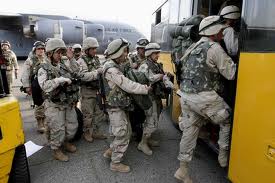
Military on Patrol in Columbus, GA

Frank Borelli
Editor-in-Chief
Officer

In a recent news article out of Columbus, Georgia, we learn that senior NCOs (non-commissioned officers) from Ft. Benning joined Columbus Police Department in patrolling the “uptown” are of the city. Oddly, “uptown” is actually the downtown area and before we get upset about having soldiers patrolling our streets, we need to also know that it’s only TWO senior NCOs and they are acting in support of Columbus PD. Is this anything new? or anything to worry about?


The reality is this: servicemen (and women) in downtown Columbus are a common sight. Personnel from nearby Ft. Benning often head “into town” on the weekends to relax and get a break from their military duties. In fact, to some extent, the city depends on the financial benefit it receives from those service members coming into town and spending their dollars in bars, etc. That said, some service members - like any other segment of today’s society - can behave in a less than model fashion when too many drinks have been consumed, or when disagreements break out.

According to the news report, there were two incidents in April that involved service members from Ft. Benning, and in an effort to work better together for the safety and peace of the citizens of Columbus, the Mayor got together with the Commanding General at Ft. Benning and they worked out this program. Before I go any further, I feel the need to commend them both for that. In today’s world where too many leaders of any given place tend to have “rice bowl thinking” mentalities and only worry about their own little piece of the world, I’m impressed and heartened to see two leaders who communicate and work together to find solutions to real world problems.

I also need to mention that the two senior NCOs are wearing armbands that say Courtesy Patrol and that they have no arrest powers within the city. So why are they there? How can they help?

As one soldier who was interviewed said, seeing a fellow soldier in uniform and in the company of the civil authorities makes any other soldier think twice before acting silly. Additionally, if the NCOs witness a soldier acting in a fashion that is unacceptable, they can order that soldier back to base, ending the “night out on the town”. If that’s not sufficient, they can summon MPs (Military Police Officers) from the base to come and “fetch” that soldier - who is under the authority of the Universal Code of Military Justice (UCMJ) 24/7/365.

What can be scary about having soldiers “on patrol” with civil authorities (police) is the potential misunderstanding that can occur. It’s all too easy for some citizens to see a soldier with a law enforcement officer and THINK that the soldier is acting as a police officer. Posse Comitatus specifically prohibits that - granting soldiers arrest authority over citizens.

what we need to recognize - as has been demonstrated in the past - is that soldiers can act in SUPPORT of the civilian authorities, just as National Guard units have been doing for years, and as various military branches and members did after the terrorist attacks of September 11th, 2001. In my view, having those soldiers on the street, helping to maintain peace by serving as a filter against unwanted behavior on the part of military members, is a good thing. I think it’s a fine example of what can be accomplished if leaders in different communities put their egos away and work together for the benefit of all involved.

What do you think?

Rumour: 2.2 million credit card details stolen in PSN attack

Tech Herald
Steven Mostyn

Following this week’s gloomy revelation that hackers have successfully stolen the personal information of 77 million users of the PlayStation Network (PSN), Sony has now moved to allay fears that credit card information was also pilfered during the attack.

“The entire credit card table was encrypted and we have no evidence that credit card data was taken,” said Patrick Seybold, senior director of corporate communications in an official blog post.

That being said, although Sony insists that the personal details of PSN users were stored separately from credit card data, its confidence has fallen short of ruling out the possibility that payment information might have been obtained.

Bearing that in mind, security firm Trend Micro has today said underground Internet chatter indicates that those responsible for attacking Sony’s online network were indeed able to make off with up to 2.2 million credit card numbers.

According to Trend Micro’s senior threat researcher, Kevin Stevens, whispers on known hacker forums suggest the hackers are now attempting to sell the ill-gotten credit card list for $100,000 USD.

He even claims the hackers have unsuccessfully tried to sell the stolen data back to Sony—something Seybold has been quick to deny.

Speaking with the New York Times, independent security specialist Dan Kaminsky said he too has monitored forum posts pointing to the cracking of PSN’s credit card database.

Kaminsky also said the Sony breach shows hackers are becoming progressively more ambitious in selecting their targets, and that current barriers used to deflect such attacks aren’t sufficient.

“The security measures technology companies employ today are just not robust enough,” he warned.

Exxon and Shell see profits boosted by high oil prices

BBC

Exxon plans to invest up to $37bn over the next five
years developing new energy supplies
Two oil firms - Exxon Mobil and Royal Dutch Shell - have reported big rises in first quarter profits thanks to higher world oil prices.

Texas-based group Exxon generated profits of $10.7bn (£6.4bn), up 69% on last year.

Anglo-Dutch firm Shell reported profits of $6.9bn on a current cost of supply basis, up 41% on last year.

It comes as US crude oil futures rose to their highest level in two-and-a half years at $113.70 a barrel.

Brent crude was trading up 58 cents at $125.71 a barrel.

Oil companies are "really benefiting from the huge jump in crude oil prices", Joshua Raymond, a market strategist at City Index in London, told the BBC.

"If you compare it from Q1 this year to Q1 last year, you're looking at above a 30% jump [in price]."

West Texas Intermediate Crude Oil Futures  $/barrel
Exxon said it had spent $7.8bn during the three month period on developing new energy supplies.

The firm also said its shareholders had benefited to the tune of $7bn in first quarter dividends.

"Exxon Mobil's earnings reflect continued leadership in operational performance during a period of strong commodity prices," said Rex Tillerson, the company's chairman.
Natural gas

Shell said cost saving measures as well as higher oil prices had contributed to its profitability in the first quarter.

Shell is also one of the world's major suppliers of liquefied natural gas (LNG).

The firm said it had started commercial production at its Qatargas 4 LNG facility.

As a consequence of the earthquake and tsunami in Japan, demand for LNG is expected to increase as nuclear power there is scaled back.

On Wednesday, BP reported first quarter profits of $5.5bn, down slightly from the same period last year.

Its production in the quarter was down 11% after BP sold assets to help pay for the cost of cleaning up last year's oil spill in the Gulf of Mexico.

Israel 'war crimes' bus ads: Group loses billboards, too

Seattle Times
By Jim Brunner

The same group that failed in a bid to place controversial ads alleging Israel "war crimes" on Metro buses is now losing billboards with a softer message decrying U.S. aid to Israel.

Clear Channel Outdoor initially reviewed and accepted the billboard ads but reversed course this week and said it will remove them, citing a company policy of avoiding messages that offend certain persons or organizations.

The ads were purchased by the Seattle Mideast Awareness Campaign. The group turned to the billboards after a judge allowed King County to reject the "war crimes" ads on buses, due to public-safety concerns.
The group bought four billboard ads, at about $1,400 apiece, which were supposed to run for four weeks. Three of the ads were in place. But Clear Channel Outdoor informed the group on Wednesday it would remove the ads — a move the Israel critics called censorship.

"We're trying to bring up a very serious human-rights issue that we're complicit with because our government supports these human-rights violations overseas," said Edward Mast, a spokesman for the group. "We're not being allowed to talk about it."

The ads show a Palestinian boy behind a fence and call for "Equal Rights for Palestinians" and for the U.S. to "stop funding the Israeli military."

In canceling the ads, Clear Channel did not object to those slogans. Instead, the company pointed to stronger language on the group's website, www.stop30billion-seattle.org, which was prominently promoted on the ads. That site calls Israel's Palestinian policies "war crimes" and "apartheid."

A Clear Channel executive said in a statement the company supports "community discussion of serious issues." But the company also wants to ensure any ads, including websites they promote, "are not offensive toward any business, group or individual," said Olivia Lippens, president of Clear Channel Outdoor Seattle, in an emailed statement.

Lippens said the Mideast Awareness Campaign's website is "not in keeping with those standards."
Mast said his group offered to delete or change language on its website but was told that wouldn't keep the billboard ads going.

Clear Channel did not identify which groups or individuals had objected to the billboards.
Some local pro-Israel groups that had protested the Israel critics' proposed Metro bus ads said they had not contacted Clear Channel about the new billboards.

Richard Fruchter, president and CEO of the Jewish Federation of Greater Seattle, said while his organization did not complain, it did mention the billboards on its website.

"We disagree with the message, but we agree with the right of free speech," said Fruchter. However, he said the "sensational" and "inflammatory" messages weren't contributing much to the public debate.
Clear Channel said it would refund the money paid for the ads.

The billboards with the ads were on Aurora Avenue at Republican, Elliot Avenue West near West Lee Street and Lake City Way Northeast near Northeast 104th Street.

Thursday, April 28, 2011

UN Gaza report co-authors reject Goldstone’s capitulation to Israel

theglobalrealm
Jean Shaoul

UN Gaza report co-authors reject Goldstone’s capitulation to Israel
By Jean Shaoul
WSWS.org
28 April 2011

Israeli bombardment of Gaza in 2009
Last week, the co-authors of the United Nations Gaza report, known as the Goldstone Report, issued a statement vigorously defending their report and rejecting Richard Goldstone and Israel’s repudiation of their 2009 accusations against Israel and Hamas of war crimes and “possibly crimes against humanity”.

The three co-members of the UN Human Rights Council’s Fact Finding Mission, Hina Jilani, Pakistani human rights lawyer, Colonel Desmond Travers, former Irish peace-keeper, and Christine Chinkin, professor of international law at the London School of Economics, said they stood by the conclusions of their report since neither Israel nor Hamas had provided any new evidence that invalidated them.

Referring to Goldstone’s op-ed piece in the Washington Post absolving Israel of intentionally, and thus criminally, targeting civilians as a matter of policy during its assault on Gaza in December 2008, they said that “it had misrepresented the facts in an attempt to delegitimize the findings” of their report and “to cast doubts on its credibility”.

The three joint authors said that calls to recant their report or misrepresent its purpose “disregard the rights of Palestinian and Israeli victims to truth and justice”.

Goldstone, a former South African judge and chief prosecutor at the UN Yugoslavia and Rwanda Tribunals, sought to justify his volte-face by saying that new evidence from Israel “probably would have influenced our findings about intentionality and war crimes” and that “If I had known then what I know now, the Goldstone Report would have been a different document”.

Goldstone’s cringing retraction of his own conclusions came after an international campaign of bullying, intimidation and vilification of the investigation and its authors, particularly Goldstone, by Israel. As his co-authors explained, these attacks were “clearly aimed at undermining the integrity of the report and its authors”.

According to US State Department cables published by WikiLeaks, Israel’s Prime Minister Benyamin Netanyahu claimed that the Goldstone report posed the third most important threat to Israel after Iran’s nuclear programme and missile proliferation.

Netanyahu had initially refused to carry out any investigations into Israel’s conduct of the assault on Gaza. He only acceded to international demands in an attempt to deflect criticisms and avoid any possible prosecution.

Israel greeted Goldstone’s volte face with jubilation and called for the report to be formally revoked. The US Senate passed a resolution calling for the UN to rescind the report and redress the damage done to Israel’s reputation. As Avigdor Lieberman, Israel’s right wing foreign secretary, put it, “The price of dealing [with the report] over the past few years was worth it”.

Taking it as a green light to do whatever it liked, Israel within days mounted an aerial bombardment on Gaza’s defenceless population, killing at least 25 and wounding dozens more. Most of the casualties were civilians, and many of those injured were children.

But Goldstone’s co-authors dismissed Israel’s demand to bin the report. They rejected any notion that “subsequent developments have rendered any part of the mission’s report unsubstantiated, erroneous or inaccurate”.

Israel’s assault, known as Operation Cast Lead, was waged against a largely unarmed and defenceless population. It killed 1,400 people, the majority of them civilians, including 400 women and children, injured at least 5,000 people, and destroyed 21,000 homes and much of its basic infrastructure, including water and sewerage treatment works. Such was the one-sided and criminal nature of the operation that Israel suffered only 13 deaths, and several of these were by “friendly fire”.

The 574-page Goldstone Report confirmed the findings of numerous other respected international studies and said little that was substantively new.

It called the war “a deliberately disproportionate attack designed to punish, humiliate and terrorise a civilian population, radically diminish its local economic capacity both to work and to provide for itself and to force upon it an ever-increasing sense of dependency and vulnerability”.

But the report itself was not, as Israel has maintained, hostile to Israel. It did not question Israel’s right to self-defence against a defenceless people whom it had illegally occupied and brutally suppressed for more than 40 years. Nor did it raise the illegality of the declared objective for the assault, the destruction of Hamas, which on its own admission Israel had been preparing for at least six months, leading it to equate Hamas’ rocket attacks on Israeli civilians with Israel’s attack on Gaza.

Goldstone had called for the UN Security Council to refer the case to the International Criminal Court (ICC) so that individuals who had ordered, planned or carried out international crimes could be prosecuted if Israel failed to conduct an independent investigation into the military’s conduct within six months. It also called on countries that are signatories to the 1949 Geneva Conventions to use their “universal jurisdiction” to search for and prosecute those responsible for war crimes.

The report’s conclusions were endorsed by the UN Human Rights Council by a majority of 25 to six, with 11 countries absenting themselves or abstaining.

Last month, the final report, written by a follow-up committee headed by the American judge Mary McGowan Davis and Swedish judge Lennart Aspergren, was presented to the UN Human Rights Council.

That committee insisted that while Israel had carried out some 400 investigations into allegations by the Goldstone Report and other human rights organisations, these were operational not legal investigations. As military investigations, it was a case of the military investigating itself and they were thus not independent investigations as required by the UN.

It noted that only three of the 400 Israeli cases were to be the subject of prosecutions. Of these three, only two have resulted in convictions. One person was convicted for the theft of a credit card which resulted in a seven month prison sentence. Another person was convicted for using a Palestinian child as a human shield, but received a lesser and derisory punishment of a three-month suspended sentence. A third case relating to allegations that Israel had deliberately targeted someone carrying a white flag has still to be heard.

The McGowan committee had deplored the dilatory nature of the proceedings, the lack of transparency and the failure to take evidence from victims and witnesses. It noted that two years after Operation Cast Lead, more than one third of the 36 incidents cited in the report were still unresolved or were without a clear status. Such delays would erode the possibility of any meaningful investigation.

Even more importantly, the committee pointed out that Israel had failed to address the most serious allegation: the policies guiding Operation Cast Lead. Israel was widely known to have a policy of targeting civilians and indeed its own officials had made statements to that effect. In October 2008, Gadi Eizencout, an IDF commander, explained Israel’s “Dahiyah doctrine”—the indiscriminate targeting of civilians and non-military sites—in an interview with the mass daily Yedioth Aharonoth.

He insisted that this was not a recommendation but a plan that “has already been approved”.

Despite this, as the committee noted, there was “no indication that Israel has opened investigations into the actions of those who designed, planned, ordered and oversaw Operation Cast Lead”.

There was therefore no basis whatsoever for revoking the Goldstone report. As the authors noted, the UN report has triggered a legal process that is still underway and should continue until justice is done. That means bringing Israel before the International Criminal Court to answer the allegations of war crimes and “possibly crimes against humanity”.

http://www.wsws.org/articles/2011/apr2011/gold-a28.shtml

Israel threatens 'arsenal of measures' in wake of Fatah Hamas pact

Mahmoud Abbas insisted that the inclusion of Hamas
made no difference to the Palestinian Authority's determination
to seek a peace deal with Israel
Telegraph
Adrian Bloomfield

Israel has threatened to use an "arsenal of measures" against the Palestinian territories, including withholding £480 million of taxes and subjecting leaders to humiliating border checks in retaliation for the Fatah Hamas pact.

Mahmoud Abbas, the pro-western president of the Palestinian Authority, was accused of siding with terrorists after his secular Fatah party agreed on Wednesday to end a long-running schism with its arch-rival Hamas, the Islamist overlords of the Gaza Strip.
Avigdor Lieberman, Israel's foreign minister, said the deal made it "inevitable" that Hamas would take over the West Bank leaving the Jewish state to confront an enemy bent on its destruction on two fronts.
Under the terms of the unexpected deal, reached after weeks of secret talks in the Egyptian capital Cairo, Hamas and Fatah, which fought a brief civil war in 2007, will form a provisional government that will oversee the preparation of presidential and parliamentary elections within a year.
While the deal has been hailed in the Arab world and among ordinary Palestinians, Israel has said it will have nothing to do with a government that comprises a significant terrorist element.
Mr Lieberman gave warning that Israel would show its displeasure by directly punishing Mr Abbas and his Prime Minister Salam Fayyad, who enjoys strong western support.

"With this accord, a red line has been crossed," Mr Lieberman said. "We have always made clear that we will not negotiate with a terror organisation. We have to make clear that our words were not empty threats.

"We have at our disposal a vast arsenal of measures including the lifting of VIP status for Abu Mazen [Mr Abbas] and Salam Fayyad, which will not allow them to move freely."

If Mr Lieberman were to make good his threat, the ability of both men to travel outside the Palestinian Territories would be heavily circumscribed and they would be subject to the frequently humiliating security checks that ordinary Palestinians face on a regular basis.

Even more damagingly, Mr Lieberman threatened to withhold Palestinian customs levies, which are collected by Israel as the occupying power, a step that could deprive the Palestinian Authority of up to a third of its revenues. Israel took the same measure after Hamas won a parliamentary majority following legislative elections in 2006.

Accusations of betrayal were also levelled against Mr Abbas by Ehud Barak, defence minister, who spoke in menacing terms of Israel's future relationship with the new Palestinian government.
Mr Abbas insisted that the inclusion of Hamas made no difference to the Palestinian Authority's determination to seek a peace deal with Israel, saying the transitional government's remit was restricted to preparations for elections and did not extend to negotiations.

He also expressed optimism that Hamas would now meet international demands by recognising Israel's right to exist and disavowing violence.

In private, some Israeli officials have been cautiously welcoming of the deal, saying it removed a major obstacle to any Arab-Israeli peace deal.

Until now, Israel has frequently argued that Mr Abbas did not have a mandate to reach a peace deal with Israel or to seek international recognition for Palestinian statehood because he did not represent the people of Gaza.

Petraeus to CIA Completes Cheney’s Dream, Consolidates Intelligence Within Pentagon

Firedoglake
Jim White

Today is the day that my worst fears will be realized, and the propaganda machine that has been mercilessly promoting the career of David Petraeus will achieve his nomination to be Director of Central Intelligence.

Aside from the horrible nature of this move in putting a blatantly political operator into a highly visible position from which he can consolidate his credentials for an eventual presidential campaign (see Spencer Ackerman for a very different take on this aspect), this move can be seen as finally completing Dick Cheney’s dream of moving virtually all intelligence functions into the Pentagon. Back when Michael Hayden was nominated to head CIA, the ongoing Defense Intelligence Agency (DIA)-CIA turf war was noted:
What worries some experts, however, is a shift in the balance of power within the US intelligence infrastructure as the CIA is weakened and the Pentagon expands its role. For one thing, the Pentagon’s intelligence activities largely escape congressional scrutiny. ”Rumsfeld and Cambone claim that everything they do is a military operation,” says Richard Clarke, the former head of counterterrorism at the National Security Council, ”[and] that therefore nothing that they do should have oversight by the House and Senate intelligence committees. But they are doing things that are clearly intelligence.”
It is precisely this ability to “escape congressional scrutiny” that has driven the move to consolidate intelligence functions within the Pentagon. Here is more from Jeremy Scahill on how this was brought about:
While JSOC has long played a central role in US counterterrorism and covert operations, military and civilian officials who worked at the Defense and State Departments during the Bush administration described in interviews with The Nation an extremely cozy relationship that developed between the executive branch (primarily through Vice President Dick Cheney and Defense Secretary Donald Rumsfeld) and JSOC. During the Bush era, Special Forces turned into a virtual stand-alone operation that acted outside the military chain of command and in direct coordination with the White House. Throughout the Bush years, it was largely General McChrystal who ran JSOC. “What I was seeing was the development of what I would later see in Iraq and Afghanistan, where Special Operations forces would operate in both theaters without the conventional commander even knowing what they were doing,” said Colonel Wilkerson. “That’s dangerous, that’s very dangerous. You have all kinds of mess when you don’t tell the theater commander what you’re doing.”
Wilkerson said that almost immediately after assuming his role at the State Department under Colin Powell, he saw JSOC being politicized and developing a close relationship with the executive branch. He saw this begin, he said, after his first Delta Force briefing at Fort Bragg. “I think Cheney and Rumsfeld went directly into JSOC. I think they went into JSOC at times, perhaps most frequently, without the SOCOM [Special Operations] commander at the time even knowing it. The receptivity in JSOC was quite good,” says Wilkerson. “I think Cheney was actually giving McChrystal instructions, and McChrystal was asking him for instructions.” He said the relationship between JSOC and Cheney and Rumsfeld “built up initially because Rumsfeld didn’t get the responsiveness. He didn’t get the can-do kind of attitude out of the SOCOM commander, and so as Rumsfeld was wont to do, he cut him out and went straight to the horse’s mouth. At that point you had JSOC operating as an extension of the [administration] doing things the executive branch–read: Cheney and Rumsfeld–wanted it to do. This would be more or less carte blanche. You need to do it, do it. It was very alarming for me as a conventional soldier.”
The key thing to note here is how Cheney bypassed McChrystal’s direct commander in SOCOM to dictate McChrystal’s actions. At least in regard to when those actions were in Iraq, it should be noted that McChrystal’s field commander there was none other than David Petraeus. I think Wilkerson is wrong here when he claims that McChrystal was acting without the knowledge of the field commander.

  For McChrystal to be carrying out “rogue” operations at the direct command of the Vice President and bypassing his SOCOM commander, it seems inconceivable that Petraeus could not have been aware of what was happening. It seems most likely that Petraeus was both aware of what was going on and approved of it, since he is often seen as crediting McChrystal and his night raids for their effects in Iraq and then in Afghanistan. This means that Petraeus had to be aware of, and approved, Cheney’s actions that were designed to bypass congressional scrutiny of actions that would have been subject to oversight had they taken place through the CIA.

In today’s New York Times article about Petraeus’ nomination, we see that the blurring of the lines between intelligence and military functions already is almost complete:
The result is that American military and intelligence operatives are at times virtually indistinguishable from each other as they carry out classified operations in the Middle East and Central Asia. Some members of Congress have complained that this new way of war allows for scant debate about the scope and scale of military operations. In fact, the American spy and military agencies operate in such secrecy now that it is often hard to come by specific information about the American role in major missions in Iraq, Afghanistan, Pakistan and now Libya and Yemen.
The operations have also created tension with important allies like Pakistan, while raising fresh questions about whether spies and soldiers deserve the same legal protections.
Officials acknowledge that the lines between soldiering and spying have blurred. “It’s really irrelevant whether you call it a covert action or a military special operation,” said Dennis C. Blair, a retired four-star admiral and a former director of national intelligence. “I don’t really think there is any distinction.”
I’m sure Dick Cheney approves of Obama’s move to put Petraeus in charge of the CIA, because it is clear that Petraeus fully subscribes to Cheney’s vision of a Pentagon in control of the most important intelligence functions, fully protected from congressional oversight.

Student Loan Debt Hell: 21 Statistics That Will Make You Think Twice About Going To College

Blacklisted News
by Michael Snyder

Is going to college a worthwhile investment? Is the education that our young people are receiving at our colleges and universities really worth all of the time, money and effort that is required? Decades ago, a college education was quite inexpensive and it was almost an automatic ticket to the middle class. But today all of that has changed. At this point, college education is a big business. There are currently more than 18 million students enrolled at the nearly 5,000 colleges and universities currently in operation throughout the United States. There are quite a few "institutions of higher learning" that now charge $40,000 or even $50,000 a year for tuition. That does not even count room and board and other living expenses.

Meanwhile, as you will see from the statistics posted below, the quality of education at our colleges and universities has deteriorated badly. When graduation finally arrives, many of our college students have actually learned very little, they find themselves unable to get good jobs and yet they end up trapped in student loan debt hell for essentially the rest of their lives.

Across America today, "guidance counselors" are pushing millions of high school students to go to the very best colleges that they can get into, but they rarely warn them about how much it is going to cost or about the sad reality that they could end up being burdened by massive debt loads for decades to come.

Yes, college is a ton of fun and it is a really unique experience. If you can get someone else to pay for it then you should definitely consider going.

There are also many careers which absolutely require a college degree. Depending on your career goals, you may not have much of a choice of whether to go to college or not.

But that doesn't mean that you have to go to student loan debt hell.

You don't have to go to the most expensive school that you can get into.

You don't have to take out huge student loans.

There is no shame in picking a school based on affordability.

The truth is that pretty much wherever you go to school the quality of the education is going to be rather pathetic. A highly trained cat could pass most college courses in the United States today.

Personally, I have had the chance to spend quite a number of years on college campuses. I enjoyed my time and I have some pretty pieces of parchment to put up on the wall. I have seen with my own eyes what goes on at our institutions of higher learning. In a previous article, I described what life is like for most "average students" enrolled in our colleges and universities today....

The vast majority of college students in America spend two to four hours a day in the classroom and maybe an hour or two outside the classroom studying. The remainder of the time these "students" are out drinking beer, partying, chasing after sex partners, going to sporting events, playing video games, hanging out with friends, chatting on Facebook or getting into trouble. When they say that college is the most fun that most people will ever have in their lives they mean it. It is basically one huge party.

If you are a parent and you are shelling out tens of thousands of dollars every year to pay for college you need to know the truth.

You are being ripped off.

Sadly, a college education just is not that good of an investment anymore. Tuition costs have absolutely skyrocketed even as the quality of education has plummeted.

A college education is not worth getting locked into crippling student loan payments for the next 30 years.

Even many university professors are now acknowledging that student loan debt has become a horrific societal problem. Just check out what one professor was quoted as saying in a recent article in The Huffington Post....

“Thirty years ago, college was a wise, modest investment,” says Fabio Rojas, a professor of sociology at Indiana University. He studies the politics of higher education. “Now, it’s a lifetime lock-in, an albatross you can’t escape.”

Anyone that is thinking of going to college needs to do a cost/benefit analysis.

Is it really going to be worth it?

For some people the answer will be "yes" and for some people the answer will be "no".

But sadly, hardly anyone that goes to college these days gets a "good" education.

To get an idea of just how "dumbed down" we have become as a nation, just check out this Harvard entrance exam from 1869.

I wouldn't have a prayer of passing that exam.

What about you?

We really do need to rethink our approach to higher education in this country.

Posted below are 21 statistics about college tuition, student loan debt and the quality of college education in the United States....

#1 Since 1978, the cost of college tuition in the United States has gone up by over 900 percent.

#2 In 2010, the average college graduate had accumulated approximately $25,000 in student loan debt by graduation day.

#3 Approximately two-thirds of all college students graduate with student loans.

#4 Americans have accumulated well over $900 billion in student loan debt. That figure is higher than the total amount of credit card debt in the United States.

#5 The typical U.S. college student spends less than 30 hours a week on academics.

#6 According to very extensive research detailed in a new book entitled "Academically Adrift: Limited Learning on College Campuses", 45 percent of U.S. college students exhibit "no significant gains in learning" after two years in college.

#7 Today, college students spend approximately 50% less time studying than U.S. college students did just a few decades ago.

#8 35% of U.S. college students spend 5 hours or less studying per week.

#9 50% of U.S. college students have never taken a class where they had to write more than 20 pages.

#10 32% of U.S. college students have never taken a class where they had to read more than 40 pages in a week.

#11 U.S. college students spend 24% of their time sleeping, 51% of their time socializing and 7% of their time studying.

#12 Federal statistics reveal that only 36 percent of the full-time students who began college in 2001 received a bachelor's degree within four years.

#13 Nearly half of all the graduate science students enrolled at colleges and universities in the United States are foreigners.

#14 According to the Economic Policy Institute, the unemployment rate for college graduates younger than 25 years old was 9.3 percent in 2010.

#15 One-third of all college graduates end up taking jobs that don't even require college degrees.

#16 In the United States today, over 18,000 parking lot attendants have college degrees.

#17 In the United States today, 317,000 waiters and waitresses have college degrees.

#18 In the United States today, approximately 365,000 cashiers have college degrees.

#19 In the United States today, 24.5 percent of all retail salespersons have a college degree.

#20 Once they get out into the "real world", 70% of college graduates wish that they had spent more time preparing for the "real world" while they were still in school.

#21 Approximately 14 percent of all students that graduate with student loan debt end up defaulting within 3 years of making their first student loan payment.

There are millions of young college graduates running around out there that are wondering where all of the "good jobs" are. All of their lives they were promised that if they worked really hard and got good grades that the system would reward them.

Sometimes when you do everything right you still can't get a job. A while back The Huffington Post featured the story of Kyle Daley - a highly qualified UCLA graduate who had been unemployed for 19 months at the time....

I spent my time at UCLA preparing for the outside world. I had internships in congressional offices, political action committees, non-profits and even as a personal intern to a successful venture capitalist. These weren't the run-of-the-mill office internships; I worked in marketing, press relations, research and analysis. Additionally, the mayor and city council of my hometown appointed me to serve on two citywide governing bodies, the planning commission and the open government commission. I used to think that given my experience, finding work after graduation would be easy.

At this point, however, looking for a job is my job. I recently counted the number of job applications I have sent out over the past year -- it amounts to several hundred. I have tried to find part-time work at local stores or restaurants, only to be turned away. Apparently, having a college degree implies that I might bail out quickly when a better opportunity comes along.

The sad truth is that a college degree is not an automatic ticket to the middle class any longer.

But for millions of young Americans a college degree is an automatic ticket to student loan debt hell.

Student loan debt is one of the most insidious forms of debt. You can't get away from student loan debt no matter what you do. Federal bankruptcy law makes it nearly impossible to discharge student loan debts, and many recent grads end up with loan payments that absolutely devastate them financially at a time when they are struggling to get on their feet and make something of themselves.

So are you still sure that you want to go to college?

Another open secret is that most of our colleges and universities are little more than indoctrination centers. Most people would be absolutely shocked at how much unfiltered propaganda is being pounded into the heads of our young people.

At most colleges and universities, when it comes to the "big questions" there is a "right answer" and there is virtually no discussion of any other alternatives.

In most fields there is an "orthodoxy" that you had better adhere to if you want to get good grades.

Let's just say that "independent thought" and "critical thinking" are not really encouraged at most of our institutions of higher learning.

Am I bitter because I didn't do well? No, I actually did extremely well in school. I have seen the system from the inside. I know how it works.

It is a giant fraud.

If you want to go to college because you want to have a good time or because it will help you get your career started then by all means go for it.

Just realize what you are signing up for.

No-Fly Zone Over Gaza — Petition [VIDEO]

No-Fly Zone Over Gaza — Petition from Anthony Lawson on Vimeo.


Video Produced by : Anthony Lawson
Petition Written by : Dr. Mohamed Khodr.

No issue in modern history has endured more words, more speeches, more conferences, more peace initiatives, more promises, and more photo-ops, than Israel’s 44 year illegal occupation of over 3 million Palestinians.

World Governments and International Bodies have failed to bring an end to this occupation and establish a free, independent Palestinian State for refugees in their own land.

Thus it is up to us, you and me, people from around the world to stand up and demand an end to this illegal occupation that has thus far paralyzed and humiliated the world, our humanity, and what we all believe in, justice for all.

Signing is the simplest activism for justice for the Palestinians. Let your name and signature be the weapon for peace and justice for the Palestinians and peace and security for the Israeli people. A free Palestine means a secure Israel.

Thank you.

Please sign this Petition now, tomorrow may be too late for someone:

http://www.petitiononline.com/p181p194/petition-sign.html