Showing posts with label Florida. Show all posts

Friday, November 9, 2012

Rep. Allen West Refuses to Concede, Seeks Hand-Count, Impounding of Ballots and Voting Systems in FL-18 U.S. House Race


BradBlog

Tea Party-backed Repub reportedly trails challenger Murphy by less than 2,500 votes as tallied by FL's flawed, failed voting systems...

By BRAD FRIEDMAN on 11/9/2012, 6:05am PT 

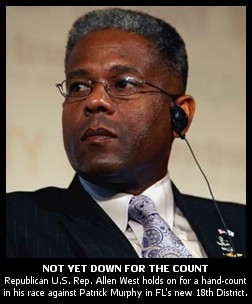
On Election Night, Democrats and progressives celebrated the reported defeat of far Rightwing Tea Party-backed Rep. Allen West (R-FL22) by his Democratic challenger Patrick Murphy in Florida's newly redistricted 18th Congressional district in Eastern Florida.

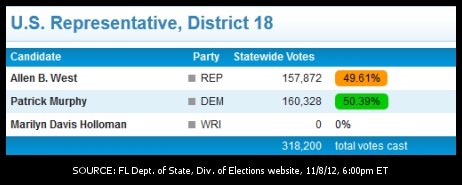
With precinct votes unofficially tabulated in the three counties which comprise the new Democratic-leaning district --- Martin, St. Lucie and part of Palm Beach --- Murphy reportedly leads West by 2,456 votes out of 318,200 electronically tallied to date. That number does not include what West's campaign manager describes as "tens of thousands of absentee ballots to be counted in Palm Beach County and potential provisional ballots across the district."
Nonetheless, Murphy has declared victory, which carries no particular legal weight, while West has filed legal documents in St. Lucie and Palm Beach calling for the impounding of voting systems, paper ballots and a hand-count of those ballots.

West may be a far Right extremist. A fair amount of evidence even suggests that West may be certifiably insane. But, even far right, possibly insane candidates, and especially their supporters, deserve to have their votes counted in a way that they can know, for certain, that they either won or lost an election.

Given the oft-failed, easily-manipulated, unoverseeable electronic voting and tabulation systems --- each with a long and well-documented record of failure and miscounts --- used in the three counties that make up Florida's new 18th district (as well as the rest of the state of Florida, and the rest of the 50 states for that matter), West and his supporters have every reason to demand a public, 100% hand-count of paper ballots before conceding defeat. Particularly in an election with such a slim margin, as reported by the flawed electronic systems, said to stand between the two candidates...


Machine tallied results to date

Here are the results of FL-18 as currently known at this hour, according to the Florida Division of Elections website...


That .78% difference between West and Murphy, if it holds after absentees and provisionals are added in, puts the race just outside of the .5% margin that would otherwise trigger a state-sponsored "recount" (albeit on the same faulty machines that tallied the ballots, either accurately or inaccurately, in the first place, as per FL law.)

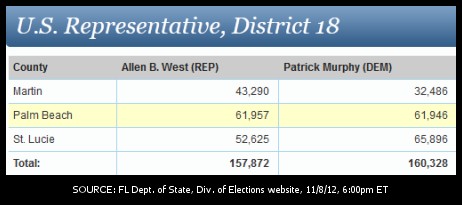
The county-by-county results for FL-18 show where the race is even tighter, particularly in Palm Beach County, where just 11 votes(!) out of 123,903 tallied there currently separate the two candidates...


On Election Night, as reported by the Sen-Sentinel, Democrats were giddy about the prospect of the controversial West being tossed out of the House.

Florida's U.S. Rep. Debbie Wasserman Schultz, who also serves as chair of the DNC, optimistically trumpeted that "moderate voters totally rejected Allen West's brand of extremism [and] his outrageous commentary. I think they didn't want a member of Congress who was in the news every day for all the wrong reasons."

Indeed, West has made a name for himself by declaring, for example, that he has "heard" some 76 of the 81 members of the Progressive Caucus in the U.S. House are "communists", and, as the Sun-Sentinel also reports, suggesting that "Nazi propaganda chief Joeseph Goebbels would be envious of the Democrats' 'incredible propaganda machine.'"

Wasserman Schultz, the paper notes, "was the subject of one of West's most talked-about tirades, when he called her 'the most vile, unprofessional and despicable' member of the House, labeled her a 'coward,' told her to 'shut the heck up,' and said she had 'proven repeatedly that you are not a lady.'"

Monday, November 5, 2012

GOP Set to Steal USA’s Banana Republic Election


U.K. Progressive


Florida Gov. Rick Scott at a bill signing ceremony in Miami.

This is The Monday Line
by Denis G. Campbell

Every four years the world is ‘treated’ to a Presidential election in the USA. Every four years a handful of states display a level of vote larceny that, if it occurred in a third world dictatorship, would have former President Jimmy Carter leading a group of sober faced UN election observers to carefully parse words and discuss “irregularities.” Every four years we are subjected to right wing talking points about Democrats stealing the election because they demand to vote while coffee spews out our noses because the coordinated theft is on the Republican side. These same flim-flam artists stand before microphones and say, teary-eyed, “God Bless our best Democracy in the world!”
Well screw parsing. I’m call ‘bullshit’ and so should you.
Voting is a right and a responsibility. In the 2008 Presidential election, only 61.6% of those eligible to cast votes did, and that was up from the average since 1980 of 56%. As a state official in charge of elections, Secretaries of State used to run adverts encouraging people to vote. Now they spend their time in highly politicised battles to remove voters from the opposite party? That’s what they do in Iran and Uganda, not the USA.
The machines with no paper trail…As we reported here last week there is a need to match hand recounts by precinct size. Paper ballots leave a trail that can prove election fraud deep inside the computerised voting system. So when an Arizona citizen’s group was forced to file Mandamus brief and suit to force the county to follow the law, a (recent Republican Governor Jan Brewer appointed) Pima County Judge got the case. He will rule later Monday on a motion that will force election officials to select and sort ballots in their 1% random hand-count sample along precinct lines.
That specific sort and reporting will help to prove retired NSA Analyst Michael Duniho, Francois Choquette and James Johnson’s assertion that there is a real software ‘fix’ built into the machine.
Of course local county election officials continue to fight this tooth and nail because the trail could lead to them. They have fought transparency since 2006 and yet were quick to claim in the Arizona Star that voting was safer and more secure than ever.
The best example though of how states and counties avoid being called to task is in this letter from the Arizona Secretary of State. The only link back to election machine software fraud is via the Duniho/Choquette/Johnson assertion that the fix is in for larger precincts. So the Pima County election commission conveniently and quietly through secret petition to the Sec State office made sure no one would ever be able to connect those dots.
The Arizona Secretary of State wrote into the 2012 election manual that it would be a good idea to sort paper ballots by precinct for the mandatory hand count by precinct. BUT, Pima County requested and won an exemption from following the state’s election directive for… (wait for it…) the 2012 Presidential election.
So the new rule that would prove election fraud built into the machines has been conveniently overturned by the Republican Arizona Secretary of State. Bananas anyone?
Ohio and Florida Incompetent or Criminal?The GOP is not even trying to gloss over their attempt to steal this election in key swing states. In Florida and Ohio their work is legend. Even in Pennsylvania the House leader actually went on camera and said, “voter ID, that will win this state for Mitt Romney? (Job) Done!”
And the USA’s gutless wonder of an Attorney General, Eric Holder, sits back and lets them do it? Jack and Bobby Kennedy would have had federal troops stationed in both states and Ohio Secretary of State Husted and Florida Governor Scott would have long been removed in handcuffs and leg irons with the Feds supervising these elections.
Husted ignored multiple direct judicial orders. He appealed them all the way to the US Supreme Court and LOST yet still blithely sits in his Columbus, Ohio Office and denies the extension of early voting hours in his state.
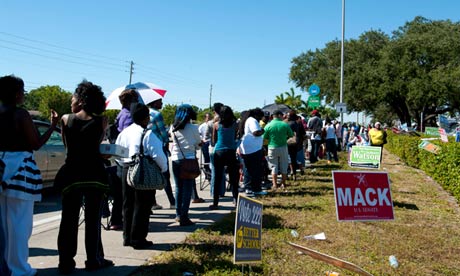
Florida Governor Rick Scott has directly defied several court defeats and still tries to purge hundreds of thousands from the voter rolls just before the election. He also refused to do what two Republican governors did before him, expand early voting hours. He instead cut the number of hours by 1/3, eliminated Sunday voting (when African American churches would carpool after services to vote), the elderly have had to queue in the hot sun for up to five hours to cast a ballot and whoops, there have been voting ‘mistakes’ in a state and election George W. Bush won by 537 votes?
  • 1,000 African American votes had a ‘glitch’ in Miami,
  • Palm Beach County (the county of the 2000 butterfly ballot debacle) had 30,000 absentee ballots go out with the wrong bar code and have to be re-marked by officials on new ballots to be counted (what could possibly go wrong there?) and
  • heavily Democratic Broward County also has huge irregularities as problems appear only in large Democratic leaning counties?
Millions enjoy the flexibility of early voting. This means they can vote on the weekend to avoid losing time at work. Early voting though favours Democrats and urban voters. So Republican election officials in the six swing states of Florida, Ohio, Virginia, Pennsylvania, Colorado and Michigan have tried throughout this campaign to limit voting, require IDs many elderly and minorities do not have (or they must buy them effectively creating a Jim Crow law poll tax) or simply removed these people from the vote rolls altogether.
Why? Because President Obama leads Hispanic voters by 65 percentage points, African Americans by 90 points and women by 50 points.
And What if I told you…The President’s brother was a Governor of a key state during a hotly contested election and in another the challenger’s son controlled the largest electronic voting machine company? You would think we’re talking about Hugo Chavez’ Venezuela or Robert Mugabe’s Zimbabwe right?
You would be wrong. George W. Bush’s brother Jeb was Florida Governor when that state pushed him over the top in 2000. Mitt’s son Tagg Romney controls Hart Intercivic and the four other companies are run by bundlers and huge donors for him.
Remember when politicians did everything in their power to avoid the appearance of impropriety? Remember when the crises exploded over under-the-table money hidden in freezers? Now they don’t even try to hide it.
- – - – -
So tomorrow night we will cover the election and pray it does not again become another conservative Supreme Court ‘selection.’ Armies of lawyers have been dispatched around the USA to document and file emergency motions if the election does not go their way.
It could be a very long night or voters, tired of GOP attempts to block and steal could seal the deal very early. There is not much chance of it being anything in between.
In any event, US Democracy loses a bit more lustre and the rest of the world wonders why anyone would buy that export? What good is a win if you steal it? Why is the US GOP only focused on what they can get away with rather than governing?
This is not my late-father’s Republican Party.

Be Sociable, Share!

 is the author of 6 books including 'Billionaire Boys Election Freak Show,' 'The Vagina Wars' & 'Egypt Unsh@ckled.' He is the editor of UK Progressive Magazine and provides commentary to the BBC, itv Al Jazeera English, CNN, MSNBC and others. His weekly 'World View with Denis Campbell' segment can be heard every Thursday on the globally syndicated The David Pakman Show. You can follow him on Twitter via @UKProgressive and on Facebook.

State's Democrats file lawsuit to keep polling places open as voter anger grows


Guardian
Chris McGreal

People queue to vote in Miami
People queue to vote early in Miami, Florida, where the
state's Republicans have been accused by the Democrats of
attempting to disenfranchise opponents. 
Florida Democrats have accused the swing state's Republican leadership of impinging on the fundamental rights of Americans amid growing voter anger at lengthy queues to vote, the shutting down of early voting and chaos in Miami over absentee ballots.

The state's Democratic party filed a lawsuit on Sunday to keep polling places open until election day as the Republicans stood accused of attempting to disenfranchise its opponents with new limits on early voting that contributed to waits of more than seven hours to cast ballots in Democratic strongholds such as Miami.

The Miami-Dade elections headquarters shut it doors on Sunday to people attempting to request absentee ballots because so many people showed up. Outside, would-be voters protested, shouting: "Let us vote".

Myrna Peralta, who waited with her four-year-old grandson for nearly two hours before being turned away, told the Miami Herald: "This is America, not a third-world country … They're not letting people vote."

After the outcry spread over social media, the department opened its doors again later in the afternoon. But the incident reflected deepening frustration at what are widely seen as Republican attempts to manipulate the election.

Long queues over the past week for early voting reflected a record turnout to vote early in Florida, with about 4 million people casting their ballots in advance of election day proper on Tuesday, as well as the longest ballot paper in the state's history, including complicated constitutional amendments.

But Democrats said they were also caused by Republican legislation sharply cutting the number of days for early voting from 14 to eight. That included scrapping voting on the final Sunday before election day, when large numbers of African Americans traditionally went to the polls after church.

The Florida Democratic party filed a legal action in Miami to try to keep at least some polling stations open for early voting in three key counties – Miami-Dade, Broward and Palm Beach – which account for about one-third of the party's support in the state.

The lawsuit said "inadequate polling facilities" contributed to long waits in all three places. The last voters in Miami cast their ballots at 1am on Sunday even though the polling place official closed at 7pm on Saturday.

"The extraordinarily long lines deterred or prevented voters from waiting to vote. Some voters left the polling sites upon learning of the expected wait, and others refused to line up altogether," the legal action said. "These long lines and extreme delays unduly and unjustifiably burdened the right to vote."

The state's Republican governor, Rick Scott, who has the power to extend early voting days, declined to do so.

Rod Smith, the chairman of the Florida Democratic party, accused Republicans of impinging on people's rights.

"Voting is a fundamental right, and we all have an interest in assuring that all Americans have effective opportunities to vote," he said.

"Florida's Republican state legislature has already reduced the number of days to early vote by six days. Because of Governor Scott's refusal to follow precedent and extend early voting hours in the face of unprecedented voter turnout in south Florida, we are requesting in federal court that more Floridians have a meaningful chance to early vote."

Separately, a judge ordered an extension to early voting at an Orange County polling station after it was shut by a bomb scare on Saturday.

The US justice department has one eye on the 2000 election debacle of hanging chads and discounted votes, as well as more recent Florida election legislation struck down in federal court as discriminating against minorities, so it is monitoring the conduct of the vote in Florida to determine if the long queues are a deliberate obstacle to voting and therefore in breach of the 1965 Voting Rights Act.


Tuesday, October 23, 2012

CBS4 Investigates: Does Your Vote Count? The Recount Test


CBS Miami
Michele Gillen

A Miami-Dade County Elections Department voting machine during pre-election testing. (Source: CBS4)INVERNESS (CBS4) – In the sleepy West Coast Florida town of Inverness, as horses graze and Spanish moss hangs still on a breezeless summer day, an elections experiment was about to get underway.


Lightening fast computer scanners, locked up ballots and a team of computer scientists from Boston, embarked on a first ever mission to verify that the votes cast in the August, Citrus County primary, are correct.

“Believe me we are not looking for trouble but we want to verify the results independently,” said Susan Gill, supervisor of elections in Citrus County.

She is one of 7 county supervisors across Florida, who agreed to allow a number of their elections to be part of the first large scale attempt to independently verify elections cast on paper ballots.


“Nelson Mandela once said ‘the thing looks impossible until it’s done.’ And we have done it,” the founder of Clear Ballot, Larry Moore told CBS4 Chief Investigator Michele Gillen.

CBS4 Investigates found the face of how America votes and whether or not every vote counts could be affected by a pioneering project unfolding in a room in which the news team camera captured this unique, independent, audit.

Gill explained that following the August election, state law required her to audit just one precinct in one race.

“One precinct, one race is not a terribly meaningful audit and we had 10 people for two days sorting the ballots so we could do that,” Gill told Gillen.

Now, Gill’s entire countrywide election, 26,000 ballots, will be scanned and audited in under three hours.

On ”audit” day, scanning began at 9:44 am. In essence, what unfolds is a high-speed, high-tech version of a hand re-count.

Asked what she would say to manufacturers who might claim that such an independent audit is not necessary Gill told Gillen, “I say, yes we do need to do that. If you have confidence in your product then you won’t be worried about us doing an audit with an independent verification.”

Haunting scenes from the 2000 Presidential Florida recount, of hanging chad ballots being examined, along with all hand recounts, could become obsolete.

One reason: the clear ballot method can instantaneously identify voter intent.

Projected onto the wall for all to see: votes cast in Citrus County for Connie Mack in the US Senate Race. Circled ovals, scribbles, check marks and X’s are visible, as are comment voters make, this one writing mouse next to Mack’s name and an empty oval. If a ballot is questionable, it is identified and examined on the spot.

“Human error is the real problem with the election process. As I say, I’ll give you perfect elections when you give me perfect voters,” Gill reflects.

Voter intent, is most critical in a close election.

“There’s nothing wrong with a close election. What’s wrong is when you can’t resolve it in a way that is transparent, quickly, cost effective and with integrity,” adds Moore.

Two hours and 38 minutes later, all 26,000 ballots had been recounted. It’s discovered that just one ballot had been missed on election night. For Susan Gill, the peace of mind is priceless.

“I think it’s wonderful. I think it’s really great and I think it’s a meaningful audit,” says Gill.

Tuesday, October 16, 2012

CBS4 Investigates: Does Your Vote Count? The Overvote Worries

Michele Gillen

(Photo by Joe Raedle/Getty Images)Imagine going to the polls November 6th and casting your vote for President Barack Obama or Governor Mitt Romney and somehow the machine thinks you voted for both candidates. That’s called an overvote, and your vote may be thrown out.

Sound impossible? It isn’t.

“You are  getting to the crux of the problem with this technology. We are supposed to trust what goes on back there blindly,” voting rights advocate and attorney Lida Rodriguez-Taseff told CBS4 Chief Investigator Michele Gillen.

“You are  getting to the crux of the problem with this technology. We are supposed to trust what goes on back there blindly,” voting rights advocate and attorney Lida Rodriguez-Taseff told CBS4 Chief Investigator Michele Gillen.


Rodriguez-Taseff has spent a decade battling to pull back the curtain on election transparency. She helped get the touch screen machines tossed in Florida in favor of getting voters a paper ballot and paper trail – only to learn that the variety of optical scan machines now in use now across America and Florida may have flaws no one could have predicted. Or could they have?

“Nobody has done and in-depth study to determine how well those machines are really working,” Rodriguez-Taseff cautioned Gillen. “It absolutely leaves me pause that we’re not looking at those machines more closely. The technology that is used for voting is generally inferior to the computing technology that most people have in their homes. And in their cars and their iPhones and cell phones. So the fact that we’re not looking more closely at this technology is really troubling to most people yes,” said Rodriguez-Taseff.

Obama and Romney on the issues: Weigh in on the Presidential Forum Kitty Garber knows the optical scan ballot and its history in Miami-Dade. She is the co-founder of the Florida Fair Election Center, and she’s worried about the optical scan system Miami-Dade county residents will cast their ballots on this presidential election. In fact, she’s been concerned over how we cast ballots here for the past five years.

At the heart of Garber’s concern is how often the machine – the ES&S DS200 in Miami Dade County, registers an overvote. That’s when, according to the machine, a voter has voted for two candidates in the same race. Their vote may then be invalidated… thrown out. Where does Miami-Dade Stand in terms of overvotes visa vie the whole state of Florida?

“It’s the worst,” said Garber referring to the top two races studied by the state of FLorida in 2010 and in the top race, she said, “Miami-Dade again came up with 43% of all the overvotes statewide. It’s awful. It’s terrible. There should be virtually no overvotes,” said Garber.

What concerns voting rights advocates? A lack of answers as to what’s causing this problem?

“The problem could arise from many different places. It could arise from the fact that voters need to be trained not to overvote. It could arise from the fact that oncevoters overvote… they aren’t being properly notified and it could arise from the fact that voters are not being made to correct their ballot. Lastly of course it could arise from the fact that the machine has a problem and is recording overvotes when it shouldn’t be,” said Rodriguez-Taseff.

That’s exactly what was just discovered to have happened in a 2010 race in the Bronx NY.

“It became obvious that this was a machine error and not a voter error,” says Larry Norden of NYU’s Brennan Center of Law who helped expose that that the machine misread dozens of votes as overvotes– with no one noticing.

“It is unacceptable. The whole point of elections is for people to make their choices known And we should have technology that is able to do that,” says Norden.

It was what Norden says was the alarming number of overvotes detected in Miami- Dade races, that caught his attention and led the Brennan Center to investigate the ES&S DS200 machines in use in a 2010 race in the Bronx.

“We looked at the record in Florida and saw that there were very high numbers of over votes, particularly in Miami-Dade county which was using this machine but particularly in all of the counties that were using this particular voting machine in Florida,” Norden added.

According to Norden, after the machines were left on for a few hours of voting— one machine wrongly read dozens of votes as over votes… and all those votes were lost.

The conclusion of the manufacturer was essentially summed up this way. “It appears that the unit was out of calibration and when the unit heated up over a period of time, the scanned image was distorted and the system recorded votes that were not marked.”

“It is absolutely chilling to hear their account of what happened with the machines. The problem is they can make whatever diagnosis they want. They can say, oh it was the temperature of the machine you don’t know. There’s no way for outsiders to know,” said Rodriguez-Taseff.

Keep in mind, that while Miami Dade and the Bronx both use the DS200, our investigation finds that the software in the machines are different versions. Could that affect or prevent the same problem from having happened here, or happening in the future?

CBS4 investigates has tried to find out.

Despite the Bronx meltdown making New York headlines and raising questions about the machines in use around the country – the Supervisor of Elections in Miami-Dade and the department’s supervisor, have denied our requests for an interview regarding the optical scanners, the problems in NY and whether anything has been done to prevent, preclude or identify a similar problem here.

On why they refuse to do an interview on the subject: “The Department cannot comment on the issue that was experienced in New York with one of their voting units. However, we can confidently state this has no impact on voting in Miami-Dade County,” said Deputy Supervisor of Elections, Christina White, in a prepared statement sent to CBS4 Investigates.

“The advocates do not have the information required to make a real analysis of whether or not the problem can happen here,” said Rodriguez-Taseff. “And part of the problem is that the technology is considered proprietary so they don’t give access to anyone other than the state. And even the state has limited access.

The manufacturer has written CBS4 Investigates that following the Bronx problem: it “issued a best practices technical bulletin to all DS200 users reminding them of the need to properly calibrate and clean units prior to an election.”

Broward County Supervisor of Elections, Brenda Snipes sat down with Gillen and answered a wide range of questions on the machines and concerns raised over what happened in the Bronx. Asked if she found out that a similar problem affected her machines, would she be outraged? ”That goes without saying,” said Snipes. “Now do I have the ability or the resources to go in and test… what do we have… 12-13 hundred machines? No I don’t. No I don’t,” she pointed out and added, “It appeared to be that it was isolated to the Bronx.

Broward County’s Department of Elections has given CBS4 Investigates access to shoot their machines. They too use the DS200 with software different from that used in Miami-Dade or in the Bronx.

Unlike Miami-Dade, Broward does not have what voting observers consider a red flag number of overvotes.

Because of the potential fallibility of the current machines— Taseff says its more urgent than ever that elections audit as many of the paper ballots as possible. Currently, by law in Florida, the departments are only allowed to audit a very small sample of the paper ballots, and only after the winner is declared and certified.

“We need to pay more attention to what is going on behind these machines so we can make sure that the next election is actually successful and every vote is counted,” said Rodriguez-Taseff.


Wednesday, October 10, 2012

CBS4 Investigates: Palm Beach County’s 2012 Ballot Debacle

CBS Miami
Michele Gillen

Al Paglia yearned to hear that he had won the Wellington, Florida city council election.

“It was ecstasy I had 50 people at my house at 11:00 at night it finally came across the TV screen.” Paglia recalled. “On the election website Al Paglia upsets incumbent – it was wonderful.”

The supposed win took place earlier this year in March.


Even in the world of politics – his honeymoon was shorter than anyone could have imagined. Just days after being declared the victor in a city councilman race, he got a call saying he was indeed… a loser.

It was Palm Beach Supervisor of Elections, Susan Bucher, and her team who discovered the mistake. In two races, winners including Paglia were announced and certified… when they were actually the losers. Bucher said Palm Beach’s optical scan election system had – unbeknownst to anyone-mixed up the race results. As a result, the wrong winners and losers were called. When asked by CBS4 Investigative reporter, Michele Gillen, what is was like to declare the wrong winners? Bucher said, “It humiliating. It was awful. It was never our intent.”

Bucher is one of several election supervisors we’ve met, who are taking aim at Florida’s audit process — the review of the paper ballots– only a sampling is done, and only after elections are certified.

Bucher said that if the audit was done on all races there could be other elections where the wrong winner was chosen. However, what is most outrageous to Bucher is that this technical problem, she told Gillen, was known by the vendor. The company did not ever reveal this information to her.

“We took over this equipment in 2007. They never disclosed the error,” said Bucher “The company didn’t own up to it real quickly and neither did the state. And we had to prove that it was a software error and we did so.”

Bucher said its time to hold Florida accountable– the State of Florida tests and certifies the voting machines for the state. Florida is one of just a handful of states that opted out of the federal program that certifies voting machines… deciding to do it on its own. Bucher said she is not confident in the system and would love to change the system she uses. She also said that the pickings are slim when it comes to finding a better choice.

“What we’re finding out, is that there are problems with almost every system in the United States,” said Bucher. This issue is leaving some supervisors to shake their heads about the machines their constituents are voting on and how paper ballots in just random races will ever be checked.

“I’m a little bit concerned about the fact that we’re conducting random audits and we might not catch, in the future, any kind of software anomaly that could occur that would call the wrong winner,” Bucher said.

Candidates like Paglia are left to wonder if a change will ever come. “I hope to God it doesn’t happen in a few weeks with the presidential election,” Paglia said. Bucher said for that reason she refuses to be silent about her concerns.

“You know the first thing that they tell you is you’re going to scare the voters,” Bucher said. “Well you know what… we’re scared too.”


Tuesday, October 9, 2012

CBS4 Investigates: Does Your Vote Count? Palm Beach County's 2012 Election Embarrassment

CBS Miami


CBS4 Investigates "Does Your Vote Count?" Twelve years ago, Palm Beach County was at the epicenter of the 2000 Presidential election meltdown over hanging and pregnant chads. Now as CBS4 Chief Investigator Michele Gillen tells us, Palm Beach County was again at the center of another election embarrassment in March.

Friday, August 31, 2012

RNC Teleprompter Had the Results of the Vote Before the Vote Was Taken

Daily Paul
Here is what you did not see on the "mainstream" news media. The teleprompter had the results of the vote before the vote was taken.
Text: in the opinion of the Chair, the "ayes" have it! Go to the 2:00 minute mark to see the pre-fabricated "opinion of the Chair"


[Washington Examiner] Aug 30, 2012
"RNC Chairman Reince Preibus and House Speaker John Boehner on Tuesdayrailroaded the party’s grass roots in order to shut down any debate over rule changes or the decision to unseat 10 Ron Paul delegates elected in Maine.
I was on the floor at the time, and I saw these party leaders chairing the convention simply ignore points of order and objections. They also ruled that the Ayes had won a voice vote when the Noes pretty clearly shouted louder. It’s hard to get more undemocratic than simply making up the results of a floor vote." ~ Timothy P. CarneyRead more


Tuesday, August 28, 2012

Anarchists and lawbreakers: Media ramps up propaganda prior to RNC


Jacob Crawford has produced a video for Indybay.org documenting the brazen scare tactics and fear-mongering used by the establishment media in the days and weeks before the RNC show now underway in Tampa, Florida.

The video reveals just how politically naive and one-dimensional the corporate media is - for instance, describing the hacker group Anonymous as anarchists (see Biella Coleman‘s disputation of this). It reveals the establishment’s overall agenda to discredit and delegitimatize all the RNC protesters and conflate them with violent anarchists (who have been repeatedly exposed as agents provocateurs). Anarchists are now portrayed as a domestic terror threat by the government and the corporate media.

The simple and mythical nature of the propaganda is designed to play on the emotions of the politically uninitiated and produce a knee-jerk reaction against street demonstrations previously protected by the First Amendment.

Earlier this month, prisonplanet.com reported on a bulletin released by the Department of Homeland Security and the FBI warning that “anarchist extremists” may use IEDs, or Improvised Explosive Devices, during both conventions.

Left unmentioned is the fact downtown Tampa is now a virtual police state and this is a now feature of all “official” events, from globalist confabs to political conventions. Speaking engagements by establishment political candidates have provided the TSA with an excuse to rifle through bags and conduct impromptu searches.

Tampa cops have used control freak rules dictating what citizens can carry in public during the convention to circumvent the protests of puppeteer activists.

“One deputy told a group of protestors carrying an oversized puppet of Mitt Romney the sticks they were using to hold up the puppet’s arms were against the rules,” Bay News 9 reported today.

The “code” imposed on the residents of Tampa, Florida, is another example of the state acclimating the public to the incremental imposition of a police state under the guise of national security and supposedly protecting us from phantom terrorists.


Adam Kokesh Has Had Enough of "Ron Paul Inc."

Editor's Note: Despite what Jesse Benton says, Adam Kokesh does not seem troubled at all. His sound observations do not bring to mind a picture of a "troubled young man".

Reason
Garrett Quinn

At one point during the Ron Paul Revolution there was no bigger advocate for the advancement of the Texas congressman than Adam Kokesh. He was the poster boy for disaffected military veterans and agitated twenty-somethings who gravitated to Paul’s unique blend of paleoconservativism and libertarianism. Kokesh organized Veterans for Ron Paul, donated an estimated $1,000 to the campaign, led marches, and even ran for Congress in New Mexico in 2010. He was Mr. Ron Paul for President.

Sitting backstage at the unofficial Ron Paul Festival at the Florida State Fairgounds in a tight “Liberty” t-shirt Kokesh tells me that’s all over.

"I am not a Ron Paul supporter anymore," said Kokesh while waiting for a band to go on.

"I support his message, love the man but there was a point that turned for me back in January and if anything I should have been more upfront about it sooner. I used to be able to say no matter how much money or support you invested in him he would use it as effectively as you would to forward the message, advance the cause. I can’t say that anymore," he said.

Kokesh referred to the Paul political organization as "Ron Paul Inc." and said he was attempting to transition over to "Rand Paul Inc.," something he is not thrilled about.

"I like Rand but he’s not one of us. He’s not a voluntaryist like his father. He’s an ally and a principled conservative."

Is Rand a libertarian?

"No, absolutely not," said Kokesh.

Ron is though, right?

"Absolutely," he answered.

What about Gary Johnson?

"In the intellectual sense but not in the philosophical sense," he said.

According to various Paul fan sites Kokesh was banned from the official Paul campaign event at the Sun Dome. Kokesh poo-pooed the rally, noting all the empty seats at a venue that was smaller than the one used for a similar rally in 2008. When reached by phone, Paul campaign manager Jesse Benton declined to comment on these claims but did say, "We respect Adam’s service but he's a very troubled young man. We just hope he can get his life together."

Kokesh didn’t want to talk about his relationship with the campaign but had harsh words for Benton. "If [Benton] wants a career as a political operative, that's fine," he said, "but nobody that donated to Ron Paul for the right reasons, because they believe in the message, is going to give money to anything that Jesse Benton has his name on."

Though disaffected with the Paul campaign, Kokesh said he plans to stay active in electoral politics.

"I feel like I am behind the curve of the movement. I had an unhealthy emotional attachment to the campaign, to the idea of the Ron Paul presidency and what he represented. I let it affect my decisions in a negative way," he said.

*Author's note: An earlier version of this post said that Kokesh was having a beer during this interview. He was not.


Monday, August 15, 2011

Criminalizing poverty: During economic crisis, new laws crack down on America's poor, homeless

Deseret News


The number of laws criminalizing poverty increased during the recession as the housing and homelessness crisis in America worsened.

Since 2006, there's been a 7 percent increase in laws prohibiting camping out in public places, an 11 percent increase in laws prohibiting loitering, a 6 percent increase in laws prohibiting begging and a 5 percent increase in laws prohibiting aggressive panhandling, according to a recent report by The National Coalition for the Homeless.

At the same time, after a double-digit jump in 2008, homelessness increased by an average of 2 percent from 2009 to 2010, according to the U.S. Conference of Mayors' Task Force on Hunger and Homelessness. Among families with children, homelessness increased by 9 percent. An average of 27 percent of homeless persons did not receive assistance last year because there weren't enough beds or shelters would not accept children.

"In this economy, cities are facing really tight budgets, so they may not be able to build up or fund housing to meet the need," Tulin Ozdeger, civil rights director for the National Law Center on Homelessness & Poverty, told USA Today. "Many people are being forced to live out on the streets."

In an essay published this week in The Guardian, Barbara Ehrenreich, author of the New York Times bestselling book "Nickel and Dimed: On (Not) Getting By in America," tells the story of a 62-year-old disabled veteran who was dragged from a homeless shelter to jail because he had an outstanding warrant for "criminal trespassing," which is how Washington, D.C., defines sleeping on the streets.

In some areas of the country, Ehrenreich wrote, cities are even beginning to crack down on do-gooders who want to hand out free food to the homeless. Las Vegas passed an ordinance forbidding the sharing of food with any "person whom a reasonable ordinary person would believe to be entitled to apply for or receive" public assistance. In Florida, Gainesville law limits the number of people soup kitchens may serve daily. In Phoenix, zoning officials have stopped a local church from serving breakfast to homeless people.

The phenomenon of criminalizing poverty isn't limited to the homeless, though. Kaaryn Gustafson of the University of Connecticut Law School compared applying for welfare, which may entail mug shots, fingerprinting and lengthy interrogations about child paternity, to "being booked by the police."

Sunday, May 9, 2010

Million gallons of oil a day gush into Gulf of Mexico


The Independent

Interviews with surviving Deepwater Horizon rig workers show how explosions led to what may be the world's worst oil spill

By David Randall

Sunday, 9 May 2010


An extraordinary account of how the Deepwater Horizon disaster occurred emerged yesterday in leaked interviews with surviving workers from the rig. They said that a gas bubble had formed, rocketed to the surface and caused a series of fires and explosions which destroyed the rig and began the gushing of millions of gallons of oil into the Gulf of Mexico, threatening wildlife and coastal livelihoods. Oil-covered birds caught by the outer edges of the 135-mile slick are now being found.

Word also came yesterday that the oil spill may be five times worse than previously thought. Ian MacDonald, a biological oceanographer at Florida State University, said he believed, after studying Nasa data, that about one million gallons a day were leeching into the sea, and that the volume discharged may have already exceeded the 11 million gallons of the 1989 Exxon Valdez disaster, widely regarded as the world's worst marine pollution incident. Mr MacDonald said there was, as of Friday, possibly as much as 6,178 square miles of oil-covered water in the Gulf.Meanwhile, at the site of the ill-fated well, a mile beneath the surface, a massive metal chamber had been positioned over the rupture so it could contain and then capture the bulk of the leaking oil. The operation, which uses undersea robots, and has never before been attempted at this depth and pressure. But last night, the formation of ice crystals meant the dome had to be moved away from the leak.

The interviews with rig workers, described to the Associated Press by Robert Bea, a University of California Berkeley engineering professor, recall the of events that led to the disaster. They said that on 20 April a group of BP executives were on board the Deepwater Horizon rig celebrating the project's safety record. Far below, the rig was being converted from an exploration well to a production well.

The workers set and then tested a cement at the bottom of the well, reduced the pressure in the drill column and attempted to set a second seal below the sea floor. But a reaction caused by the setting cement created heat and a gas bubble which destroyed the seal.

As the bubble rose up the drill column from the high-pressure environs of the deep to the less pressurised shallows, it intensified and grew, breaking through various safety barriers. "A small bubble becomes a really big bubble," Professor Bea said. "So the expanding bubble becomes like a cannon shooting the gas into your face."

Up on the rig, the first thing workers noticed was the sea water in the drill column suddenly shooting back at them, rocketing 240ft in the air. Then, gas surfaced, followed by oil. "What we had learned when I worked as a drill rig labourer was swoosh, boom, run," he said. "The swoosh is the gas, boom is the explosion and run is what you better be doing." The gas flooded into an adjoining room with exposed ignition sources, he said. "That's where the first explosion happened," said Professor Bea, who worked for Shell Oil in the 1960s during the last big northern Gulf of Mexico oil well blow-out. "The mud room was next to the quarters where the party was. Then there was a series of explosions that subsequently ignited the oil that was coming from below."

According to one interview transcript, a gas cloud covered the rig, causing giant engines on the drill floor to run too fast and explode. The engines blew off the rig and set "everything on fire". Another explosion below blew more equipment overboard. The BP executives were injured but nine crew on the rig floor and two engineers died. "The furniture and walls trapped some and broke some bones, but they managed to get in the lifeboats with assistance from others," said the transcript. The workers' accounts are likely to be presented in some form to the hearings held by the US Coastguard and Minerals Management Service, which begin next week.

By then, the success of the dome-lowering, if it is resumed, will be known. On Friday, a BP-chartered vessel lowered a 100-ton concrete and steel vault on to the ruptured well in an attempt to stop most of the gushing crude from fouling the sea. "We are essentially taking a four-storey building and lowering it 5,000ft and setting it on the head of a pin," said BP spokesman Bill Salvin. With the contraption on the seafloor, workers needed at least 12 hours to let it settle and stabilise before the robots could hook up a pipe and hose that will funnel the oil up to a tanker. By today, the box the size of a house could be capturing up to 85 per cent of the oil.

The task became urgent as toxic oil crept deeper into the bays and marshes of the Mississippi Delta. A sheen of oil began arriving on land last week, and crews have been laying booms, spraying chemical dispersants and setting fire to the slick to try to keep it from coming ashore. But now the thicker, stickier goo is drawing closer to Louisiana's coastal communities.

There are still untold risks and unknowns with the containment box. The approach has never been tried at such depths, where the water pressure is enough to crush a submarine, and any wrong move could damage the leaking pipe and make the problem worse. The seafloor is pitch black and the water murky, though lights on the robots illuminate the area where they are working. If the box works, another one will be dropped on to a second, smaller leak at the bottom of the Gulf. At the same time, crews are drilling sideways into the well in the hope of plugging it up with mud and concrete, and they are working on other ways to cap it.