Showing posts with label Karen Osborn. Show all posts

Thursday, November 8, 2012

Over 600,000 Votes in Az have NOT Yet Been Counted


AZ Central
Dennis Wagner


Voters across the Valley encountered a series of problems when they tried to cast their ballots on Tuesday at their polling places.
Many complained about long waits for provisional ballots, which are given to those who don’t show up on the poll roster or fail to produce proper identification.
Officials with Promise Arizona in Action, an organization that advocates immigration reform and fights discrimination, said they are concerned that poll workers were given pre-election instructions that may have forced the huge number of provisional ballots. They also said numerous voters reported their names were not on lists used by precinct workers.
Petra Falcon, executive director of Promise Arizona, said she was told that 200,000 provisional ballots were cast, as well as 200,000 early ballots. She said counting of those votes will not even begin until this morning and she feared the Maricopa County sheriff’s race would be called before then. And it was, with Sheriff Joe Arpaio beating Democrat Paul Penzone to win his sixth term in office.
“Four hundred thousand ballots — that’s a lot,” Falcon said. “Even if it’s an Arpaio win, those votes should be counted.”
Roopali Desai, Promise Arizona’s attorney, said the number of provisional ballots is “unprecedented” in Arizona — or anywhere. “Nobody can explain it,” she added. “We’re trying to get to the bottom of it.”
Desai said the explosion in provisional ballots appears to be a Maricopa County phenomenon that produced long lines and may have caused some qualified voters to walk away out of frustration or confusion. Desai added that the surge in provisional balloting seemed especially strong in minority neighborhoods. If that suspicion is verified, she added, “it won’t look good for the county.”
The problems appeared to be widespread, though. The Mitchell Park precinct in Tempe reportedly ran out of provisional ballots. It took about two hours to get additional ones to the location, prompting many voters to leave without voting.
Maricopa County Recorder Helen Purcell said polls ran out of provisional-ballot envelopes, not the actual ballots. She urged “a whole lot of patience.”
“We have a number of precincts throughout the Valley — I can’t tell you how many — that still have lines. Some of them may have lines for a while,” Purcell said after polls had closed Tuesday night. At least one precinct, in Mesa, “had 200 people in line” by closing time, she reported.
“It’s going to be awhile until we see all the precincts come in,” Purcell said. “From what we hear from precincts today, there were a number of provisionals. I’m thinking it will probably take us 10 to 12 days to finish up our process.
In Glendale, Ray McGuran said he waited 21/2 hours in line to cast a provisional ballot.
“I ended up dragging a folding chair around with me,” the 67-year-old said. “The time it took was unnecessary.”
When Jason Whiteside, 32, showed up to vote at the Gathering Place church in Phoenix, he was told he could not fill out a regular ballot because his name was on a list of voters who had requested an early ballot by mail. Whiteside didn’t recall ever receiving the early ballot. To vote, he had to fill out a provisional ballot.
Maricopa County Elections Director Karen Osborne said the county had an unusually large number of provisional ballots cast at polling places because many voters ordered an early ballot but went to the polls to vote without it. Provisional ballots ensure people don’t vote twice — at the polls and by early ballot.

Tuesday, September 21, 2010

Judge Prohibits Maricopa Elections' Errant Hand Count Audit Procedures then Refuses to Ensure Election Transparency


AUDITAZ

Arizona Citizens working in conjunction with AUDITAZ and BlackBoxVoting.org have made cheating a little more difficult for Maricopa County Elections officials. Judge Oberbillig agreed that the numbers to be audited needed to be disclosed before an audit took place. Unfortunately, the judge allowed sufficient loopholes for Maricopa's Elections division to commit fraud, should they elect to do so.

The following is an update from AUDIT AZ:

In a one-day mini trial September 10th in the old Courthouse in Phoenix, Judge Oberbillig granted only partial victory to individual voters who filed suit August 16 in Maricopa County [Hess vs. Purcell] to compel the Maricopa Elections Recorder and Division of Elections to follow state law expressly written to protect and empower voters.

The biggest win is a reform of how Maricopa County conducts post-election hand audits. Until now they have insisted on picking which precincts to count before telling anybody what the precinct detail results are. This allowed them to game the audit: they could cheat however they want, and then once precincts were picked “un-cheat” those selected precincts. The races would always look right despite rampant alteration of results. The whole thrust of our case (still in progress!) is to deny them the right to cheat that they’ve insisted on. Whether or not they are in fact cheating is not even at issue in court – but the degree to which they’ve insisted on having that ability in this and many other areas (unsigned results tapes, failure to seal away a results tapes copy from their own ready access, telling pollworkers to keep precinct results secret on election night and many more) should cause concern among all voters of all political stripes.
The case was a Mandamus action, which asks a court to “mandate” that government officials follow statutory law. In most states a Mandamus action is designed to be a fast-track process for cases where the issues are relatively obvious. In Arizona, there is no discovery ahead of time, which makes the process fast and inexpensive for all concerned.

The court’s ruling favored misleading testimony given by election officials – failing to realize their interest in closing off the public from an insider-controlled process that maintains the status quo, restricts observation and escapes accountability by insisting that the public just trust the officials. In our opinion, the case was compromised by lack of time for preparation, as well as the judge’s lack of technical understanding that seemed to make him inclined to believe the election officials.

At trial, plaintiffs clearly prevailed several key points and were able to win recognition from the judge that observers should have “unobstructed” viewing of the central tabulator. However, the ruling fell short of full transparency for observers at the central count facility. The complaint alleged that Maricopa Elections office has been violating and ignoring state law for years. These Points “Interlock” To Make A Complete Election Fraud Recipe.

After seven different Arizona election cases that we have been involved in since 2005 and more elsewhere, we’ve seen that almost all judges see the world from the viewpoint of other government officials. They’re a team. The judge and the county recorder are on the same team. Democratic myth has judges interpreting the constitution and making government officials carry out their legal responsibilities. Judges sometimes see it as hassling one of "their guys".
Our job is to know this and rethink why in most of those seven cases we’ve had to go back and file additional motions such as a “Motion to amend finding of fact or law or for a new trial” or “Motion for reconsideration”. Sometimes the system needs a little pushing and prodding, all done by using and clarifying the facts. That’s what we intend to do.

We summarize the explanation of our thinking on points won and lost listed below:

We won the first flurry when the opposition surrendered point eight below. The County basically admitted that they been doing the hand count audits wrong since 2006 by not publicly committing the precinct results as required by law. This is on top of not having polltapes signed as required by law, a point that we won later in the trial.

1) (WON) The judge agreed that the results tape need to be signed by pollworkers at the end of the voting day.

2) (WON PART “A”, LOST “B” AND “C” SO FAR) This point involved observation of the election process itself, esp. at the central tabulator. This point broke down into three issues:

A. We couldn’t see the monitors for the central tabulator system. In one of our biggest wins in this case, the county is required to give us “unobstructed” viewing access to the monitors on computers used for vote tabulation. Somebody’s head in the way specifically doesn’t cut it, at least based on what the judge said in court. This will likely involve a second screen up that observers will be able to see at a normal distance, on a video signal splitter. This is similar to what Pima county has already done and was mandated years ago by the California Secretary of State.

B. We can’t see the cabling in there, and cannot bring our own laptops to probe for illicit use of WiFi or Blue-tooth data connections. And per the judge we still can’t. This was among the worst rulings and one we are strongly inclined to challenge. One of the most frustrating parts: the judge said that observer laptops would be seen by other observers over wireless and be mistaken for “false positives”. He didn’t understand that wireless laptops are normally set up as “receivers” as opposed to “transmitters” and that it’s only “transmitters” (routers or access points) we’d be looking for. The judge made a major technology blunder and introduced it as new evidence. This is despite the fact that a new WiFi network popped up running from a home-grade router after midnight on election night, traceable to within the election offices. The county wouldn’t search it out themselves or allow our observers to do so with their own laptop.

Here is the legal issue: we have a legal right to observe the central tabulator system. They’ve put that system on a local area network, but the county is banned from broader connections to the county’s net or the general internet. That local net is part of the central tabulator system and if we can’t observe it, they can do whatever they want behind the scenes...and the scary part is, at least some hard evidence says they are – we saw a new wireless network based at the election processing center pop up after midnight on election eve with no explanation.

C. Per the county, no photography is allowed. The judge is fine with that. We’re not. We may or may not be able to do anything about it - for now.

3) (LOST) We asked the court to outlaw internet connections, and the county claimed there were none. We have a witness who worked for the agency as an advanced pollworker (“troubleshooter” covering several precincts) in 2008 who examined one of the regional collection station laptops and saw the software on it needed to function with a cellular modem on the Alltel network “Axcess” which in turn is a straight shot to the internet. The county claimed they don’t do that; the judge believed them over our guy. We suspect that at least in 2008, at least some of the 22 regional memory pack upload sites scattered across the county had poor quality or missing landlines for dial-up modems, so they went cellular as plan B. These regional upload centers are where pollworkers bring memory packs in to be uploaded to the central tabulator instead of driving them to downtown Phoenix.

We still have the opportunity to try and catch ‘em doing this in future elections and come back to this point.
(Amusingly, the results upload process in this last primary took a LOT longer (by several hours) than in previous years. We suspect they realized we were looking for cellular modems and didn’t use ‘em, instead carting memory packs downtown in those locations with dysfunctional phone lines. There’s no proof there of course but...it’s interesting.)

4) (LOST) This was the uncertified software/BPS issue. Basically, the judge is taking the former secretary of state’s office’s opinion (Jan Brewer) that everything is hunky dory despite strong evidence otherwise. To be fair, we could have done this better with more time to prepare. We suspect our best bet is to drop this for now and gather more evidence, including trying to get copies of the databases via another state such as California where there are stronger public records laws.

For those just tuning in, here’s what’s going on: Sequoia withheld a major portion of their software from outside scrutiny by the federally approved test labs. That was just wrong, and one of four instances in which we can prove a voting system vendor withheld components from the labs. The lab scrutiny concept is the “fig leaf of sanity” on what is fundamentally insane: counting our vote with privately owned and internally secret software. Nobody in the elections business wants to admit the test lab process is being gamed. To hide the gamesmanship, Sequoia also declared as secret the contents of the election’s key data files by claiming there’s “software” in them, which may or may not be true – if true, for a number of reasons any such “software” would be illegal on it’s face as it cannot be confirmed as authentic and is too easy to modify in the field, breaking the federal certification rules at least twice.

5) (LOST) Maricopa County instructs the pollworkers to hide all details of the vote totals as they close out the polls. The judge was OK with that. This was his most obvious legal blunder. Neighboring Pinal county puts the vote totals on the front entrance of the door. Arizona revised statute 16-60116-551 titled “Early election board; violation; classification” and you clearly mandates that pollworkers call out the vote at the end of the day. Now, there IS a rule calling for secrecy of vote totals until after 8:00pm, but it applies only to the early and mail-in votes – it’s guessed it, it refers to the operation of the early and mail-in voting boards, – NOT the polling place procedures which are still controlled by A.R.S. §§ 16-601. The judge decided to invent a new public policy based on the testimony of Karen Osborne: “don’t confuse the poor voters” with a precinct-vote-only total on election night. What he missed is that this election night report is a security measure – it gives us data from before the vote totals enter a thoroughly riggable electronic system. We WILL challenge this with the facts and law again.

6) (LOST) We challenged their policy of not putting a copy of the results tape (also known as the tally totals, tally list) in the “official returns envelope”. Several laws outright mandate this (ARS 16-615, 16-622 and 16-624) and the reason is clear: the official returns envelope is something the county election officials themselves can’t get at very easily, not without a lot of other eyeballs on the subject such as observers and/or a court order – see also the current statewide policy manual of May 2010 on page 203 for the “in case of challenge” concept. Larry Bahill is a former election director Pima 14 years and helped write the laws when he was minority leader in the state house. On the stand, Bahill clearly expressed why these statutes exist. We've confirmed that Cochise and Apache county does it correctly and we are checking others counties. You have to ask yourself this: what good is the “official returns envelope” if there’s no copy of a signed “results tape” in the envelope to be opened in case of a conflict? ARS 16-615, clearly shows the results tape also known as “tally list” going into “official returns envelope”.

7) (LOST) This was a challenge to their practice of transporting critical materials with just one person, banned in the Secretary of State’s policy manual (see pages 144 through 146). Also see ARS 16 608, 16-564, and many more in the election codes (title 16) that go into chain-of custody issues. The judge simply ignored the problem for reasons we don’t understand at all.

8) (WON before court started) Finally at point eight we win a big one. Just before the trial started the county stipulated they were wrong, a shrewd move to quietly remove one of our bigger claims: no more picking precincts to hand count until after they release precinct-detail vote totals as per the ARS 16-602. What they were doing was both crafty and disgusting: by learning which precincts would be counted before releasing details for each, they could rig the vote totals among all precincts at the central database and then once they learn what will be counted, un-rig those ones selectively (shifting any false totals assigned there to other, uncounted precincts). This was the single most blatant violation along with the unsigned results tape and they gave up before trial started. We have on video two different times that we protested on this point, on 11/05/08 and on 08/25/10.

There’s no way around it: in key areas the judge either ignored the law, introduced his own incorrect technical “knowledge” or made outright policy decisions contrary to the law as written.
The scary part: this is the chief civil court judge in the Arizona Superior court, Maricopa County branch. However, he made us feel like we all did something good, he thanked us and then said too bad there weren’t any school children here watching and learning how democracy works. Yep, Jim and I were born at night, but it wasn’t last night. He did have us going for a while until we read the Judges minute entry – his final “official” written ruling.

Well, we will most likely challenge the lack of network connection observation (point 2B), the pollworker secrecy on vote totals (point 5) and the withholding of the copy of the results tapes from the official returns envelope (point 6). Possibly others but those are the most legally clear-cut and vital in terms of the overall security of the election process.

Again we state: These Points “Interlock” To Make A Complete Election Fraud Recipe. If observers aren’t allowed to see the precinct data either on election night (point 5 above) or after wards (8), and are blocked from seeing what goes on at the central tabulator (2) when it gets there on systems connected to the internet (3) on unknown, untested and illegal software (4) and the one reliable record available of precinct results (results tapes) isn’t signed (1) OR put in a sealed bag for later review (6), then it’s not a proper election. The only thing left to call it is “illegal” – and that’s what we will present to a judge. Again, and again and again..
We below know that elections are just too important.

We've all learned over many years that Election Integrity is not about "trust" or "credentials", it's about transparency and oversight and our *right*, as a citizen, to *know* that our favorite candidate -- or least favorite -- won or lost in *our* public elections. If you find yourself having to trust in someone -- anyone, whether it be an election officials, a Judge, a voting machine company, or an EI advocate -- rather than being able to see things for yourself, then something has gone terribly wrong. As it has been in AZ and in much of the nation.
John Brakey and Jim March

Friday, August 27, 2010

Maricopa County Breaks Law: Conducts Hand Count Audit before Disclosing Figures to be Audited

In a flagrant violation of law, Maricopa County Elections Director Karen Osborn insisted on conducting a partial hand count audit before the precinct results were made public. The audit was implemented by Arizona state lawmakers and was intended for the public to check the accuracy of the precinct results once they are disclosed. Jim March, the elections observer serving on behalf of the Libertarian Party, walked out of Maricopa's Elections Division once he had confirmed that the precinct totals were not disclosed to the public at the time that precincts were being selected for audit.

"I made that decision based on my furious reading of Arizona Revised Statute 16-602. The sentence I was reading to myself was this one:

'The unofficial vote totals by precinct shall be made public before selecting the precincts to be hand counted.'

There's a reason for that. If they don't announce what the results are for each precinct...they pick the precincts to count...if they [Maricopa Elections] know what the results for each precinct are supposed to be and nobody else does, they can make sure that the reported results match what we're about to hand count."

As part of the recent lawsuit by gubernatorial candidate Barry Hess and other prominent citizens against Helen Purcell, the Maricopa County Recorder and the Maricopa Board of Supervisors, Attorney Brad Roach filed an "Emergency Request for Ruling/Request for Oral Argument" shortly after March's discovery. This emergency request asks that the court:

1. Order Maricopa County to make public the vote totals from all the districts.

2. Order Maricopa County to re-select precincts by lot that will be hand counted.

3. Order Maricopa County to hand count the precincts so selected before certifying the election results.

John Brakey recorded this incident on video and posted it on youtube. Here it is:

Tuesday, August 17, 2010

Pima County Is not the Only County Known for Breaking Election Laws

Chuck Huckelberry:

"I can continue to factually debunk unfounded accusations that cast any doubt on the integrity of County election processes as I believe it is very important that voters have the highest level of confidence in election integrity and election results. Continual misrepresentation of facts without a response from the County damages election integrity and credibility."

John Brakey:

"Well, lets start with Robbie Evan's testimony about Oro Valley Town Clerk Kathy Cuvelier being shown summary reports before the polls closed. This time, providing typical bureaucratic lip service just ain't gonna work. Everyone should expect more, especially when so many legal indiscretions start to pile up. Chuck Huckelberry is so slick he can't get a grip on himself. The only folks damaging election integrity and credibility are those who are still running the Pima Elections Department despite their past violations of the law."

AUDIT AZ has now turned its attention to Maricopa County, the largest county in Arizona responsible for 56% of the total votes in Arizona. Here is their announcement of the lawsuit:

EMERGENCY LAWSUIT FILED TO FORCE MARICOPA COUNTY ELECTIONS DEPARTMENT TO FOLLOW THE LAW TO PROTECT UPCOMING ELECTION RESULTS FROM ELECTION FRAUD

Pre-election research over the last three weeks (based on the work of AUDIT AZ since 2006) discovered flagrant ILLEGAL violations of Arizona Election Laws. The interlocking pattern of deliberate violations of these security measures indicated below makes manipulation of vote counting easy, leaving elections vulnerable to fraud that is very difficult to detect in a timely fashion:

1) Arizona Election Law requires poll workers to sign poll tapes at the conclusion of the ballot count. Maricopa Elections has removed the signature line and changed the pollworker manual to remove instructions for poll workers to sign the poll tapes printed by the precinct electronic voting machines.

2) Maricopa Elections Dept. has prevented properly credentialed party observers from observing the central tabulator systems.

3) Maricopa Elections Dept. has been connecting to and distributing election data over the Internet, in violation of Arizona law.

4) Maricopa Elections Dept uses uncertified software on the certified voting systems. These are listed in AZ law specifically as felonies.

5) Maricopa County blocks the public from knowing the vote totals at the precinct, instructing poll workers to withhold results and prevents any observers from photographing the machine totals. This is in open violation of Arizona law. Pinal County, just south of Maricopa, posts their vote totals (or result totals) on the outside of the polling house door. Why does Maricopa hide these results?

6) Maricopa County ordered their poll workers for all recent elections not to place the poll tapes produced by the electronic voting machines (“results tapes” that should, by law, be signed) into the sealed “official returns envelope”. This sealed envelope is to be preserved in case of a challenge.

7) Maricopa Elections Dept. orders their poll workers to return critical ballot materials (the “memory cartridge” electronic ballot boxes) from the polling places at the end of election day with one person only. Arizona law requires two persons to be assigned this task, one from each party.

8) Maricopa Elections Dept reports election results, combining mail-in, precinct and provisional votes. It is easier to tamper with election results either by the precinct or mail-in votes. Tampering with both to make them more or less equivalent in terms of the percentage of fraud is difficult. If a candidate or issue wins a large majority in one type of voting and loses in the other, it’s a strong indicator of election tampering. Maricopa County combines all distinguished parts of the data into one total to avoid detection of these disparities.

These problems “interlock” to form a net aggregate that ultimately effects the outcome of the election. This scheme allows for one or two discrepancies to be found, with the follow up excuse, "Yes, this was wrong, but it didn't effect the outcome of the election." If observers aren’t allowed to see the precinct data on election night (5) or afterwards (8), and are blocked from seeing what goes on at the central tabulator (2) when it gets there on systems connected to the internet (3) on unknown, untested and illegal software (4) and the one reliable record available of precinct results isn’t signed (1) or put in a sealed bag for later review (6), then it’s not a credible election. In our opinion, all of this activity is illegal and we will make that argument in court.

The state of Arizona is the most difficult state in which a recount can occur. Recounts are automatically generated only when there is a one tenth of one percent or smaller difference in election totals. Florida is the only other state comes close to this standard, and Florida recounts are still easier to obtain. In Arizona, a candidate challenge is impossible, even if the candidate pays for it. This is a recipe for un-auditable election fraud.

A pattern is emerging in Arizona elections. In the case of Maricopa Legislative District 20 (Sept 2004), Elections Director Karen Osborn testified that an 18% error rate on optical scanning machines was within the accepted error rate for those machines. This same election fiasco resulted in ballots being confiscated by the FBI. Unfortunately, the FBI refused to properly investigate this case. Regarding the Pima County legal battle over the disputed RTA Election, a court ordered examination of the stored poll tapes from the RTA election of May 2006 showed that a third of the poll tapes were missing.

Maricopa County Elections is responsible for counting 56% of the total votes of the state of Arizona and could easily swing election results for the statewide election. We are a group of concerned citizens from five Arizona counties, who have requested (as individuals) an emergency hearing to ask the court provide remedy for these violations of the law before the upcoming election on the 24th of August. This Special Action Relief request asks for an expedited hearing to ensure that the upcoming election will follow election law with accurate results in this upcoming election and all future elections in the state of Arizona.


Contacts:
John R Brakey
520-578-5678
cell 520-339-2696
AUDITAZ@cox.net

Jim March
916-370-0347
1.Jim.March@gmail.com

Tuesday, May 11, 2010

90 Million Dollars at Risk in Boycott of Arizona


Arizona Republic

by Jahna Berry - May. 11, 2010 12:00 AM
The Arizona Republic

Metropolitan Phoenix, which already has suffered convention cancellations because of Arizona's new immigration law, risks losing as much as $90 million in hotel and convention business over the next five years because of the controversy, according to city estimates.

The City Council will be briefed on the issue at 2 p.m. today

The new immigration law requires police to ask for proof of citizenship if they suspect someone is in the country illegally. The law has attracted international attention, as well as calls for tourists and businesses to boycott Arizona.

Phoenix city and tourism officials have compiled a "watch list" of about 20 events, said David Krietor, a deputy city manager tracking the issue.

The list consists of four organizations that have canceled events and more than a dozen others that have booked events but have expressed concerns about the new law.

Those watch-list events would affect city-run venues, such as the Phoenix Convention Center and the Sheraton Phoenix Downtown Hotel, as well as hotels and resorts around the Valley.

"We have an image and public-relations problem of what might be unprecedented proportions," Krietor said.

The $90 million figure represents the estimated amount that those groups' members would spend in the region. Some events are scheduled this year. Others are booked as far out as 2015.

People who attend Phoenix Convention Center events alone spend about $350 million each year, officials have said.

Recent cancellations include the oldest African-American Greek-lettered fraternity, Alpha Phi Alpha Fraternity Inc., which was supposed to hold a July meeting at the Sheraton. The fraternity's annual convention

was expected to draw about 5,000 attendees and as many as 10,000 visitors, a fraternity spokesman said.

Organizers will now hold that event in Las Vegas.

Other cancellations, all for 2012, are the National Association of Black Accountants, the International Communications Association and the National Urban League.

The city did not have attendance estimates for all of the groups, but they represent about 16,000 room nights in local hotels, Krietor said.

Host city?

At today's meeting, the city is likely to discuss strategies to help retain tourism, Phoenix Mayor Phil Gordon said.

But he worries that the impact of the immigration debate is already creating a ripple effect.

Some conventions that have decided to stay in Phoenix don't want to publicize that fact because they fear being boycotted themselves, Gordon said.

He also has heard that conventions that have decided to stay in Phoenix are getting fewer attendees and fewer sponsors.

"It's a near economic crisis," Gordon said.

The watch list does not include the Republican and Democratic national conventions in 2012. Phoenix is being considered for both, but both parties are under pressure to avoid metro Phoenix.

Democratic leaders were in Phoenix a few weeks ago, but are in the early stages of the selection process.

Phoenix is one of three finalists for the GOP gathering, along with Salt Lake City and Tampa.

Millions are at stake. The convention where President Barack Obama accepted the Democratic nomination generated $266 million in economic spending in the region, according to a Denver study.

On Wednesday, the 168-member Republican National Committee will hear the selection panel's recommendation, spokesman Jahan Wilcox said.


Friday, April 30, 2010

Behind The Arizona Immigration Law: GOP Game to Swipe the November Election

Truthout

Our investigation in Arizona discovered the real intent of the show-me-your-papers law.

Phoenix - Don't be fooled. The way the media plays the story, it was a wave of racist, anti-immigrant hysteria that moved Arizona Republicans to pass a sick little law, signed last week, requiring every person in the state to carry papers proving they are US citizens.

I don't buy it. Anti-Hispanic hysteria has always been as much a part of Arizona as the saguaro cactus and excessive air-conditioning.

What's new here is not the politicians' fear of a xenophobic "Teabag" uprising.

What moved GOP Governor Jan Brewer to sign the Soviet-style show-me-your-papers law is the exploding number of legal Hispanics, US citizens all, who are daring to vote - and daring to vote Democratic by more than two-to-one. Unless this demographic locomotive is halted, Arizona Republicans know their party will soon be electoral toast. Or, if you like, tortillas.

In 2008, working for "Rolling Stone" with civil rights attorney Bobby Kennedy, our team flew to Arizona to investigate what smelled like an electoral pogrom against Chicano voters . . . directed by one Jan Brewer.

Brewer, then secretary of state, had organized a racially loaded purge of the voter rolls that would have made Katherine Harris blush. Beginning after the 2004 election, under Brewer's command, no fewer than 100,000 voters, overwhelmingly Hispanic, were blocked from registering to vote. In 2005, the first year of the Great Brown-Out, one in three Phoenix residents found their registration applications rejected.

That statistic caught my attention. Voting or registering to vote if you're not a citizen is a felony, a big-time jail-time crime. And arresting such criminal voters is easy: After all, they give their names and addresses.

So I asked Brewer's office, had she busted a single one of these thousands of allegedly illegal voters? Did she turn over even one name to the feds for prosecution?

No, not one.

Which raises the question: Were these disenfranchised voters the criminal, non-citizens that Brewer tagged them to be, or just not-quite-white voters given the Jose Crow treatment, entrapped in document-chase trickery?

The answer was provided by a federal prosecutor who was sent on a crazy hunt all over the Western mesas looking for these illegal voters. "We took over 100 complaints, we investigated for almost two years, I didn't find one prosecutable voter fraud case."

This prosecutor, David Iglesias, is a prosecutor no more. When he refused to fabricate charges of illegal voting among immigrants, his firing was personally ordered by the president of the United States, George W. Bush, under orders from his boss, Karl Rove.

Iglesias' jurisdiction was next door, in New Mexico, but he told me that Rove and the Republican chieftains were working nationwide to whip up anti-immigrant hysteria with public busts of illegal voters, even though there were none.

"They wanted some splashy pre-election indictments," Iglesias told me. The former prosecutor, himself a Republican, paid the price when he stood up to this vicious attack on citizenship.

But Secretary of State Brewer followed the Rove plan to a T. The weapon she used to slice the Arizona voter rolls was a 2004 law, known as "Prop 200," which required proof of citizenship to register. It is important to see the Republicans' latest legislative horror show, sanctioning cops to stop residents and prove citizenship, as just one more step in the party's desperate plan to impede Mexican-Americans from marching to the ballot box.

(By the way, no one elected Brewer. Weirdly, Barack Obama placed her in office last year when, for reasons known only to the Devil and Rahm Emanuel, the president appointed Arizona's Democratic Governor Janet Napolitano to his cabinet, which automatically moved Republican Brewer into the Governor's office.)

State Senator Russell Pearce, the Republican sponsor of the latest ID law, gave away his real intent, blocking the vote, when he said, "There is a massive effort under way to register illegal aliens in this country."

How many? Pearce's PR flak told me, five million. All Democrats, too. Again, I asked Pearce's office to give me their names and addresses from their phony registration forms. I'd happily make a citizens arrest of each one, on camera. Pearce didn't have five million names. He didn't have five. He didn't have one.

The horde of five million voters who swam the Rio Grande just to vote for Obama was calculated on a Republican website extrapolating from the number of Mexicans in a border town who refused jury service because they were not citizens. Not one, in fact, had registered to vote: they had registered to drive. They had obtained licenses as required by the law.

The illegal voters, "wetback" welfare moms, and alien job thieves are just GOP website wet dreams, but their mythic PR power helps the party's electoral hacks chop away at voter rolls and civil rights with little more than a whimper from the Democrats.

Indeed, one reason, I discovered, that some Democrats are silent is that they are in on the game themselves. In New Mexico, Democratic Party bosses tossed away ballots of Pueblo Indians to cut native influence in party primaries.

But what’s wrong with requiring folks to prove they're American if they want to vote and live in America? The answer: because the vast majority of perfectly legal voters and residents who lack ID sufficient for Ms. Brewer and Mr. Pearce are citizens of color, citizens of poverty.

According to a study by professor Matt Barreto, of Washington State University, minority citizens are half as likely as whites to have the government ID. The numbers are dreadfully worse when income is factored in.

Just outside Phoenix, without Brewer's or Pearce's help, I did locate one of these evil un-American voters, that is, someone who could not prove her citizenship: 100-year-old Shirley Preiss. Her US birth certificate was nowhere to be found, as it never existed.

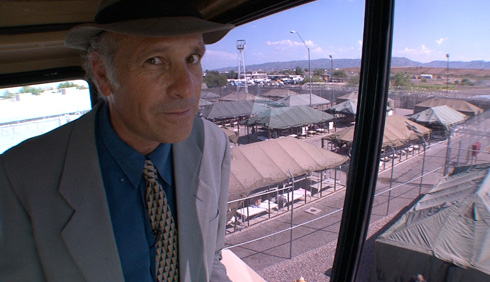
Greg Palast overlooking Maricopa County Prison
Reporter Greg Palast in a guard tower looking out on Joe Arpaio's jail in Maricopa County, Arizona. (Photo: Greg Palast)

In Phoenix, I stopped in at the Maricopa County prison where Sheriff Joe Arpaio houses the captives of his campaign to stop illegal immigration. Arpaio, who under the new Arizona law will be empowered to choose his targets for citizenship testing, is already facing federal indictment for his racially charged and legally suspect methods.

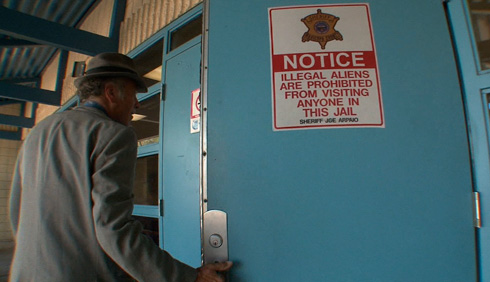
Greg Palast entering Maricopa County Prison

Ok, I admit, I was a little nervous, passing through the iron doors with a big sign, "NOTICE: ILLEGAL ALIENS ARE PROHIBITED FROM VISITING ANYONE IN THIS JAIL." I mean, Grandma Palast snuck into the USA via Windsor, Canada. We Palasts are illegal as they come, but Arpaio's sophisticated deportee-sniffer didn't stop this white boy from entering his sanctum.

But that's the point, isn't it? Not to stop non-citizens from entering Arizona - after all, who else would care for the country club lawn? - but to harass folks of the wrong color: Democratic blue.


Tuesday, March 9, 2010

Maricopa County Sheriff Arpaio learns the meaning of "backup" when all those deleted emails are recovered for a federal subpoena

AZCentral.com

So just whose e-mails are they?

On orders from Maricopa County, a third-party vendor has archived an unknown quantity of e-mails written by Maricopa County Sheriff's Office personnel since August 2008.

The Sheriff's Office says the e-mails belong to them, and they should have been deleted from an emergency backup system after 28 days.

County management says the e-mails are county property. And the messages play into two federal cases, a racial-profiling civil lawsuit against Sheriff Joe Arpaio and an FBI criminal investigation into Arpaio's office, so they refused to turn them over to the sheriff.

• Special investigator takes up Bar probe of Thomas

A Pima County judge will try to sort out ownership in an emergency hearing Wednesday morning.

The issue first arose in February when the Sheriff's Office claimed in the civil lawsuit that e-mails concerning Arpaio's controversial "crime-suppression operations" had been deleted from the system. The federal judge imposed sanctions against the office.

But last week, county officials announced they had recovered the e-mails - though actually, they had been archived.

The news caught the Sheriff's Office by surprise.

On Friday afternoon, Sheriff's Commander Bob Rampy confronted county technology managers and demanded the e-mails be turned over to him, first by e-mail and later in person. County officials turned Rampy down.

County lawyers filed an emergency motion for an order of protection against the Sheriff's Office with the Pima County judge, who is handling an ongoing case between the county and the sheriff over management of a county law-enforcement computer database.

In that motion, attorney Julie Pace, who represents the county, revealed that not only were some of the e-mails subject to the racial-profiling suit, but that other, unspecified e-mails also had been subpoenaed by a federal grand jury investigating Arpaio's office. The two sets of e-mails may overlap, but county officials will not reveal the contents of the latest subpoena.

Judge Theodore Borek, who was assigned to the computer case last year, granted the order of protection and set a hearing for Wednesday in Tucson.

Eric Dowell, an attorney representing the Sheriff's Office, said the Sheriff's Office was not aware that its e-mails had been archived since August 2008, following an order by another attorney for the county in an unrelated lawsuit involving county officials.

"They never once told anybody that for the last two and half years, they've been backing up every single e-mail," Dowell said. "If some attorney is looking at my attorney-client e-mails, there are going to be some ethical problems."

Dowell said the initial request for e-mails was based on word searches relevant to the racial-profiling case. But he did not know the extent of the federal grand jury subpoena.

"We don't know what the county has turned over, but what we do know is that someone at (the U.S. Department of Justice) is reviewing the e-mails," he said.

But Pace said that e-mail from all county departments except the County Attorney's Office and the libraries are archived in the same manner.

And Pace said that the backup e-mails are on data tapes that are inaccessible to the company that maintains them.

"They can't read them and don't read them," she said. "Only they (the Sheriff's Office) know what's in those e-mails."