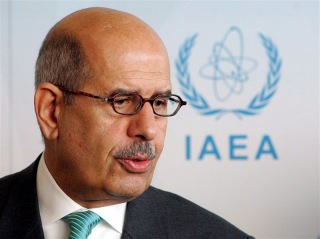
Showing posts with label Mohamed ElBaradei. Show all posts

Friday, December 30, 2011

Slip-Sliding to War with Iran

Consortium News

Exclusive: Having apparently learned nothing from the Iraq disaster, many of the same political/media players are reprising their tough-guy roles in a new drama regarding Iran. These retread performances may make another war, with Iran, hard to avoid, writes Robert Parry

By Robert Parry

With the typical backdrop of alarmist propaganda in place, the stage is now set for a new war, this time with Iran. The slightest miscalculation (or provocation) by the United States, Israel or Iran could touch off a violent scenario that will have devastating consequences.

Indeed, even if they want to, the various sides might have trouble backing down enough to defuse today’s explosive situation. After all, the Iranians continue to insist they have no intention of building a nuclear bomb, as much as Israeli and American officials insist that they are.

So, this prospective war with Iran – like the one in Iraq – is likely to come down to intelligence assessments on Iran’s intentions and capabilities. And, as with Iraq’s alleged WMD, the many loud voices claiming that Iran is on pace to build a nuclear bomb are drowning out the relatively few skeptics who think the evidence is thin to invisible.

For instance, the recent report from the International Atomic Energy Agency about Iran’s supposed progress toward a nuclear bomb was widely accepted as gospel truth without any discussion of whether the IAEA is an unbiased and reliable source.

In framing the story in support of the IAEA, the major U.S. newspapers and TV networks ignored documentary evidence that the IAEA’s new director-general was installed with the support of the United States and that he privately indicated to U.S. and Israeli officials that he would help advance their goals regarding Iran.

These facts could be found easily enough in WikiLeaks cables that the U.S. news media has had access to since 2010. Yet, the Big Media has ignored this side of the story, even as the IAEA report has been touted again and again as virtually a smoking gun against Iran.

This pattern of ignoring – or downplaying – evidence that runs counter to the prevailing narrative was a notable feature during the run-up to war with Iraq. It is now being repeated not just by the right-wing news media, but by the New York Times, the Washington Post, MSNBC and other centrist-to-left-leaning outlets. [Update: The IAEA report was cited again on Friday in another bellicose editorial in the Times.]

The IAEA Cables

Thus, very few Americans know that U.S. embassy cables from Vienna, Austria, the site of IAEA’s headquarters, revealed that the U.S. government in 2009 was celebrating its success in installing Japanese diplomat Yakiya Amano to replace Egyptian Mohamed ElBaradei, who famously had debunked some of President George W. Bush’s claims about Iraq’s supposed nuclear ambitions.

In a July 9, 2009, cable, American chargĂ© Geoffrey Pyatt said Amano was thankful for U.S. support of his election. “Amano attributed his election to support from the U.S., Australia and France, and cited U.S. intervention with Argentina as particularly decisive,” the cable said.

Saturday, April 23, 2011

ElBaradei suggests war crimes probe of Bush team

Mohamed ElBaradei, director general
of the International Atomic Energy Agency (IAEA),
reacts during his lecture at the
Council on Foreign Relations in
New York. ElBaradei suggests in a
new memoir that Bush administration officials
should face international criminal investigation
for the "shame of a needless war" in Iraq.

Seattle Pi

NEW YORK (AP) — Former chief U.N. nuclear inspector Mohamed ElBaradei suggests in a new memoir that Bush administration officials should face international criminal investigation for the "shame of a needless war" in Iraq.

Freer to speak now than he was as an international civil servant, the Nobel-winning Egyptian accuses U.S. leaders of "grotesque distortion" in the run-up to the 2003 Iraq invasion, when then-President George W. Bush and his lieutenants claimed Iraq possessed doomsday weapons despite contrary evidence collected by ElBaradei's and other arms inspectors inside the country.

The Iraq war taught him that "deliberate deception was not limited to small countries ruled by ruthless dictators," ElBaradei writes in "The Age of Deception," being published Tuesday by Henry Holt and Company.

The 68-year-old legal scholar, head of the International Atomic Energy Agency (IAEA) from 1997 to 2009 and recently a rallying figure in Egypt's revolution, concludes his 321-page account of two decades of "tedious, wrenching" nuclear diplomacy with a plea for more of it, particularly in the efforts to rein in North Korean and Iranian nuclear ambitions.

"All parties must come to the negotiating table," writes ElBaradei, who won the Nobel Peace Prize jointly with the IAEA in 2005. He repeatedly chides Washington for reluctant or hardline approaches to negotiations with Tehran and Pyongyang.

He is harshest in addressing the Bush administration's 2002-2003 drive for war with Iraq, when ElBaradei and Hans Blix led teams of U.N. inspectors looking for signs Saddam Hussein's government had revived nuclear, chemical or biological weapons programs.

He tells of an October 2002 meeting he and Blix had with Secretary of State Colin Powell, National Security Adviser Condoleezza Rice and others, at which the Americans sought to convert the U.N. mission into a "cover for what would be, in essence, a United States-directed inspection process."
The U.N. officials resisted, and their teams went on to conduct some 700 inspections of scores of potential weapons sites in Iraq, finding no evidence to support the U.S. claims of weapons of mass destruction.

In his own memoir, published last November, Bush still insisted it was right to invade to remove a "homicidal dictator pursuing WMD." But the ex-president also wrote of a "sickening feeling" when no arms turned up after the invasion, and blamed an "intelligence failure" for the baseless claim, a reference to a 2002 U.S. intelligence assessment contending WMD were being built.

But that assessment itself offered no concrete evidence, and Bush and his aides have never explained why the U.S. position was not changed as on-the-ground U.N. findings came in before the invasion.
ElBaradei cites examples, including the conclusion by his inspectors inside Iraq that certain aluminum tubes were designed for artillery rockets, not for uranium enrichment equipment to build nuclear bombs, as Washington asserted.

The IAEA chief reported this conclusion to the U.N. Security Council on Jan. 27, 2003, and yet on the next day Bush — in a "remarkable" response — delivered a State of the Union address in which he repeated the unfounded claim about aluminum tubes, ElBaradei notes.

Similar contradictions of expert findings occurred with the claim, based on a forgery, that Iraq had sought uranium from Niger, and an Iraqi exile's fabrication that "mobile labs" were producing biological weapons.

"I was aghast at what I was witnessing," ElBaradei writes of the official U.S. attitude before the March 2003 invasion, which he calls "aggression where there was no imminent threat," a war in which he accepts estimates that hundreds of thousands of Iraqi civilians were killed.

In such a case, he suggests, the World Court should be asked to rule on whether the war was illegal. And, if so, "should not the International Criminal Court investigate whether this constitutes a 'war crime' and determine who is accountable?"

Formidable political and legal barriers would seem to rule out such an investigation. But ElBaradei, citing the war-crimes prosecution of Serbia's Slobodan Milosevic, sees double standards that should end.

"Do we, as a community of nations, have the wisdom and courage to take the corrective measures needed, to ensure that such a tragedy will never happen again?" he asks.

Thursday, April 21, 2011

Voices of Opposition • Iran: Can There a New 'Grand Bargain'?

Dr. Richard Eaton
Mohamed AlBaradei's recent observations in Der Spiegel was the subject of a lecture by Dr. Richard Eaton at a Voices of Opposition event.  Voices of Opposition, a lecture and film series developed in Tucson, AZ.  

The reference is to a "Grand Bargain", which was Iran's offer of peace and cooperation with the United States prior to the U.S. invasion of Iraq.  The U.S. had ignored Iran's offer, so the discussion by Dr. Richard Eaton is looking at what can be salvaged and what hope is left for a sane foreign policy initiative.

Every Monday during the fall and spring semesters, in an effort to present the public with an alternative to the standard media outlets, they present free socially conscious political films and lectures that address the issues that all of us face from day to day, but which our 'leaders' can't seem to solve, our media just doesn't seem to cover, and no one seems to analyze as a symptom of a larger problem.

Keep an eye out for additional broadcasts and DVD's available of these series.  They will include talks by Dahr Jamail, Jody Gibbs, Norman Finkelstein, Dacajeweiah, Linda Green, Dr, Leila Hudson, and Dr. Julian Kunnie.

Special:  9/11 Hunger Strike at McCain's office.  Profile of Blair Gatsby.

Lecture by Dr. Richard Eaton, Professor of Near Eastern Studies, University of Arizona, April 14th, 2008.

This episode, from its original broadcast, contains a quick look at the 9/11 Hunger Strike in front of Senator John McCain's office before Dr. Eaton's presentation. 

ElBaradei: US, Europe Weren’t Interested in Compromise With Iran

Officials Withheld Key Info From IAEA Chief in Push for Regime Change

Former IAEA Chief and current Egyptian Presidential candidate Mohamed ElBaradei has given a high profile interview to Der Spiegel this week. Though the interview largely centers around domestic politics, it also delves into his IAEA experience, particularly with respect to the attempts to broker a deal on Iran.

ElBaradei reported that he was “on the verge of a solution on several occasions” and that politics had always foiled the efforts. In particular he accused US and European officials of withholding important documents.

“They weren’t interested in a compromise with the government in Tehran, but regime change – by any means necessary,” reported ElBaradei. He also noted the difficulty of trying to broker talks under these circumstances.

ElBaradei is releasing his memoirs of his time as IAEA chief in a book to be released next month. It is expected to detail his diplomatic efforts with Iraq (before the 2003 US invasion) as well as Iran and North Korea.

Wednesday, April 6, 2011

On El Baradei's "war declaration" on Israel

Mohammed El Baradei
Middle East Beast
Gahgeer

I had an exchange of tweets with Jim Rissier (@jm111t), who believes that Egyptian presidential hopeful and former head of the IAEA Mohammed El Baradei wanted to declare war on Israel.

The background to the story is a report by the English-language website of Israeli Yidiot Aharonot daily (also known as Ynet). In the report, El Baradei was quoted as saying that he would wage a war against Israel in the event of an Israeli attack on the Gaza Strip.

The allegation fuelled the fears of many, including Jim Rissier, and also showed how pre-conceived prejudices can sometimes exacerbate a state of paranoia.

The story also showed Ynet's slipping standards, which failed to follow the most basic of journalism rules.

According to Ynet, El Baradei said: "If Israel attacked Gaza, we would declare war against the Zionist regime."
The Israeli paper said that it took the story from another Arab newspaper called Al-Watan.

These quotes have so far been used to tarnish El Baradei, a Nobel laureate, as it made very quick resonance on the web, and "now there are 1,9 M references! http://bit.ly/gbkYRx", according to Rissier.

But let's go through the facts, not the incitement.

Al-Watan newspaper is a generic name of Arab newspapers, such as The Times or the Post in Europe and America. Several Arab papers under the same name are published in Syria, Saudi Arabi and Qatar.

However, none of them published such an article, according to their websites.

A further search on Google, shows that the original story came from a Palestinian source called Dunya al-Watan, which is not even a newspaper.

In the original story, available here in Arabic, there isn't a single mention of the word "Zionist", or a direct quote from El Baradei on the declaration of war against Israel.
The paper says: "If he wins the elections, he will discuss ways to activate the joint Arab defence treaty in case of a future attack on Gaza."

The story further adds quotes from El Baradei on his election platform and promises.
Dunya al-Watan, for the uninitiated, is a news website that thrives on strange news items and generates income from advertisements by Palestinian companies. Yes, a sort of a tabloid, but never a serious newspaper.

Look at few other headlines from this "news" source:

"Gaddafi sent to an oasis in the desert"

"Egyptian designer found dead in his apartment"

"Lebanese artist's travel to Egypt barred after her porn film"

El Baradei's story, naturally, was headlined: "El Baradei: We will declare war on Israel if Gaza is attacked."

In addition, the comments made by El Baradei are part of a one-hour interview on an Egyptian talk show, which can be viewed in full here.

As part of the interview, at 2200 through the video, El Baradei answers a question about his response to an attack on Gaza:

A: "If Israel attacks Gaza, it has to, well, at the same time I can't work alone. Where is the Arab world?"


Q: "Will you send your armed forces if you are a president to repel the attack on Gaza?"

A:  "I have to think it through, I cant' tell you; I will see what the circumstances. There is a joint defence treaty; the Arab states that are fighting each other now must stand by each other."

Of course, among Rissier's 1.9 million references to this story on Google, none comes from a respectable or credible media source - except Ynet.


But since Ynet has recently begun to read the anyone's mind when it comes to Israel - see their coverage of Goldstone's alleged "retraction" - then this is not a surprise.

But sourcing a new story from a shady website without checking the original material is just a new low, Ynet.

Perhaps El Baradei should consider a libel action.

Sunday, February 13, 2011

'Egyptians aware of US hijack plan'

Press TV

While the Egyptians are celebrating the ouster of Hosni Mubarak, many are concerned about US Israeli plans with senior Egyptian military personnel to steal and depress the revolution. 

The formation of a civilian government, configuration of a body to draft the new constitution, lifting the state of emergency, releasing political prisoners, disbanding military courts, allowing freedom of media, dissolving the cabinet recently appointed by Mubarak, suspending the Parliament elected in 2010 and prosecuting those responsible for the deaths of hundreds of protesters are among other demands of the demonstrators.

Press TV interviews a political analyst on the ground in Damascus, Sami Mobayez, to get a feeling of how informed the Egyptian public is about what is going on behind the scenes.

Press TV: It has been said that it is not in the Egyptian military's interest now to actually turnover power to a civilian entity or government or transition force. What is your take on that?

Mobayez: Even if there are ambitious officers within that group they cannot even think of the idea of staying in power. I think you have to differentiate here between what these officers would like - all of them would definitely like to be another Hosni Mubarak and all of them as we know are trained by the Mubarak regime and nourished by the Mubarak regime.

Theoretically if a military officer wants to resign and run for the presidency he can. There is nothing that constitutionally prevents him from doing so. But as a military group, to have ambitions to remain in power or to impose some kind of military force on Egypt I think that's impossible.

Taking into account that the officers and the army in general in Egypt are not hated by the Egyptian population - the people had a problem with the police state of Mubarak; with those police whom they interacted on a daily basis there was a lot of friction. Whereas, they see the army as a more senior level that are vanguards of independence, so there is no hatred, as in some other Arab countries, between the military forces and the Egyptian people.

But will this current command that's in power have grandiose ambitions? Given the current situation and given what was achieved in Tahrir Square over 18 days, I think that's impossible.

Press TV: Do you think the protesters - the opposition movement are keeping a very close eye on the moves of the military right now? If they see any deviation from the path that the people want, will they again go out in mass in the streets?

Mobayez: I think there are two things that should be noted here: one is that people are very cautious at this stage. The demonstrators that have been in Tahrir Square for the past 18 days knew what it took to get rid of Mubarak. But now that Mubarak is out many of them are worried that somebody will come in to hijack their revolution be it El-Baradei, be it Amr Moussa, or be it other military officers as mentioned earlier.

So I think there is a very strong sense of alarm as to what might happen given that some of these officers are close to the US, given the declaration that came out today about the officers abiding by all international treaties signed by the previous regime, which would include Camp David signed by Sadat. That's one thing, so there's a feeling of let's wait and see where this goes.

But if there is any deviation from what these young Egyptians demand, the dice has already been cast and there is a feeling on the streets of Egypt that if something happens that we don't like we can take it out to the streets.

If we broke down Hosni Mubarak we can force any regime that comes next to abide by our demands.

Is there a feeling of general fear from these officers? There is a feeling of alarm that some of these officers or Amr Moussa or El-Baradei or someone else might try to hijack the glory of the revolution; but it's a wait and see policy at this stage.

Press TV:How do you see the role of leadership right now with this movement at this point in time? What do the leaders need to do in your perspective?

Mobayez: First of all the demonstrators of the January 25 revolt need to decide on a leader. Until this day what is so incredibly unique about this revolution is there is no single figure representing it unlike all other revolutions in contemporary history.

In Egypt 1952 if you wanted to talk to somebody representing the revolution you would go to General Najib of Colonel Nassif. At this stage in Egypt you don't have a single person representing those masses, so, you need someone who is young and acceptable to the greater Egyptian population who would probably be running either in the upcoming parliamentary elections given that this parliament is over, or definitely getting representation in any upcoming government and finally in nominating himself for the Egyptian presidency.

You need a leader. The state of having no leader among these masses, which was perfect for the past 18 days, no longer applies because if it continues to apply for an extra day, that revolt will get swamped and as I said earlier - hijacked, used and abused by the politicians who each will try to take all credit for himself or his party - and these people are established and they have masses and they have organizational skills and that's what the young people of Egypt should not let happen.

This is not a revolt for an occupier; this is not a revolt for the Egyptian Muslim Brotherhood; it is a revolt for the Egyptian youth and that's where the real challenge emerges in the upcoming period.

Saturday, February 5, 2011

ElBaradei criticizes U.S. approach to Egypt

Reuters

It would be a "major setback" if the United States were to support either Egyptian President Hosni Mubarak or Vice President Omar Suleiman to lead a transitional government, Mohamed ElBaradei said on Saturday.

ElBaradei, a veteran diplomat and leading opposition activist, was asked about reports that Washington could support Suleiman or Mubarak to lead a transitional government. "If that were true ... that would be a major setback, I can tell you that," he told Reuters in a telephone interview from Cairo.
"If things that I hear today (are true), that would come down like lead on the people who have been demonstrating," he said.

The United States signaled on Saturday that it wanted an orderly transition of power in Egypt that could see Mubarak remaining president until September, an apparent policy shift likely to anger protesters demanding he resign now.

"To hear ... that Mubarak should stay and lead the process of change, and that the process of change should essentially be led by his closest military adviser, who's not the most popular person in Egypt, without the sharing of power with civilians, it would be very, very disappointing," ElBaradei said.
The adviser he was referring to was Suleiman, a leading figure in the security apparatus.
ElBaradei said he did not think the demonstrations were running out of steam, though he worried the situation could get even bloodier.

"There is of course a little fatigue everywhere," he said, adding that there was a "hard core" of demonstrators who would not give up as long as Mubarak held onto power.

"It might not be every day but what I hear is that they might stage demonstrations every other day," ElBaradei said. "The difference is that it would become more angry and more vicious. And I do not want to see it turning from a beautiful, peaceful revolution into a bloody revolution."

ElBaradei suggested that the United States did not appear to have a clear policy on Egypt.
"It would appear that you (the United States) are just responding to who is more powerful for each day rather than a principled position, which would be for me personally disappointing and for all the people who are demonstrating," he said.

Thursday, February 3, 2011

Neocons Attack Egyptian Dissident Mohamed ElBaradei, Again

John Bolton
The Nation
Ari Berman

Mohamed ElBaradei, a Nobel Peace Prize recipient and the former head of the International Atomic Energy Agency (IAEA), has recently emerged as a leading figure in the Egyptian pro-democracy movement and a credible alternative to Egyptian President Hosni Mubarak.

ElBaradei’s emergence has angered pro-Mubarak neoconservatives, such as Malcolm Hoenlein, executive vice president of the Council of Presidents of Major Jewish Organizations, which is closely aligned with Israeli Prime Minister Bibi Netanyahu. “There is a myth being created that ElBaradei is a human rights activist," Hoenlein told an Orthodox Jewish website on Sunday. “He is a stooge of Iran, and I don't use the term lightly. When he was the head of the International Atomic Energy Agency, for which he got a Nobel Peace Prize, he fronted for them, he distorted the reports."

Hysterical rhetoric about ElBaradei is nothing new. The same people who were wrong about Iraq’s nonexistent WMD program are once again trying to distort his work, this time as a prominent dissident in Egypt.

Over at Firedoglake, Marcy Wheeler has an excellent recap of the past neoconservative smear campaign against ElBaradei. Before the invasion of Iraq, the Bush Administration pooh-poohed his warning that there was “no evidence of ongoing prohibited nuclear or nuclear-related activities in Iraq” and paid no attention to the fact that the administration’s claim that Saddam Hussein was pursuing enriched uranium from Niger was based on forged documents, according to IAEA reporting. Despite the fact that almost everything ElBaradei said about Iraq turned out to be correct, the Bush Administration tapped his phone and led a major campaign to prevent him from leading for a third term at IAEA. Lawrence Wilkerson, a top aide to Secretary of State Colin Powell, said that then–UN Ambassador John Bolton was “going out of his way to bad-mouth” ElBaradei. Nonetheless, ElBaradei was unanimously re-elected as IAEA chief in 2005 and, shortly thereafter, awarded a Nobel Peace Prize for his arms control work. “I don’t think we were effective in our campaign to oppose him,” Bolton later admitted.

Nonetheless, the neocons who wildly hyped and distorted military intelligence in Iraq were determined to once again undermine ElBaradei when it came to Iran’s WMD program. “Mohamed ElBaradei is an apologist for Iran,” Bolton said in 2007. Why did Bolton say this? Because ElBaradei has refused to endorse a US- or Israeli-led attack on Iran, much to the chagrin of neocon war cheerleaders. The former IAEA chief has publicly criticized the Iranian government for not cooperating sufficiently with his agency, but he’s also been careful to note that robust diplomacy is the ultimate solution to the Iranian nuclear standoff.

In a 2009 interview with the Washington Post, ElBaradei called a military strike against Iran “absolutely the worst thing that could happen.” He continued:
“There is no military solution.... If a country is bombed, you give them every reason—with the support of everybody in the country and outside the country—to go for nuclear weapons, and nobody can even blame them.
“We've seen in our last report that Iran is not accelerating its production of enriched uranium. Whatever the reason—technical or political—it is something we need to take into account. We don't see an imminent threat tomorrow. “
In a 2007 profile, the New York Times called ElBaradei “an indispensable irritant to Iran and its foes.”
ElBaradei’s clashes with both Tehran and Washington will likely serve him well in Cairo, as he navigates the murky landscape of the current Egyptian regime. He’s been highly critical of Arab autocrats and the Western governments that prop them up. “Western policy towards this part of the world has been a total failure, in my view,” he told the Guardian in March 2010. “It has not been based on dialogue, understanding, supporting civil society and empowering people, but rather it's been based on supporting authoritarian systems as long as the oil keeps pumping.” He’s recently called on the Obama administration to stop supporting the Mubarak regime. If ElBaradei continues to annoy neocons in Washington, it means he’s probably doing something right.

UPDATE: Former Bush speechwriter Ari Fleischer added his voice to the anti-Elbaradei neocon caucus, posting on Twitter: "I don't trust Mohamed ElBaradei. For America, he would be bad news of a different kind." It appears that the Bush Administration's so-called freedom agenda does not apply to democratic leaders it does not like.