Showing posts with label USDA. Show all posts

Friday, October 12, 2012

New US-Canada Border Regime: Deep Integration and the North-American Homeland


Global Research
Dana Gabriel

The Beyond the Border deal announced in December 2011 represents the most significant step forward in U.S.-Canada cooperation since NAFTA. Dual action plans are further transforming trade, regulatory and security relations between both countries. Over the next few years, various cross-border initiatives will be rolled out, with some beginning as pilot programs. The U.S. and Canada have laid the framework for a new border regime which is taking their partnership to the next level and pushing the continent closer to a fully integrated North America security perimeter.

The Department of Homeland Security and Canada Border Services Agency recently announced the Phase I pilot of the Entry/Exit program which is part of the Beyond the Border action plan. It will include collecting and exchanging biographic information of third-country nationals, permanent residents of Canada, and lawful permanent residents of the U.S. at four selected land border ports of entry. A fact sheet stressed how this, “is an important step as both countries move towards a coordinated entry/exit system that will strengthen border and immigration programs, support law enforcement, and accelerate the legitimate flow of people and goods into Canada and the United States and across our common border.” The Canadian government is also advancing plans to usebiometrics for immigration and border security that would bring them in line with the U.S. and other countries.

The perimeter security agreement called for implementing, “systematic and automated biographic information-sharing capability by 2013 and biometric information-sharing capability by 2014.” A North American biometric identification system could be used to restrict, track and trace our movements.

On October 4, Transportation Security Administration (TSA) and Transport Canada officialsannounced the extension of the expedited screening initiative, TSA Pre✓™ which will now include lanes for Canadian NEXUS members at 27 participating U.S. airports. Canadian Minister of State For Transport Steven Fletcher explained that, “The Government of Canada and the United States are delivering on commitments to include Canadian NEXUS members in designated TSA Pre✓™ lanes as part of the Beyond the Border Action Plan.” He went on to say, “This will mean smarter and faster air travel for Canadian NEXUS members traveling within the U.S., while maintaining a high level of aviation security.” TSA Administrator John Pistole acknowledged that, “The inclusion of Canadian NEXUS members in TSA Pre✓™ is an important step in further harmonizing the security screening process between the U.S. and Canada.” Under NEXUS, pre-screened travelers are granted expedited access across the border, by air, land or sea. As part of the perimeter security deal, both countries are expanding and integrating trusted traveler programs.
The Next-Generation pilot project which would permit U.S. agents on Canadian soil is on hold while legal issues are being resolved. The security perimeter agreement stated that both countries would, “create integrated teams in areas such as intelligence and criminal investigations, and an intelligence-led uniformed presence between ports of entry.” The plan which is a land-based version of the Shiprider program was scheduled to be deployed this summer. Allowing U.S. agents to cross the border and pursue suspects into Canada poses a threat to sovereignty and could infringe on personal privacy laws. The pilot project is part of the process of acclimating U.S. policing activities in Canada and could later be expanded.
Last month, the USDA’s Food Safety and Inspection Service and the Canadian Food Inspection Agency established a pre-clearance initiative pilot project on import re-inspection activities for fresh meat. This is tied to the Beyond the Border deal and is aimed at streamlining meat inspections at the U.S.-Canada border. Just as the joint program was being rolled out, XL Foods in Alberta, Canada announced a massive recall of meat products due to E. coli contamination. This came on the heels of a letter from the Safe Food Coalition to the USDA citing concerns that food safety could be compromised and requesting that the border inspection pilot be halted. Some of the potential tainted meat could have been shipped to at least eight U.S. states. In a press statement, the Executive Director of Food & Water Watch, Wenonah Hauter pointed out that, “the Obama Administration and the Harper Government in Canada have been plotting to eliminate the very border inspection program that tipped off authorities that there was a major problem brewing with the products originating from the XL plant.” Plans to further deregulate food safety inspections could lead to more trouble in the future.
In September, Transport Canada and the United States Coast Guard launched a pilot project that will include joint Port State Control inspections of non-Canadian and non-U.S. flagged vessels in the Great Lakes St. Lawrence Seaway. Rear Adm. Mike Parks, Commander of the U.S. Coast Guard Ninth District described how, “This initiative is in keeping with President Obama’s and Prime Minister Harper’s Beyond the Border Perimeter Security Initiative protecting the Great Lakes and St. Lawrence Seaway region, which provides common access to the heart of North America. Our goal is to make vessel inspections more efficient and facilitate American and Canadian business on both sides of our shared border.” The program is outlined in the Regulatory Cooperation Council action plan and establishes a, “safety and security framework for the Great Lakes St. Lawrence Seaway that will align the two countries’ regulatory requirements. This pilot project will look for efficiencies in order to reduce duplicate inspections and impediments to trade.” When completed, recommendations will be made on whether to form a permanent binational foreign vessel inspection program.
NAFTA partners, in conjunction with multinational corporations and influential think tanks are pushing for deeper North American integration. As far as the upcoming U.S. election goes, Barack Obama and Mitt Romney are both committed globalists and have no intentions of upholding the constitution or protecting what is left of American sovereignty. The notion of real choice is now even more of an illusion. Minus the Democrat and Republican rhetoric, it’s essentially the same policies, same agenda, and the same team. It doesn’t matter who wins the presidency, the path towards a North American Union will continue.

beyourownleader@hotmail.com

. Visit his blog at Be Your Own Leader

Saturday, August 25, 2012

Which ‘Natural’ Food Companies Are Fighting the Effort to Label GMOs?

From the Trenches

Huffington Post  On Nov. 6, California voters will have the opportunity to vote on historic Proposition 37, which would mandate the labeling of genetically-engineered foods. At a time when it’s hard to get a large percentage of Americans to agree on almost anything, polls show that as many as 90 percent of us want genetically-modified organisms (GMOs) labeled. More than 40 other nations, including the entire European Union, already require disclosure. But Monsanto and its allies are dedicated to keeping consumers in the dark and are pouring tens of millions of dollars into a disinformation campaign intended to defeat Prop 37.

You might expect the biotech industry to try to block a measure that would require foods that contain GMOs to say so on their packages. After all, a growing body of scientific research is indicating that GMOs might be far more dangerous than was previously imagined. But Monsanto’s allies in the effort to defeat Prop 37 include some unexpected culprits. It can be shocking to realize that some of the most trusted names in the naturalfood world are in bed with Monsanto.

Naked Juice is owned by PepsiCo, which has donated $1.7 million to Monsanto’s efforts. Honest Tea, Odwalla and Simply Orange are owned by Coca-Cola, which has donated another million dollars. Alexia and Lightlife are owned by ConAgra, which has put in more than $1 million.

You won’t find this mentioned anywhere on the Kashi product packaging, but Kashi, as well as Gardenburger and Morningstar Farms, is owned by Kellogg, which has already coughed up more than $600,000 to defeat Prop 37.

Kashi has already been in plenty of trouble on the GMO front this year. A few months ago, a number of natural foods stores stopped carrying Kashi cereals when it came to their attention that the “soy used in most Kashi products is genetically modified, and that when the USDA tested the grains used there were found to be pesticides that are known carcinogens and hormone disruptors.”

In an attempt to defend itself, Kashi released a YouTube video that announced that:

“While it’s likely that some of our foods contain GMOs, the main reason for that is because in North America, well over 80 percent of many crops, including soybeans are grown using GMOs … Factors outside our control such as pollen drift from nearby crops

… have led to an environment where GMOs are not sufficiently controlled.”
This seemingly reasonable defense — that the only reason GMOs are found in Kashi products is because GMOs are widespread in the environment — might be valid if the problem was only trace GMOs, which lead to a product being less than 1 percent genetically engineered. But when theCornucopia Institute tested Kashi’s Go Lean cereal, which gets its protein from soy, they found that the soy was 100 percent genetically engineered.

There are other natural foods heroes whose profits are being used to try to keep us in the dark. Silk soy milk carries the “Non-GMO Project Verified” seal on its package. But Silk is owned by Dean Foods, which has donated more than a quarter million dollars to Monsanto’s efforts to defeat Prop 37.
The list of sell-outs who masquerade as bastions of organics is disappointingly long. R. W. Knudsen and Santa Cruz Organics are owned by Smucker, which has donated $388,000 to killing Prop 37. Cascadian Farm, Larabar and Muir Glen are owned by General Mills, which has put more than half a million dollars into the effort.

The good news is that even with large agribusiness companies purchasing natural and organic brands and then betraying consumers by funding the attack on GMO labeling, Prop 37 still stands an excellent chance of passing.

And not everyone has sold out, not by a long shot. There are still some authentic heroes in the natural food industry. Nature’s Path, Dr. Bronner’s, Nutiva and Lundberg Rice stand out among the companies that are contributing to the effort to pass Prop 37 and ensure your right to know what’s in your food. Organic Valley, Amy’s and Eden Foods are also standing up for your right to know. And the owner of a natural health website, Joseph Mercola (mercola.com), has donated nearly a million dollars to the good fight.

If you want to know more, the Cornucopia Institute has released a shopper’s guide to the companies that are donating on both sides of Prop 37.

At present, it’s not easy to know whether there are GMOs in your food. The Non-GMO Shopping Guide put out by the Institute for Responsible Technology is a great support. But the most important thing you can do is to help pass Proposition 37.

If Californians pass Prop 37 in November, it will have enormous implications to the food system throughout North America.

Ignorance, in some cases, may be bliss. But in the case of GMOs, the ignorance of not knowing what is in your food is not bliss, it’s subservience to Monsanto and its allies. And it could mean a lifetime of devastating health problems for you and your children.

It’s going to be a battle. Let’s win this one for ourselves, for the earth, and for all future generations.


Friday, April 27, 2012

America's Mad Cow Crisis

PRWatch
John Stauber

Americans might remember that when the first mad cow was confirmed in the United States in December, 2003, it was major news. The United States Department of Agriculture (USDA) and the Food and Drug Administration (FDA) had been petitioned for years by lawyers from farm and consumer groups I worked with to stop the cannibal feeding practices that transmit this horrible, always fatal, human and animal dementia. When the first cow was found in Washington state, the government said it would stop such feeding, and the media went away. But once the cameras were off and the reporters were gone nothing substantial changed.

In the United States, dairy calves are still taken from their mothers and fed the blood and fat of dead cattle. This is no doubt a way to infect them with the mad cow disease that has now been incubating here for decades, spread through such animal feeding practices. No one knows how the latest dairy cow was infected, the fourth confirmed in the United States. Maybe it was nursed on cow's blood. Perhaps it was fed feed containing cattle fat with traces of cattle protein. Or perhaps there is a mad cow disease in pigs in the United States, which simply has not been found yet, because pigs are not tested for it at all, even though pigs are fed both pig and cattle byproducts, and then the blood, fat and other waste parts of these pigs are fed to cattle.

All these U.S. cattle feeding methods are long banned and illegal in other countries that suffered through but eventually dealt properly with mad cow disease. Here, rather than stopping the transmission of the disease by stopping the cannibal feeding, mad cow is simply covered up with inadequate testing and very adequate public relations. US cattle are still fed mammalian blood, fat and protein, risking human deaths and threatening the long term safety of human blood products, simply to provide the U.S. livestock industry with a cheap protein source and a cheap way to get rid of dead animal waste.

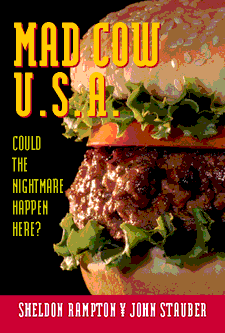
I began researching this issue around 1989, long before the disease was confirmed to have jumped from cattle to the people eating them, as announced by the British government in 1996. In 1997, I co-authored Mad Cow USA, warning that the disease was likely already here and spreading, since the animal cannibalism that caused its outbreak in Britain and spread it to other countries was actually more widespread in the United States than anywhere.

Wednesday, April 6, 2011

Fukushima in the San Francisco Rain

Slog

Posted by Jonathan Golob on Tue, Apr 5, 2011 at 9:12 PM

As a partner to an earlier paper by University of Washington scientists (detecting radioactive Iodine from Fukushima in the Seattle air), now comes a paper by Berkley physicists finding radioactive isotopes from Fukushima in San Francisco rainwater.

(For an update on the levels of radioactivity being detected here in Seattle, you can visit a UW APL website.)

A few thoughts.

1. The peak levels of I-131 detected in Seattle air (about 4.5 mBq per m^3 or 4.5 kBq per liter of air) were much higher than the levels (per liter) in the SF rainwater.

2. It's interesting how persistent the levels were in the San Francisco rainwater—lacking the clear peak and drop-off of the Seattle data.

3. I'm not sure what to make of the potential health effects of these amounts of I-131. The body's response to I-131 is complex. The risk posed by I-131 depends on a multitude of factors; age at the time of exposure, nutritional status, the kind of exposure (by air, water, food and even specific kinds of foods). Finally the effects are variable, from increased thyroid and blood cancer risks, stunning of the Thyroid (causing a poor response to the treatment for Thyroid cancer), to destruction of the Thyroid.

Most of the epidemiological data is based upon exposures from Chernobyl and above-ground nuclear bomb testing. The amounts of I-131 detected in SF and Seattle are below those shown to cause increased risk of cancer later in life—by about about a hundred fold. But, those studies were small, and only powered to detect large increases in relative risk.

In plain English, there is no proven risk from these doses of I-131. That's not to say there is no risk, just that the risk is too small to be detected in these prior studies. Given the sheer numbers of people being exposed right now—Tokyo is a city of 36 million people; the Central Valley of California feeds an astonishing number of people—I think it's reasonable to assume that even small risks will cause some real increased cancers in the world.

4. I wish there was a more systematic, more open and public, monitoring of the I-131 levels around the world—particularly in Iodine rich foods: Seaweed, eggs, milk and other dairy products. The USDA—defining the term 'captive regulatory agency'—is in charge of protecting the safety of our food supply.

What distressing about this pair of studies is not the levels of I-131 detected. What's distressing is the ad-hoc nature of the data—the lack of systematic monitoring. The problem with Fukushima is—in my mind—the same as the problem of Salmonella: We tend to ignore problems, particularly problems caused by huge, powerful industries. Just because we aren't collecting—or possibly divulging—distressing data, doesn't make the underlying problem go away.


Tuesday, October 12, 2010

Industry Front Group Gets Taxpayer Money to Convince You to Eat Pesticide-Laden Food

Alternet

Thanks to the USDA, your hard-earned money has been given to a special interest group representing giant agribusiness and its pesticide company cohorts.

Would you pay for a campaign to assure consumers that pesticide residues in their fruits and vegetables pose no harm to their health? Because, whether you want to or not, you just have. The California Department of Food and Agriculture (CDFA) recently awarded $180,000 in federal grant funding to an organization called the Alliance for Food and Farming for a project titled "Correcting Misconceptions about Pesticide Residues." The money came from the U.S Department of Agriculture's Specialty Crop Block Grant program, a grant program intended to "enhance the competitiveness" of so-called specialty crops: fruits, vegetables, tree nuts, dried fruits, horticulture, and nursery crops.

The Alliance for Food and Farming (AFF) is a front group representing California's large produce growers and marketers and suppliers who sell them pesticides and fertilizer. Some of the member organizations include the California Strawberry Commission, Western Growers, the California Table Grape Commission, Sunkist Growers, the Produce Marketing Association, the California Farm Bureau Federation, and the California Association of Pest Control Advisers. A look on the pesticides section of AFF's Web site shows headlines such as "US Farmers are Environmentalists Too" and "Everything Doesn't Cause Cancer," as well as produce industry documents refuting a recent study that linked pesticides to ADHD.

According to CDFA's press release, AFF will use its new taxpayer-funded grant, to "generate more balanced media reporting and change public perception about the safety of produce when it comes to pesticide residues," by "utilizing sound science backed by a team of nutrition and toxicological experts." The press release also charges that "claims by activist groups about unsafe levels of pesticides have been widely reported in the media for many years" and "continued media coverage of this misleading information is damaging to producers of California specialty crops and may also have a negative impact on public health."

As a part of its campaign, AFF commissioned a report by four toxicologists and a nutritionist that critiques the Environmental Working Group's (EWG) "Dirty Dozen" list of the most contaminated fruits and vegetables. Of the experts who wrote the report, two have links to the International Life Sciences Institute (ILSI), a food industry lobby group, including one who served as the executive director of ILSI's Risk Science Institute, and two who serve in university positions endowed by major corporations (Mars, Inc. and Dow Chemical). The report nitpicks EWG's methodology because the dirty dozen list measures which fruits and vegetables typically contain the most pesticide residues but does not assess which pesticides, and thus, which foods, actually carry the most risk of harm to one's health.

The AFF report also takes issue with the assertion that dietary exposure to pesticides can harm one's health. It points out that environmental and occupational exposures to pesticides are often much higher than dietary exposures (i.e. a farmworker who works among fields where pesticides were sprayed is exposed to more pesticides than the average person who eats fruits and vegetables that were grown using pesticides) and that there are relatively few studies in existence that focus specifically on dietary exposure to pesticides.

Full Article