Showing posts with label china. Show all posts

Monday, January 14, 2013

PLA officials say troops are to prepare for war amid territorial disputes with Japan


'Hard and rigorous' training planned amid territorial tension with Japan, officials declare, but observers rubbish 'loud propaganda'

South China Morning Post
Choi Chi-yuk

The PLA aims to beef up its troops' combat readiness and prepare for actual war situations through exercises this year, according to the latest annual training directive, amid escalating tensions between China and Japan over territorial disputes in the East China Sea.

"In 2013, the goal set for the entire army and the People's Armed Police force is to bolster their capabilities to fight and their ability to win a war … to be well-prepared for a war by subjecting the army to hard and rigorous training on an actual combat basis," according to yesterday's People's Liberation Army Daily, which referred to a training blueprint issued by the PLA's Department of the General Staff for the entire force.

The directive came in stark contrast to that of its predecessor. In last year's directive, more emphasis was placed on joint military trainings and co-ordination among different PLA services.

This year's statement stresses the urgency of real combat abilities in all military training by repeating the phrase "fighting wars", or dazhang, as many as 10 times in the article, which was no more than 1,000 words. The phrase did not appear in last year's directive.

The changes could be a result of the rising tensions in waters between China and Japan, while they might also indicate that there is a different focus for the PLA, since the Central Military Commission's chairman Hu Jintao was succeeded by Xi Jinping , the new PLA commander-in-chief since November.

Separately, state broadcast media reported in the past week that the PLA's naval air force kicked off the open-sea training portion of its annual exercise programme. No details were given on the specific dates or duration.

The General Staff department's training directive came a day after Japan's Self-Defence Forces conducted a massive military exercise on training grounds in Narashino, on the outskirts of Tokyo, on Sunday, in which 20 aircraft, 300 personnel and 33 vehicles participated.

Japanese Defence Minister Itsunori Onodera issued a statement after the drill insisting that Chinese ships had trespassed in "Japanese waters" near the Senkaku Islands, which are known in China as the Diaoyus, and that the security surrounding Japan was therefore being tightened.

The disputed chain of islands in the East China Sea has been claimed by both China and Japan since the early 1970s.

Andrei Chang, editor-in-chief of the Canada-based Kanwa Defence Review, said, "The PLA is making its propaganda voice louder this year, aside from shifting their target to Japan instead of the Philippines last year," adding the statement was more or less the same as last year's.

Sunday, November 11, 2012

China and Russia are Acquiring Gold, Dumping US Dollars


Global Research
Michel Chossudovsky
Central Banks are Acquiring Gold, Dumping US Dollars
There is evidence that central banks in several regions of the World are building up their gold reserves. What is published are the official purchases.

A large part of these Central Bank purchases of gold bullion are not disclosed. They are undertaken through third party contracting companies, with utmost discretion. 

US dollar holdings and US dollar denominated debt instruments are in effect being traded in for gold, which in turn puts pressure on the US dollar.  

In turn, both China and Russia have boosted domestic production of gold, a large share of  which is being purchased by their central banks:

It has long been assumed that China is surreptitiously building up its gold reserves through buying local production. Russia is another major gold miner where the Central bank has been purchasing gold from another state entity, Gokhran, which is the marketing arm and central repository for the country’s mined gold production. Now it has been reported by Bloomberg that the Venezuelan Central Bank director, Jose Khan, has said that country will boost its gold reserves through purchasing more than half the gold produced from its rapidly growing domestic gold mining industry.
In Russia, for example, Gokhran sold some 30 tonnes of gold to the Central Bank in an internal accounting exercise late last year. In part, so it was said at the time, the direct sale was made rather than placing the metal on the open market and perhaps adversely affecting the gold price.

China is currently the world’s largest gold producer and last year it confirmed it had raised its own Central Bank gold holdings by more than 450 tones over the previous six years. Mineweb.com – The world’s premier mining and mining investment website Venezuela taking own gold production into Central Bank reserves – GOLD NEWS | Mineweb

The 450 tons figure corresponds to an increase in the gold reserves of the central bank from 600 tons in 2003 to 1054 tons in 2009. If we go by official statements, China’s gold reserves are increasing by approximately 10 percent per annum.

China has risen to now be the largest gold producing nation in the world at around 270 tonnes. The amount bought in by the government initially looks like 90 tonnes per annum or just under, 2 tonnes a week. Before 2003 the announcement by the Chinese central bank that gold reserves had been doubled to 600 tonnes, accounted for similar purchases before that date. Why so small an amount you may well ask? We think local and national issues clouded the central bank’s view as it was the government that bought the gold since 2003 and have now placed it on the central bank’s Balance Sheet. So we would conclude that the government has ensured central bank gold purchasing must continue. “How will Chinese Central Bank Gold Buying affect the Gold Price short & Long-Term?” by Julian Phillips. FSO Editorial 05/07/2009
Russia
Russia’s Central bank holdings are in excess of 20 million troy ounces (January 2010)
click to enlarge
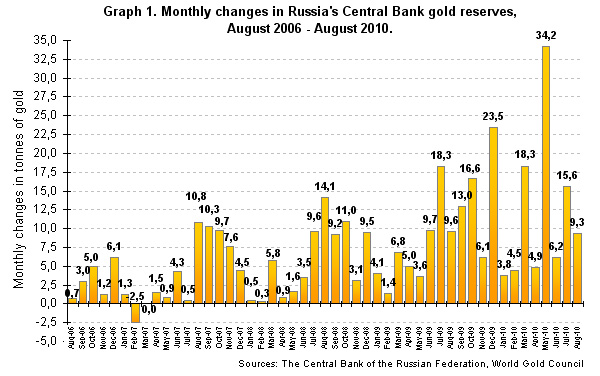
Russia’s Central Bank reserves have increased markedly in recent years. The RCB reported in May 2010 purchasing 34.2 tons of gold in a single month. Russian Central Bank Gold Purchases Soar In May – China Too? | The Daily Gold

The diagram below shows a significant increase in monthly purchases by the the RCB since June 2009.
(click on chart to enlarge)

Central Banks in the Middle East are also building up their gold reserves, while reducing their dollar forex holding.

Gold reserves of GCC states is less than 5 percent:

Dubai International Financial Centre Authority economists released a report yesterday calling for local countries to build gold reserves, according to The National.

Despite a high interest in gold, GCC states maintain less than 5 percent of their total reserves in gold. Compared to the ECB, which holds 25 percent of reserves in gold, that leaves a lot of room for growth. http://www.businessinsider.com/gcc-boost-gold-holdings-2010-12#ixzz18FEqpTy3

GCC states should boost their foreign reserve holdings of gold to help shield their billions of dollars of assets from turbulence in global currency markets, say economists at the Dubai International Financial Centre Authority (DIFCA).

Diversifying more of their reserves from US dollars to the yellow metal would help to offer central banks in the region higher investment returns, said Dr Nasser Saidi, the chief economist of DIFCA, and Dr Fabio Scacciavillani, the director of macroeconomics and statistics at the authority.

“When you have a great deal of economic uncertainty, going into paper assets, whatever they may be – stocks, bonds, other types of equity – is not attractive,” said Dr Saidi. “That makes gold more attractive.”

Declines in the dollar during recent months have dented the value of GCC oil revenues, which are predominantly weighted in the greenback. GCC urged to boost gold reserves
According to a report in People`s Daily;

The latest rankings of gold reserves show that, as of mid-December, the United States remains the top country and the Chinese mainland is ranked sixth with 1,054 tons of reserves, the World Gold Council announced recently.

Russia climbed to eighth place because its gold reserves increased by 167.5 tons since December 2009. The top ten in 2010 remains the same compared to the rankings of the same period of last year. And Saudi Arabia squeezed to the top 20.
Developing countries and regions, including Saudi Arabia and South Africa, have become the main force driving the gold reserve increase. … .

The International Monetary Fund (IMF) and the European central bank are the major gold sellers, and the IMF’s gold reserves decreased by 158.6 tons. (China’s gold reserves rank 6th worldwide – People’s Daily Online

It should be understood that actual purchases of physical gold are not the only factor in explaining the movement of gold prices. The gold market is marked by organized speculation by large scale financial institutions.

The gold market is characterised by numerous paper instruments, gold index funds, gold certificates, OTC gold derivatives (including options, swaps and forwards), which play a strong role, particularly in short-term movement of gold prices. The recent increase and subsequent decline of gold prices are the result of manipulation by powerful financial actors.

Wednesday, October 24, 2012

U.S. is Allied with and actively Supports Al-Qaeda

Iran Review
Interview with: James F. Tracy
By: Kourosh Ziabari


Professor James F. Tracy
American political commentator believes that the United States has been constantly allied with Al-Qaeda and supported it militarily and financially.
"Major media have recently had to acknowledge that US-NATO interests are aligned with Al Qaeda in Syria, of course overlooking the fact that the US and Sunni States also recruited and armed these soldiers of fortune. What the Obama administration has sought to do with the alleged murder of Bin Laden in May 2011 is to close the chapter on the old, villainous Al Qaeda and open a chapter on the new and friendly Al Qaeda. This narrative is slowly unfolding, while Americans are instructed on a different bogey to fear, which now appears to be homegrown terrorism," he said in an exclusive interview with Iran Review.
Prof. James F. Tracy is the Associate Professor of Media Studies at Florida Atlantic University in Boca Raton, where he teaches courses on media history and the role of journalism in the public sphere. Tracy's scholarly work and commentary on media and politics have appeared in numerous academic journals, edited volumes, and alternative media news and opinion outlets. He is editor of Democratic Communiqué, journal of the Union for Democratic Communications, an affiliate of Project Censored, and a regular contributor to GlobalResearch.ca. Tracy's latest work assessing Western press coverage of US-NATO military ventures and the human costs of war appears in Censored 2013: The Top Censored Stories and Media Analysis of 2011-2013 (Seven Stories Press, 2012).
Prof. Tracy took part in an interview with Iran Review to answer some questions regarding the influence of advocacy organizations on the U.S. government and the mutual relationship between these entities, the further limitation of civil liberties and individual freedoms in the United States, the challenges ahead of progressive, alternative journalism in the United States, Western mainstream media's coverage of Iran and Syria affairs and the prospect of U.S. military expeditions in the Middle East.
Q: What do you think about the role of influential American think tanks and public diplomacy and advocacy organizations such as the Council on Foreign Relations or the National Endowment for Democracy in creating unrest and instability in the countries which are opposed to the United States policies? Do you find traces of their footsteps in the ongoing violence in Syria? Do they have plans to destabilize Iran so as to realize their mischievous objective of regime change in Tehran?
A: One can contend that the Council on Foreign Relations and the National Endowment for Democracy are much more than advocacy organizations. The question suggests the popular view that Western states and especially the United States are above such organizations in terms of decision making power and responsiveness to the populations they purportedly serve.
This is the idealization of a transcendent governing apparatus upheld in public opinion and touted in Western mainstream media. This is the myth the CFR specifically perpetuates about itself and the liberal state. In fact, the CFR is a branch of the Royal Institute of International Affairs and it has more or less dictated US foreign policy from within entities such as the US State Department since before World War Two.
This is not to say that every member of the CFR is involved in such maneuvers. Some are in the organization because they're flattered to be asked and they see it as prestigious and fashionable, or they wish to network with other influential figures. Yet it is no mistake that membership is exclusive and participants all occupy strategic positions of power in major global corporations, in academe and the media, and in government, and thus can be mobilized to exert their influence as the CFR inner circle desires. They also openly share in the ideology of weakening the nation state and privileging global-regional and international bodies, such as the European Union and the United Nations.
It is through such organizations that they can get their policies enacted with little if any interference from the common people or their representatives at the national level. The CFR's interests and activities, alongside the interests supported by the major philanthropic foundations such as the Ford Foundation, Rockefeller Foundations, and the Gates Foundation, are demonstrable manifestations of the deep state that truly runs the world, has priorities that differ greatly from the bulk of humanity, and has sought to exert itself since the 1920s.
The "Arab Spring" appears to be largely a maneuver of organizations such as the CFR and NED. This was evident from the onset with the high degree of Western media exposure afforded the fairly modest demonstrations 2011 in Tahrir Square that preceded Mubarak's ouster by the Central Intelligence Agency. The same media outlets unquestioningly covered the Western and Sunni-backed deployment of Al Qaeda mercenary forces and NATO airpower against the most modern and socially progressive state on the African continent under the Obama administration's "Responsibility to Protect" cover. A central bank was reportedly created in the back of a mercenary pickup truck. This was a colossal war crime that Western public opinion is left largely in the dark about. It also underscored liberal-progressive hypocrisy and credulousness in the US, evident in the pronouncements of public figures such as Juan Cole and Amy Goodman, who led the cheering section for Libya's destruction. If the Bush administration successfully vanquished the probable leader of the African Union those on the Left would have been in a huff. When one of their purported own oversees such a campaign it's not only condoned but applauded, much like the "humanitarian" bombing of Yugoslavia by Clinton.
As many of your readers are likely aware, Libya is significant because some of the same mercenary forces recruited by US intelligence and Sunni states that were employed there are now deployed in Syria. Like Libya, Syria is also a fairly modern state that is not hostile to the West but is regarded as being autonomous, particularly in its alliance with Iran and Hezbollah. It is also seen as a strategic threat to Israel in terms of Iran, and so must be dismantled before a more concerted campaign against Iran is to take place. I'm inclined to think that those determining policy for the Obama administration want compliant fundamentalist regimes installed throughout the Middle East. This will be disastrous to overall security in the region but I don't believe that's their goal. War is much more profitable and has much greater potential than peace for those who wish to exert control over resources.
Q: In one of your articles, you argue that the United States has become a police state, with such restrictive legislations and programs which the government has put into effect to limit the citizens' personal freedoms and different types of civil liberties, such as the Sedition Act of 1798 which criminalizes the publication of "false, scandalous, and malicious writing" against the government and governmental officials. Would you please elaborate more on your notion of the United States becoming a police state?
A: I believe this was "The Paranoid Style of American Governance," where I pointed out that the laws, policies, and organizational structure of the US government, how its exaggerated concern over surveillance and security is arrayed against the American people. The situation is comparable to how an increasingly delusional paranoid might approach human relationships s/he is involved in.  As a result of the 1996 Effective Death Penalty and Anti-Terrorism Act following the Oklahoma City Murrah Federal Building bombing and the 2001 PATRIOT Act enacted after September 11, 2001 many of the civil liberties Americans have been guaranteed under the Constitution have been stolen, never to return.
Citizens cannot expect to be secure in their persons and papers. We are subjected to humiliating warrantless searches at transportation facilities. As a result of a string of legislation capped off by President Obama's National Defense Authorization Act of December 2011 the government now reserves the right to jail or murder citizens on political grounds. There is little if any recourse because our political representation has to a large degree been bought off by private interests. The US increasingly looks like a totalitarian state and is one major event away from fully resembling the Soviet Union or an Eastern Bloc state circa 1970. The extent of the rollback in civil liberties is very overdone because a majority of Americans are ill-informed, politically unsophisticated, and in many instances even functionally illiterate. Thus they are unaware of the police state's accelerated formation since the mid-1990s and unprepared to contest it. A combined regime of poor public education and the stultifying effects of mass media and culture have dumbed the American public down to the extent that its republic has been taken right out from underneath its nose.
Q: It's widely believed that the United States, as its leaders claim, is a "beacon of freedom" since the mass media are allowed to publish every critical material at will, even if they threaten the national security, in such cases of war with another nation. Is this widely-accepted belief true? Don't the mass media face any restriction or impediment by the government to censor certain stories or withhold from the public sensitive information?
A: The major, agenda-setting US news media—USA Today, the New York Times, the Wall Street Journal, the Washington Post, the Los Angeles Times, and their broadcast and cablecast amplifiers—that the small strata of semi-politically adept and literate citizens rely on for information are all controlled by interests that are overall supportive of the US police state and US-NATO foreign policy. To return to your initial question, many of the owners or top editors and journalists are also CFR members. Together they perform a central propagandistic function of the state through selective reportage of issues and events, omission of key information, and heavy reliance on "official" government or corporate sources.
Such a set of procedures is worse than outright falsehoods because a falsehood can be disproved and a journalist or news organization called out on the carpet. However, by owning most of the newsgathering and distribution outlets, by using official sources and employing careful editing procedures such media retain credibility in the public mind. In the Soviet Union much of the citizenry knew that by reading Pravda they were being fed outright lies so they learned to "read between the lines" to interpret what was really going on. That requires a degree of political sophistication that is beyond most Americans.
The government and major news media are also being challenged by alternative news media and thus resort to a more blatant form of disinformation that jeopardizes their perceived trustworthiness, which is now at an all-time low. This is the case with their coverage of the US-NATO actions and Libya and Syria—specifically the fact that the US is allied with and actively supporting its alleged arch enemy Al Qaeda.
For over a year corporate media tried to cover this up when it was there in plain view. Alternative outlets reported otherwise and in the face of this mainstream media had to eventually relent and admit that the US is indeed supporting Al Qaeda.
As an example, one case involved a US-based alternative media outlet reporting on the Department of Homeland Security and other government agencies collectively purchasing over one billion rounds of lethal, "hollow point" ammunition. Major media sought to assuage growing public concern on this by focusing on a single government agency's (the Social Security Administration) purchase of 180,000 rounds of such ammunition, asserting that it was for target practice. This was absolute propaganda likely pitched to these outlets by covert government sources. It's fairly common knowledge among American gun enthusiasts that "full metal jacket" ammo is used on the range because it's far less expensive than hollow point and performs the same function. Nevertheless, the 180,000 SSA story was widely circulated, performing the intended propaganda function, mainly through conscious omission of the most important information that alternative media honestly chose to highlight.
Another argument that I need to make in light of the world wide expanse of news and information now available on the Internet is that the US citizenry doesn't need to rely primarily on USA Today or New York Times editors for what it is exposed to. This remains the case so long as the Internet remains free from government or corporate encroachment and regulation. In this regard there is a wealth of information for those who have the time, discernment, and initiative to seek it out and become informed. Investigative journalists and commentators have much to draw on in terms of analyzing and explaining the meaning and significance of issues and events. This is essentially what newspapers and journals did before the application of scientific objectivity to journalism and the pretentious separation of news from analysis and opinion.
Q: What challenges do the independent, progressive journalists of the United States face today? In one of your articles, you had criticized some of the progressive media for failing to give coverage to important topics such as the truth about the 9/11 attacks. Would you please elaborate on that? In my view, the progressive media outlets such as CounterPunch or The Nation have to some extent broken apart the monopoly of the mainstream media and allowed the free flow of information while the mainstream media steadfastly try to suffocate the truth. Don't you agree?

Sunday, October 21, 2012

Militarizing South Korea


Global Research
Gregory Elich

koreausflag
With the presidential election in South Korea just two months away, efforts are underway to lock into place a policy of confrontation with that nation’s neighbor to the north. When current South Korean President Lee Myung-bak took office five years ago, he wasted little time in undoing the rapprochement that had been painstakingly built up during his predecessor’s term. All of the leading candidates in this year’s presidential race, including even Park Geun-hye of the conservative Grand National Party, hold more moderate positions on relations with North Korea than does President Lee. Neither Lee nor U.S. President Obama are keen on the prospect of warming relations between the two Koreas, and they are making every effort to forestall such an eventuality in the little time that remains in Lee’s term.
Under provisions of the Missile Technology Control Regime (MTCR), an international treaty involving 34 nations, South Korea was committed to limiting its ballistic missiles to a range of no more than 300 kilometers and capping payload at 500 kilograms. The Lee Administration chafed under those restrictions and long sought their removal. This month he met with success, reaching a deal with the U.S. that allows South Korea to exceed the treaty’s limits. The new agreement allows South Korea to develop ballistic missiles ranging up to 800 kilometers, sufficient to cover all of North Korea and sections of China and Russia. The payload limit remains at 500 kilograms, but only for missiles at the maximum allowable range. (1)
As South Korea sees it, any missile having a range lower than 550 kilometers can carry up to 1,000 kilograms of explosives. “We can say that there’s no payload limit actually, because if we launch a missile from the central region of the country, all of North Korean territory is under the 550-kilometer striking range,” observes Major General Shin Won-sik of the South Korean Ministry of National Defense. (2)
Under 300 kilograms, and a missile is now permitted to house a warhead weighing up to two tons, and Shin points out that most of North Korea’s primary targets lie within that distance of the border. Restraints apply only to deployment, Shin argues, so research may proceed on missiles that surpass the new limits, including the production of prototypes. (3)
The Lee Administration wants to move forward without delay on the deployment of the new missiles, and has asked the legislature to allocate $2.2 billion towards a long range ballistic missile program. Those missiles are expected to be in place by 2017. (4)
It appears that in tradeoff for allowing South Korea a special exemption under the MTCR, the U.S. expects South Korea to coordinate its efforts with U.S. missile defense plans. According to Kathleen Hicks, U.S. Principal Deputy Under Secretary of Defense for Policy, there are “a lot of ways” that South Korea could assist U.S. missile defense in Northeast Asia. “We do have a dialogue with the Koreans about how to contribute to missile defense,” she says. (5)
The Korean Air and Missile Defense System (KAMD) is scheduled to be fully deployed by 2015. Ostensibly intended to serve only as South Korea’s defense against attack by the North, it is interesting to note how well the system could mesh with that of the U.S. missile defense system. The KAMD, consisting of radar, U.S.-built Patriot PAC-2 missiles, and Aegis destroyers armed with sea-to-air missiles purchased from the U.S., is ideally suited for interoperability with the U.S. system.
This past June, the U.S. and South Korea reached agreement on a “comprehensive alliance approach” to defense, involving both modification of the MTCR and implementation of a missile defense system.  According to a South Korean government official, “It means building a South Korea-led missile defense system against North Korean missile attacks, with the U.S. providing intelligence and detection support.” (6) But U.S.-South Korean integration can cut both ways, and it is difficult to envision the KAMD remaining uninvolved in the U.S. missile defense system. A former South Korean foreign affairs/security official feels that the process of South Korea’s incorporation into the U.S. system could already be underway. “I think there needs to be a concrete explanation on this idea of it not being missile defense participation,” he said. (7)

Saturday, October 20, 2012

U.S. steps up support of Turkey amid Syrian conflict


Washington Post
Craig Whitlock


The U.S. government is intensifying its intelligence sharing and military consultations with Turkey behind the scenes as both countries confront the possibility that Syria’s civil conflict could escalate into a regional war, according to U.S. and NATO officials.
The Obama administration has said it wants to avoid getting drawn militarily into Syria and for months has resisted pressure from Arab allies and some Republicans to back Syria’s rebel groups more forcefully.
But as Syria’s internal conflict has increasingly spilled across its northern border into Turkey, the U.S. government has stepped up cooperation with its key NATO ally. In recent weeks, military officials from both countries have met to make contingency plans to impose no-fly zones over Syrian territory or seize Syria’s stockpiles of chemical and biological weapons, U.S. officials said.
U.S. intelligence agencies were also the source of a tip that led the Turkish military to intercept and ground a Syrian passenger plane en route from Moscow to Damascus last week on suspicions that it was carrying Russian-made military hardware, according to U.S. officials.
The Syrian plane was carrying “radar and electrical parts for Syria’s Russian-made antiaircraft systems,” one U.S. official said, speaking on the condition of anonymity to discuss details of the sensitive operation. Syria has relied on Russia for decades to help build its radar and antiaircraft defenses, among the most extensive in the Middle East.
The plane grounding sparked a diplomatic dust-up among Turkey, Russia and Syria and further exacerbated tensions that erupted Oct. 3 when Syria fired shells across the border and killed five Turkish civilians.
Since then, cross-border shelling has continued as the Syrian military has attacked rebel groups along the frontier, with rounds sometimes landing in Turkish territory. Turkey has retaliated with artillery strikes, most recently on Friday, while warning Damascus that the risk of all-out war is increasing.
The United States and NATO have publicly supported Turkey, saying it has a right to act in self-defense. At the same time, they have called for restraint and repeated that neither Washington nor Brussels has any intention of getting involved militarily.
Behind the scenes, however, the border clashes have changed the strategic calculus and led U.S. military and intelligence officials in particular to collaborate more closely with Turkey.
“I can certainly assure you that our militaries, our military officers, are in contact,” Francis J. Ricciardone Jr. , the U.S. ambassador to Turkey, told journalists in Ankara on Tuesday. “This week I know there is a special focus of our military experts talking about Syria. And what militaries do well is plan for every contingency and every eventuality.”

Thursday, October 18, 2012

US Imperialism Unleashed: Descent into Barbarism

Global Research
Ben Schreiner

The triumph of imperialism leads to the annihilation of civilization. Rosa Luxemburg, The Junius Pamphlet

With signs of a global economic downturn mounting, US aggression across the Middle East and North Africa ratchets up. And once again, US imperialism stands poised to swing open the gates of Hell.

The choice presently confronting humanity, then, is one between imperialism on the one hand, and the struggle against imperialism on the other. 

Global Capitalism Imperiled

According to the IMF’s World Economic Outlook report released last week, the “risks for a serious global slowdown are alarmingly high.” The report projects the world economy to expand just 3.3 percent this year and 3.6 percent in 2013—both projections down from the IMF’s July forecast. As Joseph Davis, chief economist at the Vanguard Group, cautioned to the Wall Street Journal, “The odds of a global recession are not fully appreciated.”

Indeed, for as the Financial Times reports, the Tracking Indices for the Global Economic Recovery, the Brookings Institution-Financial Times index of the world economy, finds severe problems “in both advanced and emerging markets.”

“The global economic recovery,” Brookings’ senior fellow and index creator Eswar Prasad warned, “is on the ropes.”

And though in its latest report the IMF continued to peddle the harsh elixir of austerity for the depressed economies of the euro zone periphery, the Fund also came to tacitly acknowledge the limits of austerity.

“The IMF now says global efforts to slash deficits and debt may have hurt growth because they occurred too quickly and too widely,” the Wall Street Journal reported.

But with the limits of austerity as a means of resolving the present crisis apparent, the last remaining card for the capitalist elite to play in their attempt to regenerate global capitalism appears to be in unleashing the forces of “creative destruction” wrought by military aggression. As Henryk Grossman warned in his Law of Accumulation, “The destructions and devaluations of war are a means of warding off the immanent collapse [of capitalism], of creating a breathing space for the accumulation of capital.”

It is thus out of the need to renew the impetus for capital accumulation that the iron fist of US imperialism gains free rein once more across the full spectrum of what American neo-conservatives deem the “arc of instability.”

US Imperialism on the March

According to the New York Times, the Pentagon is readying military strikes in Libya in retaliation for the September attack on the US compound in Benghazi. As the paper reports, “The top-secret Joint Special Operations Command is compiling so-called target packages of detailed information about the suspects.”

“Potential military options could include drone strikes, Special Operations raids like the one that killed Osama bin Laden and joint missions with Libyan authorities.”

The Times goes on to report that the Pentagon is also rushing to train and equip a 500 member Libyan commando force to be used to combat “Islamic extremists” within the country.

At the same time, the Pentagon has reportedly dispatched a task force of 150 military “planners” and “specialists” (i.e., special operations troops) to a Jordanian military base along the Jordan-Syria border. Speaking at a NATO conference in Brussels last week, US Defense Secretary Leon Panetta claimed that the task force was sent to help Jordan “monitor chemical and biological weapons sites in Syria.”

The specter of chemical weapons has been increasingly used as a pretext by the Atlantic powers to threaten military intervention into Syria. As President Obama declared in August, the use of chemical weapons by Syrian forces would be a “red line,” which would force him to change his “calculus” on intervention.

“Once again, Western powers are digging deep for excuses to intervene militarily in another conflict-torn Middle East country,” an editorial in the state-run Xinhua news agency of China read in response to Obama’s threat.

Sure enough, as the New York Times reported, discussions have already taken place over using the Jordanian-stationed US task force to help establish a buffer zone within Syrian territory.

(In addition to the deployment of troops along the Jordan-Syria border, CIA operatives are presently active along the Syria-Turkey border, facilitating the flow of arms to rebel forces. Meanwhile, a recent report in the Los Angeles Times noted that the US military is currently using aerial surveillance drones to monitor Syrian chemical weapon stockpiles.)

Of course, the stepped up targeting of Syria cannot be decoupled from the joint Israel-US campaign against Iran. After all, as hawks Michael Doran and Max Boot argue in a New York Times op-ed, the first reason American intervention in Syria is now merited is because it “would diminish Iran’s influence in the Arab world.”

The road to Tehran, we see, may very well lead through Damascus; although, the urge to fly non-stop to Tehran may just prove too strong to resist.

Marching Toward Tehran

With Iran clearly in mind, the US and Israel are set to begin a massive three-week joint missile and air defense exercise later this month. The exercise, Business Week reports, will include 3,500 US personnel and 1,000 members of the Israel Defense Forces, making it the largest joint military exercise held between the two nations. The planned war game also occurs amid mounting speculation of a looming strike against Iran.

According to a report in Foreign Policy by David Rothkopf, the US and Israel are actively planning a joint “surgical strike targeting Iranian enrichment facilities.” Rothkopf, a former Clinton administration official and Editor-at-Large of Foreign Policy, cites his source as stating that “the strike might take only ‘a couple of hours’ in the best case and only would involve a ‘day or two’ overall.”

Tuesday, October 16, 2012

Reality Check: Is This The End of The Petro-dollar?


Obama’s War Record


Global Research
Jack A. Smith


obamadoublespeakWhen Sen. Barack Obama ran for the presidency in 2008 many wishful-thinking Democratic voters viewed him as a peace candidate because he opposed the Iraq war (but voted yes on the war budgets while in the Senate). Some others assumed his foreign/military policy would be along the lines of Presidents George H. W. Bush (whom Obama admires) or Bill Clinton. Some who identified as progressives actually thought his foreign/military policy might tilt to the left.

Instead, center rightist that he is, Obama’s foreign/military policy amounted to a virtual continuation of George W. Bush’s Global War on Terrorism under a different name. He extended Bush’s wars to Pakistan, Yemen, Somalia, Libya and elsewhere while greatly expanding the war in Afghanistan, hiking the military budget, encouraging the growth of militarism in U.S. society by repeatedly heaping excessive praise on the armed forces, and tightening the military encirclement of China.

Summing up some of his military accomplishments a few months ago, Obama declared: “We’ve succeeded in defending our nation, taking the fight to our enemies, reducing the number of Americans in harm’s way, and we’ve restored America’s global leadership. That makes us safer and it makes us stronger. And that’s an achievement that every American — especially those Americans who are proud to wear the uniform of the United States Armed Forces — should take great pride in.”

Obama actually has little to show for his war policy after nearly four years. Most importantly, Afghanistan — the war he supported with enthusiasm — is predictably blowing up in his face. A symbol of the Bush-Obama 11-year Afghan folly is the recent 2,000th death of an American soldier, not at the hands of the Taliban but a U.S.-trained Afghan police officer, our supposed ally. The truth is that public opinion in Afghanistan has always overwhelmingly opposed the invasion, and rightly so.

Obama hopes to avoid the embarrassment of a takeover by the Taliban or another violent Afghan civil war (as happened in the 1990s) after the bulk of U.S. troops pull out at the end of 2014. He’s made a deal with the Kabul government that allows Washington to keep thousands of American troops — Army, CIA agents with their drones, elite Special Operations forces and pilots — until 2024. There are two reasons for this. One is to keep a U.S.-controlled government in Kabul as long as possible. The other is to station American combatants near Afghanistan’s borders with Iran to the west and China to the east for another 10 years, a verdict hardly appreciated in Tehran and Beijing.

The Middle East is in turmoil. Israel’s still threatening to attack Iran, an act that would transform turmoil into catastrophe. The Syrian regime refuses to fall, much to Washington’s chagrin. Egypt’s new government has just declared partial independence from Washington’s longstanding domination. The plight of the Palestinians has worsened during Obama’s presidency. Relations with China and Russia have declined.

Very few of Obama’s 2008 foreign/military election promises have come to fruition. He said he would initiate a “new beginning” in relations with the international Muslim community which had reached a low point under Bush. America’s popularity jumped after the president’s promising Cairo speech in 2009. But now, after repeatedly attacking Muslim countries with drone assassins, the rating is only 15% positive, lower than when Bush was in command.

Obama had promised to improve relations with Latin America, get diplomatically closer to Iran and Cuba, settle the Israel-Palestine dispute and close Guantanámo prison, among a number of unrealized intentions.

All the foreign developments the Democrats could really brag about at their convention were ending the war in Iraq “with heads held high” as our legions departed an eight-year stalemated conflict that cost Uncle Sam $4 trillion, and assassinating al-Qaeda leader Osama bin-Laden (which drew the most enthusiastic of those jingoist “USA! USA! USA!” chants from Democratic delegates).

Actually, Bush ended the Iraq war by signing an agreement with the Baghdad regime — before the new president took office — to pull out all U.S. troops at the end of 2011. Obama supported the treaty but tried unsuccessfully until the last minute to coerce the Iraqis to keep many thousands of American troops in the country indefinitely. (Antiwar.com reported Oct. 2 that up to 300 U.S. soldiers and security personnel have been training elite Iraqi security forces for months.)

Obama as warrior president discombobulated the Republicans who in past elections always benefited from portraying the Democrats as “weak on defense.” Efforts to do so this year have fallen flat after the president in effect melted down his undeserved Nobel Peace Prize to make more bullets. Obama also obtained a second dividend. He wasn’t besieged by antiwar protests as was his predecessor, because most anti-Bush “peace” Democrats would not publicly oppose Obama’s militarist policies. (This essentially destroyed the mass U.S. antiwar movement, which has been kept going on a much smaller scale by the left and the pacifists.)

Throughout Obama’s election declarations he occasionally speaks of, and exaggerates, increasing threats and hazards confronting the American people that only he can manage. He told the convention that the “new threats and challenges” are facing the country. Romney does the same thing, in spades. Overstating the threats confronting the U.S. is a perennial practice for Democratic and Republican presidents and candidates. George W. Bush brought this dishonest practice to an apogee, at times sounding as though he was reciting a Halloween ghost story to gullible children — but this year’s candidates are no slackers.

Historian and academic Andrew J. Bacevich, an Army colonel in the Vietnam War and now strongly opposed to America’s wars, mentioned fear-mongering in an article published in the January-February issue of The Atlantic magazine. He writes: “This national-security state derived its raison d’être from — and vigorously promoted a belief in — the existence of looming national peril…. What worked during the Cold War [fear of the 'Communist menace' and nuclear war] still works today: to get Americans on board with your military policy, scare the hell out of them.”

The main purpose of this practice today is to frighten the public into uncomplainingly investing its tax money into the largest military/national security budget in the world — about $1.4 trillion this year (up to $700 billion for the Pentagon and an equal amount for national security).

This accomplishes two objectives for that elite ruling class that actually determines the course of empire: First, it sustains the most powerful military apparatus in history, without which the U.S. could hardly function as world leader (yes it has the biggest economy, but look at the shape it’s in). Second, it constitutes a huge annual infusion of government cash — a stimulus? — into the economy via the military-industrial complex without the “stigma” of being considered a welfare-like plan to create jobs or benefit the people. (This is wrongly called Military Keynesianism, a notion that was repudiated by the great liberal economist John Maynard Keynes, who helped pull the U.S. out of the Great Depression with his plan to increase government spending to end the crisis.)

The White House and Congress talk about reductions in military spending, and there may be some cuts by eliminating obsolete defense systems — but over the decade the budget will continue to expand. Obama said to the convention, and Romney will pledge the same if elected — “As long as I am Commander-in-Chief we will sustain the strongest military in the world.”
This has been a sine qua non for election to the presidency for decades. It is so familiar and so justified by official scare stories that most Americans don’t think twice about paying an annual national fortune to maintain the most powerful military machine in the world to deal with a few thousand opponents with relatively primitive weapons many thousands of miles away. The U.S. military, of course, has an entirely different purpose: at a time of gradual U.S. decline and the rise several other countries such as Brazil, India and China, among others — Washington’s military power is intended to keep the United States in charge of the world.

Thursday, October 11, 2012

China says accusations in House report are ‘groundless’


Washington Post
William Wan
In this Oct. 8, 2012 photo, a man walks near company logos
at a R&D center of Huawei Technologies Inc. in Wuhan, in central China's Hubei province.

China on Tuesday slammed as “groundless” a congressional report that called two Chinese telecom companies a threat to U.S. national security.

The report, released Monday by the House Intelligence Committee, warned that the U.S. government and American companies should stop buying equipment from Huawei and ZTE — two of China’s largest telecom firms — because they are loyal to the Chinese government and could be used in the future as a tool for Chinese spying.

The allegations provoked strong public reactions by Chinese officials.
“It is based on subjective speculation and false foundations,” Shen Danyang, a spokesman for China’s Commerce Department, said in a written statement.

Shen also argued that the United States had violated its free-market principles and put at risk future cooperation between the United States and China. “I hope the United States will abandon its discrimination against Chinese companies.”

Hong Lei, a spokesman for China’s foreign ministry, also defended both companies.

“Chinese telecommunications companies have conducted their international operations based on market-economy principles,” Hong said. “Their investments in the U.S. reflect the mutual benefits brought about by U.S.-China trade relations. We hope the U.S. Congress will put aside its prejudice, respect the facts and do more to promote China-U.S. trade relations, not the opposite.”

China’s state-run media struck back with anger, putting the issue on several front pages. The government-run Xinhua News Agency said the report was “based on wild guesses” and blamed its conclusions on a “Cold War mentality as well as protectionism.”

The nationalistic Global Times newspaper accused the United States of seeking to block Huawei to protect American firms from a competitor — a turnabout of one of the most common complaints about the Chinese government.

“Washington is afraid that Chinese companies will bring competition and challenges to the U.S. Its lack of self-confidence is astonishing,” read one Global Times article.

The dust-up with China comes amid a U.S. presidential race in which both sides have tried to appear strong and willing in standing up to China. That has led to several harsh statements on China and criticism of President Obama by Republican challenger Mitt Romney, and a string of recent actions from Obama designed to counter Romney’s charges that he has been soft.

One Obama ad — released shortly after the congressional report — attempted to tie Romney to Huawei through the Republican’s former firm Bain Capital.

Sunday, September 30, 2012

Myanmar’s Ethno-Sectarian Clashes: Containing China?

Global Research
Nile Bowie

The sectarian violence in Myanmar’s western state of Arakan began in June 2012, and the plight of the persecuted Rohingya ethnic group has since created an international uproar. Displays of solidarity with the predominantly Muslim Rohingya people have been most potent throughout the Islamic world, with a broad spectrum of support ranging from moderate political leaders to extremist groups.

While rights advocacy groups robustly condemn Myanmar’s government for its role in the conflict, evidence suggests that the overwhelming majority of violence was attributed to rioting civilians from both the ethnic Rakhine Buddhist community and the ethnic Rohingya Muslim community. The initial violence broke out on May 28th after reports circulated that a Buddhist Rakhine woman was raped and killed by three Muslim men in the town of Ramri. Buddhist communities throughout the state responded by circulating an incendiary pamphlet containing details of the crime. This only served to enflame the already tense situation in Arakan, precipitating a series of events that would draw the attention and condemnation of much of the world.

On June 3rd, a large group of Rakhine villagers in Toungop stopped a bus and brutally killed 10 Muslims on board. In response to this contemptible act of brutality, several thousand Rohingya rioted in the town of Maungdaw on June 8th, destroying Rahkine property and killing an unknown number of predominately Buddhist villagers. These events prompted large-scale, sectarian violence that quickly swept through the Arakan State capital of Sittwe and surrounding localities. Mobs from both communities stormed unsuspecting villages, killing residents and destroying homes, businesses, and places of worship. Given the extreme poverty and sparse government security presence in the region, residents armed themselves with machetes, sticks, sharpened bamboo spears and other basic weapons in order to defend themselves. Vast stretches of homes, businesses, and property from both communities were completely destroyed, leaving thousands of residents displaced.

These events elicited an international outcry, with much of the world showing sympathy for the Rohingya communities who have long suffered systematic discrimination under Myanmar’s military junta that continues today under the newly elected civilian government. During the British colonial occupation, the lack of political borders between Arakan and Bengal (presently referred to as Bangladesh) caused the Muslim population to surge prior to Myanmar’s independence. It is precisely this migration that Burmans interpret to be evidence of the community’s illegal status. [1] Since 1982, a citizenship law passed by the former military government has excluded the Rohingya from citizenship, effectively rendering them stateless. Although records of Rohingya settlements in Arakan date back to the late 7th century, successive governments have asserted that the Rohingya are foreigners with no right to live in Myanmar, a view shared by much of the Arakan population and much of the dominant Burman ethnic group throughout the country.

The communal violence in Arakan has created a refugee crisis for neighboring Bangladesh – a nation of extreme poverty and high rates of population growth – which is not well prepared to cope with an influx of refugees. According to the United Nations Human Rights Agency (UNHCR), Bangladesh is currently host to some 29,000 recognized refugees who are housed in camps and receive international aid, as well as several thousand undocumented Rohingya living in makeshift communities. [2] Additionally, rights advocacy group Human Rights Watch (HRW) issued a report on the violence in Arakan state titled, “The Government Could Have Stopped This,” which alleges that Myanmar’s security forces initially stood by without intervening during the early stages of the unrest, before joining in with Rakhine mobs to target Rohingya communities. While it must be noted that the credibility of HRW’’s reports have come under scrutiny even from founder Robert Bernstein, who accuses the organization of using poor research methods and politicizing their testimony, the content published by HRW examining the violence in Arakan gives a general indication of what occurred. [3]

HRW’s report acknowledges the difficulty of verifying credible information and is based on 57 interviews with eyewitnesses and affected individuals, all of whom remain anonymous. Contrary to the popular perception of Rohingyas being victimized by unprovoked violence, the report concedes that members of the Muslim community indeed used brutal tactics of violence:

   A 31-year-old Arakan mother of five told Human Rights Watch how a large group of Rohingya entered her village outside Sittwe around June 12 and killed her husband. She said the government had provided no security. “They killed him right there in the village,” she said. “His arm was cut off and his head was nearly cut off. He was 35 years old.” A 40-year-old Arakan man in Sittwe said, “The government didn’t help us. We had no food, no shelter, and no security [when we fled], but we protected ourselves using sticks and knives.” [4]

The report further details how local law enforcement, military personnel, and border patrol officers targeted Rohingya groups in the ensuing riots; a quite plausible scenario. This is followed in the report by hysterical accusations of systematic rape against Rohingyas carried out by security forces, a likely exaggerated claim. In the Libyan conflict 2011, HRW played a vital role in publishing accusations that Muammar Gaddafi’s forces took part in campaigns of mass rape. [5] Advocacy groups later questioned these allegations, leading some to accuse NGOs of knowingly publishing false claims. [6] The dominant theme throughout the report of unrest in Myanmar is the absence of security forces and their general inactivity. HRW also reports the prevalence of anti-Muslim sentiment being disseminated by Myanmar’s Buddhist monks:

   Some Rohingya in displacement camps told Human Rights Watch that some Burmese soldiers had shown great compassion and gone to the market on their behalf to purchase rice and other necessities, but that their willingness to do so has since stopped. The soldiers’ refusal to informally help Rohingya buy food correlates with a local campaign by Arakan Buddhist monks—the most revered members of local Arakan society—who have distributed pamphlets advocating for separation of the communities and imploring the Arakan people to exclude Muslims in every way. “They are eating our rice and staying near our houses,” the author of one pamphlet told Human Rights Watch. “So we will separate. We need to protect the Arakan people.... We don’t want any connection to the Muslim people at all.” [7]

Myanmar’s President Thein Sein, whose administration instituted the most substantial economic and social reforms in decades, shocked many by telling the United Nations refugee agency that the Rohingya were not welcome, stating, “We will take responsibility for our ethnic people but it is impossible to accept the illegally entered Rohingyas, who are not our ethnicity. We will send them away if any third country would accept them, this is what we are thinking is the solution to the issue.” [8] Democracy icon Aung San Suu Kyi, whose movement has long received diplomatic and financial support from Britain and the United States, has disenchanted many international sympathizers by remaining willfully silent on the issue. It is essential to understand that the immigration policies of the Burman-dominated national political system remain consistent within both the ruling national government and Suu Kyi’s opposition party, the National League for Democracy (NLD), especially when dealing with the issue of the Rohingya:

   “The Rohingya are not our citizens.” - Nyan Win, National League for Democracy Spokesperson

   “There is no ethnic group named Rohingya in our country.” - Khin Yi, Immigration Minister [9]

Popular Ethno-Sectarian Nationalism & Democracy Promotion

Decades of international isolation under the rule of a paranoid and superstitious military elite have perpetuated the chauvinistic and xenophobic traits of the Theravada Buddhist culture practiced in Myanmar. In attempts to prevent political fragmentation, official mythology has long encouraged a sense of racial and moral superiority among the majority Burman Buddhists – who comprise 60 percent of the population – to the detriment of the nation’s many diverse ethnic and religious minority groups. Built on the foundations of Myanmar’s contemporary culture of national pride and militarism, the former regime perpetuated propaganda warning against multiculturalism, alleging that the health and purity of a uniquely Burman form of Buddhism were at risk from external contamination. Dr. Maung Zarni, an exiled dissident and research fellow at the London School of Economics, writes:

   Burmese society as a whole remains illiberal and potently ethno-nationalist. The dominant Burmese worldview continues to rest on an enervating combination of pre-colonial feudalism, religious mysticism, belief in racial purity and statist militarism. This is a potent and poisonous combination. [10]

Zarni also highlights how the politics of Buddhist nationalism greatly restrict Suu Kyi’s options as she pursues reform, especially when dealing with the issue of Rohingya persecution. Zarni writes, “Politically, Aung San Suu Kyi has absolutely nothing to gain from opening her mouth on this, she is no longer a political dissident trying to stick to her principles. She’s a politician and her eyes are fixed on the prize, which is the 2015 majority Buddhist vote.” [11] Since being elected to parliament, Suu Kyi’s focus has been in the realm encouraging foreign investment; it is unlikely that she will use her platform to encourage racial tolerance. As she writes in her 1985 book Burma and India, for the Burman “racial psyche,” Buddhism “represents the perfected philosophy. It therefore follows that there [is] no need to either to develop it further or to consider other philosophies.” [12] Despite the liberal reforms undertaken by the civilian government, popular ethno-nationalist sentiment is pervasive, especially among communities of Buddhist monks.

In Myanmar, the revered status of monks prompted religious leaders to trigger a failed uprising against the former military junta during the 2007 Saffron Revolution, a policy directive funded and supported by the United States and British governments. A report issued in 2006 by Burma Campaign UK entitled “Failing the People of Burma?” offers valuable insight into the “democracy promotion” efforts of Western governments. The report cites a statement issued by the US Bureau of East Asian and Pacific Affairs on October 30, 2003:

   “The restoration of democracy in Burma is a priority U.S. policy objective in Southeast Asia. To achieve this objective, the United States has consistently supported democracy activists and their efforts both inside and outside Burma...Addressing these needs requires flexibility and creativity. Despite the challenges that have arisen, United States Embassies Rangoon and Bangkok as well as Consulate General Chiang Mai are fully engaged in pro-democracy efforts. The United States also supports organizations, such as the National Endowment for Democracy, the Open Society Institute and Internews, working inside and outside the region on a broad range of democracy promotion activities. U.S.-based broadcasters supply news and information to the Burmese people, who lack a free press. U.S. programs also fund scholarships for Burmese who represent the future of Burma. The United States is committed to working for a democratic Burma and will continue to employ a variety of tools to assist democracy activists.” [13]