Showing posts with label Fort Calhoun Nuclear Power Plant. Show all posts

Sunday, July 3, 2011

ABC News Says They Made An Error In Reporting Fort Calhoun Evacuation, Demands Story Be Scrubbed From Internet

Alexander Higgins Blog

ABC says they made an error in reporting that an evacuation zone was issued around the Fort Calhoun Nuclear power plant and have since redacted the story and they have now issued a take-down order demanding that all references to the story be removed from the internet.

After ABC news initially reported that a 10 mile mandatory evacuation zone was issued at the Fort Calhoun Nuclear plant the story was scrubbed from all online news sites.

http://blog.alexanderhiggins.com/2011/06/28/fort-calhoun-nuclear-plant-underw…
ABC news has since contacted me telling me they made an error in reporting the story and they redacted the story.

They have ordered that story be taken down from YouTube apparently under the impression that I posted the copyrighted video on my YouTube account which I did not.

They have also ordered that I remove the story and any references to it from Twitter and anywhere else that the story was online.

Unfortunately, I can not help them in removing the video from YouTube but will do my best to get the word out that they made an error in reporting the story and are ordering that it be scrubbed from the Internet.

Here is the message that was left on my answering machine.


Fort Calhoun Nuclear Plant Underwater- References of 10 Mile Mandatory Evacuation Area Scrubbed From News Sites

The head of the NRC toured the Fort Calhoun Nuclear plant which is now underwater. A 10 mile evacuation around the plant has been ordered, but all references of the evacuation have been scrubbed from online news sites.


Fort Calhoun Nuclear Plant Main Building Underwater, 10 Mile Mandatory Evacuation Area


The head of the U.S. Nuclear Regulatory Commission said a Nebraska nuclear power plant is safe from flood waters a day after a protective berm failed leaving key parts of the facility surrounded by overflow from the Missouri River. NRC Chairman Gregory Jaczko visited the Fort Calhoun plant Monday, and a commission spokeswoman said he found the plant to be in safe condition. Federal officials will continue to oversee steps to control flood waters from the swollen Missouri and plan to conduct a follow-up inspection. “We do have robust systems in place to protect public health and safety,” NRC spokeswoman Lara Uselding said. Mr. Jaczko’s visit came 8 hours after a protective berm collapsed early Sunday, causing water to surround the containment buildings and key electrical equipment at the Fort Calhoun plant. Local officials in towns around the plant, which is 19 miles north of Omaha, weren’t concerned about safety at the plant Monday, saying operators there had the situation under control. The plant is operated by the Omaha Public Power District. Rod Storm, the city administrator of Blair, said officials in the town of about 8,000 people near the plant are more worried about keeping the city’s wastewater treatment facility running so it can pump about 10 million gallons of water a day to local industries. The facility sits on the bank of the Missouri River. “We’ve got a lot to worry about and the event at the nuclear facility is the least of our worries,” Mr. Storm said.

These days we don’t hear too much about the ailing nuclear reactors in Fukushima Japan, but make no mistake the situation at the Fukushima Daiichi power plant remains very serious. Now the U.S. is dealing with it’s own potentially serious nuclear situation in Nebraska. The Nuclear Regulatory Commission (NRC) said the breach in the 2,000-foot inflatable berm around the Fort Calhoun station occurred around 1:25 a.m. local time. More than 2 feet of water rushed in around containment buildings and electrical transformers at the 478-megawatt facility located 20 miles north of Omaha. Reactor shutdown cooling and spent-fuel pool cooling were unaffected, the NRC said. The plant, operated by the Omaha Public Power District, has been off line since April for refueling. Crews activated emergency diesel generators after the breach, but restored normal electrical power by Sunday afternoon, the NRC said. Buildings at the Fort Calhoun plant are watertight, the agency said. It noted that the cause of the berm breach is under investigation.
But a Google news search for 10 mile fort calhoun evacuation shows no results about the evacuation, only articles talking about how hard it would be to evacuate a 10 mile radius around many of the US nuclear plants.

There also has been an Fort Calhoun evacuation map posted on the (NEMA) Nebraska Emergency Management Website. However, Google shows that it has been there since at least the 17th of June and that indicates officials saw this coming.

 
The page also has detailed instructions on how to evacuate away from a radiation plume from different parts of the state.

Salt TV reports that the water is now up to 2 feet high around the sides of the building, but the NRC says there is no danager.
Jaczko toured the station 19 miles north of Omaha to see the flooding at the nation’s smallest nuclear power plant, the Omaha World-Herald reported. The river was more than 2 feet up around the building with months of flood conditions remaining.
“It’s certainly clear that this is not an issue that’s going to go away anytime soon,” Jaczko said.
Yes… this NRC.

Japan’s Nuclear Fallout Unlikely to Reach the U.S., NRC Official Says

The head of the Nuclear Regulatory Commission expressed confidence on Monday that there’s little chance of radioactivity from Japan’s badly damaged nuclear power plants reaching the United States.
Source: The National Journal


Friday, July 1, 2011

June 30: Japan Impact in U.S.


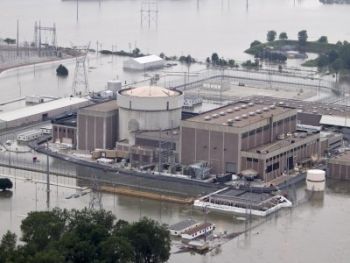
Fort Calhoun in Nebraska. Photo by Nati Harnik/AP
Footprints

The ongoing disaster in Japan at the Fukushima Dai-ichi nuclear plant has launched the nuclear debate to the forefront of energy discussions even here in the United States.  The Nuclear Regulatory Commission (NRC) recently launched a  90-day task force to assess the safety of the U.S. nuclear reactor fleet and to determine what measures the agency may need to implement in order to ensure that regulations reflect lessons from the Fukushima crisis. Initial findings indicate that there are regulatory gaps in inspections and re-licensing procedures at older reactors, which may not be equipped to handle extreme events. Several troubling findings are specifically related to training and emergency preparedness. More than 40 percent of all U.S. nuclear plants lack proper integration of safety guidelines into periodic reviews and revisions of operating procedures; only 61 percent periodically include these guidelines in their emergency drills.

Despite the initial findings of obvious regulatory gaps, Martin Vigilio, the deputy executive director of operations for the NRC, asserted his faith in the current system last week during his presentation to the Advisory Committee on Reactor Safeguards (ACRS). “We continue to have confidence in the safety of the U.S. fleet without question,” he said. In apparent contrast to this statement, however, he identified several regulatory and safety gaps, including ill-maintained or missing equipment meant to control large fires or terrorist attacks and lack of consistency for ‘voluntary industry initiatives’ meant to increase safety measures. Pressed by ACRS Chairman Abdel-Khalik, Mr. Virgilio acknowledged that the U.S. is in a similar position to the one in Japan; the International Atomic Energy Agency issued a report earlier this month raising concerns about complacency by Japanese regulators which we believe mirrors the situation here. He agreed that voluntary initiatives are unevenly applied, lack strictness and have not been reviewed or updated since 1992.


Mr. Virgilio also mentioned that emergency preparedness planning is currently the responsibility of each state. He expressed concern about the availability of training and resources to ensure that state-level decision makers are properly prepared, and also about the apparent lack of understanding about potassium iodide pills‘ potential to prevent the uptake of radioactive iodine into the thyroid gland. You can access the complete transcript of the June 23, 2011 ACRS meeting on Fukushima and the presentation slides here.

Monday, June 27, 2011

Populations Around Aging US Nuke Plants Soar

Common Dreams
Jeff Donn

BUCHANAN, N.Y. – As America's nuclear power plants have aged, the once-rural areas around them have become far more crowded and much more difficult to evacuate. Yet government and industry have paid little heed, even as plants are running at higher power and posing more danger in the event of an accident, an Associated Press investigation has found.

Populations around the facilities have swelled as much as 4 1/2 times since 1980, a computer-assisted population analysis shows.

But some estimates of evacuation times have not been updated in decades, even as the population has increased more than ever imagined. Emergency plans would direct residents to flee on antiquated, two-lane roads that clog hopelessly at rush hour.

And evacuation zones have remained frozen at a 10-mile radius from each plant since they were set in 1978 — despite all that has happened since, including the accidents at Three Mile Island, Chernobyl and Fukushima Dai-ichi in Japan.

Meanwhile, the dangers have increased.

More than 90 of the nation's 104 operating reactors have been allowed to run at higher power levels for many years, raising the radiation risk in a major accident. In an ongoing investigative series, the AP has reported that aging plants, their lives extended by industry and regulators, are prone to breakdowns that could lead to accidents.

And because the federal government has failed to find a location for permanent storage of spent fuel, thousands of tons of highly radioactive used reactor rods are kept in pools onsite — and more is stored there all the time.

These mounting risks, though, have not resulted in more vigilant preparations for possible accidents.
The AP found serious weaknesses in plans for evacuations around the plants, including emergency drills that do not move people and fail to test different scenarios involving the weather or the time of day.

Some plans are merely on checklists, and never have been tested. In drills, responders typically go to command centers and not to their emergency posts. There is no federal requirement for how fast an evacuation must be carried out.

And disaster planners from the U.S. Nuclear Regulatory Commission and the Federal Emergency Management Agency have made dubious assumptions about the public response to a major accident. They insist, for example, that people who are not called upon to evacuate will stay put; they're now saying that they might under some circumstances tell people to hunker down at home even in the 10-mile evacuation zone, and they believe people will do it.

That advice flies in the face of decades of science and policy, millions of dollars in planning and preparations — and common sense.

Sunday, June 26, 2011

Why is there a Media Blackout on Nuclear Incident at Fort Calhoun in Nebraska?

Global Research
Patrick Henningsen

Since flooding began on June 6th, there has been a disturbingly low level of media attention given to the crisis at the Fort Calhoun Nuclear Facility near Omaha, Nebraska. But evidence strongly suggests that something very serious has in fact happened there.

On June 7th, there was a fire reported at Fort Calhoun.  The official story is that the fire was in an electrical switchgear room at the plant. The apparently facility lost power to a pump that cools the spent fuel rod pool, allegedly for a duration of approximately 90 minutes.


FORT CALHOUN NUKE SITE: does it pose a public risk?

The following sequence of events is documented on the Omaha Public Power District’s own website, stating among other things, that here was no such imminent danger with the Fort Calhoun Station spent-fuel pool, and that due to a fire in an electrical switchgear room at FCS on the morning of June 7, the plant temporarily lost power to a pump that cools the spent-fuel pool.

In addition to the flooding that has occurred on the banks of the Missouri River at Fort Calhoun, the Cooper Nuclear Facility in Brownville, Nebraska may also be threatened by the rising flood waters.

As was declared at Fort Calhoun on June 7th, another  “Notification of Unusual Event” was declared at Cooper Nuclear Station on June 20th.  This notification was issued because the Missouri River’s water level reached an alarming 42.5 feet. Apparently, Cooper Station is advising that it is unable to discharge sludge into the Missouri River due to flooding, and therefore “overtopped” its sludge pond.

Not surprisingly, and completely ignored by the Mainstream Media, these two nuclear power facilities in Nebraska were designated temporary restricted NO FLY ZONES  by the FAA in early June.  The FAA restrictions were reportedly down to “hazards” and were ‘effectively immediately’, and ‘until further notice’. Yet, according to the NRC, there’s no cause for the public to panic.


FORT CALHOUN: Under water now. Is it potentially the next Fukushima?

A news report from local NBC 6 on the Ft. Calhoun Power Plant and large areas of farm land flooded by the Missouri River, interviews a local farmer worried about the levees, “We need the Corps-Army Corps of Engineers–to do more. The Corps needs to tell us what to do and where to go. This is not mother nature, this is man-made.” Nearby town Council Bluffs has already implemented its own three tier warning system should residents be prepared to leave the area quickly.

On June 6, 2011, the Federal Aviation Administration put into effect ‘temporary flying restrictions’–until further notice–over the Fort Calhoun Nuclear Power Plant in Blaine, Nebraska.

To date, no one can confirm whether or not the Ft Calhoun Nuclear incident is at a Level 4 emergency on a US regulatory scale. A Level 4 emergency would constitute an “actual or imminent substantial core damage or melting of reactor fuel with the potential for loss of containment integrity.” According to the seven-level International Nuclear and Radiological Event Scale, a Level 4 incident requires at least one death, which has not occurred according to available reports.


Nuclear engineer Arnie Gundersen explains how cooling pumps must operate continuously, even years after a plant is shut down.

According a recent report on the People’sVoice website, The Ft. Calhoun plant — which stores its fuel rods at ground level according to Tom Burnett – is now partly submerged and Missouri River levels are expected to rise further before the summer if finished, local reports in and around the Fort Calhoun Nuclear Plant suggest that the waters are expected to rise at least 5 more feet.

Wednesday, June 22, 2011

Nebraska Nuclear Threat: As Predictable as Fukushima

Global Research

Nuclear accidents - like oil spills and financial meltdowns - happen because big companies push to make more money by cutting every safety measure in the books.

The accident at Fukushima was predictable.

Likewise, the potential problem at the Fort Calhoun reactor in Nebraska was predictable. (For background, see this and this.)

As Ketv reported in March:

Fort Calhoun's nuclear power plant is one of three reactors across the country that federal regulators said they are most concerned about.

Last year, federal regulators questioned the station's flood protection protocol. NRC officials said they felt the Omaha Public Power District should do more than sandbagging in the event of major flooding along the Missouri river.

OPPD officials said they have already made amends and added new flood gates.

"We updated our flood protection strategy and have tested and re-tested our new strategy. The issue is operationally resolved, and at no time was there a threat to public safety or was public health at risk," OPPD President and Chief Executive Officer Gary Gates said.

The New York Times noted yesterday:

Last year, the Nuclear Regulatory Commission cited the Fort Calhoun plant for not being adequately prepared for floods and rated the safety violation in the “yellow” category, the second most serious. The agency ordered changes because it said that under the plan in place at the time ...

After initially contesting the findings, the plant’s operators, Omaha Public Power District, said that the problems had been resolved.

The Daily Mail writes today:

A nuclear plant was inches away from being engulfed by the bloated Missouri River after several levees in the area failed to hold back its surging waters, raising fears it could become America's Fukushima.

Dramatic pictures show the moment the plant was threatened with being shut down today, as water levels rose ominously to within 18 inches of its walls.

The river has to hit 902 feet above sea level at Brownville before officials will shut down the Cooper Nuclear Plant, which sits at 903 feet. It stopped and ebbed slightly yesterday, a reprieve caused by levee breaches in northwest Missouri - for now.

Flooding is a major concern all along the river because of the massive amounts of water that the Army Corps of Engineers has released from six dams. Any significant rain could worsen the flooding especially if it falls in Nebraska, Iowa or Missouri, which are downstream of the dams.

The river is expected to rise as much as five to seven feet above the official 'flood stage' in much of Nebraska and Iowa and as much as 10 feet over in parts of Missouri. The corps predicts the river will remain that high until at least August.

***

The river has risen at least 1.5 feet higher than Fort Calhoun's 1,004-foot elevation above sea level. The plant can handle water up to 1,014 feet, according to OPPD. The water is being held back by a series of protective barriers, including an 8-foot rubber wall outside the reactor building.

(See the Daily Mail article for photos.)

Likewise, the Cooper nuclear reactor - also in Nebraska - is threatened by the flooding as well.

The Nuclear Regulatory Commission reports that flooding has already caused oil to spill:

Facility: COOPER
Region: 4 State: NE
Event Date: 06/19/2011
Event Time: 19:40 [CDT]

RELEASE OF OIL TO THE MISSOURI RIVER

Notification is being made to the Nebraska Department of Environmental Quality regarding the release of oil to the Missouri River from the Cooper Live Fire Training Facility. Currently, levees separating the Training Facility and the Missouri River are being over topped due to flooding of the Missouri River. This condition has resulted in flooding of the burn pits in the fire training facility, with the subsequent release of the residue which includes unburned fuel oil. Any release of this water containing oil to the Missouri River is uncontrolled at this time. Then is no radiological contamination in this area.

The Lincoln Journal Star notes:

Nebraska Public Power District officials are concerned rising flood waters could force them to shut down the nuclear power plant if the river reaches a level of 902 feet above sea level...

The highest reading at Cooper on Sunday was 900.6 feet above sea level, [Nebraska Public Power District] spokesman Mark Becker] said.

WOWT says that a levy near the Cooper reactor is about to wash away:


And Action 3 News reported on Monday:

A levee on the other side of the border into Missouri is dangerously close to breaking. Atchison County authorities say it's only a matter of time before a flood of water washes through areas surrounding Highway 136.

Tuesday, June 21, 2011

Project Flood: Fort Calhoun nuclear power plant under serious flood threat

Examiner
Deborah Dupre

This picture indicates Fort Calhoun Nuclear power
plant cask building partially underwater
After the Army released near record water from six major reservoirs, levees have failed to hold the Missouri River so flooding now poses a "serious threat" to Fort Calhoun Nuclear Power Plant according to today's International Business Times article.

IBTimes Staff Reporter reported at 4:17 AM EDT that "Fort Calhoun nuclear power plant was reportedly very close to getting engulfed by the floodwaters, raising fears of a crisis similar to Japan’s Fukushima disaster."

The nuclear plant declared the event as “unusual.”

The Nuclear Regulatory Commission (NRC) has maintained that there was no risk of disaster. MIT graduate software engineer expert and nuclear researcher Arthur Hu has noted, however, that Fort Calhoun nuclear plant's "dry-storage bunker is half-submerged outside the condom," writes seasoned nuclear researcher/journalist Tom Burnett. (Listen to Burnett on http://rense.gsradio.net:8080/rense/special/rense_Burnett_061311.mp3 that also highlights nuclear industry veteran of over 30 years, Arnie Gundersen speaking about hot particles.)

IBTimes refers today to the Reuters report that federal officials widened flood gates last week to allow record, or near-record water releases to ease pressure on six major reservoirs swollen by heavy rains and melting snow.

"But later in the week, Missouri River floodwaters reached a levee built up to protect Hamburg, Iowa, after the main protection along the river failed, a county emergency official said."

Despite lowering nuclear power plant regulations and dismissing some safety threats, "industry and government officials defend their actions, and insist that no chances are being taken," reported Daily Mail at MailOnline today, referring to the extensive Associated Press nuclear industry investigation report recently released.

Negligence was the bottom line of the AP report. "Examples abound," Daily Mail says.

"[N]egligence is destined to to bring the plants closer to a catastrophic accident that could harm millions and jeopardize the future of nuclear power in the U.S."

Help Us Transmit This Story


  Add to Your Blogger Account
  Put it On Facebook
  Tweet this post
  Print it from your printer
  Email and a collection of other outlets
  Try even more services

Fort Calhoun nuclear plant new Fukushima?


Help Us Transmit This Story


  Add to Your Blogger Account
  Put it On Facebook
  Tweet this post
  Print it from your printer
  Email and a collection of other outlets
  Try even more services

Monday, June 20, 2011

12 Things That The Mainstream Media Is Being Strangely Quiet About Right Now

The American Dream

As the mainstream media continues to be obsessed with Anthony Weiner and his bizarre adventures on Twitter, much more serious events are happening around the world that are getting very little attention.  In America today, if the mainstream media does not cover something it is almost as if it never happened. Right now, the worst nuclear disaster in human history continues to unfold in Japan , U.S. nuclear facilities are being threatened by flood waters, the U.S. military is bombing Yemen, gigantic cracks in the earth are appearing all over the globe and the largest wildfire in Arizona history is causing immense devastation.  But Anthony Weiner, Bristol Palin and Miss USA are what the mainstream media want to tell us about and most Americans are buying it.

In times like these, it is more important than ever to think for ourselves.  The corporate-owned mainstream media is not interested in looking out for us.  Rather, they are going to tell us whatever fits with the agenda that their owners are pushing.

That is why more Americans than ever are turning to the alternative media.  Americans are hungry for the truth, and they know that the amount of truth that they get from the mainstream media continues to decline.

The following are 12 things that the mainstream media is being strangely quiet about right now....

#1 The crisis at the Fort Calhoun nuclear facility in Nebraska has received almost no attention in the national mainstream media.

Back on June 7th, there was a fire at Fort Calhoun.  The official story is that the fire was in an electrical switchgear room at the plant.  The facility lost power to a pump that cools the spent fuel pool for approximately 90 minutes.  According to the Omaha Public Power District, the fire was quickly extinguished and no radioactive material was released.

The following sequence of events is directly from the Omaha Public Power District website....

There was no such imminent danger with the Fort Calhoun Station spent-fuel pool.
Due to a fire in an electrical switchgear room at FCS on the morning of June 7, the plant temporarily lost power to a pump that cools the spent-fuel pool.
The fire-suppression system in that switchgear room operated as designed, extinguishing the fire quickly.
FCS plant operators switched the spent-fuel pool cooling system to an installed backup pump about 90 minutes after the loss of power.
During the interruption of cooling, temperature of the pool increased a few degrees, but the pool was never in danger of boiling.

Due to this situation, FCS declared an Alert at about 9:40 a.m. on June 7.
An alert is the second-least-serious of four emergency classifications established by the Nuclear Regulatory Commission.
At about 1:15 p.m. on June 7, FCS operators declared they had taken all appropriate measures to safely return to the previously declared Notification of Unusual Event emergency classification. (See first item above.)
But the crisis at Fort Calhoun is not over.  Right now, the nuclear facility at Fort Calhoun is essentially an island. It is surrounded by rising flood waters from the Missouri River.

Officials claim that there is no danger and that they are prepared for the river to rise another ten feet.

The Cooper Nuclear Station in Brownville, Nebraska is also being threatened by rising flood waters.  A "Notification of Unusual Event" was declared at Cooper Nuclear Station this morning at 4:02.  This notification was issued because the Missouri River's water level reached 42.5 feet.

Right now the facility is operating normally and officials don't expect a crisis.

But considering what has been going on at Fukushima, it would be nice if we could have gotten a lot more coverage of these events by the mainstream media.

#2 Most Americans are aware that the U.S. is involved in wars in Iraq, Afghanistan and Libya.  However, the truth is that the U.S. military is also regularly bombing Yemen and parts of Pakistan.  If you count the countries where the U.S. has special forces and/or covert operatives on the ground, the U.S. is probably "active" in more countries in the Middle East than it is not.  Now there are even persistent rumors that U.S. ground units are being prepared to go into Libya.  Are we watching the early stages of World War 3 unfold before our eyes in slow motion?

#3 The crisis at Fukushima continues to get worse.  Arnold Gundersen, a former nuclear industry senior vice president, recently made the following statement about the Fukushima disaster....

"Fukushima is the biggest industrial catastrophe in the history of mankind"

TEPCO has finally admitted that this disaster has released more radioactive material into the environment than Chernobyl did.  That makes Fukushima the worst nuclear disaster of all time, and it is far from over.

Massive amounts of water is being poured into the spent fuel pools in order to keep them cool.  This is creating "hundreds of thousands of tons of highly radioactive sea water" that has got to go somewhere.  Inevitably much of it will get into the ground and into the sea.

Arnold Gundersen says that the scope of this problem is almost unimaginable....

"TEPCO announced they had a melt through. A melt down is when the fuel collapses to the bottom of the reactor, and a melt through means it has melted through some layers. That blob is incredibly radioactive, and now you have water on top of it. The water picks up enormous amounts of radiation, so you add more water and you are generating hundreds of thousands of tons of highly radioactive water."

The mainstream media is not paying as much attention to Fukushima these days, but that doesn't mean that it is not a major league nightmare.

Elevated levels of radiation are being reported by Japanese bloggers all over eastern Japan.  There are reports of sick children all over the region.  One adviser to the government of Japan says that an area approximately 17 times the size of Manhattan is probably going to be uninhabitable.

Of course the mainstream media has been telling us all along that Fukushima is nothing to be too concerned about and that authorities in Japan have everything under control.

If the mainstream media is not going to tell us the truth, how are they going to continue to have credibility?

#4 Members of Congress continue to mention Christians as a threat to national security.  For example, during a recent Congressional hearing U.S. Representative Sheila Jackson Lee warned that "Christian militants" might try to "bring down the country" and that such groups need to be investigated.

#5 China's eastern province of Zhejiang has experienced that worst flooding that it has seen in 55 years.  2 million people have already been forced to leave their homes.  China has already been having huge problems with their crops over the past few years and this is only going to make things worse.

#6 Thanks to the Dodd-Frank Act, over the counter trading of gold and silver is going to be illegal starting on July 15th.  Or at least that is what some companies apparently now believe.  The following is an excerpt from an email that Forex.com recently sent out to their customers....

Important Account Notice Re: Metals Trading

We wanted to make you aware of some upcoming changes to FOREX.com’s product offering. As a result of the Dodd-Frank Act enacted by US Congress, a new regulation prohibiting US residents from trading over the counter precious metals, including gold and silver, will go into effect on Friday, July 15, 2011.

In conjunction with this new regulation, FOREX.com must discontinue metals trading for US residents on Friday, July 15, 2011 at the close of trading at 5pm ET. As a result, all open metals positions must be closed by July 15, 2011 at 5pm ET.

We encourage you to wind down your trading activity in these products over the next month in anticipation of the new rule, as any open XAU or XAG positions that remain open prior to July 15, 2011 at approximately 5:00 pm ET will be automatically liquidated.

We sincerely regret any inconvenience complying with the new U.S. regulation may cause you. Should you have any questions, please feel free to contact our customer service team.

Sincerely,
The Team at FOREX.com


Apparently, Section 742(a) of the Dodd-Frank Act prohibits anyone "from entering into, or offering to enter into, a transaction in any commodity with a person that is not an eligible contract participant or an eligible commercial entity, on a leveraged or margined basis."

So what impact is this going to have on the gold and silver markets?

Nobody is quite sure yet.

#7 All over the world, huge cracks are appearing for no discernible reason.  For example, a massive crack that is approximately 3 kilometers long recent appeared in southern Peru.  Also, a 500 foot long crack suddenly appeared recently in the state of Michigan.  When you also throw in all of the gigantic sinkholes that have been opening all over the world, it is easy to conclude that the planet is becoming very unstable.

#8 According to U.S. Forest Service officials, the largest wildfire in Arizona state history has now covered more than 500,000 acres.  But based on the coverage it is being given by the mainstream media you would think that it is a non-event.

#9 There are reports that North Korea has tested a "super EMP weapon" which would be capable of taking out most of the U.S. power grid in a single shot.  The North Koreans are apparently about to conduct another nuclear test and that has some Obama administration officials very concerned.

#10 All over the United States, "active shooter drills" are being conducted in our public schools.  Often, most of the students are not told that these drills are fake.  Instead, students often go through hours of terror as they think a hostage situation or a shooting spree is really taking place.

#11 NASA has just launched a "major" preparedness initiative for all NASA personnel.  The following is an excerpt about this plan from NASA's own website....

A major initiative has been placed on Family/Personal Preparedness for all NASA personnel. The NASA Family/Personal Preparedness Program is designed to provide awareness, resources, and tools to the NASA Family (civil servants and contractors) to prepare for an emergency situation. The most important assets in the successful completion of NASA’s mission are our employees’ and their families. We are taking the steps to prepare our workforce, but it is your personal obligation to prepare yourself and your families for emergencies.

#12 Over the past week over 40 temporary "no fly zones" have been declared by the FAA.  This is very highly unusual.  Nobody seems to know exactly why this is happening.

So what do all of these things mean?

It would be nice if the mainstream media would examine some of these important issues more closely and do some honest reporting on them.

Perhaps you have an opinion on some of these issues.  Feel free to share what you think by leaving a comment below....

Saturday, June 18, 2011

Rising water, falling journalism

Bulletin of Atomic Scientists
DAWN STOVER

Every evening, my father climbs the levee along the Missouri River in Council Bluffs, Iowa, and peers down into the black water that swallows the road. The water is rising, and the Army Corps of Engineers says the levee has never faced such a test. Dad, a retired professor, is packing his books and papers. If the levee doesn't hold, his one-story house could be underwater for months.

A little farther up the Missouri, at the Fort Calhoun Nuclear Power Station near Blair, Nebraska, the river is already lapping at the Aqua Dams -- giant plastic tubes filled with water -- that form a stockade around the plant's buildings. The plant has become an island.

In Blair, in Council Bluffs, and in my hometown of Omaha -- which are all less than 20 miles from the Fort Calhoun Station -- some people haven't forgotten that flooding is what caused the power loss at the Fukushima Daiichi nuclear power plant and the disastrous partial meltdowns that followed. They're wondering what the floodwaters might do if they were to reach Fort Calhoun's electrical systems.

The Nuclear Regulatory Commission (NRC) issued a "yellow finding PDF" (indicating a safety significance somewhere between moderate and high) for the plant last October, after determining that the Omaha Public Power District (OPPD) "did not adequately prescribe steps to mitigate external flood conditions in the auxiliary building and intake structure" in the event of a worst-case Missouri River flood. The auxiliary building -- which surrounds the reactor building like a horseshoe flung around a stake -- is where the plant's spent-fuel pool and emergency generators are located.

OPPD has since taken corrective measures, including sealing potential floodwater-penetration points, installing emergency flood panels, and revising sandbagging procedures. It's extremely unlikely that this year's flood, no matter how historic, will turn into a worst-case scenario: That would happen only if an upstream dam were to instantaneously disintegrate. Nevertheless, in March of this year the NRC identified Fort Calhoun as one of three nuclear plants requiring the agency's highest level of oversight. In the meantime, the water continues to rise.

No guarantees. On June 7, there was a fire -- apparently unrelated to the flooding -- in an electrical switchgear room at Fort Calhoun. For about 90 minutes, the pool where spent fuel is stored had no power for cooling. OPPD reported that "offsite power remained available, as well as the emergency diesel generators if needed." But the incident was yet another reminder of the plant's potential vulnerability.

And so, Fort Calhoun remains on emergency alert because of the flood -- which is expected to worsen by early next week. On June 9, the Army Corps of Engineers announced PDF that the Missouri River would crest at least two feet higher in Blair than previously anticipated.

The Fort Calhoun plant has never experienced a flood like this before. The plant began commercial operation in 1973, long after the construction of six huge dams -- from Fort Peck in Montana to Gavins Point in South Dakota -- that control the Missouri River flows and normally prevent major floods. But, this spring, heavy rains and high snowpack levels in Montana, northern Wyoming, and the western Dakotas have filled reservoirs to capacity, and unprecedented releases from the dams are now reaching Omaha and other cities in the Missouri River valley. Floodgates that haven't been opened in 50 years are spilling 150,000 cubic feet per second -- enough water to fill more than a hundred Olympic-size swimming pools in one minute. And Fort Calhoun isn't the only power plant affected by flooding on the Missouri: The much larger Cooper Nuclear Station in Brownville, Nebraska, sits below the Missouri's confluence with the Platte River -- which is also flooding. Workers at Cooper have constructed barriers and stockpiled fuel for the plant's three diesel generators while, like their colleagues at Fort Calhoun, they wait for the inevitable.

To be sure, there are coal-fired power plants on the river in Sioux City and Council Bluffs, Iowa -- north and south of Fort Calhoun, respectively -- that presumably could provide backup power if the nuclear plant were to lose power. Operators at the coal plants are protecting critical structures with berms and sandbags, but they can't guarantee that a levee break won't take the plants offline.

Failure of the fourth estate. Newspapers and websites all over the country have reported on the flooding and fire at Fort Calhoun, but most articles simply paraphrase and regurgitate information from the NRC and OPPD press releases, which aggregators and bloggers then, in turn, simply cut and paste. Even the Omaha World-Herald didn't send local reporters to cover the story; instead, the newspaper published an article on the recent fire written by Associated Press reporters -- based in Atlanta and Washington.

Unsurprisingly, much of the information in recent press reports has lacked context. For example:

Virtually every article about the flooding mentions that the Fort Calhoun plant was shut down on April 9. On May 27, the Omaha World-Herald reported, "The Omaha Public Power District said its nuclear plant at Fort Calhoun, which is shut down for maintenance, is safe from flooding." The implication is that being shut down makes a plant safe. But as the ongoing crisis in Fukushima demonstrates, nuclear fuel remains hot long after a reactor is shut down. When Fort Calhoun is shut down for maintenance and refueling, only one-third of the fuel in the reactor core is removed. Besides the hot fuel remaining in the core, there is even more fuel stored in the spent-fuel pool, which is not shut down. According to a May 2011 report PDF by Robert Alvarez at the Institute for Policy Studies, there are an estimated 1,054 assemblies of spent fuel, weighing 379 tons, at Fort Calhoun. The oldest of these assemblies are in dry-cask storage, which does not require any water or electricity for cooling. Like the dry casks at Fukushima, which survived the tsunami unscathed, the Fort Calhoun casks do not appear to be in any danger from flooding.

Many news outlets copied this sentence from a June 6 OPPD press release announcing a low-level emergency: "According to projections from the US Army Corps of Engineers, the river level at the plant site is expected to reach 1,004 feet above mean sea level later this week, and is expected to remain above that level for more than one month." Though hardly reassuring news so far, missing from these reports (and from the original release) was the elevation of the plant itself, which turns out to be -- surprise! -- 1,004 feet. According to NRC Senior Public Affairs Officer Victor Dricks, the river yesterday was at 1,005.7 feet and is expected to crest at 1,006.4 feet. By then, the plant will be standing in more than two feet of water; luckily, the eight-foot-tall Aqua Dams should keep the water at bay.

And the river is still well below the worst-imaginable scenario that OPPD is required to prepare for: a flood reaching 1,014 feet above sea level. Nevertheless, in the absence of any context, the press-release language is meaningless to any reader in the neighboring communities.

Almost every article about the fire and power loss at Fort Calhoun has quoted an OPPD spokesman who said that a diesel-powered backup pump was "available" but not needed. None of these articles, however, told readers how much diesel fuel is stored at the plant, how many generators and batteries are on site, and how long they could keep coolant circulating through both the reactor and spent-fuel pool. For the record, there are two emergency diesel generators at Fort Calhoun. According to Dricks, there is usually enough fuel on site to provide cooling for two weeks, but currently the plant has sufficient fuel for four weeks. Of course, the average newspaper reader would never know any of that or be privy to the timeline of potential events.

Finally, many articles have reported that the temperature in the spent-fuel pools rose 2 degrees during the recent power outage. That may not sound like much, but only a few articles told readers the actual temperature of the pool. And a 2 degree rise from, say, 210 degrees Fahrenheit to 212 degrees Fahrenheit (the boiling point for water) would be catastrophic. The pool is normally kept at about 80 degrees Fahrenheit. OPPD estimated that, in the absence of any power to circulate coolant, it would take about 88 hours before water in the pool would begin boiling.

Admittedly, it's not easy finding information about Fort Calhoun, even if you're a local reporter without a tight deadline. OPPD press releases and the company's online newsroom do not provide details about the plant's layout and components. Some of that information was available before 9/11 but was removed because of concerns about terrorism. In protecting ourselves from enemies, we have also hidden vital information from ourselves. So finding the relevant facts takes some digging and dialing, and most newsrooms today don't have that kind of manpower. That's especially true at newspapers scrambling to cover a multitude of flood impacts across the region.

A June 9 report delivered by the Federal Communications Commission (FCC), "Information Needs of Communities," states that the number of full-time journalists at daily newspapers has fallen from a peak of about 56,900 in 1989 to 41,600 in 2010 -- fewer than before Watergate. As the FCC report observes:

An abundance of media outlets does not translate into an abundance of reporting. In many communities, there are now more outlets, but less local accountability reporting.

While digital technology has empowered people in many ways, the concurrent decline in local reporting has, in other cases, shifted power away from citizens to government and other powerful institutions, which can more often set the news agenda.

In the absence of in-depth professional reporting on the situation at Fort Calhoun, OPPD created a web page to respond to the flurry of rumors flying around the Internet. One rumor concerns the no-fly zone ordered by the FAA on June 6, which extends two miles around, and 3,500 feet above, the nuclear plant. Contrary to rumor, the no-fly zone has nothing to do with a radioactivity release. But OPPD's rumor-control page neglects to mention that the utility requested the zone, ostensibly because of work being done on overhead power lines but also because of undisclosed "security reasons." An OPPD spokesperson said that the utility is worried about news helicopters flying low over the plant.

Greater government and industry transparency can give citizens and reporters a better understanding of what's happening at the nation's nuclear power plants, and help prevent rumors from dominating the airwaves. Nonprofit organizations such as the Bulletin can help fill today's information gap. But local reporting ultimately relies on readers and advertisers who are willing to support it. Meanwhile, in the absence of reliable information, my dad continues his evening walks to the levee and peers into the rising water to judge for himself.

Friday, June 17, 2011

US Orders News Blackout Over Crippled Nebraska Nuclear Plant

Salem-News

Report notes the “cover-up” of this nuclear disaster by President Obama is based on his “fantasy” of creating so-called green jobs which he (strangely) includes nuclear power into.

A shocking report prepared by Russia’s Federal Atomic Energy Agency (FAAE) on information provided to them by the International Atomic Energy Agency (IAEA) states that the Obama regime has ordered a “total and complete” news blackout relating to any information regarding the near catastrophic meltdown of the Fort Calhoun Nuclear Power Plant located in Nebraska.


According to this report, the Fort Calhoun Nuclear Plant suffered a “catastrophic loss of cooling” to one of its idle spent fuel rod pools on 7 June after this plant was deluged with water caused by the historic flooding of the Missouri River which resulted in a fire causing the Federal Aviation Agency (FAA) to issue a no-fly ban over the area.
Located about 20 minutes outside downtown Omaha, the largest city in Nebraska, the Fort Calhoun Nuclear Plant is owned by Omaha Public Power District (OPPD) who on their website denies their plant is at a “Level 4” emergency by stating: “This terminology is not accurate, and is not how emergencies at nuclear power plants are classified.”

Russian atomic scientists in this FAAE report, however, say that this OPPD statement is an “outright falsehood” as all nuclear plants in the world operate under the guidelines of the International Nuclear and Radiological Event Scale (INES) which clearly states the “events” occurring at the Fort Calhoun Nuclear Power Plant do, indeed, put it in the “Level 4” emergency category of an “accident with local consequences” thus making this one of the worst nuclear accidents in US history.
Though this report confirms independent readings in the United States of “negligible release of nuclear gasses” related to this accident it warns that by the Obama regimes censoring of this event for “political purposes” it risks a “serious blowback” from the American public should they gain knowledge of this being hidden from them.

Interesting to note about this event was the Nuclear Regulatory Commission (NRC) Chief, Gregory B. Jaczko, blasting the Obama regime just days before the near meltdown of the Fort Calhoun Nuclear Power Plant by declaring that “the policy of not enforcing most fire code violations at dozens of nuclear plants is “unacceptable” and has tied the hands of NRC inspectors.”

This report further notes that the “cover-up” of this nuclear disaster by President Obama is being based on his “fantasy” of creating so-called green jobs which he (strangely) includes nuclear power into as his efforts to bankrupt the US coal industry proceed at a record breaking pace.

Unknown to the American people about Obama’s “war” on the US coal industry is it’s estimated to cost them over a 60% increase in their electricity bills by 2014 and cause over 250,000 jobs to be lost in an already beleaguered economy.

More ominous for those American people whose lives depend on the coal industry that is being deliberately destroyed is the Obama regime’s  massive “security exercise” currently ongoing in the major coal mining States of Ohio, Kentucky and West Virginia, and as we can read about, in part, as reported by InfoWars.Com:

“If you’re still living under the delusion that the TSA is just restricted to airports then think again. A joint VIPR “security exercise” involving military personnel has Transportation Security Administration workers covering 5,000 miles and three states, illustrating once again how the TSA is turning into a literal occupying army for domestic repression in America.
The TSA, in alliance with a whole host of federal, state, local agencies as well as military personnel, is currently conducting a massive “security exercise” throughout Ohio, Kentucky and West Virginia.
“The participating teams are composed of a variety of TSA assets including federal air marshals, canine teams, inspectors and bomb appraisal officers. They will be joined by state and local law enforcement officials to supplement existing resources, provide detection and response capabilities. The exercise will utilize multiple airborne assets, including Blackhawk helicopters and fixed wing aircraft as well as waterborne and surface teams,” reports the Marietta Times.
Although the exercise is couched in serious rhetoric about preparedness, it relates to “no specific threat” and the details are nebulous to say the least and seems to revolve around little else than testing out high-tech surveillance equipment and reminding Americans who their bosses are.”

Obama’s fears of the American people turning against nuclear power, should its true dangers be known, appear to be valid as both Germany and Italy (whose people, unlike the Americans, have been told the truth) have turned against it after the disaster in Japan and vowed to close all of their atomic plants.

Perhaps even more sadly for the American people is this report stating that the Obama regime is “walking in lockstep” with Japan in their attempts to keep the truth of nuclear accidents from their citizens; which in the case of the Japanese can only be labeled as horrific as new evidence points to them knowing within hours of the Great Tsunami that their atomic reactors had melted down, but have only today ordered an evacuation of pregnant women from what are called “radiation hotspots.”
With a country that some scientists are now warning may soon become uninhabitable due to radiation damage, and with reports of mutant rabbits and radioactive whales now being reported, one wonders if in knowing the truth the American people would really want to follow Japan’s “example” instead of those people in Germany and Italy?

But, with an already documented 35% increase in the infant mortality rate for American mothers living in the western coastal regions of the US caused by radiation blowing onto them from Japan being ignored by these people there doesn’t seem to be much hope for them.

Source: http://www.whatdoesitmean.com