Showing posts with label Iran Contra. Show all posts

Tuesday, December 4, 2012

Arson Seen in Attack on Ex-Israeli Spy


Consortium News

Exclusive: Suspected arson destroyed the Montreal home of ex-Israeli intelligence officer Ari Ben-Menashe, who says he escaped through a rear door. It’s unclear if the fire was an assassination attempt to finally silence a man who has angered the Israeli government, powerful Republicans and others, writes Robert Parry.


By Robert Parry

Ex-Israeli intelligence officer Ari Ben-Menashe says he narrowly survived a possible assassination attempt Sunday night when his upscale home in Montreal was set ablaze in what Canadian authorities are describing as suspected arson. Police cited how quickly the house was ravaged and noted that a suspicious person was seen fleeing the scene shortly after the fire began.

In a phone call with me on Monday, Ben-Menashe said that when he detected the fire, he alerted a woman staying in the house to flee and then was able to escape through a back door. But he said everything inside was destroyed, including his passport, personal papers and his clothing. “Everything is gone,” Ben-Menashe said.
Ex-Israeli intelligence
officer Ari Ben-Menashe.
(Photo from his memoir,
Profits of War.)

Ben-Menashe said he believed the fire was set with “a Molotov cocktail” but he had no clear idea who might have tried to kill him. He did acknowledge that he has a number of enemies around the world resulting from his past as an Israeli intelligence officer and his more recent work as an international consultant often working in global hotspots.

Among Ben-Menashe’s enemies are some of his former Israeli superiors who consider him a traitor for exposing sensitive Israeli secrets and powerful Republicans, including former President George H.W. Bush whom Ben-Menashe fingered as involved in national security scandals in the 1980s.

Ben-Menashe, who served in Israeli military intelligence in the 1970s and 1980s, was arrested in the United States in 1989 for his involvement in military sales to Iran. He says the Israeli government then urged him to plead guilty to the U.S. charges, but he refused and began disclosing Israeli secrets to journalists, including me in early 1990 when I was a correspondent for Newsweek magazine.

At first, the Israeli government denounced Ben-Menashe as an “impostor” but after I obtained official Israeli letters of reference describing his decade-long work within the External Relations Department of the Israel Defence Forces, Israeli officials changed their story. They labeled him simply “a low-level translator.” But the letters described Ben-Menashe’s service in “key positions” and said he handled “complex and sensitive assignments.”

Despite the evidence that Israeli officials had first lied and then retreated to a new cover story, the Bush administration and the Israeli government managed to galvanize friendly journalists who went out of their way to discredit Ben-Menashe as a compulsive liar. [For details about one of the key denouncers of Ben-Menashe, see Consortiumnews.com’s “Unmasking October Surprise ‘Debunker’”.]

However, Ben-Menashe convinced a New York jury that he indeed had been working on official Israeli business in his transactions with Iran. He was acquitted in fall 1990. Ben-Menashe also continued to give interviews and provide testimony about the secret dealings involving Republicans and the Israeli government.

October Surprise Allegations

Perhaps Ben-Menashe’s most controversial claim was that he and other Israeli intelligence officers assisted the Republicans in brokering a deal with Iran’s Islamic regime of Ayatollah Ruhollah Khomeini in 1980 to hold 52 American hostages until after the U.S. election to ensure President Jimmy Carter’s defeat. As a result of this so-called October Surprise caper, the hostages were not released until Jan. 20, 1981, immediately after Ronald Reagan was sworn in as U.S. President, Ben-Menashe said.

After leveling his October Surprise accusations in 1990-1991 – and providing investigative journalist Seymour Hersh information about Israel’s nuclear program for his book The Samson Option – Ben-Menashe was essentially a man on the run from both the Israeli government and the U.S. administration of George H.W. Bush.

Ben-Menashe sought refuge in Australia, arriving in spring 1991, still carrying his Israeli passport. After obtaining Ben-Menashe’s Australian immigration records, journalist Marshall Wilson reported that Ben-Menashe requested what amounted to political asylum.
Dated May 15, 1991, Ben-Menashe’s 25-page declaration stated: “My case is an unprecedented case of political persecution by two governments. It was an attempt by Israel and the United States to cover up their relations with Iran since 1979.”

Ben-Menashe detailed the curious circumstances of his 1989 arrest while on a private visit to the U.S. and added: “I was not willing to keep quiet and be discredited by pleading guilty to the bogus charges. I did not accept my government’s proposal to do so. Any arms sales to Iran that I was involved in was solely in the capacity of being an employee of the Israeli government. Everything I did was authorised by the appropriate authorities in the Israeli and United States governments.

“Since I did not go along with the program and decided I would truthfully defend myself in court, I was disowned by the Israeli Government and will be prosecuted for breaking the Official Secrets Act if I return. …  I will be prosecuted … behind closed doors, ‘for national security reasons,’ and I will never again see the light of day.”

But Ben-Menashe said his case had other implications. “As an aftermath of my [1990] trial a new scandal has broken directly involving the President of the United States [George H.W. Bush],’’ Ben-Menashe wrote, “about the President being involved in an arms-for-hostage release delay deal [with Iran] in 1980. I am a central witness on that issue.

“Democratic members of the US Congress are going to speak to me about that and other issues involving US sales of unconventional weapon systems to Iraq, all connected to the present [George H.W. Bush] administration of the US,’’ Ben-Menashe told Australian immigration.  “Paradoxically speaking I am now being punished for being acquitted.”

Later in May 1991, Ben-Menashe faced an apparent plan by George H.W. Bush’s administration to divert him from Los Angeles Airport to Israel when he was en route to Washington to testify to Congress about his allegations. If he had been turned over, his fate would likely have been similar to that of technician Mordechai Vanunu, who disclosed Israel’s secret nuclear weapons program and then was kidnapped in Rome and returned to Israel for trial and imprisonment.

A Last-Minute Tip

However, before Ben-Menashe’s flight, I received a tip from a U.S. intelligence source about the plan and checked with congressional investigators who were expecting to interview the Israeli. When they couldn’t get a clear commitment from the Bush administration about Ben-Menashe’s safe passage, I called him in Australia as he was about to leave for the Sydney airport.

I suggested that he delay his flight, which he did. Later, I was informed by congressional investigators that they finally had extracted assurances from the Bush administration that Ben-Menashe would be allowed to proceed to Washington and he rescheduled his flight. Though he was not diverted to Israel, he was taken aside by U.S. authorities in Los Angeles and subjected to some harsh questioning.

That evening, I picked Ben-Menashe up at Dulles Airport and was surprised how shaken he was. I drove him to my home in Arlington, Virginia, and he asked if he could spend the night in my guest room, thinking that he was under surveillance and fearing for his life. With some hesitation, I consented.

Months later, when pro-Israeli journalists escalated their character assassination of Ben-Menashe, one New Republic writer Steven Emerson criticized my ethics for allowing Ben-Menashe to stay over in my house, which struck me as a curious accusation not only because there is no such ethical standard but because the fact had never been made public. The reference led me to believe that Ben-Menashe had not been paranoid when he worried about being under surveillance or for his safety.

Although substantial evidence has emerged to support Ben-Menashe’s claims, Republicans and the Israeli government continued to deny the October Surprise story and U.S. congressional investigations in the early 1990s confronted a stonewall of Republican obstruction. Ultimately, the investigations concluded that solid evidence of a GOP conspiracy was lacking. [For the latest details on this controversy, see Robert Parry’s new book, America’s Stolen Narrative.]

A Life of Intrigue

When published in 1992, Ben-Menashe’s memoir, Profits of War, provided further details about the cloak-and-dagger operations conducted by U.S. and Israeli intelligence.
A Jew who was born in Iran and who emigrated to Israel as a teenager, Ben-Menashe explained how his background proved valuable to Israeli intelligence after the Shah of Iran, a close Israeli ally, was overthrown in 1979. As Israel tried to rebuild some relationship with Iran, Ben-Menashe was able to reconnect with some of his friends from his youth who were rising inside the new revolutionary government.

Ben-Menashe said those contacts led him into a role as an intermediary on military sales to Iran during the U.S.-Iranian hostage crisis in 1980 and placed him near the decision by Prime Minister Menachem Begin to throw in Israel’s lot with Republican Ronald Reagan in his campaign to unseat President Jimmy Carter. Over the next several years, Ben-Menashe remained a key middleman in the arms transactions that were crucial to Iran in its long war with Iraq.

Yet, by the early 1990s, after his arrest and acquittal, Ben-Menashe had become a man without a country. On Oct. 23, 1991, he was informed that his refugee application in Australia had failed. A departmental officer declared that “there appears to have been ample opportunity for one government or another [the U.S. or Israel] to have taken action against Mr Ben-Menashe if his political importance made him of real interest to them.” [See here and here.]

Ben-Menashe appealed the finding, but on Dec. 12, 1991, the Refugee Status Review Committee confirmed the adverse ruling. A letter signed by its Chairman said in part: “The applicant’s fear of the consequences of breaking Israeli law does not warrant international protection. … The applicant has, therefore, not established a well-founded fear of persecution were he to return to Israel.’’ [See here, here, here and here.]

However, the decision was not unanimous, as Austrialian journalist Marshall Wilson reported. One member of the panel added, “I request a meeting to discuss aspects of this case, particularly the matters of what constitutes persecution given this extraordinary mix of international conspiracies and intrigue and the laws under which the applicant could be charged should he return to Israel.

“I believe the applicant has been an intelligence operative of the Israeli Government and has been involved in various arms deals. The American use of Israel to sell arms to Iran during the Iran-Iraq War is attested to by a number of sources. The delay in the release of the American hostages also is now widely accepted as true.’’

In the end Ben-Menashe left Australia of his own free will without further resort to the courts. He eventually settled in Canada, married a Canadian woman, received citizenship and built a new life as an international consultant.

Ben-Menashe stood by his sworn testimony about the October Surprise machinations and other allegations, but his credibility continued to come under assault. It didn’t seem to matter even when some Israeli officials confirmed that Ben-Menashe, indeed, had been involved in important clandestine operations for Israel.

For instance, American journalist Craig Unger was told by a senior intelligence official, Moshe Hebroni, that “Ben-Menashe served directly under me. … He had access to very, very sensitive material.” [Village Voice, July 7, 1992] In the Israeli daily, Davar, reporter Pazit Ravina wrote, “in talks with people who worked with Ben-Menashe, the claim that he had access to highly sensitive intelligence information was confirmed again and again.”

Now, in investigating the mysterious fire that could have killed Ben-Menashe — and that succeeded in destroying many of his personal papers – the authorities in Canada may have to determine if the fire resulted from some new enemy or an enemy from Ben-Menashe’s past, someone who preferred that the former Israeli spy finally be silenced.

Investigative reporter Robert Parry broke many of the Iran-Contra stories for The Associated Press and Newsweek in the 1980s. You can buy his new book, America’s Stolen Narrative, either in print here or as an e-book (from Amazon and barnesandnoble.com).

Thursday, September 27, 2012

Systemic Destabilization as “A Strategy of Tension”: 9/11, the JFK Assassination, and the Oklahoma City Bombing


Global Research
Peter Dale Scott

Introduction: Structural Deep Events and the Strategy of Tension in Italy
From an American standpoint, it is easy to see clearly how Italian history was systematically destabilized in the second half of the 20th century, by a series of what I call structural deep events. I have defined these as “events, like the JFK assassination, the Watergate break-in, or 9/11, which violate the … social structure, have a major impact on … society, repeatedly involve law-breaking or violence, and in many cases proceed from an unknown dark force.”2
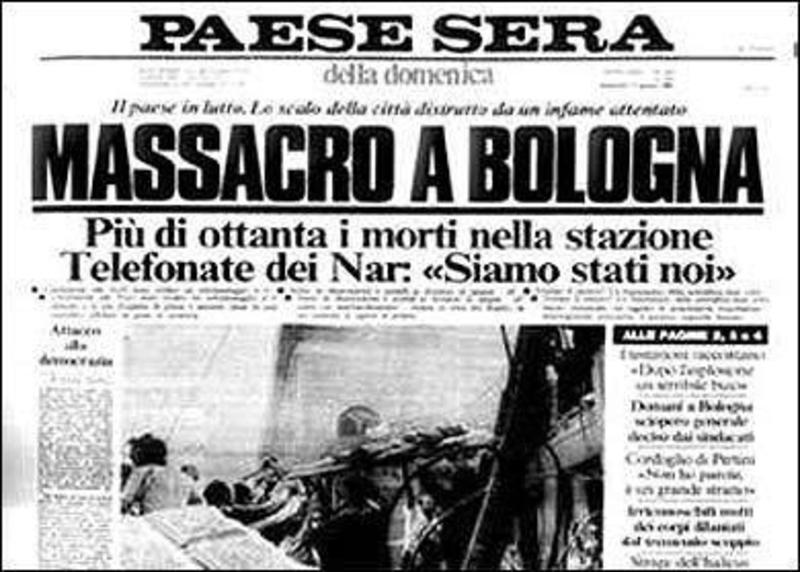
The examples in Italy, well known to Italians, include the Piazza Fontana bombing of 1969, the Piazza della Loggia bombing of 1974, and the Bologna railway bombing of 1980.
These bombings, in which over one hundred civilians were killed and many more wounded, were attributed at the time to marginal left-wing elements of society. However, thanks chiefly to a series of investigations and judicial proceedings, it is now clearly established that the bombings were the work of right-wing elements in collusion with Italian military intelligence, as part of an on-going “strategy of tension” to discredit the Italian left, encourage support for a corrupt status quo, and perhaps move beyond democracy altogether.3 As one of the conspirators, Vincenzo Vinciguerra, later stated, “The December 1969 explosion was supposed to be the detonator which would have convinced the political and military authorities to declare a state of emergency.”4
Vinciguerra also revealed that he and others had also been members of a paramilitary “stay-behind” network originally organized at the end of World War II by the CIA and NATO as “Operation Gladio.”
In 1984, questioned by judges about the 1980 Bologna station bombing, Vinciguerra said: “With the massacre of Peteano, and with all those that have followed, the knowledge should by now be clear that there existed a real live structure, occult and hidden, with the capacity of giving a strategic direction to the outrages…[it] lies within the state itself…There exists in Italy a secret force parallel to the armed forces, composed of civilians and military men, in an anti-Soviet capacity that is, to organise a resistance on Italian soil against a Russian army…A secret organisation, a super-organisation with a network of communications, arms and explosives, and men trained to use them…A super-organisation which, lacking a Soviet military invasion which might not happen, took up the task, on Nato’s behalf, of preventing a slip to the left in the political balance of the country. This they did, with the assistance of the official secret services and the political and military forces.5
Gladio connections to sustained false-flag violence, again involving NATO and the CIA, were subsequently revealed in other countries, notably Belgium and Turkey.6
The original purpose of Gladio was to consolidate resistance in the event of a Soviet takeover. But many of the senior Italians involved in the bombings implicated the CIA and NATO in them as well:
General Vito Miceli, the Italian head of military intelligence, after his arrest in 1974 on a charge of conspiring to overthrow the government, testified “that the incriminated organization, … was formed under a secret agreement with the United States and within the framework of NATO.” Former Italian defense minister Paulo Taviani told Magistrate Casson during a 1990 investigation “that during his time in office (1955-58), the Italian secret services were bossed and financed by ‘the boys in Via Veneto’—i.e. the CIA agents in the U.S. Embassy in the heart of Rome.” In 2000 “an Italian secret service general [Giandelio Maletti] said . . . that the CIA gave its tacit approval to a series of bombings in Italy in the 1970s to sow instability and keep communists from taking power. . . . ‘The CIA wanted, through the birth of an extreme nationalism and the contribution of the far right, particularly Ordine Nuovo, to stop (Italy) sliding to the left,’ he said.”7
Another conspirator, Carlo Digilio, “described how he passed on details of planned bomb attacks to his CIA contact, Captain David Carret, who had told him that the bombing campaign was part of a US plan to create a state of emergency.”8 Daniele Ganser, in his important book Nato’s Secret Armies, has endorsed a Spanish report that in 1990 NATO Secretary General Manfred Wörner (aGerman politician and diplomat) secretly confirmed that NATO’s headquarters, SHAPE, was indeed responsible:
The Supreme Headquarters Allied Powers Europe (SHAPE), directing organ of NATO’s military apparatus, coordinated the actions of Gladio, according to the revelations of Gladio Secretary-General Manfred Wörner during a reunion with the NATO ambassadors of the 16 allied nations.9
Extrapolating from such testimony, Ola Tunander has compared the strategy of tension in Italy, with its false-flag bombing attacks, to “what the Turkish military elite might describe as the correction of the course of democracy by the ‘deep state’ [a Turkish term].”10
Strategy of Tension
But I believe it would be too simplistic an analysis to blame the Italian strategy of tension exclusively on Vinciguerra’s “super-organisation which… took up the task [of false-flag bombings], on Nato’s behalf.” There appear to have been other directing forces besides NATO and those elements Vinciguerra was aware of through Italian military intelligence (the SID, later SISMI). It is important to recall that the Italian trials of those convicted for the 1980 Bologna bombing implicated not only Vinciguerra, SISMI, and Gladio, but also elements of the Italian mafia (the Banda della Magliana) and the Italian Masonic Lodge Propaganda-Due (P-2), with links to criminal bankers and the Vatican.11
In short, if we suggest that something like the Turkish deep state was involved in the Italian strategy of tension, this does not suggest a solution to the Italian mystery, so much as a zone, or interlocking network, for further research.
Has a Strategy of Tension Been Exercised in America?
Gladio connections to sustained false-flag violence, again involving NATO and the CIA, were subsequently established in other countries, notably Belgium and Turkey.12 I wish to propose that America, as well as Europe, has also suffered from a similar series of false-flag structural deep events, including bombings, that have, in conformity with the same strategy of tension, systematically moved America into its current condition, a state of emergency.
Nato headquarters
Among the false flag structural deep events I wish to consider today are
The John F. Kennedy assassination of 1963, or 11/22, which led to the CIA’s Operation Chaos against the anti-Vietnam War movement. (11/22 was clearly a deep event: many documents in the area of Lee Harvey Oswald’s relations to CIA operations are still being withheld, despite statutory and court orders to release them.13
The Robert Kennedy assassination of 1968, followed immediately by emergency legislation which led to state-sponsored violence at the 1968 Democratic Party Convention.
The 1993 first World Trade Center bombing and the 1995 Oklahoma City bombing, which led to the Antiterrorism and Effective Death Penalty Act of 1996.
9/11 and the subsequent false flag anthrax attacks of 2001, which led to the imposition of Continuity of Government (COG) measures, the Patriot Act, and the proclamation, on September 14, 2001, of a State of Emergency which remains in effect. (In September 2012 it was once again renewed for another year).14
These structural deep events have had a common and cumulative result: the erosion of public or constitutional power, and its progressive replacement by unconstrained repressive force. I have argued elsewhere that
1) as in Italy, all of these events were blamed on marginal left-wing elements, but in fact involved elements inside America’s covert intelligence agencies, along with their shadowy underworld connections.
2) some of these structural deep events bore a relationship to the ongoing secret planning – known in the Pentagon as the Doomsday Project – for Continuity of Government (or COG) in an emergency, which entailed its own secret communications network, and arrangements for what (in the Oliver North Hearings) was called “suspension of the American Constitution.”
3) in every case, the official response to the deep event was a set of new repressive measures, usually in the form of legislation.
4) cumulatively, these events suggest the on-going presence in America of what I have called a “dark force” or “deep state,” analogous to what Vinciguerra described in Italy as a “secret force…occult and hidden, with the capacity of giving a strategic direction to the [successive] outrages.”15
The Oklahoma City Bombing (4/19) and 9/11
Recently I viewed for a film, “A Noble Lie,” about the 1995 Oklahoma City bombing.16 This gave me a chance, for the first time, to test these hypotheses against the case of Oklahoma City on April 19, 1995, or what I shall call 4/19. More than I could have anticipated, 4/19 fit into and strengthened this analysis.
Oklahoma City Bombing
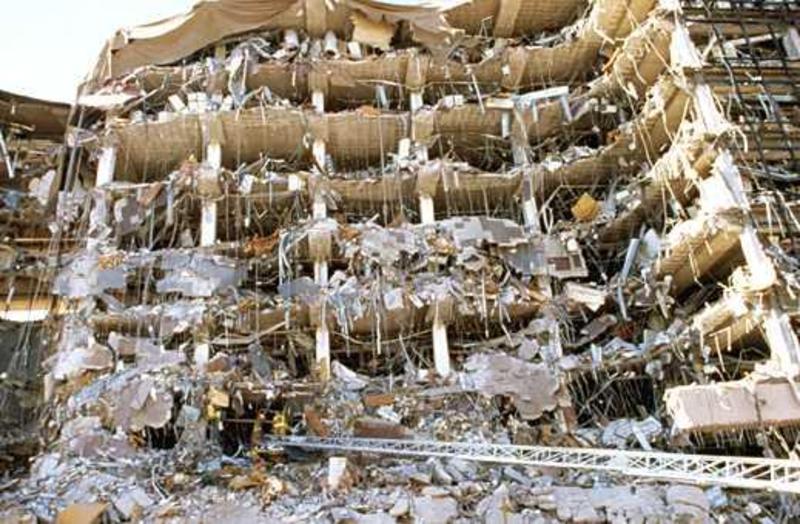
The film “A Noble Lie,” itself points to some striking similarities between the events of 1995 and of 2001. The most obvious is the alleged destruction of a steel-reinforced building by external forces (a truck bomb in the case of the Murrah Building in 1995, flying debris in the case of Building Seven in 2001). Experts in both cases have asserted that the buildings in fact could only have been brought down by cutting charges placed directly against the sustaining columns inside the building. Here for example is a report to Congress from General Benton K. Partin, a retired U.S. Air Force Brigadier General and expert on non-nuclear weapons devices:
When I first saw the pictures of the truck-bomb’s asymmetrical damage to the Federal Building, my immediate reaction was that the pattern of damage would have been technically impossible without supplementing demolition charges at some of the reinforcing concrete column bases…. For a simplistic blast truck-bomb, of the size and composition reported, to be able to reach out on the order of 60 feet and collapse a reinforced column base the size of column A-7 is beyond credulity.17
There is now a broad and growing consensus among architects, engineers, and other experts, that the three buildings which collapsed on 9/11 in the World Trade Center were also most probably destroyed by controlled demolition charges.18

Wednesday, September 7, 2011

Court documents say U.S. knew about coke

UPI

Vicente Zambada-Niebla
EL PASO, Texas, Aug. 4 (UPI) -- U.S. officials let the Sinaloa drug cartel smuggle tons of cocaine into the United States in exchange for intelligence about rival cartels, court documents say.

The claim was made by attorneys in defense of Mexico's Vicente Zambada-Niebla, who was extradited to the United States to face drug-trafficking charges in Chicago, the El Paso (Texas) Times reported.

If the claim is true, it could prove to be as damaging to federal investigators as the Alcohol, Tobacco and Firearm's "Operation Fast and Furious," that let U.S. weapons get into Mexico, the report said.
 
Documents filed in U.S. federal court said the Sinaloa cartel was allowed to bring tons of cocaine into the United States in exchange for information about rival cartels, The Houston Chronicle reported.

The documents also said Zambada-Niebla worked as an informant for the U.S. government while he was a known fugitive.

Zambada-Niebla's legal team wants a U.S. judge to drop charges against their client because his alleged agreement with the government reportedly promised him immunity from prosecution.
Federal prosecutors and the U.S. Drug Enforcement Agency declined to comment on the case.

Zambada's lawyers said as recently as 2008 his client and a top cartel lawyer allegedly met at a Mexico City hotel with two DEA agents, where he was reportedly promised immunity.

In "Fast and Furious," the ATF botched a sting to catch weapons traffickers by allowing a load of illegally purchased guns slip into Mexico. The shipment was lost and some of the guns turned up at crime scenes, including one where a U.S. Border Patrol agent was killed.