Showing posts with label Wesley Clark. Show all posts

Thursday, October 11, 2012

Towards a Western Retreat from Syria


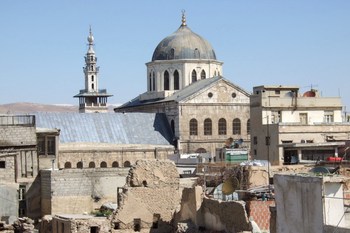
syriadamscusdome
The Syria war drags on. Continuing it has become too expensive and too dangerous for its neighbors. Russia, which aims to re-establish itself in the Middle East, is trying to show the United States that it is in their best interest to allow Moscow to resolve the conflict.

The military situation in Syria is turning against those in Washington and Brussels who hoped to change the regime there by force. Two successive attempts to take Damascus have failed and it has become clear that that objective cannot be achieved.

JPEG - 23.6 kb
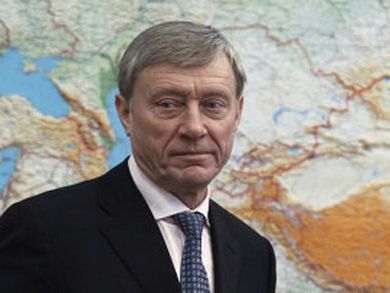
Where NATO has failed to make war, the CTSO is preparing to make peace. The Secretary General of the Organization Nikolay Bordyuzha is setting up a peacekeeping force of 50,000 men, ready to be deployed in Syria.
On July 18th, an explosion killed the leadership of the Council of National Security, signalling the beginning of a vast offensive during which tens of thousands of mercenaries descended on the Syrian capital from Jordan, Lebanon, Turkey and Iraq. After several days of pitched battles, Damascus was saved when the fraction of the population hostile to the government chose out of patriotism to assist the National Army rather than bid welcome to the forces of the FSA.
On September 26, al-Qaeda jihadists were able to penetrate the interior of the Defense Ministry, disguised as Syrian soldiers and carrying false papers. They intended to detonate their explosive vests in the office of the joint chiefs of the military but did not get close enough to their target and were killed. A second team attempted to take over the national TV station to broadcast an ultimatum to the President but were not able to reach the building as access was blocked moments after the first attack. A third team targeted government headquarters and a fourth was aimed at the airport.
In both cases, NATO coordinated the operations from its Turkish base in Incirlik, seeking to provoke a schism at the core of the Syrian Arab Army and rely on certain generals for the purpose of overthrowing the regime. But the generals in question had long been identified as traitors and marginalized from effective command. In the aftermath of the two failed attacks, Syrian power was reinforced, giving it the internal legitimacy necessary to go on the offensive and crush the FSA.
These failures put a damper on those who had been crowing in advance that the days of Bashar al-Assad were numbered. In Washington, consequently, those counselling withdrawal are carrying the day. The question is no longer how much time the «Assad regime» will hold out but whether it costs the U.S. more to continue the war than to stop it. Continuing it would entail the collapse of the Jordanian economy, losing allies in Lebanon, risking civil war in Turkey, in addition to having to protect Israel from the chaos. Stopping the war would mean allowing the Russians to regain foothold in the Middle East and strengthening the Axis of Resistance to the detriment of the expansionist dreams of the Likud.
While Washington’s response takes the Israeli dimension into account, it has stopped heeding the advice of the Netanyahu government. Netanyahu ended up undercutting himself through his manipulations behind the assassination of Ambassador Chris Stevens and through his shocking interference in the American presidential campaign. If the long-term protection of Israel is the goal rather than folding to the brazen demands of Benjamin Netanyahu, a continued Russian presence is the best solution. With one million Russian-speaking Israelis, Moscow will never allow that the survival of that colony to be imperiled.
A glance backward is necessary here. The war against Syria was decided by the Bush Administration on September 15, 2001 during a meeting at Camp David, as confirmed notably by General Wesley Clark. After having suffered several setbacks, NATO action had to be cancelled due to the vetos of Russia and China. A «Plan B» then emerged, involving the use of mercenaries and covert action once deploying uniformed soldiers had become impossible. Given that the FSA has not scored a single victory against the Syrian Army, there have been multiple predictions that the conflict will become interminable and will progressively undermine the states of the region, including Israel. In this context, Washington signed onto the Geneva Accord, under the auspices of Kofi Annan.
Subsequently, the war camp torpedoed this agreement by organizing leaks to the press concerning the West’s secret involvement in the conflict, leaks that led to Kofi Annan’s immediate resignation. It also played its two trump cards with the attacks on July 18 and September 26 and lost them both. As a result, Lakhdar Brahimi, Annan’s successor, has been called on to resuscitate and implement the Geneva Accord.
In the interim, Russia did not remain idle: it obtained the creation of a Syrian Ministry of National Reconciliation; supervised and protected the meeting in Damacus of national opposition parties; organized contacts between the U.S. and Syrian general staff; and prepared the deployment of a peace force. The first two measures scarcely registered in the Western press while the last two were flatly ignored.
Nevertheless, as revealed by Sergei Lavrov, Minister of Foreign Affairs, Russia addressed the fears of the U.S. Joint Chiefs of Staff concerning Syrian chemical weapons. It verified that these were stored in locations sufficiently secure not to fall into the hands of the FSA, be seized by jihadists and used by them indiscriminately. Ultimately, it gave credible guarantees to the Pentagon that the continuation in power of so determined a leader as Bashar el-Assad is a more manageable situation, for Israel as well, than allowing the chaos in Syria to spread further.
Above all, Vladimir Putin accelerated the projects of the CSTO, the Collective Security Treaty Organization, the anti-NATO defense alliance that unites Armenia, Belarus, Kazakhstan, Kirghizstan, Tadjikstan and Russia itself. The foreign ministers of the CSTO adopted a shared position on Syria and a logistical plan was drawn up for an eventual deployment of 50,000 men. An agreement was signed between the CSTO and the U.N. Peacekeeping Department that these «blue chapkas» would be used in the zones of conflict under a U.N. Security Council mandate. Joint drills between the two are to take place from 8 to 17 October in Kazakhstan under the label of «Inviolable Fraternity» to complete the coordination between these two intergovernmental organizations. The Red Cross and the IOM will also participate.
No official decision will be taken in the U.S. during the presidential campaign. Once that ends, peace might become conceivable.
Translation Michele Stoddard


Thursday, July 26, 2012

Who is fighting in Syria? Journalists Lie Than Admit That They’ve Been Manipulated

The 4th Media
Thierry Meyssan


Though the Western press portrays the Free Syrian Army as an armed revolutionary group, for more than a year Thierry Meyssan has affirmed that it is on the contrary a counter-revolutionary body. According to him, it would have progressively passed from the hands of reactionary monarchies in the Gulf to those of Turkey, acting for NATO. Such a non-mainstream affirmation needs demonstrative proof…
_____________________________________________
For the last 18 months, Syria has been prey to troubles that have steadily increased to become a widespread armed conflict having already killed about 20,000 people. If there is consensus on this observation, narratives and interpretations vary beyond.
For Western states and their press, the Syrians aspire to live in the Western market democracies. Following the Tunisian, Egyptian and Libyan “Arab Spring” models, they rose up to overthrow their dictator Bashar al-Assad. The latter suppressed the demonstrations with bloodshed. While Westerners would have liked to intervene to stop the massacre, the Russians and Chinese, out of self-interest or contempt for human life, opposed intervention.
On the contrary for all other states that are not vassals of the U.S. and for their media, the U.S. launched an operation planned a long time ago against Syria. First, through its regional allies, and then directly, they have introduced armed bands, modeled on the Contras in Nicaragua, that have destabilized the country.
But they found only very weak domestic support and were routed while Russia and China prevented NATO’s destroying the Syrian army and reversing the regional equation.
Who is telling the truth? Who is wrong?

Armed groups in Syria do not defend democracy, they fight against it


First, the interpretation of Syrian events as an episode of the “Arab Spring” is an illusion because this “spring” has no basis in reality. This is an advertising slogan to positively present unrelated facts. Although there has been a popular revolt in Tunisia, Yemen and Bahrain, there was none in neither Egypt nor Libya.
In Egypt, the street demonstrations have been limited to the capital and parts of the middle class; never, absolutely never, have the Egyptian people identified with the telegenic spectacle of Tahrir Square [1]. In Libya, there was no political revolt, but a separatist movement in Cyrenaica against the power of Tripoli, and the military intervention of NATO, which cost the lives of about 160,000 people.
The Lebanese station NourTV has been very successful airing a series of broadcasts by Hassan Hamade entitled “The Arab Spring, from Lawrence of Arabia to Bernard-Henri Levy.
The authors develop therein the idea that the “Arab Spring” is a remake of the “Arab Revolt” of 1916-1918 orchestrated by the British against the Ottomans. This time, Westerners have manipulated situations to upset a generation of leaders and impose the Muslim Brotherhood.
In fact, the “Arab Spring” is false advertising. Now, Morocco, Tunisia, Libya, Egypt, and Gaza are governed by a brotherhood; on the one hand imposing a moral order and on the other supporting Zionism and pseudo-liberal capitalism, that is to say the interests of Israel and the Anglo-Americans. The illusion was dispelled. Some authors, like Syria’s Said Hilal Alcharifi, now deride the “NATO spring“.
Secondly, the leaders of the Syrian National Council (SNC) as well as the Free Syrian Army (FSA) commanders are not democratic at all, in the sense that they would be favourable to “a government of the people, by the people, for the people“, according to Abraham Lincoln’s formula taken from the French Constitution.
Thus, the first president of the SNC was the Paris academic, Burhan Ghalioun. He was in no way “a Syrian opponent persecuted by the regime” since he circulated freely in and out of his country.
Nor was he a “secular intellectual” as he claims, since he was the political advisor to the Algerian Abbassi Madani, President of the Islamic Salvation Front (ISF), now a refugee in Qatar.
His successor, Abdel Basset Syda [2] entered politics only in the last months, and immediately established himself as a mere executor of US wishes. Upon his election as head of the SNC, he pledged not to defend the will of his people, but to implement the “road map” that Washington drew up for Syria: The Day After.

JPEG - 31.5 kb

                                                        Logo of the “Free Syrian Army”
Nor are the Free Syrian Army fighters champions of democracy. They recognize the spiritual authority of sheikh Adnan Alrour, a takfirist preacher, who calls for the overthrow and killing of Assad, not for political reasons but simply because Assad is of the Alawite faith, that is to say a heretic in the preacher’s eyes.
All of the identified officers in the FSA are Sunnis and all of the FSA brigades are named after historical Sunni figures. The “revolutionary tribunals” of the FSA sentence their political opponents to death (and not only supporters of Bashar al-Assad) and they slaughter the unbelievers in public. The FSA program is to end the secular regime installed by the Baath, the SSNP and the Communist Party in favor of a pure religious Sunni regime.

The Syrian conflict was premeditated by the West


The western will to end Syria is known and it is quite sufficient to explain current events. Let us recall some facts that leave no doubt as to the premeditation of these events [3].

Monday, April 23, 2012

AMERICA'S AFRICA: Hollywood Celebrities Provide "Mood Music" and "Star Appeal" for US "Humanitarian Wars"

Global Research
Finian Cunningham

It’s a sign of the times: Hollywood heart-throbs, pop divas and TV chat show celebrities are turning on the mood music for America’s never-ending global war.

In a world of lawlessness, state terrorism, rank mendacity and war criminals masquerading as government leaders, what better than to engage the glamor of reassuring celebrities to add a certain “star appeal” to otherwise barbaric endeavours?

George Clooney, Rihanna, Oprah Winfrey are just some of the big names lending their faces and voices to a script worthy of Hollywood – only the script is coming out of the Pentagon.

Perhaps unwitting agents, these consumer-culture icons are ironically lending cover and justification to crimes and human suffering that they claim to be opposed to.

Take actor George Clooney. Last month, he caused a media stir when he was arrested for his part in a demonstration outside the Sudanese embassy in Washington protesting against Khartoum’s alleged violations in neighboring South Sudan. The day before his arrest, Clooney had a private meeting with President Barack Obama in the White House to discuss the Sudanese conflict.

Two weeks later, Obama hosts Salva Kiir, the president of South Sudan, the newly formed North African state which broke away from Sudan last July after decades of civil war. Media reports claimed that Obama urged South Sudan to not engage in conflict over border disputes with its northern neighbour.

Another two weeks later, South Sudan’s army dramatically escalates conflict by invading northern Sudan and seizing its vital oil installations in the district of Heglig. The attack triggered much sabre-rattling by Khartoum with President Omar Bashar all but declaring war on South Sudan. Fears of all-out war have subsided in the past few days after South Sudan’s forces withdrew across the border. This may be just the first of many renewed skirmishes to come.