Showing posts with label Recep Tayyip Erdoğan. Show all posts

Monday, December 3, 2012

Patrick Henningsen: Syrian Internet Shutdown Could Have Been American-Influenced


Gruesome footage has emerged apparently showing Syrian rebels executing loyalists while their victims pleaded for their lives. One of the gunmen is heard referencing an al-Qaeda-linked group behind several terrorist attacks in Syria.

News analyst Patrick Henningsen says the nationwide internet shutdown, that's now ended, could have been American-influenced.

RT LIVE http://rt.com/on-air

Friday, November 9, 2012

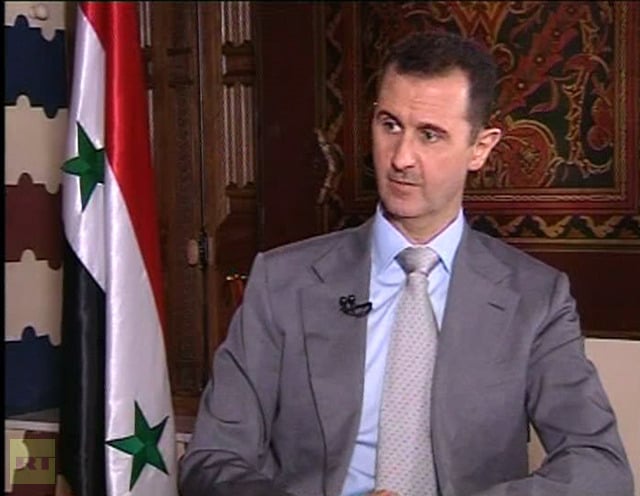
Bashar Al Assad Interview: ‘Syria faces not a Civil War, but Terrorism by Proxies’


Global Research

Sophie Shevardnadze

ASSAD

Assad: Erdogan thinks he’s Caliph, new sultan of the Ottoman
In an exclusive interview with RT, President Bashar Assad said that the conflict in Syria is not a civil war, but proxy terrorism by Syrians and foreign fighters. He also accused the Turkish PM of eyeing Syria with imperial ambitions.

Assad told RT that the West creates scapegoats as enemies – from communism, to Islam, to Saddam Hussein. He accused Western countries of aiming to turn him into their next enemy.
While mainstream media outlets generally report on the crisis as a battle between Assad and Syrian opposition groups, the president claims that his country has been infiltrated by numerous terrorist proxy groups fighting on behalf of other powers.

In the event of a foreign invasion of Syria, Assad warned, the fallout would be too dire for the world to bear.

‘My enemy is terrorism and instability in Syria’


RT: President Bashar al-Assad of Syria, thank very much for talking to us today.
Bashar Assad: You are most welcome in Damascus.

RT: There are many people who were convinced a year ago that you would not make it this far. Here again you are sitting in a newly renovated presidential palace and recording this interview. Who exactly is your enemy at this point?

BA: My enemy is terrorism and instability in Syria. This is our enemy in Syria. It is not about the people, it is not about persons. The whole issue is not about me staying or leaving. It is about the country being safe or not. So, this is the enemy we have been fighting as Syria.

RT: I have been here for the last two days and I had the chance to talk to a couple of people in Damascus. Some of them say that whether you stay or go at this point does not really matter anymore. What do you say about this?

BA: I think for the president to stay or leave is a popular issue. It is related to the opinion of some people and the only way can be done through the ballot boxes. So, it is not about what we hear. It is about what we can get through that box and that box will tell any president to stay or leave very simply.
RT: I think what they meant was that at this point you are not the target anymore; Syria is the target.

BA: I was not the target; I was not the problem anyway. The West creates enemies; in the past it was the communism then it became Islam, and then it became Saddam Hussein for a different reason. Now, they want to create a new enemy represented by Bashar. That’s why they say that the problem is the president so he has to leave. That is why we have to focus of the real problem, not to waste our time listening to what they say.

‘The fight now is not the president’s fight – it is Syrians’ fight to defend their country’


RT: Do you personally still believe that you are the only man who can hold Syria together and the only man who can put an end to what the world calls a ‘civil war’?

BA: We have to look at it from two aspects. The first aspect is the constitution and I have my authority under the constitution. According to this authority and the constitution, I have to be able to solve the problem. But if we mean it that you do not have any other Syrian who can be a president, no, any Syrian could be a president. We have many Syrians who are eligible to be in that position. You cannot always link the whole country only to one person.

RT: But you are fighting for your country. Do you believe that you are the man who can put an end to the conflict and restore peace?

BA: I have to be the man who can do that and I hope so, but it is not about the power of the President; it is about the whole society. We have to be precise about this. The president cannot do anything without the institutions and without the support of the people. So, the fight now is not a President’s fight; it is Syrians’ fight. Every Syrian is involved in defending his country now.

RT: It is and a lot of civilians are dying as well in the fighting. So, if you were to win this war, how would you reconcile with your people after everything that has happened?

BA: Let’s be precise once again. The problem is not between me and the people; I do not have a problem with the people because the United States is against me and the West is against me and many other Arab countries, including Turkey which is not Arab of course, are against me. If the Syrian people are against me, how can I be here?!

RT: They are not against you

BA: If the whole world, or let us say a big part of the world, including your people, are against you, are you a superman?! You are just a human being. So, this is not logical. It is not about reconciling with the people and it is not about reconciliation between the Syrians and the Syrians; we do not have a civil war. It is about terrorism and the support coming from abroad to terrorists to destabilize Syria. This is our war.

RT: Do you still not believe it is a civil war because I know there are a lot who think that there are terrorist acts which everyone believes take place in Syria, and there are also a lot of sectarian-based conflicts. For example we all heard about the mother who has two sons; one son is fighting for the government forces and the other son is fighting for the rebel forces, how this is not a civil war?

Friday, October 5, 2012

Turkey says it doesn’t want war with Syria


Turkish Prime Minister Recep Tayyip Erdogan speaks at a
news conference in Ankara on Thursday, October 4, 2012.
PressTV


Turkish Prime Minister Recep Tayyip Erdogan says his country does not plan to wage any war against Syria after the Turkish parliament gave the nod for military operations outside the country.


"We have no intention of starting a war with Syria," Erdogan said in a joint press conference with the visiting Iran's First Vice President Mohammad Reza Rahimi in Ankara on Thursday.

Turkey is not a warmongering country while we have witnessed the consequences of warmongering policies near our borders in Iraq and Afghanistan, he added.

He noted that the cross-border mandate was meant to serve as an "active deterrent" in the face of the escalating spillover of violence into his country’s territories.

Earlier on Thursday, the Turkish parliament approved a motion authorizing military operations outside the country's borders "when deemed necessary" after mortars fired from Syria killed five people in southeastern Turkey.

Shortly after the approval, Deputy Prime Minister Besir Atalay said the mandate was not a declaration of war and that the decision would have a deterrent effect.

The Turkish premier further said that Ankara has the military might and capability to protect its national sovereignty and borders.

Tehran and Ankara hold common talks on ways to resolve the Syrian issue, he added, noting that both the Iranian and Turkish governments have given the mandate to their foreign ministers to reach a particular conclusion on the issue at the earliest.

Also on Thursday, anti-war demonstrators gathered outside the parliament building in Ankara after Turkish forces reportedly killed several Syrian soldiers in an attack on a military post near the border town of Tel Abyad in Syria. “We don't want war!” and “The Syrian people are our brothers!” the protesters chanted.

The Turkish government said the attack was in retaliation for the mortar strike that killed five people in the country's town of Akcakale on Wednesday.

Damascus has been blaming certain Western and regional countries, including Saudi Arabia, Qatar, and Turkey, for backing the March 2011-present insurgency in Syria that has claimed the lives of many people in the Arab country, including security and Army personnel.

In July, Syrian President Bashar al-Assad said in an interview with Turkish daily Cumhuriyet that Ankara “has supplied all logistic support to the terrorists, who have killed our people.”


Friday, August 3, 2012

Feckless Erdogan Stakes Future of Turkey on Fake Promises from Con Artist Obama; Davutoglu Goes from Zero Problems to Countless Problems with Meddling In Syria

Tarpley


PressTV has conducted an interview with author and historian Webster Griffin Tarpley from Washington to further discuss the issue. What follows is a rough transcription of the interview.

Press TV: Looking at Turkey’s role…. I will just bring you a quote here now from Turkey’s Foreign Minister, Ahmed Davutoglu, I am quoting him; he says, “we will not allow the formation of terrorist structuring near our borders, no matter if it is al-Qaeda or PKK”.

Now that was when he was speaking about the threat from the Kurdish rebels, but is Turkey now practically hosting and assisting al-Qaeda when it comes to the fight against Syria, because as our guest in London [Charles Shoebridge] was also saying that al-Qaeda is also now getting involved in that fight?


Tarpley: Well, al-Qaeda was an integrated part of this from the very beginning and they have been there because they have been brought in by NATO.

Think of al-Qaeda as the NATO irregular infantry, a guerilla force if you will, that works for NATO and this structure is already existing on the Turkish territory.

Just some examples, the New York Times tells us that the CIA is present in southern Turkey as a traffic cop to direct weapons flows, paid for by Saudi Arabia and the other feudal monarchies of the Persian Gulf to direct those weapons toward certain groups inside Syria.

We had reports previously of a large airlift and sealift of terrorists, I would say, from Libya, the people who overthrew Gaddafi, who had been shipped into Libya by NATO.

They were then shipped into southern Turkey, Iskenderun is the place that was mentioned, and then they were moved into northern Syria.

We even had examples of guests in tourist hotels, along the Turkish Mediterranean coast complaining that al-Qaeda terrorists had moved into the same hotels and were showing the al-Qaeda flags.
And then most recently the Reuters dispatch that shows connection with the incirlik NATO air force base, US air force base, that there is a kind of logistical hub there, which is in the place called Adana which is directing these weapons flow.

So it is too late to make these statements, I think you have to look, though, behind this. Turkey has obviously been conned, they have been manipulated, the ambition and the vanity of Erdogan and Davutoglu, it seems to me has been played on systematically by Obama.

The word here in Washington for the last year or so, has been that Obama’s favorite telephone partner, the person in the world that he calls more than any other is Erdogan.

And he is promising to make Erdogan great, he is saying, ‘play my game and you will become the dominant satrap of the US empire in the Middle East and I am sure that Erdogan is also getting assurances from Saudi Arabia, ‘become the base for the attack on Syria and you will reap all kinds of benefits’ and of course he is not reaping benefits. He is putting his country at tremendous risk.

Press TV: Mr. Tarpley would you say that Turkey is not seriously considering any kind of military intervention in Syria? We know of course that there has been a lot of news of its deploying missiles, troops, armored vehicles along the border [with Syria].

What is it preparing for, through these deployments?

Tarpley: Well, most observers would have regarded the current state of Turkish policy as impossible.
People have been told two or three years ago that Turkey would abandon the ‘Zero Problems’ foreign policy, ‘Good Neighbor’ [foreign] policy and now engage in flagrant intervention and interference in internal affairs of Syria for the purpose of stoking a civil war on their own doorstep. That would have been considered crazy.

So I do not know what the limit is. This is something that is inherent in Hubris and megalomania. The idea that you are going to become a regional hegemon; seems to be the idea.

I would also say that they are disregarding the lessons of history, if you look back to Ataturk, at the end of the first world war, Ataturk’s basic idea was valid and he said we can not survive here as the Ottoman empire, we can, however, survive as a Turkish national state in the Anatolian peninsula and in that form we can thrive, we can do very well; and Turkey was doing very well, in terms of development and progress, until this current troubles began.

I had a chance to talk to General Auon, Michel Auon of Lebanon, who last November, in his little fortress above the Mediterranean, said, ‘Turkey is the last country that should become involved in these adventures, because they are split, they have got secularists and Islamists, they have got a Kurdish minority’ and by meddling in this way, they are getting themselves into big troubles.’

Let us look at this PKK, Erdogan has brought this up. Erdogan is complaining, he says that the PKK has taken over certain parts of northern Syria and they are going to operate into Turkey and he wants the right of hot pursuit back into Syria.

Well, Erdogan you should have thought of that, right? The great principal of international relations is reciprocity.

If you foment troubles in Syria, then you are going to sow the wind and reap the whirlwind, when that comes back to hurt you.

And the hot pursuit doctrine would work both ways, but by doing this, Erdogan has really created his own greatest nightmare which is the general uprising of the Kurds, which I think, under these circumstances would certainly have tragic aspects for many people in the region.

Press TV: Mr. Tarpley, if you could quickly also tell us. Would you say there is a connection between the sudden surge in violence as Syria says, with for instance, Kofi Annan’s visit in any effort for a peaceful resolution or political resolution to the crisis?

Tarpley: Well, we have two waves of foreign fighters being brought in. one wave was brought in during this past winter into the spring and that is what has been active over this past months and then more recently, for July, for ‘Operation Damascus Volcano’, which was the attempt to …the Syrian state.
As Hillary Clinton said, the ‘catastrophic assault’, they brought in another wave of foreign fighters from all over north Africa, and the Mediterranean and the Middle East.

Now Turkey claims that they sealed their borders, they did not. It would be good if they did; but they are still allowing illegal border crossings to function.

My advice to Turkey would be, pull back from this while you still can, seal your border; if Turkey cuts off access to foreign fighters, if they just take refugees but not allow weapon ships to go in, the rebellion in northern Syria will die down in short order.

Turkey says they want to join the Shanghai Cooperation Organization, they will never get in the SCO [Shanghai Cooperation Organization] at this rate.


Friday, July 27, 2012

The battle of Damascus has begun

Global Research
Thierry Meyssan


Western and Gulf powers have launched the largest secret war operation since the Contra war in Nicaragua.

The Battle of Damascus is not intended to topple President Bashar al-Assad, but to fracture the Syrian Army to better ensure the domination of Israel and the U.S. over the Middle East. While the city is bracing for a new assault by foreign mercenaries, Thierry Meyssan takes stock of the situation.


Coming from abroad, the "Contras" started their invasion of Syria by taking border posts.
Over the past five days Washington and Paris have launched an attack operation dubbed “Damascus Volcano and Syrian Earthquake." It is not a new campaign of aerial bombardment, but a secret military operation, similar to the one used in Central America during the Reagan era.

Within a few days, 40 to 60 000 Contras, mostly Libyans, entered the country, most often via the Jordanian border. The majority of them are attached to the "Syrian" Free Army, a secret operations front for NATO under Turkish command. Some are affiliated with groups of fanatics, including Al-Qaeda, under Qatar’s command or factions of the Saudi Royal Family, the Sudairi. Along the way, they took some border posts, and then moved to the capital where they have sown confusion by attacking random targets: police groups or isolated military.
GIF - 33.8 kb
Syrian Generals Hassan Turkmani, Daud Rajha and Assef Chawkat died on the field of honor on 18 July 2012.
Wednesday morning, an explosion destroyed National Security headquarters where some members of the National Security Council were meeting. It cost the lives of General Daoud Rajha (Defence Minister), of General Assef Shawkat (Deputy Minister) and of General Hassan Turkmani (Assistant Vice President of the Republic). The mode of attack remains uncertain: it could have been either a suicide bomber or a stealth drone.

Washington hoped that the partial decapitation of the military would lead some senior officers to defect with their units, or even to turn against the civilian government. This has not happened. President Bashar al-Assad immediately signed decrees appointing successors to the fallen heroes and the seamless continuity of the state was ensured.

In Paris, Berlin and Washington, sponsors of the operation continued their unworthy game of condemning terrorist action while reaffirming their political and logistical support for the terrorists. Shamelessly, they concluded that the responsibility for these killings lay not with the culprits, but with the victims in that they had refused to resign under pressure and surrender their homeland to western rapacity.

Caracas and Tehran have sent their condolences to Syria, stressing that the attack was sponsored and funded by Western and Gulf powers Moscow has also expressed condolences and affirmed that requesting Security Council’s sanctions against Syria amounted to political support for the attacking terrorists.
JPEG - 23.9 kb
Information Minister Omran al-Zou’bi delivers a message on national television after the attack that partially decapitated the Syrian Army.
National television channels have begun to broadcast military clips and patriotic songs several times per hour. Interrupting programs, the Information Minister al-Omran Zou’bi called for the mobilization of everyone: the time for political disputes between government and opposition is over. The enemy is at the gates. Referring to my Komsomolskaya Pravda article [1], he warned his countrymen of the imminent launch of the propaganda operation prepared by Gulf and Western channels in order to demoralize the people. Then, he put the lie to Gulf network propaganda according to which a mutiny had broken out in the fourth division and explosions had devastated its main barracks.

National channels have aired public service announcements several times hourly showing how to capture authentic programs on Atlantic Bird in case Arabsat and Nilesat satellites were interrupted.
In Lebanon, Sayyed Hassan Nasrallah recalled the brotherhood of arms uniting Hezbollah and Syria against Zionist expansionism, and assured the Syrian Army of its support.

Thursday, July 26, 2012

Who is fighting in Syria? Journalists Lie Than Admit That They’ve Been Manipulated

The 4th Media
Thierry Meyssan


Though the Western press portrays the Free Syrian Army as an armed revolutionary group, for more than a year Thierry Meyssan has affirmed that it is on the contrary a counter-revolutionary body. According to him, it would have progressively passed from the hands of reactionary monarchies in the Gulf to those of Turkey, acting for NATO. Such a non-mainstream affirmation needs demonstrative proof…
_____________________________________________
For the last 18 months, Syria has been prey to troubles that have steadily increased to become a widespread armed conflict having already killed about 20,000 people. If there is consensus on this observation, narratives and interpretations vary beyond.
For Western states and their press, the Syrians aspire to live in the Western market democracies. Following the Tunisian, Egyptian and Libyan “Arab Spring” models, they rose up to overthrow their dictator Bashar al-Assad. The latter suppressed the demonstrations with bloodshed. While Westerners would have liked to intervene to stop the massacre, the Russians and Chinese, out of self-interest or contempt for human life, opposed intervention.
On the contrary for all other states that are not vassals of the U.S. and for their media, the U.S. launched an operation planned a long time ago against Syria. First, through its regional allies, and then directly, they have introduced armed bands, modeled on the Contras in Nicaragua, that have destabilized the country.
But they found only very weak domestic support and were routed while Russia and China prevented NATO’s destroying the Syrian army and reversing the regional equation.
Who is telling the truth? Who is wrong?

Armed groups in Syria do not defend democracy, they fight against it


First, the interpretation of Syrian events as an episode of the “Arab Spring” is an illusion because this “spring” has no basis in reality. This is an advertising slogan to positively present unrelated facts. Although there has been a popular revolt in Tunisia, Yemen and Bahrain, there was none in neither Egypt nor Libya.
In Egypt, the street demonstrations have been limited to the capital and parts of the middle class; never, absolutely never, have the Egyptian people identified with the telegenic spectacle of Tahrir Square [1]. In Libya, there was no political revolt, but a separatist movement in Cyrenaica against the power of Tripoli, and the military intervention of NATO, which cost the lives of about 160,000 people.
The Lebanese station NourTV has been very successful airing a series of broadcasts by Hassan Hamade entitled “The Arab Spring, from Lawrence of Arabia to Bernard-Henri Levy.
The authors develop therein the idea that the “Arab Spring” is a remake of the “Arab Revolt” of 1916-1918 orchestrated by the British against the Ottomans. This time, Westerners have manipulated situations to upset a generation of leaders and impose the Muslim Brotherhood.
In fact, the “Arab Spring” is false advertising. Now, Morocco, Tunisia, Libya, Egypt, and Gaza are governed by a brotherhood; on the one hand imposing a moral order and on the other supporting Zionism and pseudo-liberal capitalism, that is to say the interests of Israel and the Anglo-Americans. The illusion was dispelled. Some authors, like Syria’s Said Hilal Alcharifi, now deride the “NATO spring“.
Secondly, the leaders of the Syrian National Council (SNC) as well as the Free Syrian Army (FSA) commanders are not democratic at all, in the sense that they would be favourable to “a government of the people, by the people, for the people“, according to Abraham Lincoln’s formula taken from the French Constitution.
Thus, the first president of the SNC was the Paris academic, Burhan Ghalioun. He was in no way “a Syrian opponent persecuted by the regime” since he circulated freely in and out of his country.
Nor was he a “secular intellectual” as he claims, since he was the political advisor to the Algerian Abbassi Madani, President of the Islamic Salvation Front (ISF), now a refugee in Qatar.
His successor, Abdel Basset Syda [2] entered politics only in the last months, and immediately established himself as a mere executor of US wishes. Upon his election as head of the SNC, he pledged not to defend the will of his people, but to implement the “road map” that Washington drew up for Syria: The Day After.

JPEG - 31.5 kb

                                                        Logo of the “Free Syrian Army”
Nor are the Free Syrian Army fighters champions of democracy. They recognize the spiritual authority of sheikh Adnan Alrour, a takfirist preacher, who calls for the overthrow and killing of Assad, not for political reasons but simply because Assad is of the Alawite faith, that is to say a heretic in the preacher’s eyes.
All of the identified officers in the FSA are Sunnis and all of the FSA brigades are named after historical Sunni figures. The “revolutionary tribunals” of the FSA sentence their political opponents to death (and not only supporters of Bashar al-Assad) and they slaughter the unbelievers in public. The FSA program is to end the secular regime installed by the Baath, the SSNP and the Communist Party in favor of a pure religious Sunni regime.

The Syrian conflict was premeditated by the West


The western will to end Syria is known and it is quite sufficient to explain current events. Let us recall some facts that leave no doubt as to the premeditation of these events [3].

Friday, July 20, 2012

US dirty hands behind cold-blooded killings of top Syrian officials

PressTV


In Las Vegas, the house seldom loses. Rarely are dirty Washington schemes foiled. It's playing hardball against Syria.

Its dirty hands are all over months of violence. In a July 18 press briefing , State Department spokesman Patrick Ventrell refused to condemn Wednesday's cold-blooded killings.

Syrian Defense Minister Dawood Rajiha, his deputy General Asef Shawkat, and Assistant Vice President General Hassan Turkmani died.

A terrorist bombing killed them at Damascus National Security headquarters. At the time, a ministerial, military, and security meeting was in progress. Others attending were injured.

Pressed for an answer on whether the Obama administration believes killing high-level Syrian officials is good or bad, he stressed only that Washington is: "focused on ending the bloodshed. It is the Assad regime that, in slaughtering its own people, has created these chaotic conditions....(W)e want a peaceful, orderly transition."

In other words, cold-blooded murder is OK as long as it advances America's imperium. Uncooperative countries will be ravaged. Body counts don't matter. Top officials are fair game. So are all imaginable lawless tactics.

Washington's dirty hands are all over Wednesday's attack. Death squad diplomacy is prioritized. Hillary Clinton warned about a price to be paid.

Unexplained was that it's far beyond murdering officials. Turning Syria into a charnel house is planned. Daily death squad killings increase body counts. Western and perhaps Qatari special forces as well as intelligence operatives direct them.

Satellite and other communications aid them. Taking the battle to Damascus streets ups the stakes. Scurrilous propaganda conveys the impression that the Assad's government is collapsing. Insurgent attacks alone can't defeat him.

Only body counts increase. Civilians and security forces suffer most.

All sorts of spurious reports circulate. Fake videos are used. Al Jazeera uses footage produced on a Qatar sound stage. Isolated images distort the larger picture. Disreputable sources are cited.

Al Jazeera claimed "the latest developments" reflect a "turning point" in the conflict. "The prestige of the regime has been shattered. Losing control of Damascus (means) the regime is slowly losing its grip over the country."

Nonsense!

Washington and/or NATO countries designated Syria's capital fighting "Operation Damascus Volcano." They call it a full-scale offensive. Insurgent commander Qassem Saadeddine said "(t)here is no going back. The Damascus battle has priority for us. We have started the operation to liberate Damascus."

Without elaborating, he said "expect surprises."

Washington's longstanding plans involve destroying, not liberating, Syria. Claimed end game operations in Damascus is propaganda. Media scoundrels repeat it. At issue is winning the information war, intensifying death squad attacks, and sustaining conflict on the ground.

After defecting, Syria's former Iraq ambassador, Nawaf Fares, made spurious accusations. He's in the tank for Washington.

He claimed Syrian officials told him to enlist "Jihadi units" to fight US forces in Iraq. Most recently he suggests Assad used chemical weapons in Homs.

He admits he can't confirm it, but believes Assad will use them if threatened.

Security Council Showdown

On July 19, Britain, America, France, Germany, Portugal, and Ireland tabled a resolution for consideration. Eleven nations voted aye. Others besides sponsoring countries included Azerbaijan, Colombia, Guatemala, India, Morocco, and Togo. South Africa and Pakistan abstained.

Russia and China vetoed it. Invoking UN Chapter VII, it effectively declared war.

Moscow and Beijing acted responsibly. They did so for the third time. They want conflict resolution not bombs away. They need to go further. Hopefully they'll get more assertive.

At issue is forthrightly denouncing Washington's war on Syria. Drawing a line in the sand is crucial. Raging conflict can't be tolerated. Arming and otherwise supporting their Syrian ally is vital.
The entire region's up for grabs. Both countries have vital interests at stake. Only they can protect them. Months of diplomacy failed. Realpolitik dictates assertive action. Washington understands it. It won't risk war at this time with either country.

The resolution's text in part said "the situation constitutes a threat to international peace and security."

UN Charter Chapter VII was invoked. It authorizes measures ranging from economic sanctions to blockades or direct military intervention if other measures fail.

It endorsed the June 30 Geneva agreement text. It called for ending armed conflict, implementing Annan's peace plan, adhering to provisions of Security Council Resolutions 2042 and 2043, releasing detainees, permitting humanitarian access to areas needing help, and other steps to be taken.

It called for Syrian-led political transition. Its guidelines included establishing a firm timeline. It urged avoiding further bloodshed and violence.

It ignored what Assad already accomplished. In February, Syrians overwhelmingly supported new constitutional provisions by national referendum. Despite opposition boycotts and violence, 89.4% of eligible voters approved it. Another 9% opposed, and 1.2% of ballots were declared invalid.

Among other reforms, political pluralism was established for the first time. So were presidential term limits and press freedom.

Friday, June 29, 2012

NATO Proxies Turkey and Saudi Arabia Move to War Footing on Eve of Syrian ‘Peace Summit’

Global Research
Finian Cunningham

UN's Ban pushes Annan Syria plan at Arab summit
The NATO-backed covert aggression against Syria could be reaching a tipping point for all-out war involving state forces. That should be no surprise. For the past 16 months, NATO and its regional proxies have been steadily increasing the violence and turmoil inside and outside Syria, while the Western corporate-controlled media maintain the ridiculous fiction that the bloody chaos is largely due to the government forces of President Bashar Al Assad cracking down on “peaceful protesters”.

Ironically, the crisis is culminating at the same time that the United Nations convenes an emergency summit on Syria in Geneva this weekend. The meeting, which is ostensibly aimed at “reviving the Kofi Annan peace plan”, will be attended by the five permanent members of the UN security council and other “invited” regional states. The irony is that leading NATO members, the US, Britain and France, as well as their Turkish and Arab allies who will also be attending the crisis conference, are the very parties that have deliberately created the precipice for all-out war in the Middle East.

As dignitaries fly into Geneva to “salvage peace in Syria”, there is a lockstep military build-up on the northern and southern flanks of Syria underway, with news that Turkey has dispatched battlefield tanks, missile batteries and heavy artillery to its Syrian border, while to the south Saudi Arabia has announced that its military forces have been put on a “state of high alert”.

Ankara’s military mobilization along its 800km land border with Syria came within hours of the declaration by Turkey’s prime minister Recep Tayyip Erdogan slating Syria as “a hostile state”. The immediate cause of the deterioration in relations between the neighbouring countries is the downing of a Turkish fighter jet last week in Syrian territorial waters. Syria claims it was acting in self-defence after the Phantom RF-4E warplane entered its airspace on Friday. Ankara has so far failed to give an explanation for why one of its warplanes was making such a provocative low-flying manoeuvre into Syrian airspace. But the Turkish government has announced that any move by Syrian armed forces towards its border will be viewed as another “hostile act” that it will respond to. How’s that for a provocative tether? Especially towards a country that is being attacked by armed groups crossing over its border with Turkey.

Meanwhile, on the same day that Turkey is militarizing along its border with Syria, Saudi Arabia’s King Abdullah makes an unprecedented announcement putting his armed forces on high alert “due to the tense situation in the Middle East”. Using vague and contrived language, the Saudi ruler warned against “foreign or terrorist attacks” to justify the mobilization of the kingdom’s armed forces.

The military pincer movement against Syria tends to support the analysis that the downing of the Turkish fighter jet was a deliberate set-piece scenario designed to furnish a cause for war, or at least a stepping up of the international psy-ops campaign of intimidation against Syria.

Wednesday, June 27, 2012

Rick Rozoff: NATO War Council To Target Syria

Global Research
Rick Rozoff

Turkish fighter jet flies into
Syrian airspace.
On Tuesday, June 26 Belgium time the North Atlantic Council, the highest governing body of the U.S.-dominated North Atlantic Treaty Organization military bloc, will take up the issue of Syria under provisions of its founding document that in the past ten and a half years have resulted in military deployments preparatory to and the subsequent waging of full-scale wars.

The ambassadors of the alliance's 28 member states constitute the council, nations whose collective population is 900 million. Its founding members include three nuclear powers - the U.S., Britain and France - the first the self-proclaimed world's sole military superpower.

Until the day before the meeting NATO was to take up a request by member Turkey to hold consultations under the terms of the North Atlantic (Washington) Treaty's Article 4, which allows any member state to call on the entire alliance to respond to alleged threats to its territorial integrity and security.

On June 25, three days after a Turkish F-14 supersonic fighter-bomber was shot down over Syrian waters, Turkey announced that it was going to ask the military alliance to discuss its Article 5, which states that "an armed attack against one or more of them in Europe or North America shall be considered an attack against them all" and commits NATO allies to "assist the Party or Parties so attacked by taking forthwith, individually and in concert with the other Parties, such action as it deems necessary, including the use of armed force..."

Article 5 was invoked for the first and to date only time in October 2001 and is the basis for the deployment of troops from 28 NATO and 22 partner states to Afghanistan over the past decade.

Article 4 was first invoked on February 16, 2003, again by the North Atlantic Council and again in relation to Turkey, on the eve of the U.S. and British invasion of Iraq. So-called Operation Display Deterrence was launched as a result and five Patriot interceptor missile batteries, three Dutch and two American, and four Airborne Warning and Control System (AWACS) surveillance aircraft were deployed to Turkey in conjunction with NATO's Integrated and Extended Air Defence System.

NATO, in its own words, deployed "1000 technically advanced and highly capable forces" to run the operation.

The first AWACS aircraft arrived on February 26 and three weeks later the bombardment and invasion of Iraq began. Although Iraq at the time had a population of approximately 25 million and Turkey 70 million, and although Turkey had one of the most formidable militaries in the region while Iraq's had been weakened by the eight-year war with Iran in the 1980s, the U.S. and allied bombing campaign of 1991 and in the interim, and twelve years of crushing sanctions, NATO afterward praised Operation Display Deterrence as having "tested and proved the success of NATO’s military to respond immediately and with appropriate defensive force to a rapidly developing threat against a member of the Alliance."

In what manner a fatally debilitated Iraq had presented Turkey with "a rapidly developing threat" was never specified.

The AWACS flew 100 missions and the Dutch Patriot batteries included Patriot Advanced Capability-2 missiles and "a more modern missile provided by Germany," according to NATO.

The operation was concluded on May 3, 65 days after it began and 45 days after the invasion of Iraq. To provide an indication of what NATO will claim after its meeting on Syria, the then-Turkish ambassador to the bloc stated after the invoking of Article 4:  

Tuesday, March 20, 2012

Turkish Reporters Struggle Against Repression

Der Spiegel
Daniel Steinvorth

Recep Tayyip Erdogan
Turkey has sparked international criticism over its treatment of journalists who dare to criticize the government, with many jailed on terrorism charges. The recent release of prominent reporters may signal change, but more than 100 journalists are still imprisoned in the country, more than in China or Iran. 

He has done things in the last 375 days that he would never have imagined doing before. He made dumbbells out of pipe sections, watched too much television, and at some point he discovered the sunflower seeds. That was when he realized that he was losing too much weight in prison. "I chewed those damned sunflower seeds like someone possessed," says Ahmet Sik.

The journalist is sitting in his living room in Istanbul, surrounded by his wife Yonca, daughters and closest friends. There is red wine and chocolate cake, and Sik, a youthful 42-year-old with a thin beard, still can't believe he's a free man. It is the evening of Tuesday, March 13, the day after his release from the Silivri high-security prison for presumed terrorists .
He was in pretrial detention for a year and 10 days on charges of being a "member of a terrorist organization." Sik is one of the most famous investigative journalists and authors in Turkey. His colleague Nedim Sener, another investigative reporter who has won several awards, had researched the reasons behind the murder of journalist Hrant Dink in 2007. A little over a year ago, on the morning of March 3, 2011, a special unit of the Turkish police arrested both men.

The journalists were charged with belonging to an ultra-nationalist secret organization called "Ergenekon," though there was no evidence to support the allegations. The notorious network, Turkish prosecutors claim, contrived a plan to overthrow the government of Prime Minister Recep Tayyip Erdogan several years ago. Since 2007, special police units have been trying to put a stop to the activities of the Ergenekon group, although its existence has never been proven.

Non-governmental organizations like Reporters Without Borders and Human Rights Watch had long criticized Turkey for its repression of journalists, but a line was crossed with Sik and Sener's arrests. With their work, the two men had helped expose connections among politicians, the judiciary and organized crime in Turkey, the so-called "Deep State" that went back decades.

International Concerns 

Was the administration of Prime Minister Erdogan and his Justice and Development Party (AKP) trying to silence two men after finding them useful at first but then changing its mind when their revelations became too embarrassing? After all, the two reporters had not just poked around among members of the old government elite, but had also dared to investigate the Islamists, the new people in power and their networks.

Wednesday, March 14, 2012

Turkish PM: Israeli attacks on Gaza are ‘state terror’

End the Lie

Turkish Prime Minister Recep Tayyip Erdogan made some quite heated statements in condemnation of the most recent Israeli airstrikes on the Gaza Strip in a speech Tuesday, calling the attacks a “massacre.”

A cease fire between Gaza militants and the Israel Defense Forces (IDF) went into effect Tuesday but there have been reports of rocket attacks despite this agreement.
Thus far, according to Israeli news outlet Haaretz, almost 200 rockets have hit Israeli territory since the most recent outbreak of violence began on Friday.

The Israeli Air Force has conducted some 37 airstrikes on targets in the Gaza Strip, 19 of which supposedly targeted rocket launchers while 18 allegedly targeted weapons warehouses.

These attacks have resulted in 26 Palestinian deaths, 22 of which were allegedly militants while four were civilians who had no hand in the rocket fire.

In a speech to the Turkish parliament, Erdogan called on Israel to “stop the brutal attack against Palestinians and stop the massacre and bloodshed.”

He also called the Israeli airstrikes on Palestinians “state terror,” adding that the Turkish people have an obligation to “remember that Gazans are our brothers, and will always remain so.”

Erdogan has made some similarly strong comments in regards to the Israeli actions in the past, even going as far as to say that any further flotillas which intend to break through the Gaza blockade would be accompanied by Turkish vessels after the massacre on the Mavi Marmara, in addition to claims that Turkey was going to seek legal retribution for the murders.

Even considering his fiery words, Erdogan tends to fail to actually follow through, and I honestly doubt that he will take any action against the Israeli attacks.

During the speech Erdogan also took the opportunity to address Syria, saying that “the window of opportunity was closing following the massacres taking place daily in the country,” while also saying that Turkey “was making every possible effort to prevent further escalation in Syria.”

Thursday, September 29, 2011

Turkey to escort Gaza aid ships amid row with Israel

The Muslim News
Elham Asaad Buaras

Recep Erdogan has said his country will escort aid ships travelling to Gaza

Turkish Prime Minister, Recep Tayyip Erdogan, has said his country will in future escort aid ships travelling to the Gaza Strip.

Reacting to Israel’s refusal to apologise and a UN report on last year’s Gaza flotilla incident, which failed to condemn the killing of the nine Turkish activists, Erdogan said, “Turkish warships, in the first place, are authorized to protect our ships that carry humanitarian aid to Gaza…From now on, we will not let these ships be attacked by Israel, as happened with the Freedom Flotilla.”

Turkish demands for an official apology from Israel and compensation for the families of the raid’s victims have not been met. Israel has, however, downplayed the diplomatic standoff, saying relations with Turkey are strong enough to weather the current differences.


However, Turkish officials described the standoff as a serious crisis.

“We waited fifteen months for an Israeli apology, but it never came,” said Turkish Foreign Ministry Spokesman, Selcuk Unal. “Throughout this period, we continued to consult with Israeli authorities and made our demands clear. But so far Israel has chosen to ignore our demands.”

A UN report commissioned by the UN Secretary General to investigate this incident – The Palmer Report - was leaked on September 1 saying the Israeli soldiers used “excessive and unreasonable” force against passengers of the Mavi Marmara but, contrary to what Turkey has argued, it found that the Israeli blockade of Gaza is legal, a sharp contradiction to the UN commissioned report presented to the UN Human Rights Council almost a year ago, in September 2010.

The report from the UN Human Rights Council found that not only the siege and the attack on the Mavi Marmara was illegal, but that “There is clear evidence to support prosecutions of the following crimes within the terms of article 147 of the Fourth Geneva Convention: wilful killing; torture or inhuman treatment; wilfully causing great suffering or serious injury to body or health.”

It found that the Israeli blockade on Gaza is illegal, and said, “There is clear evidence to support prosecutions of the following crimes…wilful killing; torture or inhuman treatment; wilfully causing great suffering or serious injury to body or health.”

It added: “The conduct of the Israeli military and other personnel toward the flotilla passengers was not only disproportionate to the occasion but demonstrated levels of totally unnecessary and incredible violence. It betrayed an unacceptable level of brutality,” the report said.

Erdogan said the raid, which took place in international waters in the Mediterranean, was “inhumane” and “an act of state terrorism and savagery” and asserted that the UN panel’s report “holds no value for us.”

“If the measures [we have] taken so far [against Israel] are part of a Plan B, then there will also be a Plan C. Different steps will be taken depending on the course of developments…We are totally suspending our commercial, military and defense ties. They are being frozen entirely,” he added, without clarifying what the next round of sanctions might include.

Human right groups have slammed Palmer panellists for announcing that it believed Israel’s naval blockade was legal when in the same report declares that the legality of the blockade was not in the panellists remit.

“The Palmer Report was a product of deliberations by two ex-premiers, together with representatives of Israel and Turkey – in contrast, the UN Human Rights Council report was written by three internationally renowned lawyers, who interviewed over 100 passengers,” said a Palestine Solidarity Campaign (PSC) spokesman.

Sarah Colborne, PSC Director, and a passenger on the Mavi Marmara which came under attack, told The Muslim News: “Israel’s desperate attempt to use the Palmer report to justify its blockade, and its attack on civilians in international waters, has run aground. The report clearly states that the loss of life and injuries resulting from the use of force by Israeli forces during the take-over of the Mavi Marmara was unacceptable, and that Israel did not ‘adequately account’ for the forensic evidence showing that seven of those killed were shot multiple times, including in the back, or at close range.”

Turkey has already cut military ties and expelled Israel’s Ambassador.

It has also said it will challenge Israel’s blockade of Gaza at the International Court of Justice.
Relations between Turkey and Israel have worsened since Israeli forces boarded the Mavi Marmara aid ship in May last year as it was heading for Gaza. Nine Turkish activists were killed during the raid.
Spokesman of Turkish Humanitarian Relief Foundation, Salih Bilici, who organised the flotilla told The Muslim News that they were “not expecting any apology or compensation from Israel. We are waiting for international action.”

Sunday, September 18, 2011

Erdogan: Israel is the West’s Spoiled Child

Sabbah
James M. Wall

On Tuesday, Turkey's President Recep Tayyip Erdogan told an Arab League meeting in Cairo, Egypt, that a vote to accept a Palestinian state in the United Nations "is not a choice but an obligation."

Later, on a Cairo television program, Erdogan declared: "Israel is the West's spoiled child. To this day it has never executed a decision by the international community."

The Turkish leader was on his second day of an "Arab Spring" tour which was obviously designed to gain Arab support for a Palestinian state application before the UN General Assembly, which meets in New York this week.

Both Palestinian Authority President Mahmoud Abbas and Israeli Prime Minister Benjamin Netanyahu will state their positions in back to back addresses before the UN, Friday, September 23, setting up a confrontation between "the West's spoiled child" and a captive population fighting to escape from a military occupation.

So desperate was the US to avoid having to cast its usual pro-Israel veto in the Security Council against the Palestinian Authority/PLO application for UN membership, that it has twice dispatched its pro-Israel diplomatic team, David Hale and Dennis Ross, to Tel Aviv and Ramallah to "persuade" Abbas and Netanyahu to agree to return to negotiations.

The Hale-Ross effort was a failure from the start. The two envoys returned to the region two times, knowing full well that Netanyahu would not budge from his rejection of two Palestinian preconditions for talks: Stop building settlements and start negotiations along the 1967 Green Line border, both positions advocated in previous statements by President Obama.

In his Friday, September 16, televised address from Ramallah, President Abbas ended speculation that the Palestinian Authority and the Palestinian Liberation Organization (both of which he heads) might yield to US-Israeli pressure and go directly to the General Assembly, bypassing the Security Council where the Obama veto was waiting. That will not happen. Abbas is going for broke. He will present his request to the UN Security Council, fully aware that the US will veto the request.

Speaking to reporters in Ramallah, Palestinian negotiator Nabil Shaath said the plan delivered by U.S. envoys Hale and Ross did not meet the two Palestinian demands. This convinced President Abbas that the US was not serious in trying to negotiate peace.

"David Hale and Dennis Ross came with a paper that was the last straw that he [Abbas] could take," Shaath said. "It seems that it was designed to be rejected."

One problem the Palestinians had with the American proposal was that it "did not refer to disputed Israeli settlements as illegal, instead attributing their presence to demographic trends since 1967″.

This means that the two most recent Hale-Ross missions have failed, "forcing" President Obama to cast his Israel-lobby dictated, pro-Israel veto. It will not be the first veto President Obama has ordered to reject policies which Obama was on record supporting. The first Obama pro-Israel veto came February 18, blocking a resolution that condemned "Israeli settlements as an illegal obstacle to peace".

Members of Obama's own government have tried to alert the President to the danger of giving in to Israel's every demand. Jeffrey Goldberg wrote recently for the Bloomberg web site that Robert M. Gates, the now-retired secretary of defense, warned Obama, directly, that Netanyahu was "an ungrateful ally".

Sunday, September 4, 2011

'Turkey's Erdogan to visit Egypt, may cross into Gaza'

Jerusalem Post
Field Marshal Mohamed Hussein Tantawi

Turkish president reportedly set to meet with Tantawi, other Egyptian officials to strengthen relations between the two countries.

Turkish Prime Minister Recep Tayyip Erdogan will pay a two-day visit to Egypt beginning September 12 and may subsequently cross the border into the Gaza Strip, the Qatar News Agency reported on Sunday.

QNA quoted Turkish Deputy Premier Bulent Arinc as saying in a statement on Sunday that Erdogan was scheduled to meet with the head of Egypt's ruling military council, Field Marshal Mohamed Hussein Tantawi and other leading Egyptian politicians and intellectuals during the visit.

Arinc stated that the visit was expected to produce important decisions reflecting the strength of relations between Turkey and Egypt. He added that Turkey hopes for reforms and elections in Egypt to proceed in accordance with the will of the people.

The Turkish deputy prime minister said that Erdogan would possibly cross into Gaza at the Rafah crossing after making arrangements with the relevant Egyptian authorities.

The announcement came as diplomatic relations between Turkey and Israel were severely strained following the release of the Palmer Commission report on the raid of the Mavi Marmara and Israel's refusal to answer Ankara's insistence that it issue an apology for the incident.

Turkish Foreign Minister Ahmet Davutoglu told Turkish television on Saturday that Ankara would apply to the International Court of Justice next week for an “investigation into what the Gaza blockade really is.”


This was one of five actions Davutoglu announced at a press conference on Friday, even before the Palmer Report was presented to UN Secretary-General Ban Ki-moon, based on a leak of the complete report that vindicated Israel’s blockade but faulted the IDF for unreasonable and excessive force, even though it acknowledged Israel Navy sailors came up against strong, pre-meditated resistance by those on board the Mavi Marmara on May 31, 2010.

At his press conference, Davutoglu announced Ankara was expelling Israel’s ambassador, and freezing all military agreements. He also said Turkey would take measures for freedom of maritime movement in the eastern Mediterranean Sea, no longer recognizing the Gaza blockade, and support “flotilla victims” who take the matter to court.

Israel has also recently experienced tension in its relations with Egypt following the deaths of five Egyptian soldiers during a firefight between the IDF and terrorists during last month's Eilat terror attacks.

The incident led to a four-day demonstration outside the Israeli embassy in Cairo, where Egyptian protesters demanded the peace treaty with Israel be annulled.

Tuesday, May 24, 2011

ISRAEL TO BE SUED FOR MURDER ON THE SEA IN US COURT

Desert Peace


Furkan Doğan, American Citizen Killed by
IDF on the Mamara
Last year, Turkish Prime Minister Recep Tayyip Erdoğan criticized the administration of U.S. President Barack Obama for remaining silent on the death of an American citizen. “We are protecting the rights of our eight martyrs. The United States is not taking care of Furkan, its own citizen. Is it because of his Turkish origin?” Erdoğan said.

The father of a Turkish-American man killed last year in an Israeli raid on a Gaza-bound aid flotilla will file a compensation case against the Israeli government Tuesday in the United States, his lawyer has said.

“We will open a compensation case against Israel and we’ll declare this at a press conference tomorrow [Tuesday] in front of the U.S. Capitol,” Ramazan Arıtürk, a lawyer for the Humanitarian Relief Foundation, or İHH, which organized the ill-fated flotilla, told the Hürriyet Daily News on Monday.

The declaration will come after the lawyers meet with officials from the U.S. Department of Justice as well as U.S. senators and congressmen on the issue, the lawyer said.

The Israeli raid May 31, 2010, killed nine people aboard the Mavi Marmara, including Furkan Doğan, an American of Turkish descent, and eight Turkish citizens.

“Furkan is an American citizen. He was martyred in international waters. The United States has not taken any action against Israel over the past year. The legal procedures launched by U.S. authorities have not reached any result,” Hüseyin Oruç, an İHH board member and the spokesman for a new flotilla set to sail to Gaza next month, told the Daily News.


Ahmet Doğan, Fukan's father
He declined to comment on the amount of compensation that is being sought, saying this would be set by Doğan’s father, Ahmet, who is currently in the United States along with a group of lawyers.

Eight other compensation cases for the other victims will be opened in Turkey “very soon,” Arıtürk said.

Last year, Turkish Prime Minister Recep Tayyip Erdoğan criticized the administration of U.S. President Barack Obama for remaining silent on the death of an American citizen. “We are protecting the rights of our eight martyrs. The United States is not taking care of Furkan, its own citizen. Is it because of his Turkish origin?” Erdoğan said.

Despite calls from the U.S. for Ankara to block the new flotilla from setting off for Gaza in late June, İHH officials ruled out any Turkish government interference to prevent the trip.

“There has been no interference from the Turkish government so far. We are insistently saying that this is a civil-society initiative and İHH is only one of 22 separate [groups involved], including those from a wide range of countries, from Indonesia to Canada,” Oruç said.

In remarks published in daily Bugün, Foreign Minister Ahmet Davutoğlu said the second flotilla was a civil-society initiative. “There are also citizens from other countries [set to be onboard],” he added, but repeated that the government might advise the İHH not to go.

“All the teams are very much determined. These are civilian vessels and carry nothing threatening Israel’s security,” Oruç said. “Israel has not yet given an account of what it did last year despite significant reports released by the U.N. We believe Israel will not repeat the same mistake because any action aimed at stopping the flotilla will receive an enormous amount of reaction from the world.”

This year 25 vessels will set out carrying 1,500 activists, up from six vessels and 700 activists last year. The İHH will be represented by 100 activists. One ship is expected to set out from New York on Saturday and all the vessels of the flotilla will meet in the Mediterranean before steering for Gaza.

A ceremony will be held May 30 at Istanbul’s central Taksim Square to commemorate victims of last year’s raid. According to Oruç, the event will be attended by the international participants in this year’s flotilla.