


The Guardian
Glenn Greenwald
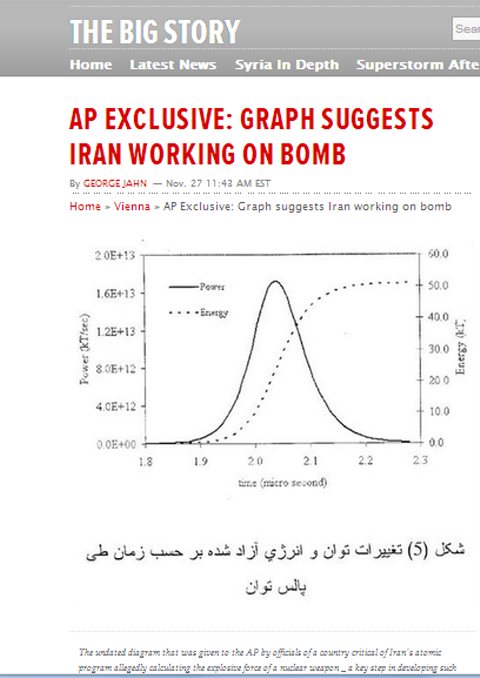
An article published by Associated Press about Iran's nuclear program has sparked controversy (screen shot of AP story)
(updated below w/AP's response)
It's important to return to the story about AP's nuclear Iran "exclusive" which I wrote about yesterday. Although it was intuitively obvious that the graph trumpeted by AP as scary and incriminating of Iran's nuclear program was actually a farce, there is now new, overwhelming, very compelling scientific evidence that is the case. Whether as victim or recklessly culpable participant, AP helped perpetrate a dangerous hoax, and owes an explanation and accounting for what took place, including identifying the "officials from a country critical of Iran's atomic program" who made false claims about what this is.
To begin with, the graph AP touted as reflecting some sort of nefarious, highly threatening and complex nuclear calculation is, in fact, widely available all over the Internet in the most innocuous places. Just consider this side-by-side comparison of the AP graph on the left, with the graph on the right on this harmless site designed to teach beginner users how to use Microsoft Excel:
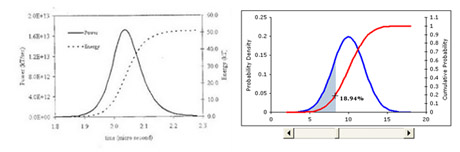
At the Bulletin of Atomic Scientists (BAS), Yousaf Butt and Ferenc Dalnoki-Veress on Wednesday night wrote: "Graphs such as the one published by the Associated Press can be found in nuclear science textbooks and on the Internet." Similarly, Prof. Muhammad Sahimi, a professor of chemical engineering at USC and expert in Iran's nuclear program, told Richard Silverstein of Tikun Olum that "too many graphs like this can be generated by a competent undergraduate student." So what AP presented to the world as some sort of highly complex, specialized document was, in fact, nothing more than a completely common graph easily found in all sorts of public venues.
Even worse, the calculations reflected on this graph are patently ridiculous. Butt and Dalnoki-Veress document that the graph "does nothing more than indicate either slipshod analysis or an amateurish hoax" [emphasis added]. That's because, they explain, "the diagram features quite a massive error, which is unlikely to have been made by research scientists working at a national level"; namely:
But AP never indicated that this error strongly suggested that no real nuclear scientist would have prepared it, and immediately went back in the very next paragraph to touting the document as some sort of scary evidence of Iran's threatening nuclear weapons machinations.
It's important to return to the story about AP's nuclear Iran "exclusive" which I wrote about yesterday. Although it was intuitively obvious that the graph trumpeted by AP as scary and incriminating of Iran's nuclear program was actually a farce, there is now new, overwhelming, very compelling scientific evidence that is the case. Whether as victim or recklessly culpable participant, AP helped perpetrate a dangerous hoax, and owes an explanation and accounting for what took place, including identifying the "officials from a country critical of Iran's atomic program" who made false claims about what this is.
To begin with, the graph AP touted as reflecting some sort of nefarious, highly threatening and complex nuclear calculation is, in fact, widely available all over the Internet in the most innocuous places. Just consider this side-by-side comparison of the AP graph on the left, with the graph on the right on this harmless site designed to teach beginner users how to use Microsoft Excel:
At the Bulletin of Atomic Scientists (BAS), Yousaf Butt and Ferenc Dalnoki-Veress on Wednesday night wrote: "Graphs such as the one published by the Associated Press can be found in nuclear science textbooks and on the Internet." Similarly, Prof. Muhammad Sahimi, a professor of chemical engineering at USC and expert in Iran's nuclear program, told Richard Silverstein of Tikun Olum that "too many graphs like this can be generated by a competent undergraduate student." So what AP presented to the world as some sort of highly complex, specialized document was, in fact, nothing more than a completely common graph easily found in all sorts of public venues.
Even worse, the calculations reflected on this graph are patently ridiculous. Butt and Dalnoki-Veress document that the graph "does nothing more than indicate either slipshod analysis or an amateurish hoax" [emphasis added]. That's because, they explain, "the diagram features quite a massive error, which is unlikely to have been made by research scientists working at a national level"; namely:
"The image released to the Associated Press shows two curves: one that plots the energy versus time, and another that plots the power output versus time, presumably from a fission device. But these two curves do not correspond: If the energy curve is correct, then the peak power should be much lower - around 300 million ( 3x10⁸) kt per second, instead of the currently stated 17 trillion (1.7 x10¹³) kt per second. As is, the diagram features a nearly million-fold error."This error is patently obvious to anyone versed in nuclear physics. Nima Shirazi yesterday spoke with Dr. M. Hossein Partovi, who teaches courses in thermodynamics and quantum mechanics at Sacramento State, and he echoed the BAS scientists:
"[Dr. Partovi], noting that the graph is plotted in microseconds, explains that 'the graph depicted in the report is a nonspecific power/energy plot that is primarily evidence of the incompetence of those who forged it: a quick look at the energy graph shows that the total energy is more than four orders of magnitude (forty thousand times) smaller than the total integrated power that it must equal!'"Notably, the nuclear expert quoted by AP in its article, David Albright, also seemed to be trying to tell AP that the graph contained this same obvious, glaring error, yet AP - eager to believe, or at least lead others to believe, that it had some incriminating evidence - either failed or refused to understand its significance. Buried in the AP article was this passage:
"'The yield is too big,' Albright said, noting that North Korea's first tests of a nuclear weapon were only a few kilotons."
But AP never indicated that this error strongly suggested that no real nuclear scientist would have prepared it, and immediately went back in the very next paragraph to touting the document as some sort of scary evidence of Iran's threatening nuclear weapons machinations.


 Posts
Posts


