Showing posts with label Charles Schumer. Show all posts

Monday, September 10, 2012

Democratic Convention: Controversial Amendment Pertaining to Reinstatment of Jerusalem as Israel’s Capital

Global Research
Michael Carmichael


“The Democratic national convention in Charlotte has been plunged into chaos with a row over Israel threatening to overshadow Bill Clinton’s speech as the second day of business was mired in a clumsy and embarrassing climbdown.
Barack Obama intervened personally to try and head off a mounting clamour from Jewish donors and pro-Israel groups who objected to the dropping of a line supporting Jerusalem as the capital of Israel from the Democratic policy platform.
A day after the platform was published without the recognition of Jerusalem, the line was reinstated. Pressure had been building over not only the dropping of that statement – which was part of the Democratic party platform in 2008 – but also the removal of any reference to God in the document. Those omissions threatened to alienate both Jewish Democratic supporters and Christian swing voters.
But the reintroduction of the lines was equally controversial; its clumsy handling resulting in a confusing vote and booing on the convention floor.
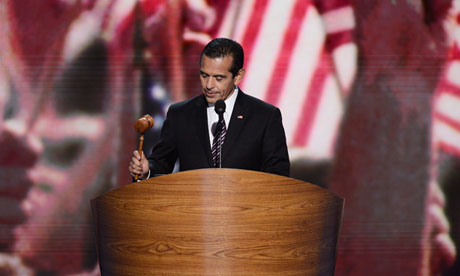
At the formal opening of the day’s business, the convention chairman, Antonio Villaraigosa, proposed a vote to return to the document its past commitment to Jerusalem as the Israeli capital as well as a reference to God.” (The Guardian, September 5, 2012)
The backlash caused by the dishonest handling of the gavel and the vote on this deeply unpopular amendment will ripple through the Democratic Party for years to come.
Handling his gavel so clumsily, so dishonestly, Villaraigosa must have been under strict orders from above.

Apparently Chuck Schumer played a heavy hand as he strode through the thick crowd surrounded by a beefy phalanx of security agents before, during and after Villaraigosa’s gavel fiasco.

Antonio Villaraigosa
The bottom line is that the majority of the delegates to the Democratic National Convention opposed the Jerusalem plank.

Netanyahu’s arrogant White House press conference and his harangue of Congress have not been forgotten by the rank-and-file Democrats who want to see a swift end to all US wars in the Middle East supported by a sustainable peace treaty between the Israelis and Palestinians.

Everyone is waiting for Netanyahu’s visit to New York later this month when he will harangue the UN General Assembly and demand US backing for a unilateral attack on Iran.

During his visit to the USA, Netanyahu will confer with his pals in New York and on Capitol Hill in the next episode of his strenuous campaign to unseat his nemesis:  Barack Hussein Obama.


Tuesday, August 21, 2012

Congress Agrees To Expand Presidential Power

Personal Liberty
Sam Rolley

President Barack Obama signs a bill into law earlier
this month. Staff Secretary Doug Kramer prepares
the next bill for the President's signature.
Political polarization is supposedly at an all-time high as Americans enjoy a tedious election-season that the populace is told pits big government, socialist values that would impress the likes of Karl Marx against small government, pro-business ideals that should satisfy any conservative.

So polarized is the political landscape that legislators are unable to produce a budget for the United States because of sheer gridlock, the conversation about social issues has denigrated into screaming on both sides and it is political heresy to come to agreement with your political opponent no matter what heights of idiocy you must reach in proving your dissident.

But lawmakers recently and oddly came to agreement that the power of the President should be met with less political opposition, at least when it comes to making certain appointments.

As Americans have been busy trying to make sense of the upcoming Presidential election, Congress quietly agreed on a matter of importance: making sure that, without Senate approval and without retribution, 170 people can be pointed to powerful positions by whoever assumes the Presidency.
The Presidential Appointment Efficiency and Streamlining Act of 2011 — sponsored by Senators Joe Lieberman (I-Conn.), Chuck Schumer (D-N.Y.), Susan Collins (R-Maine) and Lamar Alexander (R-Tenn.) — eliminates the need to obtain Senate confirmation for about 170 executive branch posts. The act was passed by the Senate last summer, met House approval last month and was signed into law by President Barack Obama earlier this month.

The legislation’s sponsors claim it simply reduces the amount of time it takes for a newly elected President to make low-level appointments. But the list includes top public-policy positions within the following Departments: Defense, State, Labor, Treasury, Housing and Urban Development, and Veterans Affairs. A full list can be viewed here.
Lieberman said of the legislation:

This bipartisan legislation represents the Senate at its best. A problem was identified, and Democrats and Republicans worked together to craft a solution. Now, future Administrations will be able to get their teams in place more quickly, and the Senate will be able focus its time and energy on the most important Executive Branch appointments. In no way does this bill erode the Senate’s role of “advice and consent.” Rather, it strengthens the Senate’s power by freeing us up to concentrate on nominees who will actually shape national policy.

Despite Lieberman’s assertion that many of these positions do little in the way of shaping public policy, Americans concerned about the growing power of the Presidency might argue that lessening the vetting process is just another step in the direction of complete top-down political control in the Nation.


Wednesday, October 12, 2011

Everyone Missed It, But China Has ALREADY Retaliated For Last Night's Big Currency Vote In The Senate

Editor's Note:  Looks like China was looking for an excuse.

Business Insider
Joe Weisenthal

Things move fast.


Last night, the Senate passed a bill that would impose tariffs on currency manipulators like China.
It's not expected to pass the House or get signed by The President, but China has already responded to the provocation.

As Nomura explains, it fixed the yuan shockingly low against the dollar last night, moving it in the exact opposite direction the U.S. wants:

The disappointing USD/CNY fix today, 116 pips higher than yesterday’s (to 6.3598) and compared with our model forecast of 23 pips could reflect an element of Chinese retaliation to the Senate’s vote. The last time we saw such a big fix (compared to the previous session) was on 29 November 2010 (147 pips), which came on the back of EUR weakness (broad USD strength) on EU-related debt concerns (primarily Ireland). Previous large USD/CNY fixes that surprised on the upside (in October-November 2010) coincided with either North Korea provocation or followed major political events (the G20 Leaders summit, Premier Wen Jiabao’s October visit to Europe)
However, before you think we're looking at a full-on trade war, some caveats:

1)    The approach of the G20 Leaders summit (3-4 Nov) could still see USD/CNY resume lower fixings (after today’s ‘warning shot’);

2)    Macro data continues to support CNY appreciation over the medium term. This Friday’s September CPI will be closely watched, with Nomura forecasting 6.3% y-o-y (Consensus, 6.1%; Previous, 6.2% – Exhibit 2). Thursday’s trade data should also be supportive, with September exports expected to rise by 20% (Consensus: 20.8%) and the trade surplus expected to widen to US$20.3bn (from US$17.8bn in August); and

3)    It is still too early to conclude that the Schumer bill will actually become law.


Wednesday, April 20, 2011

A Year After BP Blowout, Lawmakers Say Drill

A year after the BP oil spill put the brakes on full-bore domestic production, it's

back to "drill, baby, drill" as federal lawmakers, anxious about rising gasoline prices, push legislation to open offshore leases and make it easier to drill domestically.

Nowhere is this emphasis on increasing domestic production louder than in the Gulf Coast states hit hard by the oil spill - Louisiana, Mississippi and Texas - where the calls for drilling from members of both parties are louder than last year's calls for caution as oil spewed into the Gulf of Mexico.

"Louisiana is home to the nation's oil and gas industry that is trying to get back to work after the Deepwater Horizon accident," said Sen. Mary Landrieu, D-Louisiana. The Pelican State lawmaker, one of the Gulf Coast's few Democrats, is critical of the drilling moratorium imposed by the Obama administration after the spill, as well as its slow restarting of the oil well permitting process on the Outer Continental Shelf.

"We need to rapidly accelerate the permitting process in the Gulf to increase production," she said, as well as expanding it to offshore Alaska and other areas.

Last April 20, the Deepwater Horizon oil platform exploded, killing 11 men and injuring 17. The rig's blowout preventer failed, sending oil gushing into the Gulf of Mexico for three months, causing widespread economic and environmental damage. The leak was stopped on July 15, after more than 4.9 million barrels of crude oil contaminated the Gulf. The wellhead was permanently sealed on Sept. 19.

BP initially underestimated the size of the spill. Tony Hayward, then BP's chief executive, downplayed its impact without much challenge from the Obama administration, which coordinated the response to the spill with the oil company.

Still, Gulf Coast lawmakers say, it's time to get back into the oil business. Republican lawmakers are pushing legislation that would give leaseholders an additional year to make up for production lost during the moratorium.

"At the one-year anniversary mark, I believe progress has been made to clean up after the spill and to begin rebuilding the economy along the coast," said Sen. Thad Cochran, R-Mississippi. "I will continue to support legislation to ensure that Gulf energy exploration, and the jobs associated with that industry, are not unjustifiably obstructed by the federal bureaucracy."

A CNN/Opinion Research Corporation survey released Tuesday indicates that 69 percent of Americans favor increased offshore drilling. That's up 20 percentage points from last June, while the oil spill was still in progress, and is back to the level of support seen in the summer of 2008.

In the Republican-controlled House of Representatives, the Natural Resources Committee last week approved three bills that would force the Interior Department to speed up permits, open leases in the Gulf of Mexico and off the Virginia coast, set a domestic production goal and, as Chairman Doc Hastings, R-Washington, said, "end the administration's de facto moratorium in the Gulf of Mexico."

The House is expected to vote on the bills, which includes the one-year extension for leaseholders, when Congress returns from its spring break.

The reason for the push: instability in the Middle East and $4-a-gallon gasoline in several states, with the national average price for a gallon of regular unleaded at $3.83 a gallon. Crude oil reached a high of $112 a barrel on April 8, with the Energy Information Administration warning that "crude oil prices are currently at their highest level since 2008."

Environmental activists are alarmed at what they say are short memories by lawmakers on the dangers of offshore drilling.

"We are seeing the chronic effects of the oil spill with 65 (baby) dolphins washing up on the coasts of Mississippi, Alabama and Florida," said Louie Miller, head of the Sierra Club in Mississippi, who added that there have also been 87 dead sea turtles since March 15. "Our concerns are that we haven't recovered from the first disaster."

Tyson Slocum, the director of energy programs for Public Citizen, the grassroots organization founded by Ralph Nader, said, "People tend to forget that the industry screwed this up. BP cut corners." All the legislation moving to open up drilling, he said, is going in the wrong direction. "It's crazy that Congress has not passed reform in response to the largest environmental accident in our history."

But lawmakers from oil-producing states - who are getting an earful from constituents - say drilling has to be part of a comprehensive national energy strategy.

"The lack of a coherent energy policy is one of the drivers that clearly leaves us vulnerable to fluctuating energy prices," said Rep. Michael Burgess, R-Texas. "We feel it, especially in Texas." And drilling, he said, has to be a part of that policy. "We're fooling ourselves if we think we're beyond that point."

Democratic lawmakers from other regions are urging the tapping of the Strategic Petroleum Reserve - the federal government's oil storage tank - to help increase supply and lower prices, and encouraging the administration to promote alternative fuels.

Sen. Charles Schumer, D-New York, is pushing for releasing oil from the Strategic Petroleum Reserve. But President Barack Obama cautioned in a television interview Friday that the U.S. should be "very careful" about going that route. "The Strategic Petroleum Reserve was designed for when oil actually shuts off," Obama told ABC.

Oil industry supporters in Congress say that the U.S. has to drill.

"The longer this administration chooses to delay on issuing permits," said Sen. John Cornyn, R-Texas, "the longer they endanger jobs for thousands of America's Gulf Coast workers."