


 Posts
Posts


Welcome to 9-11 Movies
-
The idea behind this site is to present the most rudimentary, simplified,
common-sense information about the anomalies that fuel our doubts about the
offic...
Showing posts with label Chernobyl. Show all posts
Showing posts with label Chernobyl. Show all posts
Friday, May 4, 2012
Wednesday, April 11, 2012
The Army Is Stocking Up On A Ton Of Anti-Radiation Pills To Protect Troops
Military and Defense
 While checking out the Federal Business Opportunities network, we came across a listing by the Defense Logistics Agency— the Troop Support branch — seeking a supply of potassium iodide tablets.
Scrolling through the online solicitation, you'll see the U.S. Army Medical Material Agency wants to ensure "critical operational forces are protected in the event of nuclear fallout."
The FDA recommends taking potassium iodide in radiation emergencies to block cancer-causing radioiodines that would otherwise be absorbed by the body's thyroid — the gland in your neck that regulates adrenaline and metabolism, along with doing a bunch of other stuff we need to survive.
The U.S. has bought potassium iodide tablets in the past, and is now looking ahead to scenarios, possibly spurred by last year's Fukushima crisis.
As the federal solicitation is quick to point out, "The recent earthquake in Japan in March of 2011 and the resultant nuclear crisis has renewed interest in this item."
The pills are also used in case of terrorist-related release of radioactivity from nuclear weapons or dirty-bombs, says Anbex Inc., the only FDA-approved manufacturer of the pills.
Of course, potassium iodide would also come in handy if there were to be an airstrike against a target laden will nuclear material, say, like the sites in Iran. One of the big concerns surrounding the practical devastation of those nuclear facilities is the radiation it will unleash into the surroundings.
Destroying one of the most likely Iranian targets, the 1000-megawatt Bushehr nuclear plant, would create just such a concern.

The 1,000-megawatt reactor is what was in place at Chernobyl at the time of its meltdown, and though there were four in the Ukraine, the radiation exposure from blowing up even a single reactor would be immense.
But how immense, no one is really quite sure.
When Israel destroyed Iraq's Osiris 70-megawatt nuclear reactor in a bold 1981 attack, the plant hadn't yet been stocked with nuclear fuel so there was no risk of radiation.
But an attack on Iran's Bushehr plant, which has been stocked with radioactive fuel rods since 2010, would be an incalculable mess.
While the potassium iodide tablets wanted by the Army don't necessarily mean a thing, they'll sure be nice to have if an attack against Iran eventually goes down.
And until that actually happens, the only clue we'll have about what the Pentagon may be planning is in small inconclusive supply requests like this.

Scrolling through the online solicitation, you'll see the U.S. Army Medical Material Agency wants to ensure "critical operational forces are protected in the event of nuclear fallout."
The FDA recommends taking potassium iodide in radiation emergencies to block cancer-causing radioiodines that would otherwise be absorbed by the body's thyroid — the gland in your neck that regulates adrenaline and metabolism, along with doing a bunch of other stuff we need to survive.
The U.S. has bought potassium iodide tablets in the past, and is now looking ahead to scenarios, possibly spurred by last year's Fukushima crisis.
As the federal solicitation is quick to point out, "The recent earthquake in Japan in March of 2011 and the resultant nuclear crisis has renewed interest in this item."
The pills are also used in case of terrorist-related release of radioactivity from nuclear weapons or dirty-bombs, says Anbex Inc., the only FDA-approved manufacturer of the pills.
Of course, potassium iodide would also come in handy if there were to be an airstrike against a target laden will nuclear material, say, like the sites in Iran. One of the big concerns surrounding the practical devastation of those nuclear facilities is the radiation it will unleash into the surroundings.
Destroying one of the most likely Iranian targets, the 1000-megawatt Bushehr nuclear plant, would create just such a concern.

The 1,000-megawatt reactor is what was in place at Chernobyl at the time of its meltdown, and though there were four in the Ukraine, the radiation exposure from blowing up even a single reactor would be immense.
But how immense, no one is really quite sure.
When Israel destroyed Iraq's Osiris 70-megawatt nuclear reactor in a bold 1981 attack, the plant hadn't yet been stocked with nuclear fuel so there was no risk of radiation.
But an attack on Iran's Bushehr plant, which has been stocked with radioactive fuel rods since 2010, would be an incalculable mess.
While the potassium iodide tablets wanted by the Army don't necessarily mean a thing, they'll sure be nice to have if an attack against Iran eventually goes down.
And until that actually happens, the only clue we'll have about what the Pentagon may be planning is in small inconclusive supply requests like this.
Tuesday, December 27, 2011
No-man's land attests to Japan's nuclear nightmare
Seattle Pi
DAvid Guttenfelder
Eric Talmadge

DAvid Guttenfelder
Eric Talmadge

IWAKI, Japan (AP) — Fukushima was just emerging from the snows of winter when the disaster hit — a 9.0-magnitude earthquake, the strongest in Japan's recorded history, followed by a tsunami.
The wall of water destroyed much of the northeastern coast on March 11. In the northeast region of Fukushima, a different disaster was brewing: Three reactors at the Fukushima Dai-ichi nuclear plant were melting down, irreparably damaged by the super tremor.
Now, as the snows are beginning to fall again, the government has announced the plant has attained a level of stability it is calling a "cold shutdown." As many as 3,000 workers — plumbers, engineers, technicians — stream into the facility each day.
The tsunami's destruction is still visible. Mangled trucks, flipped over by the wave, sit alongside the roads inside the complex, piles of rubble stand where the walls of the reactor structures crumbled and large pools of water still cover parts of the campus.
In the ghost towns around Fukushima Dai-ichi, vines have overtaken streets, feral cows and owner-less dogs roam the fields. Dead chickens rot in their coops.
The tens of thousands of people who once lived around the plant have fled. They are now huddling in gymnasiums, elementary school classrooms, bunking with friends, sometimes just sleeping in their cars, moving from place to place as they search for alternatives.
For those who lived on the perimeter of the Fukushima Dai-ichi nuclear plant, fliers used to come in the mail every so often explaining that someday this might happen. Most recipients saw them as junk mail, and threw them away without a second glance. For those who did read them, the fliers were always worded to be reassuring — suggesting that although a catastrophic nuclear accident was extremely unlikely, it could require evacuating the area.
Never was it even hinted that the evacuation could last years, or decades.
At most of the shelters, food is doled out military-style, at set times. Personal space is extremely limited, often just big enough to fit a futon and the collective snoring at night makes sleep fitful, at best. Baths are public, cramped, dark.
The total amount of radiation released from the plant is still unknown, and the impact of chronic low-dose radiation exposures in and around Fukushima is a matter of scientific debate.
Recent studies also suggest Japan continues to significantly underestimate the scale of the disaster — which could have health and safety implications far into the future.
According to a study led by Andreas Stohl the Norwegian Institute for Air Research, twice as much radioactive cesium-137 — a cancer-causing agent — was pumped into the atmosphere than Japan had announced, reaching 40 percent of the total from Chernobyl. The French Institute for Radiological Protection and Nuclear Safety found 30 times more cesium-137 was released into the Pacific than the plant's owner has acknowledged.
Under a detailed roadmap, plant operator Tokyo Electric Power Co. will remove the melted nuclear fuel, most of which is believed to have fallen to the bottom of the core or even down to the bottom of the larger, beaker-shaped containment vessel, a process that is expected to begin in 10 years.
All told, decommissioning the plant will likely take 40 years.
The wall of water destroyed much of the northeastern coast on March 11. In the northeast region of Fukushima, a different disaster was brewing: Three reactors at the Fukushima Dai-ichi nuclear plant were melting down, irreparably damaged by the super tremor.
Now, as the snows are beginning to fall again, the government has announced the plant has attained a level of stability it is calling a "cold shutdown." As many as 3,000 workers — plumbers, engineers, technicians — stream into the facility each day.
The tsunami's destruction is still visible. Mangled trucks, flipped over by the wave, sit alongside the roads inside the complex, piles of rubble stand where the walls of the reactor structures crumbled and large pools of water still cover parts of the campus.
In the ghost towns around Fukushima Dai-ichi, vines have overtaken streets, feral cows and owner-less dogs roam the fields. Dead chickens rot in their coops.
The tens of thousands of people who once lived around the plant have fled. They are now huddling in gymnasiums, elementary school classrooms, bunking with friends, sometimes just sleeping in their cars, moving from place to place as they search for alternatives.
For those who lived on the perimeter of the Fukushima Dai-ichi nuclear plant, fliers used to come in the mail every so often explaining that someday this might happen. Most recipients saw them as junk mail, and threw them away without a second glance. For those who did read them, the fliers were always worded to be reassuring — suggesting that although a catastrophic nuclear accident was extremely unlikely, it could require evacuating the area.
Never was it even hinted that the evacuation could last years, or decades.
At most of the shelters, food is doled out military-style, at set times. Personal space is extremely limited, often just big enough to fit a futon and the collective snoring at night makes sleep fitful, at best. Baths are public, cramped, dark.
The total amount of radiation released from the plant is still unknown, and the impact of chronic low-dose radiation exposures in and around Fukushima is a matter of scientific debate.
Recent studies also suggest Japan continues to significantly underestimate the scale of the disaster — which could have health and safety implications far into the future.
According to a study led by Andreas Stohl the Norwegian Institute for Air Research, twice as much radioactive cesium-137 — a cancer-causing agent — was pumped into the atmosphere than Japan had announced, reaching 40 percent of the total from Chernobyl. The French Institute for Radiological Protection and Nuclear Safety found 30 times more cesium-137 was released into the Pacific than the plant's owner has acknowledged.
Under a detailed roadmap, plant operator Tokyo Electric Power Co. will remove the melted nuclear fuel, most of which is believed to have fallen to the bottom of the core or even down to the bottom of the larger, beaker-shaped containment vessel, a process that is expected to begin in 10 years.
All told, decommissioning the plant will likely take 40 years.
Friday, November 18, 2011
Nuclear Madness: Iran, Kuwait or the IAEA?
Global Research
Felicity Arbuthnot
 “The Public cannot be too curious concerning the characters of public men.” (Samuel Adams, letter to James Warren, 1775.)
As the sabre rattling against Iran becomes more deafening, week on week, with threats of the nuclear insanity of potentially, deliberately, creating a few Chernobyls or a Fukushima, by bombing working nuclear power plants, another potential nuclear madness is planned, geographically “next door.”
The IAEA appears to be behaving in as partisan, shameless way regarding Iran, as it did with Iraq. Then, accusations, with considerable justification, were that the inspection teams were more about spying then neutral observation. “The way back to (the UN) was via Tel Aviv”, remarked one former inspector, memorably.
Gareth Porter has meticulously, comprehensively trashed (i) the IAEA’s latest Report on Iran, showing disturbing parallels with the tragic Iraq fiasco. Iraq had Ahmed Chalabi, Iyad Allawi and “Curveball”, selling fairy stories. Iran, seemingly, has an expert in nanodiamonds, Vyacheslav Danilenko, apparently doubling as a nuclear weapons expert, and a plethora of unidentified spokespersons for “Member States.” Hardly rigid, verifiable scholarship.
Previous “concerns” expressed, has been that Iran has vast oil reserves, so there must be a weapons related reason to expand nuclear power. However Iran has been under increasingly stringent sanctions since 14th November 1979, ironically, necessitating additional sources of energy – for which it is now being threatened with Iraq’s fate.
Yet headlines in the Middle East, warning: “Most volatile region in the world is going nuclear”, one with a helpful map of “volatile” countries with advanced nuclear ambitions, seem to have escaped IAEA notice. Iran, of course, has no history of belligerence towards its neighbours, for decades. Indeed, in 2003, in spite of the terrible cost of the eight year war after the 1980 (Western driven) invasion by Iraq, told that the country was still a “threat to its neighbours” by Washington, Tehran repeatedly responded that it was not.
Felicity Arbuthnot
As the sabre rattling against Iran becomes more deafening, week on week, with threats of the nuclear insanity of potentially, deliberately, creating a few Chernobyls or a Fukushima, by bombing working nuclear power plants, another potential nuclear madness is planned, geographically “next door.”
The IAEA appears to be behaving in as partisan, shameless way regarding Iran, as it did with Iraq. Then, accusations, with considerable justification, were that the inspection teams were more about spying then neutral observation. “The way back to (the UN) was via Tel Aviv”, remarked one former inspector, memorably.
Gareth Porter has meticulously, comprehensively trashed (i) the IAEA’s latest Report on Iran, showing disturbing parallels with the tragic Iraq fiasco. Iraq had Ahmed Chalabi, Iyad Allawi and “Curveball”, selling fairy stories. Iran, seemingly, has an expert in nanodiamonds, Vyacheslav Danilenko, apparently doubling as a nuclear weapons expert, and a plethora of unidentified spokespersons for “Member States.” Hardly rigid, verifiable scholarship.
Previous “concerns” expressed, has been that Iran has vast oil reserves, so there must be a weapons related reason to expand nuclear power. However Iran has been under increasingly stringent sanctions since 14th November 1979, ironically, necessitating additional sources of energy – for which it is now being threatened with Iraq’s fate.
Yet headlines in the Middle East, warning: “Most volatile region in the world is going nuclear”, one with a helpful map of “volatile” countries with advanced nuclear ambitions, seem to have escaped IAEA notice. Iran, of course, has no history of belligerence towards its neighbours, for decades. Indeed, in 2003, in spite of the terrible cost of the eight year war after the 1980 (Western driven) invasion by Iraq, told that the country was still a “threat to its neighbours” by Washington, Tehran repeatedly responded that it was not.
Tuesday, August 9, 2011
Experts: Fukushima 'off-scale' lethal radiation level infers millions dying
Examiner
Deborah Dupre
Fukushima nuclear power plant radiation recordings of external gamma radiation have been so high this week, they went off scale said veteran nuclear expert Arnie Gunderson on Thursday after the famous physicist, Dr. Chris Busby told the Japanese people this week that radioactive air contamination there is now 300 times that of Chernobyl and 1000 times the atomic bomb peak in 1963, inferring that hundreds of millions of people are now dying from Fukushima radiation, including people in the United States.
If noticing unusual amounts of hair falling out, confusion, nose bleeds or other odd symptoms typical of radiation sickness, it might be due to the United States record high levels of radiation, now multiple times acceptable safety limits not only on the west coast, but also in other locations around the nation.
Because Fukushima radiation data retrieval and interpretation has been so complex or non-existent for the concerned public, citizen reporters in Japan and United States have now established easily accessible ways to view radiation levels on the internet.
Deborah Dupre
 |
| On this atomic bombing of Japan anniversary, at Hiroshima, radiation victims will call for an end to nuclear industry |
If noticing unusual amounts of hair falling out, confusion, nose bleeds or other odd symptoms typical of radiation sickness, it might be due to the United States record high levels of radiation, now multiple times acceptable safety limits not only on the west coast, but also in other locations around the nation.
Because Fukushima radiation data retrieval and interpretation has been so complex or non-existent for the concerned public, citizen reporters in Japan and United States have now established easily accessible ways to view radiation levels on the internet.
Fukushima radiation depopulation unfathomable: Possibly 100s of millions deaths
Dr Janette Sherman, a highly respected physician and acknowledged expert in radiation exposure who has reported a north-east United States 35% baby death spike since Fukushima fall-out reached the nation, concurs with estimates that world wide, the Chernobyl Kill is one million people killed to date reported NOVA News. Extrapolating, worldwide deaths by Fukushima radiation could eventually be hundreds of millions of people, becoming the most significant depopulation event to date.
Dr. Chris Busby, world famous physicist, said tests conducted at the respected Harwell Radiation Laboratory in England demonstrate that airborne radiation in Japan is 1,000 times higher than radioactive “fallout” at the peak in 1963 of H-Bomb detonations by nuclear powers. In March, Busby had estimated that Fukushima radiation to be 72,000 times greater than what the United States released at Hiroshima.
"Let’s wipe the Tokyo Electric Power Company and the General Electric officials and policy makers off the face of the Earth, as they manifestly deserve," asserted Dr. Busby when addressing the Japanese this week.
Thirty-nine year nuclear industry veteran Arnie Gunderson of Fairwinds stated Tuesday,"There will continue to be enormous spikes for at least ten years."
Dr. Busby advocates not only independent studies of the nuclear catastrophe. He received a resounding applause when he told the Japanese people this week that in his opinion, scientists who said this accident was not a problem must be prosecuted.
"Many nuclear scientists said it was not a problem when the knew it was a serious accident. People who listened to those scientists and did not run away when they should have. Because of that, people will die."
Thursday, June 23, 2011
What Happened to Media Coverage of Fukushima?
Center for Media and Democracy
While the U.S. media has been occupied with Anthony Weiner, the Republican presidential candidates and Bristol Palin's memoir, coverage of Japan's Fukushima Daiichi nuclear power plant disaster has practially fallen off the map. Poor mainstream media coverage of Japan's now months-long struggle to gain control over the Fukushima disaster has deprived Americans of crucial information about the risks of nuclear power following natural disasters. After a few weeks of covering the early aftermath of Japan's earthquake and tsunami, the U.S. media moved on, leaving behind the crisis at Fukushima which continues to unfold. U.S. politicians, like Rep. Joe Barton of Texas, have made disappointing and misleading statements about the relative safety of nuclear power and have vowed to stick by our nuclear program, while other countries, like Germany and Italy, have taken serious steps to address the obvious risks of nuclear power -- risks that the Fukushima disaster made painfully evident, at least to the rest of the world.
Efforts to bring problems at Fukushima under control are not going well, either. Japanese authorities only just recently admitted that nuclear fuel in the three damaged Fukushima reactors has likely burned through the vessels holding it, a scenario called "melt-through", that is even more serious than a core meltdown. Months of spraying seawater on the plant's three melted-down fuel cores -- and the spent fuel stored on site -- to try and cool them has produced 26 million of gallons of radioactive wastewater, and no place to put it.
After a struggle, the Tokyo Electric Power Company (TEPCO), finally managed to put in place a system to filter radioactive particles out of the wastewater, but it broke down soon after it started operating. A filter that was supposed to last a month plugged up with radioactive material after just five hours, indicating there is more radioactive material in the water than previously believed. Meanwhile, TEPCO is running out of space to store the radioactive water, and may be forced to again dump contaminated water into the Pacific Ocean. TEPCO already dumped some water into the ocean weeks ago, amid protests from fisherman, other countries and environmental organizations. And even if TEPCO does successfully filter the contaminated water and manage to bring its radioactivity down to acceptable levels, the utility will still have to deal with the pile of radioactive sludge the process will produce. The plan they've come up with to deal with the sludge is to seal it in drums and discard it into the ocean, which may cause even more problems. Greenpeace has already found levels of radiation exceeding legal limits in seaweed and shellfish samples gathered more than 12 miles away from the plant. The high levels of radiation in the samples indicate that leaks from the plant are bigger than TEPCO has revealed so far.
The cascade of other problems caused by the Fukushima disaster include the costs of relocating residents from the affected area around the plant, compensating people for the loss of their homes and belongings, and a drop-off in global sales of goods and products exported from Japan due to fear of radioactive contamination.
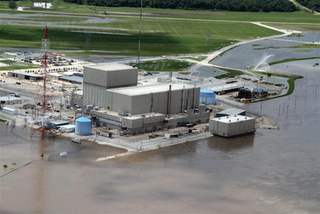 Nebraska's Cooper Nuclear plant, amid floodwaters (Photo: Journal Star) Tensions are also rising over two U.S. nuclear reactors in Nebraska located on the banks of the Missouri River, which is now at flood stage. On June 20, the Omaha, Nebraska World Herald reported that flood waters from the Missouri River came within 18 inches of forcing the Cooper Nuclear Station near Brownville, Nebraska, to shut down. Officials are poised to shut down the Cooper plant when river reaches a level of 902 feet above sea level. The plant is 903 feet above sea level. The Fort Calhoun Nuclear Plant, 20 miles north of Omaha, issued a "Notification of Unusual Event" to the Nuclear Regulatory Commission on June 6 due to local flooding. That plant is currently shut down for refueling, but will not restart because of the flooding. Compounding worries over these two plants is a shortage of sand needed to fill massive numbers of sandbags to hold off Missouri River floodwaters. One ton of sand makes just 60 sandbags, and hundreds of thousands of sandbags are needed to help save towns along the river from flooding. Sand is obtained from dredging the riverbed -- and the companies that sell sand can't dredge the river while it is flooding. These plants are already in a risky situation, and the flooding in Nebraska could easily be worsened just by a summer afternoon cloudburst.
While the U.S. media has been occupied with Anthony Weiner, the Republican presidential candidates and Bristol Palin's memoir, coverage of Japan's Fukushima Daiichi nuclear power plant disaster has practially fallen off the map. Poor mainstream media coverage of Japan's now months-long struggle to gain control over the Fukushima disaster has deprived Americans of crucial information about the risks of nuclear power following natural disasters. After a few weeks of covering the early aftermath of Japan's earthquake and tsunami, the U.S. media moved on, leaving behind the crisis at Fukushima which continues to unfold. U.S. politicians, like Rep. Joe Barton of Texas, have made disappointing and misleading statements about the relative safety of nuclear power and have vowed to stick by our nuclear program, while other countries, like Germany and Italy, have taken serious steps to address the obvious risks of nuclear power -- risks that the Fukushima disaster made painfully evident, at least to the rest of the world.
Problems Multiply
News outlets in other countries have been paying attention to Fukushima, though, and a relative few in this country have as well. A June 16, 2011 Al Jazeera English article titled, "Fukushima: It's much worse than you think," quotes a high-level former nuclear industry executive, Arnold Gunderson, who called Fukushima nohting less than "the biggest industrial catastrophe in the history of mankind." Twenty nuclear cores have been exposed at Fukushima, Gunderson points out, saying that, along with the site's many spent-fuel pools, gives Fukushima 20 times the release potential of Chernobyl.Efforts to bring problems at Fukushima under control are not going well, either. Japanese authorities only just recently admitted that nuclear fuel in the three damaged Fukushima reactors has likely burned through the vessels holding it, a scenario called "melt-through", that is even more serious than a core meltdown. Months of spraying seawater on the plant's three melted-down fuel cores -- and the spent fuel stored on site -- to try and cool them has produced 26 million of gallons of radioactive wastewater, and no place to put it.
After a struggle, the Tokyo Electric Power Company (TEPCO), finally managed to put in place a system to filter radioactive particles out of the wastewater, but it broke down soon after it started operating. A filter that was supposed to last a month plugged up with radioactive material after just five hours, indicating there is more radioactive material in the water than previously believed. Meanwhile, TEPCO is running out of space to store the radioactive water, and may be forced to again dump contaminated water into the Pacific Ocean. TEPCO already dumped some water into the ocean weeks ago, amid protests from fisherman, other countries and environmental organizations. And even if TEPCO does successfully filter the contaminated water and manage to bring its radioactivity down to acceptable levels, the utility will still have to deal with the pile of radioactive sludge the process will produce. The plan they've come up with to deal with the sludge is to seal it in drums and discard it into the ocean, which may cause even more problems. Greenpeace has already found levels of radiation exceeding legal limits in seaweed and shellfish samples gathered more than 12 miles away from the plant. The high levels of radiation in the samples indicate that leaks from the plant are bigger than TEPCO has revealed so far.
The cascade of other problems caused by the Fukushima disaster include the costs of relocating residents from the affected area around the plant, compensating people for the loss of their homes and belongings, and a drop-off in global sales of goods and products exported from Japan due to fear of radioactive contamination.
Domestic Nuclear Worries
For Americans who think "out of sight, out of mind" or "it can't happen here" when it comes to Fukishima and its ramifications, think again. Janette Sherman, M.D., an internal medicine specialist, and Joseph Magano, an epidemiologist with the Radiation and Public Health Project research group, noticed a 35% jump in infant mortality in eight northwestern U.S. cities located within 500 miles of the Pacific coast since the Fukushima meltdown. They wrote an essay, published by CounterPunch, suggesting there may be a link between the statistic and the Fukushima disaster. They cited similar problems with infant mortality among people who were exposed to nuclear fallout from Chernobyl. Sherman and Magano urge that steps be taken to measure the levels of radioactive isotopes in the environment of the Pacific northwest, and in the bodies of people in these areas, to determine if nuclear fallout from Fukushima could, in fact, be related to the spike in infant mortality.Nebraska's Cooper Nuclear plant, amid floodwaters (Photo: Journal Star) Tensions are also rising over two U.S. nuclear reactors in Nebraska located on the banks of the Missouri River, which is now at flood stage. On June 20, the Omaha, Nebraska World Herald reported that flood waters from the Missouri River came within 18 inches of forcing the Cooper Nuclear Station near Brownville, Nebraska, to shut down. Officials are poised to shut down the Cooper plant when river reaches a level of 902 feet above sea level. The plant is 903 feet above sea level. The Fort Calhoun Nuclear Plant, 20 miles north of Omaha, issued a "Notification of Unusual Event" to the Nuclear Regulatory Commission on June 6 due to local flooding. That plant is currently shut down for refueling, but will not restart because of the flooding. Compounding worries over these two plants is a shortage of sand needed to fill massive numbers of sandbags to hold off Missouri River floodwaters. One ton of sand makes just 60 sandbags, and hundreds of thousands of sandbags are needed to help save towns along the river from flooding. Sand is obtained from dredging the riverbed -- and the companies that sell sand can't dredge the river while it is flooding. These plants are already in a risky situation, and the flooding in Nebraska could easily be worsened just by a summer afternoon cloudburst.Tuesday, June 14, 2011
Confessions of a Nuclear Power Safety Expert
Miller-McMCune
Corners he saw cut there eventually soured Silvi on that endeavor. His next position — at the Italian Commission on Nuclear and Alternative Energy Sources, which included work on nuclear disarmament — eventually soured him on nuclear energy itself.
“[If we] continue with nuclear power, there will definitely be worse accidents,” he argued in the wake of Japan’s Fukushima Daiichi disaster. Over the weekend, Italian voters agreed and overwhelming rejected restarting nuclear power in their country.
“Why not consider Three Mile Island, Chernobyl and Fukushima as warnings of greater catastrophes to come and avoid the inevitable by shutting them down, much like changing your diet and/or lifestyle after finding out that your cholesterol or blood pressure is elevated, rather than continuing down the same path until a heart attack or stroke strikes?”
In the meantime, he suggests that wrangling existing power plants requires a global response toward the dangers he predicts.
“Instead of a Kyoto accord,” he says, “we will have to have some kind of multilateral nuclear agreement to deal with such threats.”
In the last two decades, Silvi has gone on to acclaim in the world of solar energy, where has been president of the International Solar Energy Society and founder of the Italian Group for the History of Solar Energy.
Silvi originally worked in the north of Italy as a engineer. He did not like the polluted Po River valley, where the smell from various industries near his flat — despite his boss’ assurances of “You’ll get used to it” — annoyed him.
Then the 1973 Arab-Israeli War and its attendant oil crisis prompted the Italian government to consider nuclear energy, and a door opened for Silvi. The newly formed Italian National Commission on Nuclear Energy sought out young engineers like Silvi, who saw the opportunity as a means to return home to Rome. His top scores on the entrance tests won him a spot in the Directorate for Nuclear Safety and Radioactive Protection, and in 1975, the directorate tasked Silvi to examine and analyze threats to the well-being of nuclear power plants from the outside environment.
“I was looking at low-possibility events, like a meteor striking the housing of a reactor or a car thrown at it by a tornado. These definitely had a small chance of happening, but the end result would have been horrific.” Plus, he says now, the proliferation of nuclear plants just adds more targets.
“Many laughed at such speculation and planning,” he says, “but then again, how many would have taken seriously a recommendation of extending the height of the seawall at Fukishima another six meters? They would have questioned your sanity, if you had argued that the 10-meter barrier was inadequate.
“Our problem is that we don’t know what will happen on any scale of time. Such uncertainty is OK when dealing with train trips or dinner choices. But it becomes problematic when considering the possible spread of very dangerous material that will stay deadly for hundreds, if not thousands, of years.”
In his introduction to risk analysis, Silvi provides a very simple equation: R=PxC. In English, that translates to the probability of something happening (the P) times the consequences if it does (C) equals the risk to society (R).
He illustrates this by comparing driving on the Italian highway, the Autostrada, with running a nuclear power station. Driving on the Autostrada has a low risk to the general population. A possibility does exist that you will crash, and perhaps die as a result, but the consequences of the accident to the general society will be next to nil. That’s why countries let almost anyone drive. So a moderately high P times a very low C equals a small risk to society as a whole.
On the other hand, the chance of an earthquake and tsunami of the magnitude that hit Japan are quite remote, especially occurring in tandem, which makes for a tiny P. But the consequences — the C — of them imperiling a nuclear power plant are huge, leading to a much higher risk to society.
That equation played out in the Soviet Union a quarter-century ago at Chernobyl, and the aftereffects still ripple throughout Europe. A 1,600-square-mile exclusionary zone in Ukraine and southern Belarus remains off limits. Students gestated during the Chernobyl disaster in contaminated regions as far north as Sweden and Norway have shown poorer performance in school and lower verbal IQ scores.
Silvi’s sincere assessment of outside threats ultimately butted up against unfortunate human constraints.
“One day,” Silvi recalls, “the boss said, ‘Figure out how far should a nuclear plant be from an airport.’ As I did my study, I found that it wasn’t too easy to protect the reactor from a plane crash. The plant can be perfect from the inside, but the problem arises: How many low-probability events that could result in devastating consequences do you protect against through proper construction before such expenditures make the plant too costly to operate? Even if we could affordably, say, pay to reinforce the plant to withstand a hit from a plane or missile, the question never leaves you — ‘Have I figured in everything that might damage the nuclear reactor over its long lifetime?
“I left the field because I couldn’t do my analyses as I thought necessary. There was this nuclear power plant [the Caroso Nuclear Power Plant] in the north of Italy, along the Po River. An oil pipe broke and caught fire six kilometers from the plant. Oil also spilled into the river. It clogged the reactor’s condenser. After that, my team discovered there were four pipelines less than 500 meters from the plant. I felt it was necessary to determine what was flowing through them.
“But the boss complained, ‘You’re trying to get at too many details,’ and stopped the study. It turned out that some very powerful person owned the pipelines and was hiding what was going through those pipes for tax purposes.”
(Italian voters in 1987 decided to shutter all the nation’s nuclear plants and by 1990 they were closed, although the government opted to restart nuclear power in 2008. Post-Fukushima, the country has placed a moratorium on those plans and over the weekend the country’s voters decisively rejected a return to nuclear power.)
While at the job, Silvi had an epiphany: “If we are struggling to control the spread of nuclear weapons, why should we extend the technology to civilian use?”
Named a resident fellow of the East West Institute in 1986, being the first physical scientist to labor among its political scientists changed his perspective, he explained on the East West Institute’s blog.
With Chernobyl then in everyone’s mind, he spent his early time there explaining how all nuclear reactors are not created equal.
“With a sheet of paper and a pencil, I illustrated the difference. Cupping the curved sheet in my hand, I placed the pencil at the bottom of the curve to simulate the behavior of a western nuclear reactor. If its equilibrium changes, it rolls back and forth until it finds the stable position again. To simulate nuclear reactor such as the one in Chernobyl, I flipped the curved sheet over and placed the pencil on the top of the curve, illustrating that once equilibrium is lost, it is impossible to control.
“… I soon came to the conclusion that neither international cooperation nor technological advancements would guarantee human societies to build and safely run nuclear reactors in all possible conditions on Earth (earthquakes, floods, droughts, tornadoes, wars, terrorism, climate change, tsunamis, pandemics, etc.). I am sadly reminded of this turning point in my life as I listen to the news about the earthquake, tsunami and extremely worrying nuclear crisis in Japan.”
Upon leaving the Institute, he added, he moved away from nuclear energy and focused on solar energy.
“Nuclear today only generates about 12 percent of the developed world’s electricity. By instituting an energy efficiency program,” Silvi suggests, “we could fill the gap caused by shutting them all down and put this malevolent genie back into the bottle.
“Human history is full of madness, full of catastrophes. Imagine if we had nuclear reactors when we fought wars in the past. If you try to consider all the events that might happen over the years, you start to ask, ‘What are the benefits of such an effort, especially when you have opportunities to get electricity in many other ways?’”
 |
| "Why not consider Three Mile Island, Chernobyl and Fukushima as warnings of greater catastrophes to come and avoid the inevitable by shutting them down," Cesare Silvi says. |
Nuclear engineer Cesare Silvi studied unlikely outside threats to nuclear plants in Italy, which soured him on the energy source and caused him to go solar
When Italy decided in the mid-’70s to add nuclear power to its power portfolio, young mechanical and nuclear engineer Cesare Silvi was among those attracted to the opportunities it presented. His work centered on nuclear safety issues — in particular, what might happen if something unexpected struck a power plant.Corners he saw cut there eventually soured Silvi on that endeavor. His next position — at the Italian Commission on Nuclear and Alternative Energy Sources, which included work on nuclear disarmament — eventually soured him on nuclear energy itself.
“[If we] continue with nuclear power, there will definitely be worse accidents,” he argued in the wake of Japan’s Fukushima Daiichi disaster. Over the weekend, Italian voters agreed and overwhelming rejected restarting nuclear power in their country.
“Why not consider Three Mile Island, Chernobyl and Fukushima as warnings of greater catastrophes to come and avoid the inevitable by shutting them down, much like changing your diet and/or lifestyle after finding out that your cholesterol or blood pressure is elevated, rather than continuing down the same path until a heart attack or stroke strikes?”
In the meantime, he suggests that wrangling existing power plants requires a global response toward the dangers he predicts.
“Instead of a Kyoto accord,” he says, “we will have to have some kind of multilateral nuclear agreement to deal with such threats.”
In the last two decades, Silvi has gone on to acclaim in the world of solar energy, where has been president of the International Solar Energy Society and founder of the Italian Group for the History of Solar Energy.
• • • • • • • • • • • • • • •
Then the 1973 Arab-Israeli War and its attendant oil crisis prompted the Italian government to consider nuclear energy, and a door opened for Silvi. The newly formed Italian National Commission on Nuclear Energy sought out young engineers like Silvi, who saw the opportunity as a means to return home to Rome. His top scores on the entrance tests won him a spot in the Directorate for Nuclear Safety and Radioactive Protection, and in 1975, the directorate tasked Silvi to examine and analyze threats to the well-being of nuclear power plants from the outside environment.
“I was looking at low-possibility events, like a meteor striking the housing of a reactor or a car thrown at it by a tornado. These definitely had a small chance of happening, but the end result would have been horrific.” Plus, he says now, the proliferation of nuclear plants just adds more targets.
“Many laughed at such speculation and planning,” he says, “but then again, how many would have taken seriously a recommendation of extending the height of the seawall at Fukishima another six meters? They would have questioned your sanity, if you had argued that the 10-meter barrier was inadequate.
“Our problem is that we don’t know what will happen on any scale of time. Such uncertainty is OK when dealing with train trips or dinner choices. But it becomes problematic when considering the possible spread of very dangerous material that will stay deadly for hundreds, if not thousands, of years.”
In his introduction to risk analysis, Silvi provides a very simple equation: R=PxC. In English, that translates to the probability of something happening (the P) times the consequences if it does (C) equals the risk to society (R).
He illustrates this by comparing driving on the Italian highway, the Autostrada, with running a nuclear power station. Driving on the Autostrada has a low risk to the general population. A possibility does exist that you will crash, and perhaps die as a result, but the consequences of the accident to the general society will be next to nil. That’s why countries let almost anyone drive. So a moderately high P times a very low C equals a small risk to society as a whole.
On the other hand, the chance of an earthquake and tsunami of the magnitude that hit Japan are quite remote, especially occurring in tandem, which makes for a tiny P. But the consequences — the C — of them imperiling a nuclear power plant are huge, leading to a much higher risk to society.
That equation played out in the Soviet Union a quarter-century ago at Chernobyl, and the aftereffects still ripple throughout Europe. A 1,600-square-mile exclusionary zone in Ukraine and southern Belarus remains off limits. Students gestated during the Chernobyl disaster in contaminated regions as far north as Sweden and Norway have shown poorer performance in school and lower verbal IQ scores.
Silvi’s sincere assessment of outside threats ultimately butted up against unfortunate human constraints.
“One day,” Silvi recalls, “the boss said, ‘Figure out how far should a nuclear plant be from an airport.’ As I did my study, I found that it wasn’t too easy to protect the reactor from a plane crash. The plant can be perfect from the inside, but the problem arises: How many low-probability events that could result in devastating consequences do you protect against through proper construction before such expenditures make the plant too costly to operate? Even if we could affordably, say, pay to reinforce the plant to withstand a hit from a plane or missile, the question never leaves you — ‘Have I figured in everything that might damage the nuclear reactor over its long lifetime?
“I left the field because I couldn’t do my analyses as I thought necessary. There was this nuclear power plant [the Caroso Nuclear Power Plant] in the north of Italy, along the Po River. An oil pipe broke and caught fire six kilometers from the plant. Oil also spilled into the river. It clogged the reactor’s condenser. After that, my team discovered there were four pipelines less than 500 meters from the plant. I felt it was necessary to determine what was flowing through them.
“But the boss complained, ‘You’re trying to get at too many details,’ and stopped the study. It turned out that some very powerful person owned the pipelines and was hiding what was going through those pipes for tax purposes.”
(Italian voters in 1987 decided to shutter all the nation’s nuclear plants and by 1990 they were closed, although the government opted to restart nuclear power in 2008. Post-Fukushima, the country has placed a moratorium on those plans and over the weekend the country’s voters decisively rejected a return to nuclear power.)
• • • • • • • • • • • • • • •
So in 1981, Silvi shifted his work to nuclear disarmament with the Agency for the Promotion of European Research, and was working in that field as the Soviet Union spun out of existence. Suddenly, many Warsaw Bloc bases containing atomic arms essentially were abandoned, leaving them vulnerable to nuclear thievery. Silvi was part of a NATO delegation sent to Moscow to account for and inventory atomic supplies throughout Russia.While at the job, Silvi had an epiphany: “If we are struggling to control the spread of nuclear weapons, why should we extend the technology to civilian use?”
Named a resident fellow of the East West Institute in 1986, being the first physical scientist to labor among its political scientists changed his perspective, he explained on the East West Institute’s blog.
With Chernobyl then in everyone’s mind, he spent his early time there explaining how all nuclear reactors are not created equal.
“With a sheet of paper and a pencil, I illustrated the difference. Cupping the curved sheet in my hand, I placed the pencil at the bottom of the curve to simulate the behavior of a western nuclear reactor. If its equilibrium changes, it rolls back and forth until it finds the stable position again. To simulate nuclear reactor such as the one in Chernobyl, I flipped the curved sheet over and placed the pencil on the top of the curve, illustrating that once equilibrium is lost, it is impossible to control.
“… I soon came to the conclusion that neither international cooperation nor technological advancements would guarantee human societies to build and safely run nuclear reactors in all possible conditions on Earth (earthquakes, floods, droughts, tornadoes, wars, terrorism, climate change, tsunamis, pandemics, etc.). I am sadly reminded of this turning point in my life as I listen to the news about the earthquake, tsunami and extremely worrying nuclear crisis in Japan.”
Upon leaving the Institute, he added, he moved away from nuclear energy and focused on solar energy.
“Nuclear today only generates about 12 percent of the developed world’s electricity. By instituting an energy efficiency program,” Silvi suggests, “we could fill the gap caused by shutting them all down and put this malevolent genie back into the bottle.
“Human history is full of madness, full of catastrophes. Imagine if we had nuclear reactors when we fought wars in the past. If you try to consider all the events that might happen over the years, you start to ask, ‘What are the benefits of such an effort, especially when you have opportunities to get electricity in many other ways?’”
Friday, June 10, 2011
Is the Dramatic Increase in Baby Deaths in the US a Result of Fukushima Fallout?
CounterPunch
By JANETTE D. SHERMAN, MD
and JOSEPH MANGANO

(Chernobyl – Consequences of the Catastrophe for People and the Environment, Alexeiy V. Yablokov, Vasily B. Nesterenko, and Alexey V. Nesterenko. Consulting Editor: Janette D. Sherman-Nevinger. New York Academy of Sciences, 2009.)
By JANETTE D. SHERMAN, MD
and JOSEPH MANGANO
U.S. babies are dying at an increased rate. While the United States spends billions on medical care, as of 2006, the US ranked 28th in the world in infant mortality, more than twice that of the lowest ranked countries. (DHHS, CDC, National Center for Health Statistics. Health United States 2010, Table 20, p. 131, February 2011.)
The recent CDC Morbidity and Mortality Weekly Report indicates that eight cities in the northwest U.S. (Boise ID, Seattle WA, Portland OR, plus the northern California cities of Santa Cruz, Sacramento, San Francisco, San Jose, and Berkeley) reported the following data on deaths among those younger than one year of age:
4 weeks ending March 19, 2011 - 37 deaths (avg. 9.25 per week)
10 weeks ending May 28, 2011 - 125 deaths (avg.12.50 per week)
This amounts to an increase of 35% (the total for the entire U.S. rose about 2.3%), and is statistically significant. Of further significance is that those dates include the four weeks before and the ten weeks after the Fukushima Nuclear Power Plant disaster. In 2001 the infant mortality was 6.834 per 1000 live births, increasing to 6.845 in 2007. All years from 2002 to 2007 were higher than the 2001 rate.
Spewing from the Fukushima reactor are radioactive isotopes including those of iodine (I-131), strontium (Sr-90) and cesium (Cs-134 and Cs-137) all of which are taken up in food and water. Iodine is concentrated in the thyroid, Sr-90 in bones and teeth and Cs-134 and Cs-137 in soft tissues, including the heart. The unborn and babies are more vulnerable because the cells are rapidly dividing and the delivered dose is proportionally larger than that delivered to an adult.
Data from Chernobyl, which exploded 25 years ago, clearly shows increased numbers of sick and weak newborns and increased numbers of deaths in the unborn and newborns, especially soon after the meltdown. These occurred in Europe as well as the former Soviet Union. Similar findings are also seen in wildlife living in areas with increased radioactive fallout levels.
(Chernobyl – Consequences of the Catastrophe for People and the Environment, Alexeiy V. Yablokov, Vasily B. Nesterenko, and Alexey V. Nesterenko. Consulting Editor: Janette D. Sherman-Nevinger. New York Academy of Sciences, 2009.)
Levels of radioisotopes were measured in children who had died in the Minsk area that had received Chernobyl fallout. The cardiac findings were the same as those seen in test animals that had been administered Cs-137. Bandashevsky, Y. I, Pathology of Incorporated Ionizing Radiation, Belarus Technical University, Minsk. 136 pp., 1999. For his pioneering work, Prof. Bandashevsky was arrested in 2001 and imprisoned for five years of an eight year sentence.
The national low-weight (under 2500 grams, or 5.5 lbs) rate has risen 23% from 1984 to 2006. Nearly 400,000 infants are born under 2500g each year in the U.S. Most of the increase in infant mortality is due specifically to infants born weighing less than 750 grams (I lb 10 1/2 oz). Multiple births commonly result in underweight babies, but most of the increase in births at less than 750 grams occurred among singletons and among mothers 20-34 years of age. (CDC, National Vital Statistics Report, 52 (12): 1-24, 2005.)
From an obstetrical point of view, women in the age bracket 20 to 34 are those most physically able to deliver a healthy child. So what has gone wrong? Clues to causation are often revealed when there is a change in incidence, a suspicious geographical distribution, and/or an increase in hazards known to adversely affect health and development.
The risk of having a baby with birth defects is estimated at three to four of every 100 babies born. As of 2005, the Institute of medicine estimated the cost of pre-term births in the US at more than $2.6 billion, or $51,600 for each infant.
Low birth weight babies, born too soon and too small, face a lifetime of health problems, including cerebral palsy, and behavioral and learning problems placing an enormous physical, emotional and economic burdens on society as a whole and on those caring for them. Death of a young child is devastating to a family.
As of June 5, 2011, The Japan Times reported that radiation in the No. 1 plant was measured at 4,000 milliseverts per hour. To put that in perspective, a worker would receive a maximal “permissible” dose in 4 minutes. In addition there are over 40,000 tons of radioactive water under that reactor with more radioactivity escaping into the air and sea. Fuel rods are believed to have melted and sunk to the bottom of reactors 1, 2, and 3.
Tepco, the corporate owner took more than two months to confirm the meltdowns and admitted lying about the levels of destruction and subsequent contamination, resulting in “Public Distrust.” Over 100,000 tons of radioactive waste are on the site.
Why should we care if there may be is a link between Fukushima and the death of children? Because we need to measure the actual levels of isotopes in the environment and in the bodies of people exposed to determine if the fallout is killing our most vulnerable. The research is not technically difficult – the political and economic barriers may be greater. Bandshevsky and others did it and confirmed the connection. The information is available in the Chernobyl book. (Previously cited.)
The biological findings of Chernobyl cannot be ignored: isotope incorporation will determine the future of all life on earth – animal, fish, bird, plant and human. It is crucial to know this information if we are to avoid further catastrophic damage.
Janette D. Sherman, M. D. is the author of Life's Delicate Balance: Causes and Prevention of Breast Cancer and Chemical Exposure and Disease, and is a specialist in internal medicine and toxicology. She edited the book Chernobyl: Consequences of the Catastrophe for People and Nature, written by A. V. Yablokov, V. B., Nesterenko and A. V. Nesterenko, published by the New York Academy of Sciences in 2009. Her primary interest is the prevention of illness through public education. She can be reached at: toxdoc.js@verizon.net and www.janettesherman.com
Joseph Mangano is an epidemiologist, and Executive Director of the Radiation and Public Health Project research group.
Wednesday, June 8, 2011
FUKUSHIMA IS WORSE THAN CHERNOBYL
The Explorer

In a recent statement by Dr. Gabriel Cousens, MD, MD(H), he speaks frankly about the overdue acknowledgement worldwide that the Fukushima crisis continues to worsen beyond even Dr. Helen Caldicott’s recent comments, “It’s worse than Chernobyl.”
To generalize the big picture, Dr. Cousens explains “the Japanese government has not been able to stop the biggest radiation leak the world has ever seen. And now to make matters worse, they alternate between denial and admitting the bare essential facts; (a little bit more than the US government is doing). This is a serious problem because without adequate and honest information the Japanese, American, and global public are severely limited in understanding the seriousness of the situation.”
His concern continues “They are thusly unmotivated and are not empowered to protect themselves. The reason I write this blog is because people need to know that this is not a crisis that is going to go away next month or even next year. For reasonable protection we would do well to follow very seriously my radiation crisis protocol for at least the next year.”
With his latest findings he explains that, “on May 13th Japan finally released an aerial map, developed with the US Energy Commission, showing radioactive contamination at very high levels outside their initial 20 kilometer exclusion up to 80 kilometers. In other words, serious radiation contamination covered an area nearly 4 times greater than was originally admitted. Disturbing as it is, they haven’t evacuated the adults or the children in these high radiation areas.”
Dr. Cousins addresses, “This is a crime against humanity, and this won’t come to public awareness until we see the increased cancer rates and decreased longevity of these people at least 20 years from now. The children inside the radiation zone of 80 km are being kept inside because their playgrounds are too radioactive. These children should be out of the zone entirely.”
Dr. Cousens recaps the current events, “what we know at this point is that Japanese authorities have admitted 3 of the reactors have melted down. Reactor number 4 is seriously damaged and actually may completely fall over, which will create another level of lethal toxicity for the world. At least two of the nuclear spent fuel ponds are partially blown up and/or leaking. With all this happening they have now admitted that radiation levels from Fukushima are higher than Chernobyl.”
Trying to make sense of it all he speaks about, “in response to this catastrophe there has been some positive thoughtfulness. On May 10th, Japanese Prime Minister Natokan appears to have cancelled plans to build 14 new nuclear reactors. Another piece of good news is that Japan has closed their most dangerous nuclear reactor plant – the Hamaoka nuclear reactor station. This plant was also built on a fault. It would be nice if the United States would follow in these sage actions. Some of the US reactors are also built on faults, and we no longer have a “no fault” situation. This includes the nuclear power plants San Onfre and Diablo Canyon in California, which are on earthquake lines as well with the ocean not too far away. Japan has made some really some good choices in retrospect and is really committing itself toward sustainability, rather than toward nuclear power in the future. It would be nice, again, if the US would follow the obvious, logical, preventative medicine, ethical, and humanitarian approaches for the protection of its population. India also has denied a proposal for four 1,000 Megawatt plants on the Bay of Bengal and has refused to give these plants a license. Germany has committed itself to shut down all its nuclear reactors by 2020. Other countries are in various levels of considering change. People are listening around the world; the transformation into the Culture of Life is happening. But this is a hard way to learn.”
Many agree globally with Dr. Cousens observations that, “Much is being minimized or unpublished in the US news, Fukushima nuclear plants 1, 2, 3, and 4 have gone through some form of meltdown. This includes several nuclear pools for spent fuel rods having burned out. They are nowhere near controlling the radiation leak. This furthers our concern as we are far from beyond the acute phase of this situation. We are even ready to talk about the next 20- 30 years of recovery. A small part of the acute phase, which is not hitting the news, is that a major area of sewer systems are contaminated with radioactive water, and Japan uses these sewage systems sludge to make cement. They are continuing to sell this radioactive cement. It is amazing how unaware people are and how fixated they are on making money. There are 62 sewage treatment plants in the Fukushima prefecture, and when this sewage was tested they found high amounts of radioactive cesium in all but one. The news is not about the sewage plants, but there is still much need for a transformation in thinking to happen away from the culture of death paradigm.”
Dr. Cousens ask major questions that are on the minds of many “Why aren’t the people being evacuated? Why aren’t the governments warning people to protect themselves? Why are the Fukushima reactors, which are still actively leaking radiation, not being covered with tons of zeolite and cement as was done in Chernobyl, Russia?”
“It is a little unbelievable.” Dr. Cousens reflects on, “So we’re concerned about the consequences of this denial. This situation is far from over. It is worsening. The bottom line is that we as responsible people have to urge people to not interpret the absence of information as anything other than denial.”

In a recent statement by Dr. Gabriel Cousens, MD, MD(H), he speaks frankly about the overdue acknowledgement worldwide that the Fukushima crisis continues to worsen beyond even Dr. Helen Caldicott’s recent comments, “It’s worse than Chernobyl.”
To generalize the big picture, Dr. Cousens explains “the Japanese government has not been able to stop the biggest radiation leak the world has ever seen. And now to make matters worse, they alternate between denial and admitting the bare essential facts; (a little bit more than the US government is doing). This is a serious problem because without adequate and honest information the Japanese, American, and global public are severely limited in understanding the seriousness of the situation.”
His concern continues “They are thusly unmotivated and are not empowered to protect themselves. The reason I write this blog is because people need to know that this is not a crisis that is going to go away next month or even next year. For reasonable protection we would do well to follow very seriously my radiation crisis protocol for at least the next year.”
With his latest findings he explains that, “on May 13th Japan finally released an aerial map, developed with the US Energy Commission, showing radioactive contamination at very high levels outside their initial 20 kilometer exclusion up to 80 kilometers. In other words, serious radiation contamination covered an area nearly 4 times greater than was originally admitted. Disturbing as it is, they haven’t evacuated the adults or the children in these high radiation areas.”
 |
| Chernobyl |
Dr. Cousens recaps the current events, “what we know at this point is that Japanese authorities have admitted 3 of the reactors have melted down. Reactor number 4 is seriously damaged and actually may completely fall over, which will create another level of lethal toxicity for the world. At least two of the nuclear spent fuel ponds are partially blown up and/or leaking. With all this happening they have now admitted that radiation levels from Fukushima are higher than Chernobyl.”
Trying to make sense of it all he speaks about, “in response to this catastrophe there has been some positive thoughtfulness. On May 10th, Japanese Prime Minister Natokan appears to have cancelled plans to build 14 new nuclear reactors. Another piece of good news is that Japan has closed their most dangerous nuclear reactor plant – the Hamaoka nuclear reactor station. This plant was also built on a fault. It would be nice if the United States would follow in these sage actions. Some of the US reactors are also built on faults, and we no longer have a “no fault” situation. This includes the nuclear power plants San Onfre and Diablo Canyon in California, which are on earthquake lines as well with the ocean not too far away. Japan has made some really some good choices in retrospect and is really committing itself toward sustainability, rather than toward nuclear power in the future. It would be nice, again, if the US would follow the obvious, logical, preventative medicine, ethical, and humanitarian approaches for the protection of its population. India also has denied a proposal for four 1,000 Megawatt plants on the Bay of Bengal and has refused to give these plants a license. Germany has committed itself to shut down all its nuclear reactors by 2020. Other countries are in various levels of considering change. People are listening around the world; the transformation into the Culture of Life is happening. But this is a hard way to learn.”
Many agree globally with Dr. Cousens observations that, “Much is being minimized or unpublished in the US news, Fukushima nuclear plants 1, 2, 3, and 4 have gone through some form of meltdown. This includes several nuclear pools for spent fuel rods having burned out. They are nowhere near controlling the radiation leak. This furthers our concern as we are far from beyond the acute phase of this situation. We are even ready to talk about the next 20- 30 years of recovery. A small part of the acute phase, which is not hitting the news, is that a major area of sewer systems are contaminated with radioactive water, and Japan uses these sewage systems sludge to make cement. They are continuing to sell this radioactive cement. It is amazing how unaware people are and how fixated they are on making money. There are 62 sewage treatment plants in the Fukushima prefecture, and when this sewage was tested they found high amounts of radioactive cesium in all but one. The news is not about the sewage plants, but there is still much need for a transformation in thinking to happen away from the culture of death paradigm.”
Dr. Cousens ask major questions that are on the minds of many “Why aren’t the people being evacuated? Why aren’t the governments warning people to protect themselves? Why are the Fukushima reactors, which are still actively leaking radiation, not being covered with tons of zeolite and cement as was done in Chernobyl, Russia?”
“It is a little unbelievable.” Dr. Cousens reflects on, “So we’re concerned about the consequences of this denial. This situation is far from over. It is worsening. The bottom line is that we as responsible people have to urge people to not interpret the absence of information as anything other than denial.”
Saturday, May 7, 2011
U.S.-Japan joint survey reveals high radiation beyond evacuation zone
Asahi
 The first map of ground surface contamination within 80 kilometers of the crippled Fukushima No. 1 nuclear power plant shows radiation levels higher in some municipalities than those in the mandatory relocation zone around the Chernobyl plant.
The map, released May 6, was compiled from data from a joint aircraft survey undertaken by the Ministry of Education, Culture, Sports, Science and Technology and the U.S. Department of Energy.
It showed that a belt of contamination, with 3 million to 14.7 million becquerels of cesium-137 per square meter, spread to the northwest of the nuclear plant.
After the 1986 Chernobyl disaster, those living in areas with more than 555,000 becquerels of cesium-137 per square meter were forced to relocate. However, the latest map shows that accumulated radioactivity exceeded this level at some locations outside the official evacuation zones, including the village of Iitate and the town of Namie.
"I am surprised by the extent of the contamination and the vast area it covers," said Tetsuji Imanaka, assistant professor of nuclear engineering at the Kyoto University Research Reactor Institute. "This (map) will be useful in planning evacuation zones as well as the decontamination of roads and public facilities."
The map was made with data showing the amount of accumulated radioactive substances across a grid comprising 1 to 2 km boxes. The measurements were taken between April 6 and April 29.
The U.S. Department of Energy used an airplane and a helicopter to survey the area within a 60-km radius of the plant, while the ministry hired a private helicopter to scan the area within 60 to 80 km.
Dosimeters were mounted on the aircraft, which flew at altitudes of about 150 to 700 meters to survey the ground surface.
The difference in energies between various radioactive substances allowed them to estimate the accumulation of cesium-137 and cesium-134, which have half-lives of about 30 years and two years, respectively.
While the measurements were all taken from the air, the ministry plans to add more data measured on the ground to help fine-tune the delineation of the evacuation zones.

The map, released May 6, was compiled from data from a joint aircraft survey undertaken by the Ministry of Education, Culture, Sports, Science and Technology and the U.S. Department of Energy.
It showed that a belt of contamination, with 3 million to 14.7 million becquerels of cesium-137 per square meter, spread to the northwest of the nuclear plant.
After the 1986 Chernobyl disaster, those living in areas with more than 555,000 becquerels of cesium-137 per square meter were forced to relocate. However, the latest map shows that accumulated radioactivity exceeded this level at some locations outside the official evacuation zones, including the village of Iitate and the town of Namie.
"I am surprised by the extent of the contamination and the vast area it covers," said Tetsuji Imanaka, assistant professor of nuclear engineering at the Kyoto University Research Reactor Institute. "This (map) will be useful in planning evacuation zones as well as the decontamination of roads and public facilities."
The map was made with data showing the amount of accumulated radioactive substances across a grid comprising 1 to 2 km boxes. The measurements were taken between April 6 and April 29.
The U.S. Department of Energy used an airplane and a helicopter to survey the area within a 60-km radius of the plant, while the ministry hired a private helicopter to scan the area within 60 to 80 km.
Dosimeters were mounted on the aircraft, which flew at altitudes of about 150 to 700 meters to survey the ground surface.
The difference in energies between various radioactive substances allowed them to estimate the accumulation of cesium-137 and cesium-134, which have half-lives of about 30 years and two years, respectively.
While the measurements were all taken from the air, the ministry plans to add more data measured on the ground to help fine-tune the delineation of the evacuation zones.
Saturday, April 30, 2011
How to Help Protect Yourself From Low-Level Radiation
Washington's Blog
 But as I've previously noted, even low level radiation can cause big problems. Columbia provides an illustration:
 Radiation can sicken or kill us by directly damaging cells:

Indeed, some radiation experts argue that the creation of a lot of free radical creation is the most dangerous mechanism of low level ionizing radiation:
Countering free radicals is therefore one of the most important ways we can help protect ourselves from the effects of low-level radiation from Japan, from Chernobyl and elsewhere.
Now that you know, I invite you to read the following articles to learn how to help counter free radicals:
Note: The Bulletin of Atomic Scientists reported that one of the best-known scientists of the 20th century - Dr. John Gofman - also believed that chronic low level radiation is more dangerous than acute exposure to high doses. Gofman was a doctor of nuclear and physical chemistry and a medical doctor who worked on the Manhattan Project, co-discovered uranium-232 and -233 and other radioactive isotopes and proved their fissionability, helped discover how to extract plutonium, led the team that discovered and characterized lipoproteins in the causation of heart disease, served as a Professor Emeritus of Molecular and Cell Biology at the University of California Berkeley, served as Associate Director of the Livermore National Laboratory, was asked by the Atomic Energy Commission to undertake a series of long range studies on potential dangers that might arise from the "peaceful uses of the atom", and wrote four scholarly books on radiation health effects.
But whether or not chronic, low doses of radiation cause more or less damage than acute, higher doses is beyond the scope of this article. The point is that they both can cause damage.
But as I've previously noted, even low level radiation can cause big problems. Columbia provides an illustration:

Indeed, some radiation experts argue that the creation of a lot of free radical creation is the most dangerous mechanism of low level ionizing radiation:
During exposure to low-level doses (LLD) of ionizing radiation (IR), the most of harmful effects are produced indirectly, through radiolysis of water and formation of reactive oxygen species (ROS). The antioxidant enzymes - superoxide dismutase (SOD): manganese SOD (MnSOD) and copper-zinc SOD (CuZnSOD), as well as glutathione (GSH), are the most important intracellular antioxidants in the metabolism of ROS. Overproduction of ROS challenges antioxidant enzymes.Scientists from the Institute of Nuclear Science claim in the Archive of oncology:
Chronic exposure to low-dose radiation doses could be much more harmful than high, short-term doses because of lipid peroxidation initiated by free radicals.(See this for more on the Petkau effect.)
***
Peroxidation of cell membranes increases with decreasing dose rate (Petkau effect).
Countering free radicals is therefore one of the most important ways we can help protect ourselves from the effects of low-level radiation from Japan, from Chernobyl and elsewhere.
Now that you know, I invite you to read the following articles to learn how to help counter free radicals:
Note: The Bulletin of Atomic Scientists reported that one of the best-known scientists of the 20th century - Dr. John Gofman - also believed that chronic low level radiation is more dangerous than acute exposure to high doses. Gofman was a doctor of nuclear and physical chemistry and a medical doctor who worked on the Manhattan Project, co-discovered uranium-232 and -233 and other radioactive isotopes and proved their fissionability, helped discover how to extract plutonium, led the team that discovered and characterized lipoproteins in the causation of heart disease, served as a Professor Emeritus of Molecular and Cell Biology at the University of California Berkeley, served as Associate Director of the Livermore National Laboratory, was asked by the Atomic Energy Commission to undertake a series of long range studies on potential dangers that might arise from the "peaceful uses of the atom", and wrote four scholarly books on radiation health effects.
But whether or not chronic, low doses of radiation cause more or less damage than acute, higher doses is beyond the scope of this article. The point is that they both can cause damage.
Sunday, April 17, 2011
Germany to close all nuclear plants
Press TV
Germany is speeding up plans to close all of its nuclear reactors as criticism over the government's nuclear plans has grown since the Fukushima nuclear power plant disaster in Japan.

Germany is speeding up plans to close all of its nuclear reactors as criticism over the government's nuclear plans has grown since the Fukushima nuclear power plant disaster in Japan.
Germany to close all nuclear plants
Sat Apr 16, 2011 3:15AM
Germany is speeding up plans to close all of its nuclear reactors as criticism over the government's nuclear plans has grown since the Fukushima nuclear power plant disaster in Japan.
Chancellor Angela Merkel invited the 16 German state premiers to the capital Berlin to discuss the country's energy policy, a Press TV correspondent in Berlin reported Friday.
"We plan to phase out our nuclear energy and go for renewable energy," Merkel said to the premiers.
Germany has shut down eight of its oldest nuclear reactors for a 90-day security assessment after the March 11 earthquake in Japan brought about the massive nuclear crisis in the Asian country.
Germany's upper house, dominated by the opposition Social Democrats, called for the immediate closure of the eight reactors.
The latest polls indicate that 76 percent of Germans prefer all 17 nuclear reactors in the country to be decommissioned.
"We really have to phase out the nuclear energy and do our best to move towards renewable energy, Claudia Roth of the Green Party told Press TV.
Outside the chancellery, several hundred people protested against the use of nuclear energy. Large nationwide demonstrations are expected for the 25th anniversary of the 1986 Chernobyl nuclear disaster next week.
“Germany needs to take leadership and to move us as quickly as possible to a hundred percent renewable clean, safe energy," Kumi Naidoo with the Greenpeace International said.
Germany's Economy Minister Rainer Bruederle has warned that replacing nuclear energy with renewable sources may cost the country as much as two billion euros each year.
German opposition leader in the parliament has asked to assemble a special committee on energy transition.
"We never had this kind of chaos and insecurity in our energy policy. We cannot build a future on this," Frank-Walter Steinmeier with the Social Democratic Party of Germany said.
German Environment Minister Norbert Roettgen announced the government would offer five billion euros in soft loans to help investments in offshore wind power.
Nuclear power accounts for about a quarter of Germany's energy supply.
Chancellor Angela Merkel invited the 16 German state premiers to the capital Berlin to discuss the country's energy policy, a Press TV correspondent in Berlin reported Friday.
"We plan to phase out our nuclear energy and go for renewable energy," Merkel said to the premiers.
Germany has shut down eight of its oldest nuclear reactors for a 90-day security assessment after the March 11 earthquake in Japan brought about the massive nuclear crisis in the Asian country.
Germany's upper house, dominated by the opposition Social Democrats, called for the immediate closure of the eight reactors.
The latest polls indicate that 76 percent of Germans prefer all 17 nuclear reactors in the country to be decommissioned.
"We really have to phase out the nuclear energy and do our best to move towards renewable energy, Claudia Roth of the Green Party told Press TV.
Outside the chancellery, several hundred people protested against the use of nuclear energy. Large nationwide demonstrations are expected for the 25th anniversary of the 1986 Chernobyl nuclear disaster next week.
“Germany needs to take leadership and to move us as quickly as possible to a hundred percent renewable clean, safe energy," Kumi Naidoo with the Greenpeace International said.
Germany's Economy Minister Rainer Bruederle has warned that replacing nuclear energy with renewable sources may cost the country as much as two billion euros each year.
German opposition leader in the parliament has asked to assemble a special committee on energy transition.
"We never had this kind of chaos and insecurity in our energy policy. We cannot build a future on this," Frank-Walter Steinmeier with the Social Democratic Party of Germany said.
German Environment Minister Norbert Roettgen announced the government would offer five billion euros in soft loans to help investments in offshore wind power.
Nuclear power accounts for about a quarter of Germany's energy supply.
Japan's Nuclear Volcano Erupts
Michael Whitney
 |
| Fire Fukushima #1 Plant, |
Shares plunged across Europe, Asia and the United States on Tuesday as the crisis at the Fukushima Daiichi nuclear plant deepened and Japan’s Nuclear and Industrial Safety Agency raised its radiological event scale to its highest level. Conditions at the stricken facility have steadily deteriorated despite the valiant efforts of emergency workers. The station continues to spew lethal amounts of radiation and other toxins into the atmosphere and around the world. A French nuclear group has warned that children and pregnant mothers should protect themselves from the fallout. According to Euractiv:
"The risks associated with iodine-131 contamination in Europe are no longer ‘negligible,’ according to CRIIRAD, a French research body on radioactivity. The NGO is advising pregnant women and infants against ‘risky behavior,’ such as consuming fresh milk or vegetables with large leaves."
The group's warning underlines the dangers posed by the out-of-control facility which is causing unprecedented damage to earth, sea and sky. But while the disaster continues to grow larger by the day, the government's only response has been to expand the evacuation zone and try to shape news to minimize the public backlash.
Emergency crews have braved high levels of radiation to bring the plant back under control, but with little success. A number of violent tremors and a second smaller tsunami have made their jobs nearly impossible. Thousands of gallons of radioactive water that was used as coolant has been flushed into the sea threatening marine life and sensitive habitat. The toxic release of radiation now poses an incalculable risk to the battered fishing industry and to fish-stocks around the world. This is from an article at Global Research:
"Fish in nearby waters are now being measured at 4,000% above the Codex Alimentarius limits for Iodine-131 and 447% of Caesium-137. Radioactive caesium has a half-life of 30 years. Radiation levels for the isotope are not considered “safe” for 10 to 20 times longer. The caesium released today will remain dangerous six centuries from now....“Fukushima has become the dirty bomb of the Pacific"....("Radiation Spreads Worldwide", Freedom Against Censorship Thailand, Global Research, April 14, 2011)
These costs were never factored in when industry executives and politicians decided to exploit an energy source that can cause cancer, pollute the environment for millennia, and bring the world's third largest economy to its knees.
Raising the alert-rating to its highest level is an admission that a “major release of radioactive material with widespread health and environmental effects" has taken place and will likely continue for some time to come. The situation is getting worse by the day. Japan's government will now insist on the "implementation of planned and extended countermeasures.” In other words, a red alert. The threat to water supplies, food sources, livestock and humans is grave and ongoing. The media's efforts to protect the nuclear industry by downplaying the scale of the catastrophe have been moderately successful, but public awareness is rising as more people turn to alternate sources of information. The disaster has been as ruinous to the media's reputation as it has been to the environment.
This is from Reuters:
"Japan's economics minister warned on Tuesday that the economic damage from last month's earthquake and tsunami is likely to be worse than initially thought as power shortages will crimp factory output and restrict supply chains."
The more sober assessment came as Japan raised the severity of its nuclear crisis at the Fukushima Daiichi nuclear plant to a level 7 from 5, putting it on par with the Chernobyl nuclear disaster in 1986.
“The Bank of Japan governor said the economy was in a "severe state," while central bankers were uncertain when efforts to rebuild the tsunami-ravaged northeast would boost growth, according to minutes from a meeting held three days after a record earthquake struck Japan on March 11." ("Japan quake's economic impact worse than first feared", Reuters, April 14, 2011)
Foreign investors have yet to grasp the full impact of the crisis on Japan's economy. The Bank of Japan (BOJ) has increased its bond purchasing program and "launched an ultra-cheap loan scheme for banks in the area devastated by the quake", but monetary policy alone will not lead to a recovery. The government will have to initiate large-scale programs to engage the public while setting aside neoliberal policies that slash state spending and privatize public assets. Restoring economic well-being means strong leadership that moves forcefully in the opposite direction of present trends with the emphasis on shared sacrifice and community values.
This is from the Wall Street Journal:
“Fukushima Daiichi operator Tokyo Electric Power Co. warned Tuesday that since the Fukushima Daiichi plant is still releasing radioactive materials, the total level of radiation released could eventually exceed that of Chernobyl, a spokesman said.
“The new assessment comes as Japan admits that the effects of the Fukushima Daiichi nuclear accident—which has already caused the evacuation of tens of thousands of people and spread radiation through groundwater and farms over a broad section of eastern Japan—are likely to be long-lasting and grave...
“Japanese nuclear regulators determined that after the accident, the plant has likely released tens of thousands of terabecquerels—or a mind-boggling tens of thousands of trillions of becquerels—of radiation in the immediate area. That's a level that's been recorded only during the Chernobyl accident." ("Japanese Declare Crisis at Level of Chernobyl", Wall Street Journal)
Experts anticipate that the troubles at Fukushima will persist for months if not years. In the meantime, life-threatening levels of toxic radioactive material will be released into the air, water and soil. Small children and the unborn are at greatest risk, but incidents of adult thyroid cancer, immune system disorders and other maladies will increase exponentially as well. The future of the nuclear industry has never been more uncertain, and for good reason.
Thursday, April 14, 2011
Rethinking Germany
Richard Falk
 Not only the unforgettable Nazi past, but also the hard power materialism and reactionary politics of the German success story, made Germany in many respects the least lovable country in the Western world.
Despite the rise of the European Union, and Germany’s dominant role as the economic engine pulling the European train, the culture and politics of the country remained unpleasantly nationalist, unwelcoming to foreign minorities even after several generations of residence, an assessment that the three million Turks will confirm. If anyone doubts this harsh depiction of German reality, I recommend watching the acclaimed Christian Petzold film, Jerichow, that depicts the tragic plight of a Turkish ‘success’ story in Germany, or for that matter, a reading of almost any novel by Gunter Grass, especially, The Tin Drum and The Rat.
Of course, national stereotypes should always be skeptically viewed, if not altogether avoided, but if invoked, at least balanced by an acknowledgement of contradictory evidence, which in this case would call attention to a litany of German achievements through the ages. Germany has given the world far more than its share of great music and literature, and its engineering skills produce a range of superior products. And philosophically, German thinkers have exerted a profound influence on modern thought, perhaps none more than the enigmatic Nietzsche whose metaphysical nihilism induced a still not fully acknowledged or understood courageous humanism.
Personally, I had the good fortune to have a friendship with two extraordinary Germans, Petra Kelly and Rudolph Barro, who represented the opposed factions of the Green Party during its early period of formation and prominence in the heartland of the Cold War. It was this green questioning of modern industrial society in Germany that raised the most serious post-Marxist challenge in the West. It was a challenge directed at what later became known as the ‘Washington Consensus,’ the label used to draw attention to the regressive neoliberal ideology that continues to generate market behavior that exploits the peoples of the world and destroys our natural habitat. In the last several years this ideology of contemporary capitalism proved itself resistant to correction despite a deep recession, and expectations of worse to come in the near future. These two German public intellectuals disagreed sharply as to the proper depth and breadth of the green vision. Kelly thought that a responsible reformation of capitalism was possible while Barro was convinced that nothing less than the rollback of industrialism could ensure ecological and spiritual survival for the human species. Especially in the aftermath of the Sendai/Fukushima ordeal these issues are again becoming integral to the political and moral imagination for all those of us who see the future through a glass darkly.
My emphasis here is on the recent bashing of Germany because of its stands on nuclear energy and the Libyan intervention. With respect to nuclear energy, German public opinion exhibited more of a reaction to the Fukushima problems than anywhere else on the planet, probably in part because of the strong Green political presence, memories of the devastation of World War II, fears generated by the 1986 Chernobyl meltdown and radioactivity carried to the West by wind currents, and because 25% of German power comes from nuclear reactors. With the Fukushima disaster intensifying day by day, Chancellor Angela Merkel found herself in an anxious political atmosphere relating to domestically crucial upcoming elections at the sub-federal or länder level. Merkel retreated from an earlier embrace of nuclear energy, imposing a moratorium on extending the life of existing reactors and temporarily shutting down seven reactors that were of the same design as those in trouble at the Fukushima Daiichi reactor complex. German voters were not persuaded by this switch, apparently regarding it as a tactical ploy, and in the key conservative länder of Baden-Württemberg the electorate gave the Green Party a stunning surprise victory. It was the first time that the Greens won political control of a German länder, one that was known to be the most conservative in all of Germany where the Christian Democratic Union (CDU) had exercised uninterrupted dominance during the past six decades.
The mainstream media has both derided Merkel for her failed cheap political trick to assume an anti-nuclear pose and attacked the Greens as unfit to govern or to devise an economically responsible energy policy for the future. In effect, Green insistence on ending German dependence on nuclear power has been accompanied by the belief that the accelerated development of wind and solar can supply energy needs without hurting the economy. In their bid for greater political influence the Greens now accept capitalism as their policy framework, and believe that markets can be made to function humanely and in a manner that is environmentally sustainable. Whatever else, this Green upsurge in Germany brings to the fore some alternative thinking that is desperately needed throughout the world, and is currently absent in most major societies, perhaps most dramatically here in the United States. This Green thinking has great appeal for German youth, especially women, as a way of forging a brighter future. Instead of considering the Green success in Germany as an anomaly in secular politics because it focuses less on jobs and Eurozone difficulties, it should be regarded as a challenge to the sterile and historically irrelevant political parties that continue to dominate the scene in Euro-American elections, and help explain the alienation of the young and the embitterment of the old, as well as the rise of the mean spirited and totally dysfunctional Tea Party in America. What strange plants manage to flourish in this political desert of American political life should make all Americans, and for that matter everyone everywhere, tremble. We not only are damaging ourselves by this politics of evasion, but also due to our heavy global footprint, putting others throughout the world at severe risk.
The growing oppostion of the German public to nuclear energy is equally justifiable. Rather than being dismissed by the pundits as an over-reaction (Germany is not prone to earthquakes or tsunamis) or economically quixotic (renewable energy will not be able to supply sufficient energy to dispense with nuclear), it should be praised as taking weighing carefully risks that have been thoughtlessly assumed elsewhere. It is not only the events in Japan that should give us pause. The explosion of the oilrig engaged in deep sea drilling by British Petroleum in the Gulf of Mexico and the oil-driven interventions in Iraq and elsewhere in the Middle East are kindred events that should be introduced into the societal calculus of gains and losses. These various developments, including a variety of geo-engineering schemes under consideration to gain access to deep pockets of natural gas and oil shale deposits are suggestive of the overall pressure to rely on these economically seductive frontier technologies despite the massive environmental risks posed. In effect, the compulsion of modern civilization to grow beyond the carrying capacity of the earth is pushing human endeavor up against a series of limits, which if not respected enter domains of catastrophic risk that can and will only be appreciated fully in retrospect. It seems self-evident beyond discussion that now that the Fukushima reactor accidents have taken place, the future of nuclear energy will be scrutinized in a manner that was inconceivable only two months earlier.
Will it be enough to prevent future disasters? Just as Hiroshima was a warning ignored with respect to nuclear weaponry, there is every indication that Fukushima will become another unheeded warning. Reassurances from influential members of the governing elites are likely to take the form of promising higher safety and monitoring standards and more care when deciding in the future upon where to locate reactors. These gestures will be reinforced by a variety of arguments put forward by formidable private interests to the effect that soft coal is far more dangerous to human health and societal wellbeing than is nuclear energy even if full account is taken of the periodic occurrences that generate public fear of the sort now present in Japan. Conventional wisdom is claiming that such a catastrophic accident temporarily disrupts social reason, and that in due course there will be a return to rational decision that will restore confidence that nuclear energy is comparatively benign, and in any event, is necessary to prevent economic collapse. Germany, whatever its motivations, has reminded the world that these issues, however resolved, should engage both the leadership and citizenry of a robust democracy, and in this sense, represents a display of public reason at its best, rather than a foolish detour into the underbrush of romantic politics derisively associated with this unexpected Green upsurge. Of course, it is not clear that the rest of the world, or even the rest of Europe, will take any significant note of this German response to Fukushima and the threat of nuclear energy beyond cynical commentary.
Germany has also been widely criticized for its refusal to back the Security Council Resolution 1973 of March 17, 2011 authorizing the establishment of a No Fly Zone for the protection of civilians in Libya. The widely voiced opinion in Europe and the United States was that the German vote to abstain was a stab in the back from the perspective of European unity and loyalty to NATO, and some went so far as to call it as an inappropriate expression of ingratitude for the protection given to Germany by NATO throughout the Cold War. It was also suggested that the German abstention was an irresponsible refusal to stand up for the humanitarian values that the intervening governments were insisting to be at stake in Libya. No matter that the concerns that Germany expressed prior to the vote have all been proven correct: a No Fly Zone is a clumsy instrument of intervention, essentially incapable of either altering the outcome of the struggle for power that was underway in Libya or achieving regime change, and to the extent this political goal was being pursued it would involve ignoring the limits and purpose set forth by the UN resolution. As the military operation unfolded, it has decreasingly been devoted to protecting Libyan civilians in cities under attack by Qaddafi forces, and mostly dedicated to helping the rebels somehow prevail, despite their meager military capabilities and shadowy political identity. By refusing to endorse such a venture it would seem to me that Germany deserves the thanks of the world, not a lecture about alliance loyalty. Should not a democratic government be reluctant to commit its resources and risk the lives of its citizens in foreign military undertakings?
In the instance of Libya, Germany had urged that diplomacy and sanctions be tried prior to any serious consideration of military intervention. Is not this what the UN Charter mandates, seeking to make recourse to force the last option after all efforts at peaceful resolution have been tried and failed? Unfortunately this is not the first time that the UN has succumbed to American-led geopolitics in the aftermath of the Cold War. It authorized without any ongoing supervision the first Gulf War (1991) when a diplomatic solution could probably have avoided mass killing and the destruction of Iraq’s civilian infrastructure, and now this new authorization in relation to Libya issued twenty years later. True, the Security Council did not endorse the Kosovo War (1999) (thanks to the prospect of a Russian veto) or the Iraq War (2003), but it did acquiesce afterwards in the results produced by the unlawful uses of forces in both instances, thereby making its refusal to mandate the attacks in the first place little more than a nominal obstacle that could be circumvented by ‘a coalition of the willing’ acting independently of UN blessings. For Germany to stand alone among its Western allies while being in solidarity with the BRIC countries should be a moment of national pride, not a time for solemn soul searching as the German mainstream media has been encouraging. It may even be, if the EU cannot manage its sequence of sovereign debt and banking crises that Germany in the future base its security and wellbeing by moving toward a closer alignment with an emergent global multipolarism and giving up altogether an outmoded adherence to an American led unipolarity that has existed in the aftermath of the Cold War era. Admittedly, this remains but a glint in the eye at present, although attractive from the perspective of constituting a genuine ‘new world order,’ which is long overdue. In the face of continuing American decline as a responsible global leader, Germany can seize the day by withdrawing from the anachronistic behavior of violent geopolitics, and put to rest once and for all its own disastrous heritage of failed militarism.
In concluding, where others raise eyebrows over these controversial recent German developments, I find them deserving of admiration and reflection. Just as Turkey has been recently chastised by American neoconservatives and Israeli warmongers for getting out of its lane, that is, seeking a peaceful resolution of the conflict with Iran in relation to its nuclear program, so Germany is being told to get back in its NATO lane, which is tantamount to doing what the United States wants done on the global stage. It is true that here in response to domestic pressures that it was France and Britain that were most ardent champions of intervention, seeming having most to gain (above all, oil and the avoidance of an influx of Libyan immigrants) by getting rid of the Qaddafi regime. But unfortunately, for these former senior partners of the colonial era, a major NATO undertaking cannot be made credible without American leadership. The Libyan operations seem to have demonstrated this, and may inhibit future European adventurism. In effect, in matters of war and peace, each country is ethically sovereign given the way the world is organized even if many countries often act as if they were politically subservient, that is, by being more deferential to the geopolitical hierarchy than respectful of international law or even of its own selfish calculus of values and interests. With this background in mind, let us hope that these German initiatives are not merely episodes soon to be forgotten, but rather represent the first steps along a new pathway to a global future that others should reflect upon rather than dismiss or ignore.

Despite the rise of the European Union, and Germany’s dominant role as the economic engine pulling the European train, the culture and politics of the country remained unpleasantly nationalist, unwelcoming to foreign minorities even after several generations of residence, an assessment that the three million Turks will confirm. If anyone doubts this harsh depiction of German reality, I recommend watching the acclaimed Christian Petzold film, Jerichow, that depicts the tragic plight of a Turkish ‘success’ story in Germany, or for that matter, a reading of almost any novel by Gunter Grass, especially, The Tin Drum and The Rat.
Of course, national stereotypes should always be skeptically viewed, if not altogether avoided, but if invoked, at least balanced by an acknowledgement of contradictory evidence, which in this case would call attention to a litany of German achievements through the ages. Germany has given the world far more than its share of great music and literature, and its engineering skills produce a range of superior products. And philosophically, German thinkers have exerted a profound influence on modern thought, perhaps none more than the enigmatic Nietzsche whose metaphysical nihilism induced a still not fully acknowledged or understood courageous humanism.
Personally, I had the good fortune to have a friendship with two extraordinary Germans, Petra Kelly and Rudolph Barro, who represented the opposed factions of the Green Party during its early period of formation and prominence in the heartland of the Cold War. It was this green questioning of modern industrial society in Germany that raised the most serious post-Marxist challenge in the West. It was a challenge directed at what later became known as the ‘Washington Consensus,’ the label used to draw attention to the regressive neoliberal ideology that continues to generate market behavior that exploits the peoples of the world and destroys our natural habitat. In the last several years this ideology of contemporary capitalism proved itself resistant to correction despite a deep recession, and expectations of worse to come in the near future. These two German public intellectuals disagreed sharply as to the proper depth and breadth of the green vision. Kelly thought that a responsible reformation of capitalism was possible while Barro was convinced that nothing less than the rollback of industrialism could ensure ecological and spiritual survival for the human species. Especially in the aftermath of the Sendai/Fukushima ordeal these issues are again becoming integral to the political and moral imagination for all those of us who see the future through a glass darkly.
My emphasis here is on the recent bashing of Germany because of its stands on nuclear energy and the Libyan intervention. With respect to nuclear energy, German public opinion exhibited more of a reaction to the Fukushima problems than anywhere else on the planet, probably in part because of the strong Green political presence, memories of the devastation of World War II, fears generated by the 1986 Chernobyl meltdown and radioactivity carried to the West by wind currents, and because 25% of German power comes from nuclear reactors. With the Fukushima disaster intensifying day by day, Chancellor Angela Merkel found herself in an anxious political atmosphere relating to domestically crucial upcoming elections at the sub-federal or länder level. Merkel retreated from an earlier embrace of nuclear energy, imposing a moratorium on extending the life of existing reactors and temporarily shutting down seven reactors that were of the same design as those in trouble at the Fukushima Daiichi reactor complex. German voters were not persuaded by this switch, apparently regarding it as a tactical ploy, and in the key conservative länder of Baden-Württemberg the electorate gave the Green Party a stunning surprise victory. It was the first time that the Greens won political control of a German länder, one that was known to be the most conservative in all of Germany where the Christian Democratic Union (CDU) had exercised uninterrupted dominance during the past six decades.
The mainstream media has both derided Merkel for her failed cheap political trick to assume an anti-nuclear pose and attacked the Greens as unfit to govern or to devise an economically responsible energy policy for the future. In effect, Green insistence on ending German dependence on nuclear power has been accompanied by the belief that the accelerated development of wind and solar can supply energy needs without hurting the economy. In their bid for greater political influence the Greens now accept capitalism as their policy framework, and believe that markets can be made to function humanely and in a manner that is environmentally sustainable. Whatever else, this Green upsurge in Germany brings to the fore some alternative thinking that is desperately needed throughout the world, and is currently absent in most major societies, perhaps most dramatically here in the United States. This Green thinking has great appeal for German youth, especially women, as a way of forging a brighter future. Instead of considering the Green success in Germany as an anomaly in secular politics because it focuses less on jobs and Eurozone difficulties, it should be regarded as a challenge to the sterile and historically irrelevant political parties that continue to dominate the scene in Euro-American elections, and help explain the alienation of the young and the embitterment of the old, as well as the rise of the mean spirited and totally dysfunctional Tea Party in America. What strange plants manage to flourish in this political desert of American political life should make all Americans, and for that matter everyone everywhere, tremble. We not only are damaging ourselves by this politics of evasion, but also due to our heavy global footprint, putting others throughout the world at severe risk.
The growing oppostion of the German public to nuclear energy is equally justifiable. Rather than being dismissed by the pundits as an over-reaction (Germany is not prone to earthquakes or tsunamis) or economically quixotic (renewable energy will not be able to supply sufficient energy to dispense with nuclear), it should be praised as taking weighing carefully risks that have been thoughtlessly assumed elsewhere. It is not only the events in Japan that should give us pause. The explosion of the oilrig engaged in deep sea drilling by British Petroleum in the Gulf of Mexico and the oil-driven interventions in Iraq and elsewhere in the Middle East are kindred events that should be introduced into the societal calculus of gains and losses. These various developments, including a variety of geo-engineering schemes under consideration to gain access to deep pockets of natural gas and oil shale deposits are suggestive of the overall pressure to rely on these economically seductive frontier technologies despite the massive environmental risks posed. In effect, the compulsion of modern civilization to grow beyond the carrying capacity of the earth is pushing human endeavor up against a series of limits, which if not respected enter domains of catastrophic risk that can and will only be appreciated fully in retrospect. It seems self-evident beyond discussion that now that the Fukushima reactor accidents have taken place, the future of nuclear energy will be scrutinized in a manner that was inconceivable only two months earlier.
Will it be enough to prevent future disasters? Just as Hiroshima was a warning ignored with respect to nuclear weaponry, there is every indication that Fukushima will become another unheeded warning. Reassurances from influential members of the governing elites are likely to take the form of promising higher safety and monitoring standards and more care when deciding in the future upon where to locate reactors. These gestures will be reinforced by a variety of arguments put forward by formidable private interests to the effect that soft coal is far more dangerous to human health and societal wellbeing than is nuclear energy even if full account is taken of the periodic occurrences that generate public fear of the sort now present in Japan. Conventional wisdom is claiming that such a catastrophic accident temporarily disrupts social reason, and that in due course there will be a return to rational decision that will restore confidence that nuclear energy is comparatively benign, and in any event, is necessary to prevent economic collapse. Germany, whatever its motivations, has reminded the world that these issues, however resolved, should engage both the leadership and citizenry of a robust democracy, and in this sense, represents a display of public reason at its best, rather than a foolish detour into the underbrush of romantic politics derisively associated with this unexpected Green upsurge. Of course, it is not clear that the rest of the world, or even the rest of Europe, will take any significant note of this German response to Fukushima and the threat of nuclear energy beyond cynical commentary.
Germany has also been widely criticized for its refusal to back the Security Council Resolution 1973 of March 17, 2011 authorizing the establishment of a No Fly Zone for the protection of civilians in Libya. The widely voiced opinion in Europe and the United States was that the German vote to abstain was a stab in the back from the perspective of European unity and loyalty to NATO, and some went so far as to call it as an inappropriate expression of ingratitude for the protection given to Germany by NATO throughout the Cold War. It was also suggested that the German abstention was an irresponsible refusal to stand up for the humanitarian values that the intervening governments were insisting to be at stake in Libya. No matter that the concerns that Germany expressed prior to the vote have all been proven correct: a No Fly Zone is a clumsy instrument of intervention, essentially incapable of either altering the outcome of the struggle for power that was underway in Libya or achieving regime change, and to the extent this political goal was being pursued it would involve ignoring the limits and purpose set forth by the UN resolution. As the military operation unfolded, it has decreasingly been devoted to protecting Libyan civilians in cities under attack by Qaddafi forces, and mostly dedicated to helping the rebels somehow prevail, despite their meager military capabilities and shadowy political identity. By refusing to endorse such a venture it would seem to me that Germany deserves the thanks of the world, not a lecture about alliance loyalty. Should not a democratic government be reluctant to commit its resources and risk the lives of its citizens in foreign military undertakings?
In the instance of Libya, Germany had urged that diplomacy and sanctions be tried prior to any serious consideration of military intervention. Is not this what the UN Charter mandates, seeking to make recourse to force the last option after all efforts at peaceful resolution have been tried and failed? Unfortunately this is not the first time that the UN has succumbed to American-led geopolitics in the aftermath of the Cold War. It authorized without any ongoing supervision the first Gulf War (1991) when a diplomatic solution could probably have avoided mass killing and the destruction of Iraq’s civilian infrastructure, and now this new authorization in relation to Libya issued twenty years later. True, the Security Council did not endorse the Kosovo War (1999) (thanks to the prospect of a Russian veto) or the Iraq War (2003), but it did acquiesce afterwards in the results produced by the unlawful uses of forces in both instances, thereby making its refusal to mandate the attacks in the first place little more than a nominal obstacle that could be circumvented by ‘a coalition of the willing’ acting independently of UN blessings. For Germany to stand alone among its Western allies while being in solidarity with the BRIC countries should be a moment of national pride, not a time for solemn soul searching as the German mainstream media has been encouraging. It may even be, if the EU cannot manage its sequence of sovereign debt and banking crises that Germany in the future base its security and wellbeing by moving toward a closer alignment with an emergent global multipolarism and giving up altogether an outmoded adherence to an American led unipolarity that has existed in the aftermath of the Cold War era. Admittedly, this remains but a glint in the eye at present, although attractive from the perspective of constituting a genuine ‘new world order,’ which is long overdue. In the face of continuing American decline as a responsible global leader, Germany can seize the day by withdrawing from the anachronistic behavior of violent geopolitics, and put to rest once and for all its own disastrous heritage of failed militarism.
In concluding, where others raise eyebrows over these controversial recent German developments, I find them deserving of admiration and reflection. Just as Turkey has been recently chastised by American neoconservatives and Israeli warmongers for getting out of its lane, that is, seeking a peaceful resolution of the conflict with Iran in relation to its nuclear program, so Germany is being told to get back in its NATO lane, which is tantamount to doing what the United States wants done on the global stage. It is true that here in response to domestic pressures that it was France and Britain that were most ardent champions of intervention, seeming having most to gain (above all, oil and the avoidance of an influx of Libyan immigrants) by getting rid of the Qaddafi regime. But unfortunately, for these former senior partners of the colonial era, a major NATO undertaking cannot be made credible without American leadership. The Libyan operations seem to have demonstrated this, and may inhibit future European adventurism. In effect, in matters of war and peace, each country is ethically sovereign given the way the world is organized even if many countries often act as if they were politically subservient, that is, by being more deferential to the geopolitical hierarchy than respectful of international law or even of its own selfish calculus of values and interests. With this background in mind, let us hope that these German initiatives are not merely episodes soon to be forgotten, but rather represent the first steps along a new pathway to a global future that others should reflect upon rather than dismiss or ignore.
Sunday, April 3, 2011
Why George Monbiot is wrong on nuclear power
International Journal of Socialist Renewal
By Ricardo Sequeiros Coelho
 March 29, 2011 -- Cool the Earth -- George Monbiot, the well-known environmentalist and journalist, managed to surpass the nuclear power lobby in the downplaying of the Fukushima disaster. First, he wrote that the disaster should not lead to an end of nuclear power, since that would mean more coal plants, so we should build more nuclear plants (Monbiot.com). Then, he wrote that since no one died from Fukushima he is now a nuclear power advocate (Monbiot.com). Amazing.
His arguments are as far fetched as they are deceiving. It is worth discussing them in detail, going through the four strategies that he uses to make his point.
Cherry picking: playing with statistics to downplay the health effects of ratiation
Nuclear power enthusiasts like to say that the damage to human health from Chernobyl was negligible. Monbiot with them and quotes the United Nations Scientific Committee on the Effects of Atomic Radiation (UNSCEAR) figure of 28 deaths from Chernobyl’s staff and emergency workers, caused by radiation exposure, and 15 additional deaths from thyroid cancer from people living in the surroundings (link). The figure appears in the Chernobyl Forum, a regular meeting of IAEA and several UN agencies, reports.
But Monbiot forgot to add to this figure the estimated 4000 deaths from thyroid cancer. He also didn’t notice that the Chernobyl Forum, while avoiding estimates of cancer deaths among the most exposed to radiation because of the significant uncertainties regarding the treatment of data, it admitted that they could amount to thousands (PDF). Worse still, he forgot to mention how these estimates are contested.
In 2006, Greenpeace commissioned a report on the health effects from Chernobyl, in which it is estimated that about 200,000 people may die from cancers caused by radiation exposure (PDF). The Chernobyl Forum dismissed this study as “ideological” and “non-scientific” but its results were backed by many scientific studies.
In the same year, the International Physicians for the Prevention of Nuclear War (IPPNW) estimated that more than 10,000 people were affected by thyroid cancer, to which 50,000 more cases are expected in the future should be added. The IPPNW report (link) is highly critical of the Chernobyl Forum’s evaluation of the scientific literature, as the references it quotes mention 10,000 to 25,000 additional deaths due to cancer but the number was somehow crushed to 4000 and as statistics regarding the increase in several health problems and deaths among rescue workers were ignored.
More importantly, in 2007, a book published by the New York Academy of Sciences, called Chernobyl: Consequences of the Catastrophe of the People and the Environment (Google Books) estimated a whopping 985,000 deaths as a result of the radioactivity released in the 1986-2004 period. The book used as a reference more than 1000 published scientific articles and more than 5000 internet and printed publications, mostly from Slavic origin, which were ignored by the Chernobyl Forum.
I’m no expert on the matter, so I won’t discuss the differences in methodology among these studies. It is worthy of note that we still know little about the effects of radiation on human health because there aren’t a lot of subjects to study. The estimates we have now on safe levels of radiation are based on data from the survivors of the infamous bombings of Hiroshima and Nagasaki. Fortunately, it is still impossible to find other populations that were exposed to high levels of radiation, so all we can do is extrapolate from this data and try to estimate the long-term effects of radiation exposure.
Yet, it seems evident to me that one should be suspicious of the Chernobyl Forum’s estimates, as one of the main participants is the powerful pro-nuclear lobby, the IAEA. As someone who states “I despise and fear the nuclear industry as much as any other green”, Monbiot should do the same, instead of just assuming that the “green” side of the argument is wrong and arguing that “some greens have wildly exaggerated the dangers of radioactive pollution”.
Crystal ball: pretending to have the ability to guess the future
The danger of a nuclear meltdown on Fukushima is still long from gone. The rescue team has managed to put the power back on and start pumping water but, according to the engineers running the operation, the hardest tasks are still ahead and only two weeks from now, if all goes well, can we be sure that the worse was prevented. We still don’t know how much radiation was leaked into the surrounding area, how many people are going to be exposed and what the consequences will be. But Monbiot assures us that the problem was solved: “Atomic energy has just been subjected to one of the harshest of possible tests, and the impact on people and the planet has been small.”
Unless Monbiot has psychic abilities, it is hard to imagine how he can know that, no matter what happens in the next days, the impact of the leaked radiation on human health and on the environment will be negligible. Personally, I don’t believe that Monbiot can guess the future, so I can only conclude that he is being cynical and wonder if he would have the guts to tell the residents from Fukushima that there’s nothing to worry about.
Deceitfulness: playing with words to fool the reader
Monbiot bases his argument for nuclear power on the false choice between nuclear winter and global warming. If we don’t have nuclear power, the argument goes, we will need to use coal, and we’ll all die from climate change. If we use nuclear power instead, only some people die. In his words: “Nuclear causes calamities when it goes wrong, coal causes calamities when it goes right, and coal goes right a lot more often than nuclear goes wrong.”
He goes then to show that even the main problem of nuclear power, radioactivity, is present in coal-fired plants, by quoting a Scientific American article (link) stating “the fly ash emitted by a power plant—a by-product from burning coal for electricity—carries into the surrounding environment 100 times more radiation than a nuclear power plant producing the same amount of energy”. From this, Monbiot concludes that, on every measure, coal is 100 times worse than nuclear, even considering radioactivity. But reading the quoted article, one can easily see how misleading this conclusion is.
What the article is quoting is a figure from a 1978 study that compared the radioactivity present in fly ash and the radioactivity present in the surroundings of a nuclear plant, where radioactive waste is sealed. It is no wonder that the former is greater than the latter, despite still not being high enough to cause health problems. To jump from this to comparisons between burning coal and being exposed to radioactivity from nuclear fuel when there is a leak or a meltdown makes no sense.
The editors note on the article says it all: “As a general clarification, ounce for ounce, coal ash released from a power plant delivers more radiation than nuclear waste shielded via water or dry cask storage.” So, the comparison is between a certain event with negligible health effects or a low-probability event with significant health effects. Monbiot clearly thinks that the former is more acceptable than the latter, after leaving aside the possibility of neither being acceptable. He should have been honest enough to make this point clearly, instead of playing with words.
Twilight zone: what is true in this reality can be untrue in another dimension
To us the coal-vs-nuclear blackmail (which is the only convincing pro-nuclear argument an environmentalist can offer), Monbiot has to prove that we cannot have 100% renewable energy. It should not come as a surprise that he chooses to evade the hard question.
There are several reports which show that we can abandon both fossil fuels and nuclear power and still provide energy to everyone’s needs. Both WWF (link) and Greenpeace (link) published reports showing possible pathways to achieve this goal by 2050. A similar study was made for Australia by Beyond Zero Emissions (link).
There are also several scientific papers on the subject, based on case studies from a single country. A paper in Energy (abstract) concluded that reaching 100% renewables by 2050 is feasible for Denmark. Another paper in Applied Energy (abstract) concludes that “a 100% renewable energy-system is not only feasible in Ireland, but that there are numerous methods of achieving this”, leaving as an object of future research how and when to achieve this goal.
I could go on showing examples but the point is that while Monbiot crossed his arms and assumed that getting rid of fossil fuels and nuclear is impossible in the next decades, experts around the world are using their brains to figure out how we can phase out non-renewable energy starting now.
Then there’s the problem of cost. The main argument given against the expansion of renewables is their high cost, but nuclear power is even more expensive. Back in 2003, already a comprehensive study by the MIT concluded that nuclear power can only be competitive against fossil fuels if its cost decreases and a high carbon tax is imposed (link), and the conclusion was again present in the 2009 update and in the 2010 evaluation of the nuclear fuel cycle (PDF). MIT then recommended that taxpayers’ money should be used to subsidise the nuclear power industry, as a temporary measure until its cost decreases enough to make it competitive in deregulated markets. But last year, Citibank issued a report showing that the cost of nuclear power has been increasing and predicting that it will not decrease in the future (PDF). Further, the cost estimates that MIT uses are much lower than the estimates from consultancies and the historical data from the industry (Nuclear Information and Resource Service).
Nuclear power isn’t even cost-efficient compared to renewables. A study from the Rocky Mountain Institute, for instance, estimates that reducing emissions through expansion of nuclear power is two to 10 times more expensive and takes 20 to 40 times as much time as reducing emissions by investing in efficiency, renewables and co-generation (link). Talk about wasting money.
Monbiot’s answer to these claims is laughable. In the debate with Green MP Caroline Lucas (Guardian), he makes the following point: “When you have a relatively low penetration of renewables on the grid – 10, 20, 30, even 50%, the costs will not be that high. But once you get beyond 50% or maybe 70%, they are likely to escalate dramatically, because you need a lot more redundancy and storage. So while you can say wind at the moment costs less than nuclear, it’s much harder to be confident that wind, once we’ve got 60% of all our electricity being produced by renewables, will cost less than nuclear. My guess, because I haven’t yet seen a comparative study, and I don’t believe one exists, is that when we get up to those sorts of levels, nuclear is likely to be quite a lot cheaper.”
To put it in other words, while it is true that nuclear is not cost-effective now, it might be true that it will be cost-effective when we have a high percentage of renewables (even though their cost is decreasing) and this possibility justifies the investment in new nuclear power plants.
This “what if” argument is present in a different form in one of his articles: “It may well be the case (I have yet to see a comparative study) that up to a certain grid penetration – 50 or 70% perhaps? – renewables have smaller carbon impacts than nukes, while beyond that point, nukes have smaller impacts than renewables.” When everything else fails, Monbiot turns to guessing the future games.
Flip-flop leads to discredit
In December 2009, I saw George Monbiot in a debate on nuclear power in the KlimaForum. Among environmental activists, he claimed that he changed his stance from neutrality to opposition to nuclear power because the risks are too high. Among other things, he mentioned how there is no regulatory system that is reliable enough to assure us that radioactive waste won’t be just thrown into the sea, as some has been in the last decades. Now, he uses the most ridiculous, cynical and even dishonest arguments to support nuclear energy, destroying the image of a journalist who is serious about his use of sources.
It is one thing to change one’s mind and only an idiot doesn’t do that several times over her life. It’s another thing to engage in an intensive flip-flop and become someone who has no opinion of his/her own. Maybe someday Monbiot will change his mind again and turn anti-nuclear again, but I for one can’t take him seriously anymore.
[This article first appeared at Ricardo Sequeiros Coelho's website, Cool the Earth. He is a Portugal-based ecosocialist.]
By Ricardo Sequeiros Coelho
“This is a very serious accident by all standards. And it is not yet over.” – Yukiya Amano, director general of the International Atomic Energy Agency (IAEA)

His arguments are as far fetched as they are deceiving. It is worth discussing them in detail, going through the four strategies that he uses to make his point.
Cherry picking: playing with statistics to downplay the health effects of ratiation
Nuclear power enthusiasts like to say that the damage to human health from Chernobyl was negligible. Monbiot with them and quotes the United Nations Scientific Committee on the Effects of Atomic Radiation (UNSCEAR) figure of 28 deaths from Chernobyl’s staff and emergency workers, caused by radiation exposure, and 15 additional deaths from thyroid cancer from people living in the surroundings (link). The figure appears in the Chernobyl Forum, a regular meeting of IAEA and several UN agencies, reports.
But Monbiot forgot to add to this figure the estimated 4000 deaths from thyroid cancer. He also didn’t notice that the Chernobyl Forum, while avoiding estimates of cancer deaths among the most exposed to radiation because of the significant uncertainties regarding the treatment of data, it admitted that they could amount to thousands (PDF). Worse still, he forgot to mention how these estimates are contested.
In 2006, Greenpeace commissioned a report on the health effects from Chernobyl, in which it is estimated that about 200,000 people may die from cancers caused by radiation exposure (PDF). The Chernobyl Forum dismissed this study as “ideological” and “non-scientific” but its results were backed by many scientific studies.
In the same year, the International Physicians for the Prevention of Nuclear War (IPPNW) estimated that more than 10,000 people were affected by thyroid cancer, to which 50,000 more cases are expected in the future should be added. The IPPNW report (link) is highly critical of the Chernobyl Forum’s evaluation of the scientific literature, as the references it quotes mention 10,000 to 25,000 additional deaths due to cancer but the number was somehow crushed to 4000 and as statistics regarding the increase in several health problems and deaths among rescue workers were ignored.
More importantly, in 2007, a book published by the New York Academy of Sciences, called Chernobyl: Consequences of the Catastrophe of the People and the Environment (Google Books) estimated a whopping 985,000 deaths as a result of the radioactivity released in the 1986-2004 period. The book used as a reference more than 1000 published scientific articles and more than 5000 internet and printed publications, mostly from Slavic origin, which were ignored by the Chernobyl Forum.
I’m no expert on the matter, so I won’t discuss the differences in methodology among these studies. It is worthy of note that we still know little about the effects of radiation on human health because there aren’t a lot of subjects to study. The estimates we have now on safe levels of radiation are based on data from the survivors of the infamous bombings of Hiroshima and Nagasaki. Fortunately, it is still impossible to find other populations that were exposed to high levels of radiation, so all we can do is extrapolate from this data and try to estimate the long-term effects of radiation exposure.
Yet, it seems evident to me that one should be suspicious of the Chernobyl Forum’s estimates, as one of the main participants is the powerful pro-nuclear lobby, the IAEA. As someone who states “I despise and fear the nuclear industry as much as any other green”, Monbiot should do the same, instead of just assuming that the “green” side of the argument is wrong and arguing that “some greens have wildly exaggerated the dangers of radioactive pollution”.
Crystal ball: pretending to have the ability to guess the future
The danger of a nuclear meltdown on Fukushima is still long from gone. The rescue team has managed to put the power back on and start pumping water but, according to the engineers running the operation, the hardest tasks are still ahead and only two weeks from now, if all goes well, can we be sure that the worse was prevented. We still don’t know how much radiation was leaked into the surrounding area, how many people are going to be exposed and what the consequences will be. But Monbiot assures us that the problem was solved: “Atomic energy has just been subjected to one of the harshest of possible tests, and the impact on people and the planet has been small.”
Unless Monbiot has psychic abilities, it is hard to imagine how he can know that, no matter what happens in the next days, the impact of the leaked radiation on human health and on the environment will be negligible. Personally, I don’t believe that Monbiot can guess the future, so I can only conclude that he is being cynical and wonder if he would have the guts to tell the residents from Fukushima that there’s nothing to worry about.
Deceitfulness: playing with words to fool the reader
Monbiot bases his argument for nuclear power on the false choice between nuclear winter and global warming. If we don’t have nuclear power, the argument goes, we will need to use coal, and we’ll all die from climate change. If we use nuclear power instead, only some people die. In his words: “Nuclear causes calamities when it goes wrong, coal causes calamities when it goes right, and coal goes right a lot more often than nuclear goes wrong.”
He goes then to show that even the main problem of nuclear power, radioactivity, is present in coal-fired plants, by quoting a Scientific American article (link) stating “the fly ash emitted by a power plant—a by-product from burning coal for electricity—carries into the surrounding environment 100 times more radiation than a nuclear power plant producing the same amount of energy”. From this, Monbiot concludes that, on every measure, coal is 100 times worse than nuclear, even considering radioactivity. But reading the quoted article, one can easily see how misleading this conclusion is.
What the article is quoting is a figure from a 1978 study that compared the radioactivity present in fly ash and the radioactivity present in the surroundings of a nuclear plant, where radioactive waste is sealed. It is no wonder that the former is greater than the latter, despite still not being high enough to cause health problems. To jump from this to comparisons between burning coal and being exposed to radioactivity from nuclear fuel when there is a leak or a meltdown makes no sense.
The editors note on the article says it all: “As a general clarification, ounce for ounce, coal ash released from a power plant delivers more radiation than nuclear waste shielded via water or dry cask storage.” So, the comparison is between a certain event with negligible health effects or a low-probability event with significant health effects. Monbiot clearly thinks that the former is more acceptable than the latter, after leaving aside the possibility of neither being acceptable. He should have been honest enough to make this point clearly, instead of playing with words.
Twilight zone: what is true in this reality can be untrue in another dimension
To us the coal-vs-nuclear blackmail (which is the only convincing pro-nuclear argument an environmentalist can offer), Monbiot has to prove that we cannot have 100% renewable energy. It should not come as a surprise that he chooses to evade the hard question.
There are several reports which show that we can abandon both fossil fuels and nuclear power and still provide energy to everyone’s needs. Both WWF (link) and Greenpeace (link) published reports showing possible pathways to achieve this goal by 2050. A similar study was made for Australia by Beyond Zero Emissions (link).
There are also several scientific papers on the subject, based on case studies from a single country. A paper in Energy (abstract) concluded that reaching 100% renewables by 2050 is feasible for Denmark. Another paper in Applied Energy (abstract) concludes that “a 100% renewable energy-system is not only feasible in Ireland, but that there are numerous methods of achieving this”, leaving as an object of future research how and when to achieve this goal.
I could go on showing examples but the point is that while Monbiot crossed his arms and assumed that getting rid of fossil fuels and nuclear is impossible in the next decades, experts around the world are using their brains to figure out how we can phase out non-renewable energy starting now.
Then there’s the problem of cost. The main argument given against the expansion of renewables is their high cost, but nuclear power is even more expensive. Back in 2003, already a comprehensive study by the MIT concluded that nuclear power can only be competitive against fossil fuels if its cost decreases and a high carbon tax is imposed (link), and the conclusion was again present in the 2009 update and in the 2010 evaluation of the nuclear fuel cycle (PDF). MIT then recommended that taxpayers’ money should be used to subsidise the nuclear power industry, as a temporary measure until its cost decreases enough to make it competitive in deregulated markets. But last year, Citibank issued a report showing that the cost of nuclear power has been increasing and predicting that it will not decrease in the future (PDF). Further, the cost estimates that MIT uses are much lower than the estimates from consultancies and the historical data from the industry (Nuclear Information and Resource Service).
Nuclear power isn’t even cost-efficient compared to renewables. A study from the Rocky Mountain Institute, for instance, estimates that reducing emissions through expansion of nuclear power is two to 10 times more expensive and takes 20 to 40 times as much time as reducing emissions by investing in efficiency, renewables and co-generation (link). Talk about wasting money.
Monbiot’s answer to these claims is laughable. In the debate with Green MP Caroline Lucas (Guardian), he makes the following point: “When you have a relatively low penetration of renewables on the grid – 10, 20, 30, even 50%, the costs will not be that high. But once you get beyond 50% or maybe 70%, they are likely to escalate dramatically, because you need a lot more redundancy and storage. So while you can say wind at the moment costs less than nuclear, it’s much harder to be confident that wind, once we’ve got 60% of all our electricity being produced by renewables, will cost less than nuclear. My guess, because I haven’t yet seen a comparative study, and I don’t believe one exists, is that when we get up to those sorts of levels, nuclear is likely to be quite a lot cheaper.”
To put it in other words, while it is true that nuclear is not cost-effective now, it might be true that it will be cost-effective when we have a high percentage of renewables (even though their cost is decreasing) and this possibility justifies the investment in new nuclear power plants.
This “what if” argument is present in a different form in one of his articles: “It may well be the case (I have yet to see a comparative study) that up to a certain grid penetration – 50 or 70% perhaps? – renewables have smaller carbon impacts than nukes, while beyond that point, nukes have smaller impacts than renewables.” When everything else fails, Monbiot turns to guessing the future games.
Flip-flop leads to discredit
In December 2009, I saw George Monbiot in a debate on nuclear power in the KlimaForum. Among environmental activists, he claimed that he changed his stance from neutrality to opposition to nuclear power because the risks are too high. Among other things, he mentioned how there is no regulatory system that is reliable enough to assure us that radioactive waste won’t be just thrown into the sea, as some has been in the last decades. Now, he uses the most ridiculous, cynical and even dishonest arguments to support nuclear energy, destroying the image of a journalist who is serious about his use of sources.
It is one thing to change one’s mind and only an idiot doesn’t do that several times over her life. It’s another thing to engage in an intensive flip-flop and become someone who has no opinion of his/her own. Maybe someday Monbiot will change his mind again and turn anti-nuclear again, but I for one can’t take him seriously anymore.
[This article first appeared at Ricardo Sequeiros Coelho's website, Cool the Earth. He is a Portugal-based ecosocialist.]
Subscribe to:
Posts (Atom)


