


 Posts
Posts


Welcome to 9-11 Movies
-
The idea behind this site is to present the most rudimentary, simplified,
common-sense information about the anomalies that fuel our doubts about the
offic...
Showing posts with label Copyright Infringement. Show all posts
Showing posts with label Copyright Infringement. Show all posts
Friday, November 9, 2012
Friday, October 5, 2012
US agencies seize 686 websites accused of selling fake drugs
ICE and the DOJ have now seized more than 1,500 websites for alleged copyright infringement in the past two years
Grant Gross
Two U.S. agencies have seized 686 websites accused of selling counterfeit and illegal medicines as part of an international crackdown on online sales of fake drugs.
U.S. Immigration and Customs Enforcement's (ICE) Homeland Security Investigations division, along with the U.S. Department of Justice, seized the websites in the past week, ICE said in a press release. The U.S. operation, nicknamed Bitter Pill, was part of an Interpol operation aimed at disrupting organized crime networks allegedly behind illegal online drug sales.
The new seizures by ICE and the DOJ nearly double the number of websites shut down by the agencies in the name of copyright enforcement. As of July, the agencies had seized 839 websites for alleged copyright infringement over the past two years.
Civil liberties groups have criticized the seizure efforts, saying they lack due process for the website owners. In August, the DOJ dropped chargesagainst two sports streaming websites after shutting them down for 17 months.
The new worldwide effort, involving 100 countries, resulted in 79 arrests and the seizure of 3.7 million doses of counterfeit medicines worth an estimated US$10.5 million, ICE said. Worldwide, about 18,000 websites were shuttered during the weeklong operation, which ended Tuesday.
"These international partnerships are essential in the global fight against the trafficking of counterfeit drugs," ICE Director John Morton said in a statement. "Instead of taking potentially life-saving medicines, customers are duped into purchasing drugs that are fake or untested and could ultimately do them more harm than good."
During the operation, U.S. Customs and Border Protection intercepted packages that were believed to contain fake or illicit drugs. Payment processing companies supported the operation by identifying and blocking payments connected to illicit online pharmacies, identifying individuals responsible for sending spam emails and identifying abuse of electronic payment systems, ICE said.
During the operation, ICE special agents made undercover purchases of counterfeit drugs from multiple websites. The counterfeit drugs seized during Bitter Pill included anti-cancer medication, antibiotics and erectile dysfunction pills as well as weight loss and food supplements.
The new effort is part of Operation in Our Sites, a two-year-old effort by ICE and the DOJ to target the sale of counterfeit merchandise on the Internet. The agencies shut down the seized websites and took custody of their domain names.
Grant Gross covers technology and telecom policy in the U.S. government for The IDG News Service. Follow Grant on Twitter at GrantGross. Grant's e-mail address is grant_gross@idg.com.
Friday, September 28, 2012
New Zealand Prime Minister Apologizes To Kim Dotcom
Torrent Freak
New Zealand Prime Minister John Key has apologized to Kim Dotcom after a report from the Inspector-General of Intelligence and Security found that the government illegally monitored the Megaupload founder. The Government Communications Security Bureau (GCSB) carried out surveillance on Dotcom, but did not check out his residency status, instead relying on incorrect information supplied by the police.
 “Of course I apologize to Mr Dotcom, and I apologize to New Zealanders.”
These were the humbling words of New Zealand Prime Minister John Key today after a report from Inspector-General of Intelligence and Security Paul Neazor found that a NZ security service did indeed wrongfully spy on Kim Dotcom and associate Bram van der Kolk.
In a media conference following the release of the report, Key said that New Zealanders had a right to be protected by the law and that the government had “failed to provide that protection to them.”
The findings of the report, commissioned by the Prime Minister on September 17, were released this morning and are a clear embarrassment to the government.
Neazor found that the Government Communications Security Bureau (GSCB), which by law can only conduct action against foreign targets, failed to check Dotcom’s immigration status. If they had done so
they would have discovered he hold’s a permanent resident’s visa.
they would have discovered he hold’s a permanent resident’s visa.
“The GCSB relied on information provided to it by the Organized and Financial Crime Agency. In my view, reliance on another party by GCSB is unacceptable,” Key said.
“It is the GCSB’s responsibility to act within the law, and it is hugely disappointing that in this case its actions fell outside the law. I am personally very disappointed that the agency failed to fully understand the workings of its own legislation.”
So just how did Dotcom come to be monitored illegally? The purported answers to that question can be found in a section of the report titled “Potential for confusion.”
“As this matter went along what was discovered in the case of Dotcom and associated people was that resident status had been obtained on their behalf under the Immigration Act 1987 and carried forward under the later 2009 Act. It was understood incorrectly by the GCSB that a further step in the immigration process would have to be taken before Dotcom and associates had protection against interception of communications,” Neazor wrote.
But whatever the case, according to a document published by ComputerWorld, police clearly knew of Dotcom’s residency status when they compiled a planning document known as the “Blue Folder” in which help from the anti-terrorist Special Tactics Group was requested.
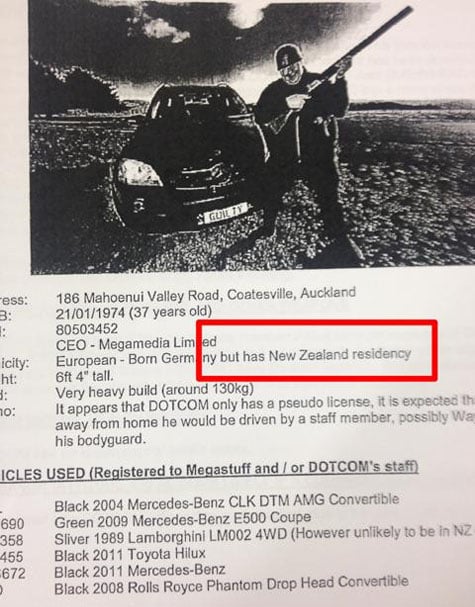
Following Mr Key’s apology today [video here], Dotcom announced his acceptance via Twitter, but
called for an investigation into the case against him.
“I accept your apology,” Dotcom wrote. “Show your sincerity by supporting a full, transparent & independent inquiry into the entire Mega case.”
Monday, September 3, 2012
Members of Congress Demand Answers for Homeland Security’s Unjust Domain Name Seizures
Electronic Frontier Foundation
Trevor Timm

“Our concern centers on your Department’s methods, and the process given, when seizing the domain names of websites whose actions and content are presumed to be lawful, protected speech,” the letter said, which was also signed by Rep. Jared Polis (D-Colo.) and Rep. Jason Chaffetz (R-Ut.).
The Representatives’ letter focused on the case of former hip hop website Dajaz1. Dajaz1’s domain name had been seized for over a year, despite evidence that the website had lawful material, and that “many of the allegedly infringing links to copyrighted songs, and specifically the links that were the basis of the seizure order, were given to the site’s owner by artists and labels themselves” including Kanye West, Diddy, and a vice president of a major record label.
Adding to the injustice, the government refused to cooperate with Dajaz1’s attorneys for months, and sought numerous extensions of the seizure authority in secret. When the court records were finally released, it showed that the government was waiting on the RIAA to evaluate a "sampling of allegedly infringing content" and respond to other “outstanding questions.” While the RIAA fiddled, Dajaz1 lost the right to speak and the public lost its right to read what was published there.
Finally, after a year, control over dajaz1.com was handed back to the owners with no apology, and no explanation. It is disturbing enough that DHS has been effectively acting as the tax-funded hired gun of the content industry, but, even more horrifying, it censored the wrong targets, for no good reason, for a year.
Dajaz1’s case is far from unique, as we found out earlier this week when a similar situation happened to Rojadirecta.com and Rojadirecta.org, the popular sports streaming sites that were seized—again with no due process—back in February 2011. The sites, which have been in the midst of a court fight to return its domains, had been arguing that linking was not infringing, noting that a Spanish court had already found the sites legal. Yet the government still held onto their domain for 18 months. On Wednesday, they again handed back their domains with no explanation.
As we explained:
Dropping the case was, of course, the right move. The government's copyright arguments were incredibly weak (it’s pretty well-settled that linking is not infringement). Even more troubling, the seizures also captured plenty of legal and protected speech. Indeed, many (including EFF) have been making these arguments for well over a year. The real question is why it took so long.
We also demanded the government should explain why it reversed its position, and provide a clear policy rationale so websites around the world could assess their risk for unexplained and unjustified seizures.
The Representatives want answers to the same questions. At the end of their letter, they ask seven specific questions about DHS’ policy, their rationale, and what procedures they plan on implementing so websites’ rights aren’t trampled on again. You can read the full letter here.
EFF is encouraged that Congress is taking an increased interest in making sure First Amendment protected speech is not censored on the Internet due to draconian copyright policy, and we look forward to the Justice Deparment and Homeland Security’s official response.
Monday, August 13, 2012
Kim Dotcom Resists, Pussy Riot Protests and the Insane Clown Posse Sues ... Internet Reformation Rolls
Daily Bell
 Your life is precious ... precious, yeah
So don't you forget it, get it, no
You decide who you are
You decide who you are.
~ Kim Dotcom, lyrics to "Precious"
Dominant Social Theme: These people are all criminals! If only the world had a single corpus, we could throw everyone in jail at once.
Free-Market Analysis: As the power elite that wants to run the world continues to race against time more and more brutally, what we call the Internet Reformation becomes ever more visible.
It is becoming more visible because as the elites shove the world toward global governance, people being shoved, some of them, push back.
In the past week, we've seen three high-profile instances of this sort of resistance. Kim Dotcom, CEO of destroyed Megaupload, has launched a website to proclaim his innocence and begun releasing surprisingly tuneful pop music to plead his cause and shape his public image.
Over in Russia, the punk girl band Pussy Riot is finishing up a trial that sees them accused of violating the sanctity and physical space of the Russian Orthodox Church to protest Vladimir Putin's endlessly authoritarian reign. One of the members made an eloquent closing statement that we reproduce in part below.
Most recently, the Insane Clown Posse has filed a lawsuit against the FBI declaring the group and its followers to be a "gang." We last wrote about the Insane Clown Posse here:
In Defense of the Insane Clown Posse
It seems to us that the Internet Reformation is gaining traction, inevitably, as we long ago predicted. We first pointed to Congressman Ron Paul as an embodiment of the modern Reformation but as the powers-that-be push forward on all fronts, they are assaulting many other bright and courageous people who then step to the fore.
The initial Reformation was in part sponsored by the power elite, and the elites are trying to take over THIS reformation as well. But the trouble with taking over the Internet is that one has to do it in full VIEW of the Internet.
Confusion, therefore, is employed. "They" are using apparent false flags like Julian Assange, Anonymous and even faux alternative currency movements to undercut the tremendous progress that free-market thinking has made over the past decade.
But as we long ago predicted, the Internet Reformation is fairly unstoppable at the moment. The European Union is falling apart, the global warming scam is unraveling, the war on terror has not gone as planned in Afghanistan and many other elite promotions have been exposed in detail on the Internet.
The ancient power elite, that evidently wants to run the world and uses its control of central banks to fund its mania, is in no sense defeated but it is facing challenges that it has not faced since the Gutenberg Press itself began exposing the power structure 600 years ago.
Then, the Church was riven, a New World was discovered, two vast revolutions were initiated and the cause of freedom was at once massively advanced and then, after a time, retarded.
It took the elites about 400 years to fully control the damage. They didn't really overcome it until about the 20th century, and now the Internet Reformation has undone much of the globalist progress that was made.
Let's take these three examples cited above and analyze how they may be contributing to the current Reformation.
The violent raid on Kim Dotcom's mansion may soon be seen as disastrous overreach by US Federal authorities. It was no doubt thought that 400 pound Kim Dotcom was an easy target. He could be mocked and generally demonized as a greedy, overweight criminal.
But those in the upper reaches of this elite global conspiracy are still floundering when it comes to confronting the damage the Internet is doing to their plans.
Copyright was apparently invented by the power elite of the day to retard information flow from the Gutenberg Press. It was a brilliant stroke, at once slowing injurious information and placing many informed communicators on the side of the state itself because copyright would enrich them.
But in a 21st century Internet world we need only to turn to natural law to decide how well copyright works now. Laws that demand egregious violent enforcement and then are STILL flouted are dysfunctional ones. They are in legal parlance "positive" rather than natural. Like prohibition, they don't work.
People sense that the powers-that-be are on the wrong side of the copyright issue, thus some of the sentiment supporting Kim Dotcom. You can see some of our articles here:
The Creepy Pursuit of Kim Dotcom by Corporate America and Why it Matters
VIDEO: Internet Piracy – Who are the Thieves?
Both New Zealand and American authorities are being handed one defeat after another in this case, including a judicial invalidation of the very warrant that was executed on Kim Dotcom.
The elites behind this raid – the West's top dynastic families and their enablers and associates – may eventually come to regret making Kim Dotcom their number one target. He is big, increasingly angry and something of a marketing genius.
It may be that Vladimir Putin shall also regret HIS foray into further authoritarianism. Putin is worried about his legitimacy as a ruler and has decided that making a case against three pretty young women collectively called Pussy Riot will provide the shock value he needs to calm protest against him.
But late last week it backfired with Nadezhda Tolokonnikova's closing statement, which, in our humble view, is so good it's almost dumbfounding. You can find the full statement at Infowars and Business Insider. Here's a little:
We are absolutely not happy with—and have been forced into living politically—by the use of coercive, strong-arm measures to handle social processes, a situation in which the most important political institutions are the disciplinary structures of the state – the security agencies, the army, the police, the special forces and the accompanying means of ensuring political stability: prisons, preventive detention and mechanisms to closely control public behaviour.
Nor are we happy with the enforced civic passivity of the bulk of the population or the complete domination of executive structures over the legislature and judiciary. Moreover, we are genuinely angered by the fear-based and scandalously low standard of political culture, which is constantly and knowingly maintained by the state system and its accomplices.
Look at what Patriarch Kirill has to say: "The Orthodox don't go to rallies." We are angered by the appalling weakness of horizontal relationships within society. We don't like the way in which the state system easily manipulates public opinion through its tight control of the overwhelming majority of media outlets. A perfect example is the unprecedentedly shameless campaign against Pussy Riot, based on distorting facts and words, which has appeared in nearly all the Russian media, apart from the few independent media there are in this political system.
The full text of the speech has by now been broadcast and texted around the world. Putin, who is evidently and obviously an ally of the Western power elite (he just returned from an Israeli love fest) made a mistake going after these girls.
The FBI meanwhile made a mistake targeting Insane Clown Posse, which is now going to sue them for falsely labeling them and their followers as a "gang."
The Insane Clown Posse is not a gang. In any case, if the far more insane laws against drugs and other private practices were lifted there probably wouldn't be any gang violence, especially if monopoly central banking were done away with, along with public schools, so that the economy could recover and people could find jobs again.
The FBI also played a big role in the raid on Kim Dotcom and it is very likely as the Internet Reformation continues the FBI's increasingly aggressiveness on behalf of the power elite shall meet rising pushback from the Internet Reformation.
The FBI has been exposed on the 'Net for creating and fostering false-flag terrorist episodes and has evidently and obviously covered up whatever really happened on 9/11. Like the CIA, which evidently created al Qaeda, the FBI's tactics have been exposed by the Internet and are increasingly transparent to the larger masses of people that might in a different era have been more trusting.
It is, after all, a matter of trust. What the Internet Reformation increasingly presents to viewers is a civilization that doesn't work as advertised ... and perhaps was designed not to work on purpose.
As this knowledge continues to percolate through the body politic, the ability of the powers that be to manipulate people via war, economic ruin and regulatory authoritarianism becomes increasingly difficult. The elites' dominant social themes are exposed along with their apparent one-world agenda.
The three examples we have examined here are just a small exhibit of the larger changes that are sweeping the world and making it increasingly difficult for those involved in a greater one-world conspiracy.
The last meme to fall, in our view, will be one having to do with what we call "private justice" – which was the way societies handled internal quarrels and injustices for tens of thousands of years. Public justice is increasingly exposed for the unjust mechanism that it is. You can read an article on public and private justice here:
What Amanda Knox Tells Us About Justice
Conclusion: Times are changing but we don't see that the power elite has developed any effective tactics to control the damage to their plans. Right now, they're becoming increasingly authoritarian and violent. But we bet in time they'll be forced to take a step back.
So don't you forget it, get it, no
You decide who you are
You decide who you are.
~ Kim Dotcom, lyrics to "Precious"
Dominant Social Theme: These people are all criminals! If only the world had a single corpus, we could throw everyone in jail at once.
Free-Market Analysis: As the power elite that wants to run the world continues to race against time more and more brutally, what we call the Internet Reformation becomes ever more visible.
It is becoming more visible because as the elites shove the world toward global governance, people being shoved, some of them, push back.
In the past week, we've seen three high-profile instances of this sort of resistance. Kim Dotcom, CEO of destroyed Megaupload, has launched a website to proclaim his innocence and begun releasing surprisingly tuneful pop music to plead his cause and shape his public image.
Over in Russia, the punk girl band Pussy Riot is finishing up a trial that sees them accused of violating the sanctity and physical space of the Russian Orthodox Church to protest Vladimir Putin's endlessly authoritarian reign. One of the members made an eloquent closing statement that we reproduce in part below.
Most recently, the Insane Clown Posse has filed a lawsuit against the FBI declaring the group and its followers to be a "gang." We last wrote about the Insane Clown Posse here:
In Defense of the Insane Clown Posse
It seems to us that the Internet Reformation is gaining traction, inevitably, as we long ago predicted. We first pointed to Congressman Ron Paul as an embodiment of the modern Reformation but as the powers-that-be push forward on all fronts, they are assaulting many other bright and courageous people who then step to the fore.
The initial Reformation was in part sponsored by the power elite, and the elites are trying to take over THIS reformation as well. But the trouble with taking over the Internet is that one has to do it in full VIEW of the Internet.
Confusion, therefore, is employed. "They" are using apparent false flags like Julian Assange, Anonymous and even faux alternative currency movements to undercut the tremendous progress that free-market thinking has made over the past decade.
But as we long ago predicted, the Internet Reformation is fairly unstoppable at the moment. The European Union is falling apart, the global warming scam is unraveling, the war on terror has not gone as planned in Afghanistan and many other elite promotions have been exposed in detail on the Internet.
The ancient power elite, that evidently wants to run the world and uses its control of central banks to fund its mania, is in no sense defeated but it is facing challenges that it has not faced since the Gutenberg Press itself began exposing the power structure 600 years ago.
Then, the Church was riven, a New World was discovered, two vast revolutions were initiated and the cause of freedom was at once massively advanced and then, after a time, retarded.
It took the elites about 400 years to fully control the damage. They didn't really overcome it until about the 20th century, and now the Internet Reformation has undone much of the globalist progress that was made.
Let's take these three examples cited above and analyze how they may be contributing to the current Reformation.
The violent raid on Kim Dotcom's mansion may soon be seen as disastrous overreach by US Federal authorities. It was no doubt thought that 400 pound Kim Dotcom was an easy target. He could be mocked and generally demonized as a greedy, overweight criminal.
But those in the upper reaches of this elite global conspiracy are still floundering when it comes to confronting the damage the Internet is doing to their plans.
Copyright was apparently invented by the power elite of the day to retard information flow from the Gutenberg Press. It was a brilliant stroke, at once slowing injurious information and placing many informed communicators on the side of the state itself because copyright would enrich them.
But in a 21st century Internet world we need only to turn to natural law to decide how well copyright works now. Laws that demand egregious violent enforcement and then are STILL flouted are dysfunctional ones. They are in legal parlance "positive" rather than natural. Like prohibition, they don't work.
People sense that the powers-that-be are on the wrong side of the copyright issue, thus some of the sentiment supporting Kim Dotcom. You can see some of our articles here:
The Creepy Pursuit of Kim Dotcom by Corporate America and Why it Matters
VIDEO: Internet Piracy – Who are the Thieves?
Both New Zealand and American authorities are being handed one defeat after another in this case, including a judicial invalidation of the very warrant that was executed on Kim Dotcom.
The elites behind this raid – the West's top dynastic families and their enablers and associates – may eventually come to regret making Kim Dotcom their number one target. He is big, increasingly angry and something of a marketing genius.
It may be that Vladimir Putin shall also regret HIS foray into further authoritarianism. Putin is worried about his legitimacy as a ruler and has decided that making a case against three pretty young women collectively called Pussy Riot will provide the shock value he needs to calm protest against him.
But late last week it backfired with Nadezhda Tolokonnikova's closing statement, which, in our humble view, is so good it's almost dumbfounding. You can find the full statement at Infowars and Business Insider. Here's a little:
We are absolutely not happy with—and have been forced into living politically—by the use of coercive, strong-arm measures to handle social processes, a situation in which the most important political institutions are the disciplinary structures of the state – the security agencies, the army, the police, the special forces and the accompanying means of ensuring political stability: prisons, preventive detention and mechanisms to closely control public behaviour.
Nor are we happy with the enforced civic passivity of the bulk of the population or the complete domination of executive structures over the legislature and judiciary. Moreover, we are genuinely angered by the fear-based and scandalously low standard of political culture, which is constantly and knowingly maintained by the state system and its accomplices.
Look at what Patriarch Kirill has to say: "The Orthodox don't go to rallies." We are angered by the appalling weakness of horizontal relationships within society. We don't like the way in which the state system easily manipulates public opinion through its tight control of the overwhelming majority of media outlets. A perfect example is the unprecedentedly shameless campaign against Pussy Riot, based on distorting facts and words, which has appeared in nearly all the Russian media, apart from the few independent media there are in this political system.
The full text of the speech has by now been broadcast and texted around the world. Putin, who is evidently and obviously an ally of the Western power elite (he just returned from an Israeli love fest) made a mistake going after these girls.
The FBI meanwhile made a mistake targeting Insane Clown Posse, which is now going to sue them for falsely labeling them and their followers as a "gang."
The Insane Clown Posse is not a gang. In any case, if the far more insane laws against drugs and other private practices were lifted there probably wouldn't be any gang violence, especially if monopoly central banking were done away with, along with public schools, so that the economy could recover and people could find jobs again.
The FBI also played a big role in the raid on Kim Dotcom and it is very likely as the Internet Reformation continues the FBI's increasingly aggressiveness on behalf of the power elite shall meet rising pushback from the Internet Reformation.
The FBI has been exposed on the 'Net for creating and fostering false-flag terrorist episodes and has evidently and obviously covered up whatever really happened on 9/11. Like the CIA, which evidently created al Qaeda, the FBI's tactics have been exposed by the Internet and are increasingly transparent to the larger masses of people that might in a different era have been more trusting.
It is, after all, a matter of trust. What the Internet Reformation increasingly presents to viewers is a civilization that doesn't work as advertised ... and perhaps was designed not to work on purpose.
As this knowledge continues to percolate through the body politic, the ability of the powers that be to manipulate people via war, economic ruin and regulatory authoritarianism becomes increasingly difficult. The elites' dominant social themes are exposed along with their apparent one-world agenda.
The three examples we have examined here are just a small exhibit of the larger changes that are sweeping the world and making it increasingly difficult for those involved in a greater one-world conspiracy.
The last meme to fall, in our view, will be one having to do with what we call "private justice" – which was the way societies handled internal quarrels and injustices for tens of thousands of years. Public justice is increasingly exposed for the unjust mechanism that it is. You can read an article on public and private justice here:
What Amanda Knox Tells Us About Justice
Conclusion: Times are changing but we don't see that the power elite has developed any effective tactics to control the damage to their plans. Right now, they're becoming increasingly authoritarian and violent. But we bet in time they'll be forced to take a step back.
Monday, August 6, 2012
Homeland Security Teams Up With YouTube To Take Down Controversial Videos
Govt Slaves


(Mike Masnick) We recently wrote about the fight over copyright/fair use in political videos. In the comments, someone anonymous pointed us to a YouTube page including a typical takedown notice.. Here’s a screenshot.
This is actually the first time I can recall that I’ve seen a takedown that had “multiple” takedown notices. So it’s interesting that YouTube even has such an error message. But what really caught my attention was the second claimant listed. United States Department of Homeland Security. Homeland Security? Issuing copyright takedowns? For what it’s worth, the commenter who submitted this pointed us to another video, which they claim is the same as what was taken down. I have no idea if it’s the same video or not, but it is some idiotic conspiracy mongering, taking one comment from a reporter completely out of context, and pretending President Obama said it, when he did not. I never understand conspiracy theories like that, but that’s really neither here nor there.
The real question is why is Homeland Security issuing takedowns? Works produced by the federal government, of course, can’t have copyright. However, it is possible for the government to hold copyrights — mainly if someone else gets it and assigns it to the government. So it’s possible that happened here, though it still seems like a strange move. If the video is the same as the other one pointed to, it’s just conspiracy theory claptrap, and I don’t see why DHS would even bother issuing a takedown.
But, even if we assume that the copyright itself and the takedown were legit, does this seem reasonable at all? Having a government agency directly using a copyright claim to take down a video? Especially when that group is DHS — in which national internet censor ICE exists. Giving it the power to censor videos too just seems like it’s going way too far. It’s not as if Homeland Security is going to bring the work “to market” to make money, so it’s not like there’s an “impact on the market” for the work. The only reason to issue the takedown — no matter how accurate the claim is — is to silence speech. A government organization using a government-granted monopoly to stifle speech may be all too common, but that doesn’t mean it should pass by unremarked upon.
I reached out to people at YouTube to see if they could explain why DHS appears to be issuing DMCA takedowns, and got back the equivalent of a “no comment.” I also reached out to Homeland Security, who at first seemed interested in looking into the details and then completely stopped responding to emails. Having not received further communication from them in over a week at this point, I’m just going with the post as is, in the hopes that maybe someoneout there can explain why the federal government is using copyright to censor speech?
Thursday, January 19, 2012
Supreme Court rules Congress can re-copyright public domain works
ARS Technica
David Kravetze

Congress may take books, musical compositions and other works out of the public domain, where they can be freely used and adapted, and grant them copyright status again, the Supreme Court ruled Wednesday.
In a 6-2 ruling, the court ruled that just because material enters the public domain, it is not “territory that works may never exit.” (PDF)
The top court was ruling on a petition by a group of orchestra conductors, educators, performers, publishers and film archivists who urged the justices to reverse an appellate court that ruled against the group, which has relied on artistic works in the public domain for their livelihoods.
They claimed that re-copyrighting public works would breach the speech rights of those who are now using those works without needing a license. There are millions of decades-old works at issue. Some of the well-known ones include H.G. Wells’ Things to Come; Fritz Lang’s Metropolis and the musical compositions of Igor Fyodorovich Stravinsky.
The court, however, was sympathetic to the plaintiffs’ argument. Writing for the majority, Justice Ruth Ginsburg said “some restriction on expression is the inherent and intended effect of every grant of copyright.” But the top court, with Justice Elena Kagan recused, said Congress’ move to re-copyright the works to comport with an international treaty was more important.
For a variety of reasons, the works at issue, which are foreign and produced decades ago, became part of the public domain in the United States but were still copyrighted overseas. In 1994, Congress adopted legislation to move the works back into copyright, so U.S. policy would comport with an international copyright treaty known as the Berne Convention.
David Kravetze

Congress may take books, musical compositions and other works out of the public domain, where they can be freely used and adapted, and grant them copyright status again, the Supreme Court ruled Wednesday.
In a 6-2 ruling, the court ruled that just because material enters the public domain, it is not “territory that works may never exit.” (PDF)
The top court was ruling on a petition by a group of orchestra conductors, educators, performers, publishers and film archivists who urged the justices to reverse an appellate court that ruled against the group, which has relied on artistic works in the public domain for their livelihoods.
They claimed that re-copyrighting public works would breach the speech rights of those who are now using those works without needing a license. There are millions of decades-old works at issue. Some of the well-known ones include H.G. Wells’ Things to Come; Fritz Lang’s Metropolis and the musical compositions of Igor Fyodorovich Stravinsky.
The court, however, was sympathetic to the plaintiffs’ argument. Writing for the majority, Justice Ruth Ginsburg said “some restriction on expression is the inherent and intended effect of every grant of copyright.” But the top court, with Justice Elena Kagan recused, said Congress’ move to re-copyright the works to comport with an international treaty was more important.
For a variety of reasons, the works at issue, which are foreign and produced decades ago, became part of the public domain in the United States but were still copyrighted overseas. In 1994, Congress adopted legislation to move the works back into copyright, so U.S. policy would comport with an international copyright treaty known as the Berne Convention.
Friday, November 19, 2010
Web Censorship Bill Sails Through Senate Committee

On Thursday, the Senate Judiciary Committee unanimously approved a bill that would give the Attorney General the right to shut down websites with a court order if copyright infringement is deemed “central to the activity” of the site — regardless if the website has actually committed a crime. The Combating Online Infringement and Counterfeits Act (COICA) is among the most draconian laws ever considered to combat digital piracy, and contains what some have called the “nuclear option,” which would essentially allow the Attorney General to turn suspected websites “off.”
COICA is the latest effort by Hollywood, the recording industry and the big media companies to stem the tidal wave of internet file sharing that has upended those industries and, they claim, cost them tens of billions of dollars over the last decade.
suing college students. They’ve tried suing internet startups. Now they want the federal government to act as their private security agents, policing the internet for suspected pirates before making them walk the digital plank.
Many people opposed to the bill agree in principle with its aims: Illegal music piracy is, well, illegal, and should be stopped. Musicians, artists and content creators should be compensated for their work. But the law’s critics do not believe that giving the federal government the right to shut down websites at will based upon a vague and arbitrary standard of evidence, even if no law-breaking has been proved, is a particularly good idea. COICA must still be approved by the full House and Senate before becoming law. A vote is unlikely before the new year.
Subscribe to:
Posts (Atom)


