Showing posts with label FOIA. Show all posts

Thursday, January 3, 2013

White House wins fight to keep drone killings of Americans secret


RussiaToday


Reuters / Pascal Lauener

A federal judge issued a 75-page ruling on Wednesday that declares that the US Justice Department does not have a legal obligation to explain the rationale behind killing Americans with targeted drone strikes.

United States District Court Judge Colleen McMahon wrote in her finding this week that the Obama administration was largely in the right by rejecting Freedom of Information Act (FOIA) requests filed by the American Civil Liberties Union and The New York Times for materials pertaining to the use of unmanned aerial vehicles to execute three US citizens abroad in late 2011 [pdf].

Anwar al-Awlaki and Samir Khan, both US nationals with alleged ties to al-Qaeda, were killed on September 30 of that year using drone aircraft; days later, al-Awlaki’s teenage son, Abdulrahman al-Awlaki, was executed in the same manner. Although the Obama administration has remained largely quiet about the killings in the year since, a handful of statements made from senior White House officials, including Pres. Barack Obama himself, have provided some but little insight into the Executive Branch’s insistence that the killings were all justified and constitutionally-sound. Attempts from the ACLU and the Times via FOIA requests to find out more have been unfruitful, though, which spawned a federal lawsuit that has only now been decided in court.

Siding with the defendants in what can easily be considered as cloaked in skepticism, Judge McMahon writes that the Obama White House has been correct in refusing the FOIA requests filed by the plaintiffs.

"There are indeed legitimate reasons, historical and legal, to question the legality of killings unilaterally authorized by the Executive that take place otherwise than on a 'hot' field of battle," McMahon writes in her ruling. Because her decision must only weigh whether or not the Obama administration has been right in rejecting the FOIA requests, though, her ruling cannot take into consideration what sort of questions — be it historical, legal, ethical or moral — are raised by the ongoing practice of using remote-controlled drones to kill insurgents and, in these instances, US citizens.

"The Alice-in-Wonderland nature of this pronouncement is not lost on me; but after careful consideration, I find myself stuck in a paradoxical situation in which I cannot solve a problem because of contradictory constraints and rules — a veritable Catch-22,” she writes. “I can find no way around the thicket of laws and precedents that effectively allow the Executive Branch of our Government to proclaim as perfectly lawful certain actions that seem on their face incompatible with our Constitution and laws, while keeping the reason for their conclusion a secret.”

Throughout her ruling, Judge McMahon cites speeches from both Pres. Obama and Attorney General Eric Holder in which the al-Awlaki killings are vaguely discussed, but appear to do little more than excuse the administration’s behavior with their own secretive explanations.

“The Constitution’s guarantee of due process is ironclad, and it is essential — but, as a recent court decision makes clear, it does not require judicial approval before the President may use force abroad against a senior operational leader of a foreign terrorist organization with which the United States is at war — even if that individual happens to be a US citizen,” McMahon quotes Mr. Holder as saying during a March 2012 address at Chicago’s Northwestern University. “Holder did not identify which recent court decisions so held,” the judge replies, “Nor did he explain exactly what process was given to the victims of targeted killings at locations far from ‘hot’ battlefields…”

And while both Mr. Holder and Pres. Obama have discussed the killings in public, including one appearance by the president on the Tonight Show with Jay Leno, the Justice Department insists that going further by releasing any legal evidence that supports the executions would be detrimental to national security.

While Judge McMahon ends up agreeing with the White House, she does so by making known her own weariness over how the Obama administration has forced the court to rely on their own insistence that information about the attacks simply cannot be discussed.

“As they gathered to draft a Constitution for their newly liberated country, the Founders — fresh from a war of independence from the rule of a King they styled a tyrant — were fearful of concentrating power in the hands of any single person or institution, and most particular in the executive,” McMahon writes.

Responding to the decision on Wednesday, ACLU Deputy Legal Director Jameel Jaffer issued a statement condemning the White House’s just-won ability to relieve itself from any fair and honest explanation as to the justification of Americans.

“This ruling denies the public access to crucial information about the government’s extrajudicial killing of US citizens and also effectively green-lights its practice of making selective and self-serving disclosures,” Jameel writes. “As the judge acknowledges, the targeted killing program raises profound questions about the appropriate limits on government power in our constitutional democracy. The public has a right to know more about the circumstances in which the government believes it can lawfully kill people, including US citizens, who are far from any battlefield and have never been charged with a crime.”

The ACLU says they plan to appeal Judge McMahon’s decision and are currently awaiting news regarding a separate lawsuit filed alongside the Center for Constitutional Rights that directly challenges the constitutionality of the targeted kills.

“The government has argued that case should also be dismissed,” the ACLU notes.
In a Wednesday afternoon statement from the Times, assistant general counsel David McCraw says the paper will appeal the ruling as well.

"We began this litigation because we believed our readers deserved to know more about the US government's legal position on the use of targeted killings against persons having ties to terrorism, including US citizens," McCraw says.

Although she ruled against the plaintiffs, Judge McMahon, says McCraw, explained "eloquently … why in a democracy the government should be addressing those questions openly and fully."


Thursday, November 8, 2012

Why Is The S.E.C. Concealing Massive Citigroup Fraud?


Citigroup, the most insolvent bank ever to foul the earth, is being protected by the S.E.C.  We want to know why.

---

Guest post submitted by Cheyenne, writer and producer of the soon to be released documentary, Bailout. Watch a trailer for Bailout here.

---
What is the SEC hiding?
Part One
William Cohan of Bloomberg wrote a curious story last week, "Why does the SEC protect banks’ dirty secrets?"
It's a really good question.
Standing alone, however, Cohan's article is just another electric tile in a giant mosaic that flashes intermittently in a news cycle, briefly illuminating another piston or grommet in the Wall Street-Washington corruption machine before fading without impact.
But when coupled with other evidence, Cohan's piece, concerning the S.E.C.'s wholesale expungement of information from Citigroup documents in response to a Freedom of Inforation Act (FOIA) request, leads to what looks very much like a criminal conspiracy by Citigroup executives, up to and including Robert Rubin, to defraud the company's investor-clients on a scale that is nothing short of colossal.
In this light, the S.E.C.'s concealment effort on behalf of Citigroup--not its first, as we shall see--poses issues about the exact nature of the S.E.C.'s role with respect to financial crime, because neither "regulator" nor "crime fighter" applies under any reasonable interpretation of the evidence.
The questions raised here are both fair and viable. They’re fair because the S.E.C. elected to make a mockery of both the law it's supposed to follow and the public it's supposed to serve by redacting in their totality documents sought under the FOIA, leaving the inference of criminality to waft plume-like through its own stench. They’re viable because while the statute of limitations for criminal fraud may have run, the statute of limitations for conspiracy to commit fraud—a crime whose very essence, secrecy, precludes the statute from running in the first place—presents no such legal obstacle.
Part One examines the available evidence, which includes Cohan's article, the congressional testimony of former Citigroup risk officer Richard Bowen, and a lawsuit against Citigroup that the S.E.C. filed and immediately tried to settle--unsuccessfully--a year ago. Along the way, we'll see just how pernicious bailouts are to a functioning democracy.
Part Two will explore the potential ramifications of the S.E.C.'s failure to sweep its suit against Citigroup under the rug. The S.E.C.'s failure was due, almost laughably, to the random assignment of its case to Judge Jed Rakoff, a jurist whose revulsion at the S.E.C.'s corruption, already legendary, may well carry everyone involved into unchartered territory.
Cohan's Article About The S.E.C.'s Response to FOIA Requests Involving Citigroup Mortgages
Cohan’s particular focus was on documents that the S.E.C. produced relating to congressional testimony given by Richard Bowen. Bowen is the former Citi risk officer who told the Financial Crisis Inquiry Commission, among other things, that Citi sold MBS products despite knowing—based on information that Bowen provided to the top ranks of the company, including ex-CEO Robert Rubin himself—that huge swaths of mortgages owned by Citi were defective to the tune of between 60 and 80%.
To pursue Bowen’s revelations further, another Bloomberg reporter, Bob Ivry, filed FOIA requests with the S.E.C. seeking documents related to Bowen’s potent disclosures.
What Ivry likely hoped to discover was additional documentary evidence (beyond Bowen’s email to Rubin included with his testimony) that Citigroup officers, including Rubin, had defrauded purchasers of Citi’s MBS products by intentionally selling investments that Citi executives knew to be dogshit. (The term “dogshit” is used in accordance with Citigroup technical parameters for its investment products, which we’ll come to in a minute.)
What Ivry received in response, after a bit of wrangling, was a pile of documents notable only for their extensive redactions, i.e., blacked out content. The S.E.C. contends that the information that it’s concealing on Citi’s behalf qualifies as trade secrets.
The rub here isn’t whether or not the information satisfies the legal criteria for trade secret status. A bit of it probably does while the heft undoubtedly does not. What carries the trade secret assertion into the theater of absurd moral hazard isn't the nature of the information itself, but rather the fact that Citi is able to make the claim at all.
How Bailouts Cover Up Ineptitude and Potential Crime
Citigroup is the most pathetic TBTF bank in business, no mean feat among a herd of behemoths that is deathly ill. Citi exceeds its peers in just about every category you can think of associating with “broke bank” since the crisis began in 2008:
When the crisis hit in 2008, Citigroup should have followed Lehman Brothers—or perhaps led it—into the morgue of corporate obesity. Citigroup posted losses that year of $27.7 billion, more than four times Lehman’s losses before it collapsed into dust during the third quarter, and yet Citi paid out $32.4 billion in compensation—the bulk of it in bonusesafter receiving the $45 billion welfare check.
And Citigroup’s figures that year, as pustulent as they appear, in all likelihood mask even deeper rot within the company. Compare Citigroup's valuations of its MBS holdings with those of another sick TBTF firm at the time, Merrill Lynch.
Merrill matched Citi’s loss with a $27.7 billion loss of its own, and its deteriorating corpus had to be kept alive by Hank “The Hammer” Paulson, who shoved it snugly within a warm Bank of America cavity.
Merrill's troubles reltated in no small part to MBS. In July 2008, Merrill sold $31 billion in mortgage-backed securities at 22 cents on the dollar. A 78% discount, while huge, was not at all unusual as the darkling reality of MBS assets materialized before a market that was sobering up after a very long binge. A few months earlier, Citadel had bought MBS at 27 cents on the dollar. And yet in this very market decline, Citi was marking equivalent investments at the imperial rate of 61 cents.
Of course, when Citi was appraising its MBS assets at nearly 3 times as valuable as those of the soon-to-be-ambulance-bound Merrill, and regulators were looking the other way (often at pornography rather than the raging crisis), no one knew that Richard Bowen would come before Congress and testify that Citigroup mortgages were 60% defective in 2006 and 80% defective in 2007, casting further doubt—this time from within the company itself—on Citi’s 61-cent MBS valuation.
Were Citi's incredibly rich valuations the product of accounting fraud? After all, the congressional repeal of mark-to-market accounting rules wouldn't occur until the following year. Or did Citi have some foresight about that event?

Tuesday, September 18, 2012

Emails show Justice working with Media Matters on stories that target critics

Fox News


Newly published emails show the top spokeswoman at the U.S. Justice Department regularly collaborating with the liberal advocacy group Media Matters on stories that slam the administration's critics.

The emails, obtained through a Freedom of Information Act request and published by The Daily Caller, often show department public affairs chief Tracy Schmaler communicating with Media Matters bloggers. Sometimes, the emails were in response to inquiries. Other times, Schmaler was pitching ideas, according to the Caller.

In a January 2012 email chain, Schmaler sent a Media Matters writer lines from House Oversight and Government Reform Committee Chairman Darrell Issa's comments at a recent hearing. She reportedly underlined passages where the California Republican tries to explain the difference between Operation Fast and Furious and other anti-gunrunning operations under former President George W. Bush.

Hours later, an article appeared on Media Matters' site titled "Rep. Issa Ties Himself in Fast and Furious Knots."

Daily Caller editor Tucker Carlson, also a Fox News contributor, said the emails show "moment-to-moment coordination" between the department and Media Matters.

"We received a massive amount of these communiques that indicate direct coordination between the Obama Justice Department ... and Media Matters to subvert news stories," he said Tuesday. "This proves coordination."

Emails from late 2010 also reportedly showed Schmaler sending Media Matters information to help challenge claims that the department dealt lightly with New Black Panther members who allegedly intimidated voters in Philadelphia in 2008.

Another March 12 email showed Schmaler pointing out "false" statements made by Tea Party Nation founder Judson Phillips in a Fox News interview. Phillips called Operation Fast and Furious a "political operation" -- pushing a claim that the administration let guns walk across the Mexico border to build a case for gun control.

The Media Matters writer then wrote a blog slamming Phillips' "right-wing conspiracy theory," and also sent the text to Schmaler.

The Daily Caller reported that throughout the exchanges, Media Matters staffers were often sending to Schmaler the full text of what they wrote about the department's critics.

Tuesday, August 28, 2012

NYT reporter leaked advance copy of Maureen Dowd column to CIA

Politico
Dylan Byers

America's favorite bearded time lord
Newly available CIA records obtained by Judicial Watch, the conservative watchdog group, reveal that New York Times reporter Mark Mazzetti forwarded an advance copy of a Maureen Dowd column to a CIA spokesperson -- a practice that is widely frowned upon within the industry.

Mazzetti's correspondence with CIA spokesperson Marie Harf, on August 5, 2011, pertained to the Kathryn Bigelow-Mark Boal film "Zero Dark Thirty," about the killing of Osama bin Laden, and a Times op-ed column by Dowd set to be published two days later that criticized the White House for having "outsourced the job of manning up the president’s image to Hollywood."

According to Judicial Watch, Mazzetti sent Harf an advance copy of Dowd's column, and wrote: “this didn’t come from me… and please delete after you read.  See, nothing to worry about!”

POLITICO has just reached out to the Times for comment, as it was unable to do so prior to Judicial Watch's decision to lift the embargo on the files. Updates here if and when I hear back.

Judicial Watch obtained the files through a formal Freedom of Information Act request. The full email can be viewed here.


Sunday, May 6, 2012

Government's answer to "Fast and Furious" records requests: Blank pages

CBS
 Sharyl Attkisson
For more than a year, CBS News has been investigating the Bureau of Alcohol Tobacco and Firearms' "Fast and Furious" operation and related cases that also employed the controversial tactic of "gunwalking." With Justice Department officials refusing all interview requests to date, CBS News requested numerous public documents through the Freedom of Information Act.

So far, all of the requests that have been answered have been denied in part or in full.

This week, we received a partial response to a request made more than a year ago. It asked for communications involving "Project Gunrunner," the umbrella program for Fast and Furious, from 2010 through April 2011. Specifically, it sought any communications to which any of the following top Justice officials were a party: Attorney General Eric Holder; Lanny Breuer, Assistant Attorney General for the Criminal Division; Kevin Carwile, chief of the Capital Case Unit; and Deputy Assistant Attorney Generals Bruce Schwarz and Kenneth Blanco.

The response includes mostly-blank pages.

See the nearly-blank provided to CBS News (PDF)
 
Federal agencies can legally claim exemptions from the Freedom of Information Act for a number of reasons including attorney-client privilege, law enforcement purposes, and personal privacy. However, they've fallen under sharp criticism from the media and public interest groups in the past decade as a large number of FOIA requests have languished, sometimes for years.

FOIA was originally intended to expedite the release of public materials to the public and media. However, in practice, FOIA requests are often not even marginally effective at obtaining documents for news reporting. To be most effective and helpful, the requests would often need to be filled in a matter of days or at least weeks.

Few requests filed by this reporter are answered within a year. When and if documents are ever produced, they are often heavily redacted and the timeliness of the information relative to the public interest has long since subsided.

Separately the FBI has denied CBS News all information requested regarding the death of Border Patrol Agent Brian Terry. Two Fast and Furious weapons were found at his murder scene in December 2010. The FBI stated that the information was withheld because the murder investigation is ongoing. That investigation has now entered its second year.

Republicans prepare contempt citation against Eric Holder over Fast and Furious CBS News appealed the FBI's denial, arguing that some records had already been made public by FBI to news agencies, that releasing certain parts of its investigative documents would not jeopardize any investigation, and that the FBI should provide, at a minimum, a log of the withheld materials. The appeal was denied. The ATF likewise denied our FOIA request under the basis of "opening investigation."

Wednesday, May 2, 2012

Pentagon admits it has no photo evidence of Bin Laden's death

Digital Journal
Elliot Freeman
Pentagon officials recently disclosed to the Associated Press (AP) that they could not find any photo or video evidence to confirm that Al Qaeda leader Osama Bin Laden was killed in the Navy Seal raid in Pakistan a year ago.

AP has submitted more than 20 requests for information surrounding the raid on Bin Laden’s Abbottabad compound to the U.S. Government under the Freedom of Information Act (FOIA).

In response to the request for visual evidence of Bin Laden’s death, the Pentagon stated that it could not find any pictures or video footage of the raid itself or of Bin Laden’s dead body. It also told AP it could not locate any images of Bin Laden’s body that were taken on the U.S.S. Carl Vinson, the Navy aircraft carrier that reportedly lowered him into the sea after his death.

In addition, the Pentagon admitted that it could not find an autopsy report, death certificate or results of a DNA identification test for Bin Laden, in spite of claims made by President Obama and reported by CBC News that a DNA test was performed.

These admissions follow a related FOIA response by the Department of Defense in February, in which it stated that it had no emails concerning the Bin Laden raid that were sent prior to its execution.

The Atlantic Wire reported in February that the CIA claimed it had visual proof of Bin Laden’s death, but the Pentagon’s admission that it does not have any evidence of this kind still raises significant questions, since its jurisdiction includes the Navy Seals that conducted the raid and the Navy ship that buried Bin Laden at sea.

Tuesday, April 3, 2012

“Guidebook to False Confessions”: Key Document John Yoo Used to Draft Torture Memo Released

Public Record

Jason Leopold and Jeffrey Kaye have another exclusive over at Truthout on the origins of Bush’s torture program. Kaye and Leopold report:
In May of 2002, one of several meetings was convened at the White House where the CIA sought permission from top Bush administration officials, including then National Security Adviser Condoleezza Rice, to torture the agency’s first high-value detainee captured after 9/11: Abu Zubaydah.

The CIA claimed Zubaydah, who at the time was being held at a black site prison in Thailand, was “withholding imminent threat information during the initial interrogation sessions,” according to documents released by the Senate Intelligence Committee in April 2009.

So, “attorneys from the CIA’s Office of General Counsel [including the agency's top lawyer John Rizzo] met with the Attorney General [John Ashcroft], the National Security Adviser [Rice], the Deputy National Security Adviser [Stephen Hadley], the Legal Adviser to the National Security Council [John Bellinger], and the Counsel to the President [Alberto Gonzales] in mid-May 2002 to discuss the possible use of alternative interrogation methods that differed from the traditional methods used by the U.S.”

One of the key documents handed out to Bush officials at this meeting, and at Principals Committee sessions chaired by Rice that took place between May and July 2002, was a 37-page instructional manual that contained detailed descriptions of seven of the ten techniques that ended up in the legal opinion widely referred to as the “torture memo,” drafted by Justice Department Office of Legal Counsel (OLC) attorney John Yoo and signed by his boss, Jay Bybee, three months later. According to Rice, Yoo had attended the Principals Committee meetings and participated in discussions about Zubaydah’s torture.

That instructional manual, referred to as “Pre-Academic Laboratory (PREAL) Operating Instructions,” has just been released by the Department of Defense under the Freedom of Information Act (FOIA). The document sheds additional light on the origins of the Bush administration’s torture policy and for the first time describes exactly what methods of torture Bush officials had discussed – and subsequently approved – for Zubaydah in May 2002.


Thursday, March 29, 2012

ACLU: FBI illegally used ‘outreach’ program to spy on Muslims

NY Daily News
Larry McShane

Wrong for FBI to ‘target American Muslim’ groups like this, American Civil Liberties Union says


The FBI’s San Francisco office illegally collected intelligence on Muslims religious activities under the guise of an outreach program, the American Civil Liberties Union says.

FBI records obtained by the ACLU indicated the federal agents violated the U.S. Privacy Act — which protects maintaining records on religious practice unless there is a clear law enforcement purpose.

“Everyone understands that the FBI has a job to do, but it is wrong and counterproductive for the bureau to target American Muslim religious groups for secret intelligence gathering,” said ACLU attorney Hina Shamsi.

The documents covered the years from 2004 through 2008, and were obtained in a Freedom of Information Act request.

The FBI, in its response, defended its action and noted that the agents involved identified themselves in every case — even handing out business cards in some instances.

“These 2004-2008 documents reflect that information was collected within the scope of an authorized law enforcement activity ... including activities designed to strengthen relationships in various activities,” said FBI spokesman Michael Kortan.

The FBI has since established a formal community outreach program and put new rules into effect regarding intelligence gathering.

In the reports made public by the ACLU, the religious information was mentioned in passing in larger reports filed by FBI agents.

lmcshane@nydailynews.com

Sunday, March 25, 2012

DHS Documents Show Role in Occupy Crackdown

Reader Supported News

A trove of documents released today by the Department of Homeland Security (DHS) in response to a FOIA request filed by the Partnership for Civil Justice Fund, filmmaker Michael Moore and the National Lawyers Guild Mass Defense Committee reveal that federal law enforcement agencies began their coordinated intelligence gathering and operations on the Occupy movement even before the first tent went up in Zuccotti Park on September 17, 2011.

On September 17, 2011, a Secret Service intelligence entry in its Prism Demonstrations Abstract file records the opening of the Occupy Wall Street (OWS) movement. The demonstration location that the Secret Service was protecting? The "Wall Street Bull." The name of the Protectee? The "U.S. Government."

American taxpayers might find it odd to learn that the Secret Service was on duty to protect the Wall Street Bull in the name of protecting the U.S. Government. But there it is.

The DHS's Game of Three Card Monte to Deflect Disclosure of Law Enforement Operations

These documents, many of which are redacted, show that the highest officials in the Department of Homeland Security were preoccupied with the Occupy movement and have gone out of their way to project the appearance of an absence of federal involvement in the monitoring of and crackdown on Occupy.

On the street it would be called "Three Card Monte," a swindler's game to hide the ball - a game of misdirection. The House always wins.

The DHS, as revealed in the newly released documents, has engaged in what appears to be a effort to avoid looking for Occupy related materials where it is likely to be found, including in Fusion Centers and DHS sub-divisions such as the Operations Coordination & Planning sub-division which is responsible for DHS coordination with local and federal law enforcement partners.

Monday, March 19, 2012

Pentagon says it has no records of bin Laden's death; CIA hasn't answered open records request

StarTribune
Richard Lardner

WASHINGTON - The hunt for Osama bin Laden took nearly a decade. It could take even longer to uncover U.S. government emails, planning reports, photographs and more that would shed light on how an elite team of Navy SEALs killed the world's most wanted terrorist.

Ten months after that electrifying covert mission, an administration that has pledged to be the most transparent in American history is refusing to release documents about it under the Freedom of Information Act. The records could provide insights into how bin Laden died, how the U.S. verified his identity and how it decided to bury him at sea, as well as photographs taken during and after the May 2011 raid on his compound in Abbottabad, Pakistan.

Government officials have openly discussed details of the mission in speeches, interviews and television appearances, but the administration won't disclose records that would confirm their narrative of that fateful night. The Obama administration has not said even where in Washington's bureaucracy all the documents might be stored.

Requests for bin Laden materials were among the most significant of any filed last year under the open records law, which compels the government to turn over copies of federal records for free or at little cost. Anyone who seeks information under the law is generally supposed to get it unless disclosure would hurt national security, violate personal privacy or expose business secrets or confidential decision-making. The law has been the focus of extra attention since Sunday, the start of Sunshine Week, when news organizations promote open government and freedom of information.

Citing the law, The Associated Press asked for files about the raid in more than 20 separate requests, mostly submitted the day after bin Laden's death. The Pentagon told the AP this month it could not locate any photographs or video taken during the raid or showing bin Laden's body. It also said it could not find any images of bin Laden's body on the Navy aircraft carrier where the al-Qaida leader's body was taken.

Tuesday, February 28, 2012

White House refuses to reveal ties with Monsanto

Russia Today

Volunteer reapers ("Faucheurs volontaires"), beekeepers
and anti-GMO activists put a placard in front of the
Regional Direction of Agriculture on
February 21, 2012 in Toulouse
Despite requests made under the Freedom of Information Act for correspondence out of the White House, the Obama administration is refusing to comply with calls to disclose discussions with Monsanto-linked lobbyists.

The US-based non-profit group Public Employees for Environmental Responsibility (PEER) is demanding that the White House comply with a FOIA request for information that might link the Obama administration with lobbyists tied to the Monsanto corporation. Monsanto, an agricultural biotech company that rakes in billions each year, has become the enemy of independent farmers in recent years after the corporation has sued hundreds of small-time growers and, in many cases, purchased farms that are unable to compete in a court of law. As Monsanto’s profits grow and the group comes close to monopolizing the market for American agriculture, the company has at the same time thrived due its use of controversial genetically-engineered seeds.

Three-hundred thousands organic farmers across America are currently trying to take Monsanto to court to keep the corporation from continuing its war on independent growers. As a case is composed, the PEER group suspects that the White House’s refusal to comply with the FOIA request could be because Monsanto has some powerful friends on Pennsylvania Avenue.

Particularly, PEER is trying to pry correspondence that came into the inbox of a White House policy analyst from a lobbyist with the Biotechnology Industry Organization (BIO), which represents Monsanto and other manufacturers of genetically-engineered seeds. The White House says that disclosing the full details of the email could give competing companies an advantage as lobbying secrets are unearthed for the world, but PEER thinks the truth is much worse than that.

"We suspect the reason an industry lobbyist so cavalierly shared strategy is that the White House is part of that strategy," PEER staff counsel Kathryn Douglass tells the Truthout website. "The White House's legal posture is as credible as claiming Coca Cola's secret formula was 'inadvertently' left in a duffel bag at the bus station."

Michael Taylor, a former attorney for the US Department of Agriculture and lobbyist for Monsanto, was recently appointed to a federal role as the deputy commissioner for foods at the United States Food and Drug Administration (FDA). Since then, the FDA shot down requests from consumer protection groups to label genetically modified products as such. With a White House-Monsanto connection already established with the appointment of Taylor, PEER and others are interested in what other ties could exist between the two.

The inquiry from PEER stems from an earlier email obtained in which biotech lobbyist Adrianne Massey confronts a White House official with regards to if and how the administration is dealing with a lawsuit PEER had filed. In that instance, PEER had fought and won to keep genetically-engineered crops from being planted in wildlife refuges. PEER is now suing the White House for the rest of that correspondence and other related emails.


Saturday, February 4, 2012

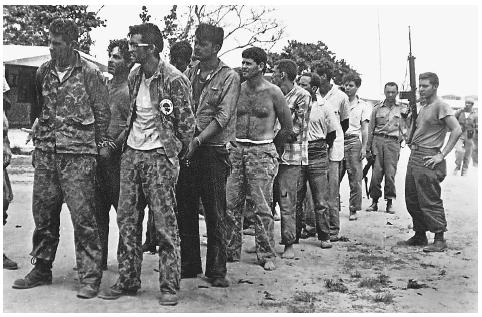
CIA Claims Release of its History of the Bay of Pigs Debacle Would “Confuse the Public.”


Confused anti-Castro forces captured during the Bay of Pigs invasion. History is being held captive, as well.
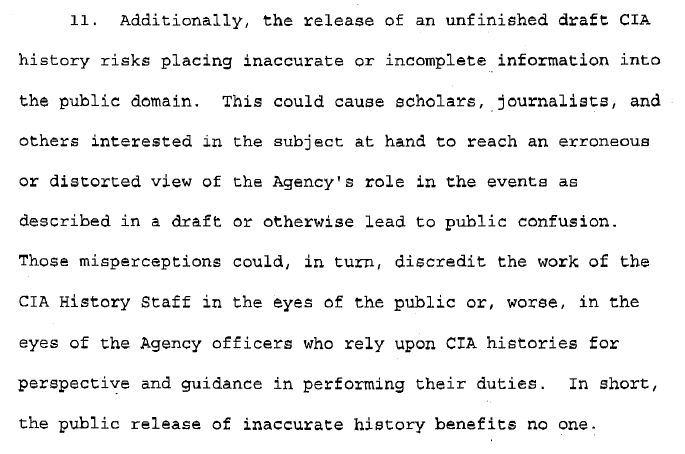
Late last year, the Central Intelligence Agency explained to Judge Kessler of the US District Court in Washington DC that releasing the final volume of its three-decade-old history of the 1961 Bay of Pigs debacle would “confuse the public,” and should be withheld because it is a “predecisional” document.    Wow.  And I thought that I had heard them all.

On the 50th anniversary of the Bay of Pigs invasion, the National Security Archive filed a Freedom of Information Act lawsuit for the release of a five-volume CIA history of the Bay of Pigs affair.  In response to the lawsuit, the CIA negotiated to release three volumes of the history — the JFK Assassination Records Review Board had already released Volume III– with limited redaction, currently available on the National Security Archive’s website.  At the time, the Director of the National Security Archive’s Cuba Documentation project, Peter Kornbluh, quipped that getting historic documents released from the CIA was “the bureaucratic equivalent of passing a kidney stone.”   He was right.  The Agency refused to release the final volume of this history, and the National Security Archive is not giving up on the fight.


Keet it secret!
Volume five of the history, written by CIA historian Jack Pfeiffer –who sued the CIA himself to release the history in 1987, and lost– is described by the CIA as an “Internal Investigation document” that “is an uncritical defense of the CIA officers who planned and executed the Bay of Pigs operation… It offers a polemic of recriminations against CIA officers who later criticized the operation and against those U.S. officials who its author, Dr. Pfeiffer, contends were responsible for the failure of that operation.”
While Dr. Pfeiffer’s conclusions may or may not be true, FOIA case law appears to be pretty clear that Americans –who funded the operation and Dr. Pfeiffer’s histories– have the right to read this document and decide for themselves its merits.  Despite the claims of the CIA’s chief historian David Robarge, the document should not remain in the CIA vaults because its conclusions “could cause scholars, journalists, and others interested in the subject at hand to reach an erroneous or distorted view of the Agency’s role.”  Historians, after all, are well trained in treating documents –especially CIA hagiographies sources– skeptically.

To prevent the public from reading this volume, the CIA has argued that because it is a draft, it is a predecisional document and can be denied under exemption b(5) of the FOIA.  Except –as Davis Sobel, counsel to the National Security Archive points out in our motions– the case law states otherwise.

Saturday, November 5, 2011

Feds Drop Plan to Lie in Public-Record Act Requests

Wired
David Kravitz

Bowing to political pressure, the Justice Department abruptly dropped proposed revisions to Freedom of Information Act rules Thursday that would have authorized the government to inform the public that requested records do not exist even if they do.

The proposal would have granted the government a new option to state that documents relevant to a FOIA request did not exist. According to the Justice Department’s proposal, if the government believes records should be withheld, the government agency to which the request was made “will respond to the request as if the excluded records did not exist.”

Under normal practice, which seems Orwellian enough, the government may assert that it can neither confirm nor deny that relevant records exist if the matter involves national security.

Civil rights groups, and a host of lawmakers from both sides of the spectrum, had blasted the Justice Department’s original proposal.

“For five decades, the Freedom of Information Act has given life to the American value that in an open society, it is essential to carefully balance the public’s right to know and government’s need to keep some information secret,” said Senate Judiciary Chairman Patrick Leahy (D-Vermont.) “The Justice Department’s decision to withdraw this proposal acknowledges and honors that careful balance, and will help ensure that the American people have confidence in the process for seeking information from their government.”

Thursday, October 6, 2011

NY judge won't find CIA in contempt over tapes

Associated Press
Larry Neumeister

CIA Interrogation
NEW YORK (AP) — A federal judge declined Wednesday to find the CIA in contempt for destroying videotapes of Sept. 11 detainee interrogations, saying to do so would serve no beneficial purpose and the CIA had put in place new procedures to prevent such destruction from happening again.

U.S. District Judge Alvin Hellerstein said in a written ruling that the CIA has since remedied its failure to produce videotapes in response to requests by the American Civil Liberties Union. He wrote that the people processing the ACLU's Freedom of Information Act request may not have been aware of the videotapes' existence before they were destroyed.

The government has acknowledged destroying 92 videotapes, including those containing interrogations of a high-level al-Qaida lieutenant who claimed he suffered physical and mental torture at the hands of the CIA. The tapes were destroyed in 2005.

In January, the judge said a contempt finding would be impractical and told the CIA to investigate itself and report how it will prevent employees from destroying information in the future. On Wednesday, he noted that the CIA adopted two new policies in August regarding document preservation to ensure that destruction of any documents outside of routine management of CIA materials will not occur without a review by lawyers to ensure they are preserved for legal proceedings or congressional oversight activity.

The judge said the CIA's new protocols would have "a remedial and deterrent effect should a CIA official think to destroy documents."

"The protocols should lead to better communication and more complete written records within the agency and across the government when an issue of document destruction or retention arises within the agency," he said. "The CIA's new protocols should lead to greater accountability within the agency and prevent another episode like the videotapes' destruction."

Alexander Abdo, staff attorney with the ACLU National Security Project, wrote the ACLU was "profoundly disappointed by the court's unwillingness to label as contempt what it describes as the CIA's 'dereliction.'"

"We also strongly disagree with the court's finding that the CIA has 'remedied' the destruction," Abdo wrote. "The truth is that the CIA destroyed evidence of torture, and the destruction of this evidence has made it harder to hold high-level officials accountable for the abuse that they authorized."

Carly Sullivan, a spokeswoman for federal lawyers who argued the case, said the government had no comment on the ruling.

Tuesday, October 4, 2011

Michael ‘Climategate’ Mann Suffers Three Legal Blows in Court Escapade

CO2 Insanity
John O’Sullivan

Discredited global warming scientist, Michael Mann, sees his last-ditch efforts to hide data fall apart as legal experts reveal a mountain of legal precedents against him.

In his recent papers (filed on September 2, 2011) Mann claims ‘academic freedom’ and ‘proprietary materials’ as his defense. But legal experts who have since reviewed Mann’s submission to the Circuit Court of Prince William County, Va., say they are so full of holes they are doomed to fail.

In this article we show why the Virginia court isn’t likely to give Michael Mann a ‘get out of jail free’ card when it comes to covering up what looks increasingly like a monumental climate conspiracy.
The three facts likely to be fatal to Mann’s case are:
  • Of more than 240 reported cases involving professor-v-university disputes the university almost always wins (note: Mann’s former university employer has already agreed to surrender Mann’s files).
  • Freedom of speech for professors at state universities has been restricted in a series of U.S. Supreme Court case rulings since 1977.
  • No American court has ever ruled to protect a former employee (Mann is no longer employed in Virginia).
Doomsayer’s Defeat Looms in Hockey Stick Face Off 

The match summary so far: Professor Mann played ‘home ice’ advantage last year when three friendly ‘independent’ inquiries gave him temporary respite when they cleared him of foul play.

Mann has been skating on thin ice ever since November 2009 when he and a clique of global warming colleagues were caught personal fouling freedom of information (FOIA) requests in the Climategate scandal.

Leaked emails proved global warming climatologists had been getting away with cynically hiding unfavorable key data concerning past global temperature proxies for years.

But late in the game (May 2011) Mann’s former employer, the University of Virginia (UVA) agreed to comply with a court order to comply with a Freedom of Information (FOIA) request. They had 90 days to release from their computer files Mann’s alleged dodgy data kept hidden for over a decade.

Then, deep into overtime (September 2, 2011), Mann came off the bench to mount a delaying blocking defense asserting ‘academic freedom’ plus his ‘private ownership’ of such data trumps the FOIA rights of taxpayers.

Academic Freedom: A Quasi-legal Concept

A leading authority on education law, Ronald B. Standler, shows that academic freedom has been nothing but an amorphous quasi-legal concept since it first appeared in American courts in the late 1950’s. [1.]

Courts have consistently upheld that the fundamental principle in America is that the law applies equally to everyone. A mountain of U.S. case-law shows that academic freedom is nothing more than any citizen’s right to free speech on issues including: (i.) political free speech (ii.) freedom of association and (iii.) religious expression [2.]

For arrogant academics to claim that their occupational group should have greater rights than any other occupational group is, by definition, discriminatory.

Standler’s reasoning is a telling assist to the climate skeptics’ legal playmaker, Chris Horner of ATI who now looks set be the attorney who scores the courtroom winner.

First Amendment Free Speech Extols Openness Not Censorship

The case boils down to a personal interest versus public interest question: are voters more entitled to see all the scientific evidence they paid for so that they may knowledgeably apply their free speech in the debate over so-called man-made climate change?

The real perversity in Mann’s legal position is that he argues for free speech in reverse – he wants courts to chill debate over the climate controversy and not let voters be properly informed.

In his court papers Professor Mann argues for censorship to suit him. He is seeking a NEGATIVE application of a POSITIVE right. Indeed, it may be shown that Mann’s application of his ‘right’ is as a tool to aid and abet a cover up of misconduct and/or fraud.

But in no small part, academics in a democracy have a moral imperative to not undermine openness and transparency for all. Professors should never abuse their position by claiming any special personal privilege to facilitate censorship and contradict freedom of information laws.

Along the theme of skewed reasoning Mann’s attorneys disingenuously cite Sweezy v. New Hampshire, 354 U.S. 234 (1957), being that the ‘Sweezy’ case addressed freedom of association rather than free speech. And when we examine ‘Sweezy’ this is what we find:

Teachers and students must always remain free to inquire, to study and to evaluate, to gain new maturity and understanding; otherwise our civilization will stagnate and die.”

Sweezy v. New Hampshire, 354 U.S. 234, 250 (1957).

Mann may now wish he hadn’t cited ‘Sweezy’ because he has been caught cherry-picking and misapplying what ‘Sweezy’ actually says. That case was specifically about freedom of association; upholding that community interest allows us open debate where we may apply free speech and be better informed to make democratic decisions on a contentious public policy (e.g. climate taxes).

Tuesday, August 16, 2011

As America's Economy Collapses, "New Normal" Police State Takes Shape

Global Research
Tom Burghardt

Antifascist Calling...

Forget your rights.

As corporate overlords position themselves to seize what little remains of a tattered social net (adieu Medicare and Medicaid! Social Security? Au revoir!), the Obama administration is moving at break-neck speed to expand police state programs first stood-up by the Bush government.

After all, with world share prices gyrating wildly, employment and wages in a death spiral, and retirement funds and publicly-owned assets swallowed whole by speculators and renter scum, the state better dust-off contingency plans lest the Greek, Spanish or British "contagion" spread beyond the fabled shores of "old Europe" and infect God-fearin' folk here in the heimat.

Fear not, they have and the lyrically-titled Civil Disturbances: Emergency Employment of Army and Other Resources, otherwise known as Army Regulation 500-50, spells out the "responsibilities, policy, and guidance for the Department of the Army in planning and operations involving the use of Army resources in the control of actual or anticipated civil disturbances." (emphasis added)

With British politicians demanding a clampdown on social media in the wake of London riots, and with the Bay Area Rapid Transit (BART) agency having done so last week in San Francisco, switching off underground cell phone service to help squelch a protest against police violence, authoritarian control tactics, aping those deployed in Egypt and Tunisia (that worked out well!) are becoming the norm in so-called "Western democracies."

Secret Law, Secret Programs

Meanwhile up on Capitol Hill, Congress did their part to defend us from that pesky Bill of Rights; that is, before 81 of them--nearly a fifth of "our" elected representatives--checked-out for AIPAC-funded junkets to Israel.

Secrecy News reported that the Senate Intelligence Committee "rejected an amendment that would have required the Attorney General and the Director of National Intelligence to confront the problem of 'secret law,' by which government agencies rely on legal authorities that are unknown or misunderstood by the public."

That amendment, proposed by Senators Ron Wyden (D-OR) and Mark Udall (D-CO) was rejected by voice vote, further entrenching unprecedented surveillance powers of Executive Branch agencies such as the FBI and NSA.

As Antifascist Calling previously reported, the Electronic Frontier Foundation filed a Freedom of Information Act lawsuit against the Justice Department "demanding the release of a secret legal memo used to justify FBI access to Americans' telephone records without any legal process or oversight."

The DOJ refused and it now appears that the Senate has affirmed that "secret law" should be guiding principles of our former republic.

Secrecy News also disclosed that the Committee rejected a second amendment to the authorization bill, one that would have required the Justice Department's Inspector General "to estimate the number of Americans who have had the contents of their communications reviewed in violation of the FISA Amendments Act of 2008 [FAA]."

As pointed out here many times, FAA is a pernicious piece of Bushist legislative detritus that legalized the previous administration's secret spy programs since embellished by our current "hope and change" president.

During the run-up to FAA's passage, congressional Democrats, including then-Senator Barack Obama and his Republican colleagues across the aisle, claimed that the law would "strike a balance" between Americans' privacy rights and the needs of security agencies to "stop terrorists" attacking the country.

If that's the case, then why can't the American people learn whether their rights have been compromised?

Perhaps, as recent reports in Truthout and other publications suggest, former U.S. counterterrorism "czar" Richard Clarke leveled "explosive allegations against three former top CIA officials--George Tenet, Cofer Black and Richard Blee--accusing them of knowingly withholding intelligence ... about two of the 9/11 hijackers who had entered the United States more than a year before the attacks."

Clarke's allegations follow closely on the heels of an investigation by Truthout journalists Jeffrey Kaye and Jason Leopold.

"Based on on documents obtained under the Freedom of Information Act and an interview with a former high-ranking counterterrorism official," Kaye and Leopold learned that "a little-known military intelligence unit, unbeknownst to the various investigative bodies probing the terrorist attacks, was ordered by senior government officials to stop tracking Osama bin Laden and al-Qaeda's movements prior to 9/11."

As readers are well aware, the 9/11 provocation was the pretext used by the capitalist state to wage aggressive resource wars abroad while ramming through repressive legislation like the USA Patriot Act and the FISA Amendments Act that targeted the democratic rights of the American people here at home.

But FAA did more then legitimate illegal programs. It also handed retroactive immunity and economic cover to giant telecoms like AT&T and Verizon who profited handily from government surveillance, shielding them from monetary damages which may have resulted from a spate of lawsuits such as Hepting v. AT&T.

This raises the question: are other U.S. firms similarly shielded from scrutiny by secret annexes in FAA or the privacy-killing USA Patriot Act?

Echelon Cubed

Last week, Softpedia revealed that "Google has admitted complying with requests from US intelligence agencies for data stored in its European data centers, most likely in violation of European Union data protection laws."

"At the center of this problem," reporter Lucian Constantin wrote, "is the USA PATRIOT ACT, which states that companies incorporated in the United States must hand over data administered by their foreign subsidiaries if requested."

"Not only that," the publication averred, "they can be forced to keep quiet about it in order to avoid exposing active investigations and alert those targeted by the probes."

In other words, despite strict privacy laws that require companies operating within the EU to protect the personal data of their citizens, reports suggest that U.S. firms, operating under an entirely different legal framework, U.S. spy laws with built-in secrecy clauses and gag orders, trump the laws and legal norms of other nations.

Given the widespread corporate espionage carried out by the National Security Agency's decades-long Echelon communications' intercept program, American firms such as Google, Microsoft, Apple or Amazon may very well have become witting accomplices of U.S. secret state agencies rummaging about for "actionable intelligence" on EU, or U.S., citizens.

Indeed, a decade ago the European Union issued its final report on the Echelon spying machine and concluded that the program was being used for corporate and industrial espionage and that data filched from EU firms was being turned over to American corporations.

In 2000, the BBC reported that according to European investigators "U.S. Department of Commerce 'success stories' could be attributed to the filtering powers of Echelon."

Duncan Campbell, a British journalist and intelligence expert, who along with New Zealand journalist Nicky Hager, helped blow the lid off Echelon, offered two instances of U.S. corporate spying in the 1990s when the newly-elected Clinton administration followed-up on promises of "aggressive advocacy" on behalf of U.S. firms "bidding for foreign contracts."

According to Campbell, NSA "lifted all the faxes and phone-calls between Airbus, the Saudi national airline and the Saudi Government" to gain this information. In a second case which came to light, Campbell documented how "Raytheon used information picked up from NSA snooping to secure a $1.4bn contract to supply a radar system to Brazil instead of France's Thomson-CSF."

As Softpedia reported, U.S.-based cloud computing services operating overseas have placed "European companies and government agencies that are using their services ... in a tough position."

With the advent of fiber optic communication platforms, programs like Echelon have a far greater, and more insidious, reach. AT&T whistleblower Mark Klein noted on the widespread deployment by NSA of fiber optic splitters and secret rooms at American telecommunications' firms:

What screams out at you when examining this physical arrangement is that the NSA was vacuuming up everything flowing in the Internet stream: e-mail, web browsing, Voice-Over-Internet phone calls, pictures, streaming video, you name it. The splitter has no intelligence at all, it just makes a blind copy. There could not possibly be a legal warrant for this, since according to the 4th Amendment warrants have to be specific, "particularly describing the place to be searched, and the persons or things to be seized." ...

This was a massive blind copying of the communications of millions of people, foreign and domestic, randomly mixed together. From a legal standpoint, it does not matter what they claim to throw away later in their secret rooms, the violation has already occurred at the splitter. (Mark Klein, Wiring Up the Big Brother Machine... And Fighting It, Charleston, South Carolina: BookSurge, 2009, pp. 38-39.)

What was Google's response?

In a statement to the German publication WirtschaftsWoche a Google corporate spokesperson said: "As a law abiding company, we comply with valid legal process, and that--as for any U.S. based company--means the data stored outside of the U.S. may be subject to lawful access by the U.S. government. That said, we are committed to protecting user privacy when faced with law enforcement requests. We have a long track record of advocating on behalf of user privacy in the face of such requests and we scrutinize requests carefully to ensure that they adhere to both the letter and the spirit of the law before complying." (translation courtesy of Public Intelligence)

Is the Senate Intelligence Committee's steadfast refusal to release documents and secret legal memos that most certainly target American citizens also another blatant example of American exceptionalism meant to protect U.S. firms operating abroad from exposure as corporate spies for the government?

It isn't as if NSA hasn't been busy doing just that here at home.

As The New York Times reported back in 2009, the "National Security Agency intercepted private e-mail messages and phone calls of Americans in recent months on a scale that went beyond the broad legal limits established by Congress last year."

Chalking up the problem to "overcollection" and "technical difficulties," unnamed intelligence officials and administration lawyers told journalists Eric Lichtblau and James Risen that although the practice was "significant and systemic ... it was believed to have been unintentional."

As "unintentional" as ginned-up intelligence that made the case for waging aggressive war against oil-rich Iraq!

In a follow-up piece, the Times revealed that NSA "appears to have tolerated significant collection and examination of domestic e-mail messages without warrants."

A former NSA analyst "read into" the illegal program told Lichtblau and Risen that he "and other analysts were trained to use a secret database, code-named Pinwale, in 2005 that archived foreign and domestic e-mail messages."

Email readily handed over by Google, Microsoft or other firms "subject to lawful access" by the Pentagon spy satrapy?

The Times' anonymous source said "Pinwale allowed N.S.A. analysts to read large volumes of e-mail messages to and from Americans as long as they fell within certain limits--no more than 30 percent of any database search, he recalled being told--and Americans were not explicitly singled out in the searches."

Saturday, May 14, 2011

Records show FBI practice of hiding evidence in secret databases

KSL
By Dennis Romboy
SALT LAKE CITY — A federal court hearing regarding allegedly hidden Oklahoma City bombing videotapes raised questions about the FBI evidence filing system that a Salt Lake attorney says shows a pattern of deception.

"They hide things. That's for sure," said Jesse Trentadue.

Court documents from various cases, an Associated Press story and a recent court order in California suggest the FBI has routinely concealed evidence from defense attorneys and others seeking records through the Freedom of Information Act.

Trentadue believes the agency has withheld from him surveillance footage from the Alfred P. Murrah Building and police dashcam video of Timothy McVeigh on the day of the deadly explosion.

The Salt Lake attorney began looking into the 1995 bombing case after his brother died in a federal detention center in Oklahoma. He believes federal agents mistook Kenneth Trentadue for a suspect and beat him to death during an August 1995 interrogation. He claims the video will reveal a second bombing suspect who resembles but is not his brother.

FBI storage systems
 
In a U.S. District Court hearing this week, Trentadue recited a recent history of FBI information storage systems bearing names such as "june files," "zero files, "I-drive" and now "S-drive."

The S-drive apparently is where the FBI currently stores documents. Kathryn Wyer, a Department of Justice attorney representing the FBI in the Trentadue case, acknowledged its existence during the hearing. But she said there's nothing nefarious about it.

"The S in S-drive stands for shared drive, not secret drive," she said.

In his ruling after the hearing, Judge Clark Waddoups ordered the FBI to further explain the S-drive and prove it searched that database in the Trentadue matter.

The FBI has already turned over 30 videotapes and 200 documents to Trentadue, and Wyer said there is nothing more in the files. She said the FBI does not have to prove whether other tapes exist or not, but show it conducted a reasonable search of databases where the records are likely to be.

Spokespersons for FBI in Salt Lake City and Washington, D.C., and the Department of Justice said they could not comment on the FBI's evidence storage systems, citing the ongoing litigation.

How the FBI uses those systems illustrates a practice of deception that is well documented in the public record, Trentadue said.

Zero files, for example, were reports containing information the agency did not want disclosed to defense counsel and which were kept separate from specific case files, according to a former FBI agent's affidavit in the Terry Lynn Nichols criminal case. The file name arose from the zero placed at the end of a report's assigned number to set it apart from other documents.

In 2004, the Associated Press revealed the existence of the "I-drive," a temporary  storage device created for FBI field office computer networks. Starting in 1996, agents used the I-drive to upload investigative documents for their supervisors to decide whether to place in the agency's official case files.

According to the story, the FBI did not routinely search the I-drive to see whether requested materials should be sent to defense lawyers, Congress or special investigative bodies such as the 9/11 inquiry.

The FBI acknowledged that some documents the AP unearthed for a 2004 story on the Oklahoma City bombing were inexplicably never given to its own investigators or lawyers for McVeigh, who was executed for the crime. And in 2001, the agency found 4,000 relevant documents that also were never turned over, which delayed McVeigh's execution for a month, according to AP.

FBI concealed documents in Calif. FOIA case
 
Just last month, a federal judge in the Central District of California called the FBI and its records manager David M. Hardy on the carpet for submitting false declarations in an attempt to conceal documents from plaintiffs in a FOIA case. Hardy also has been involved with Trentadue's FOIA request.

In that case, the FBI asserted authority to provide false information to the court.

"The government argues that there are times when the interests of national security require the government to mislead the court. The court strongly disagrees," wrote Judge Cormac J. Carney. "The government’s duty of honesty to the court can never be excused, no matter what the circumstance."

Wyer said that case isn't relevant in Trentadue because it doesn't involve national security.

All of those factors feed Trentadue's suspicion that FBI is concealing videotapes in his case. He believes the video will somehow help unravel what happened to his brother.

History of Trentadue's lawsuit
 
Kenneth Trentadue was a convicted bank robber who was taken to the federal transfer center in Oklahoma City after violating probation in San Diego in June 1995. His official cause of death was listed as suicide. But when his body was returned to the Trentadue family, it was covered with blood and bruises that Jesse Trentadue contends could have only come from a beating.

In a letter to Trentadue, the FBI said its search of the I-drive in the Oklahoma City field office yielded no records concerning him or his brother.

Still, Trentadue raised enough questions in court about how the FBI handles information requests that Waddoups ordered the agency to provide answers.

In addition to explaining the S-drive, the judge wants the FBI to prove it searched the I-drive. He wants Hardy and other FBI employees to indicate if they made truthful statements in the Trentadue case. He also wants the agency to address whether it searched evidence control centers in Oklahoma City and FBI headquarters and the FBI crime lab.

Finally, Waddoups ordered the FBI to explain how burdensome it would be to check the Oklahoma City bombing case file for entries in the two weeks after the explosion.

Trentadue said now that he knows about the different storage drives, his next FOIA request will specify searches of the A-drive, B-drive, C-drive, etc.

Tuesday, May 10, 2011

Breaking news: Corporations have no First Amend. Rights. Ruling invalid.

Human Rights Examiner
Deborah Dupre

Corporations having First Amendment Rights, as ruled by the Supreme Court, has been challenged by Human Rights Alert and proven on Monday to be a bogus court ruling according to the Freedom of Information Act (FOIA) response that the human rights project received. The response evidences that the FEC produced invalid records about the case including no NEF on the ruling documentation.

Citizens United v Federal Election Commission (FEC) (08-205), a landmark decision of the US Supreme Court, was reported to have accorded corporations First Amendment rights.

The ruling was a “decision holding that corporations and unions can spend unlimited amounts of money in election campaigns… a stunning example of judicial activism…” as Human Rights Alert head, Dr. Joseph Zernik highlighted today.

As of yesterday, however, Dr. Zernik has evidence that the Corporation Corporate Rights ruling "cannot possibly be a valid court record" he said. Dr. Zernik lists the following four reasons:

1. It is a record dated January 21, 2010, whereas the online docket noted the issuance of a Judgment on February 22, 2010.

2. It is an unsigned record, which bears a stamp certifying that it is a “true copy” of an unsigned original record.

3. The stamp is signed, but not dated. Moreover, the name and authority of the person who signed the stamp (Cynthia Rapp) were not printed below the signature line. Therefore, the signature on the stamp, certifying “true copy” is of dubious validity as well.

4. It has no true and valid attestation/authentication by the Clerk of the Supreme Court of the United States. Contrary to what was stated in the FOIA response letter [i], the record provided did not include true and valid attestation/authentication by the Clerk of the Supreme Court of the United States.

In a statement that Dr. Zernik released Tuesday after receiving the FOIA evidence, he highlights the legal definition of Authentication:

"An attestation made by a proper officer, by which he certifies that a record is in due form of law, and that the person who certifies it is the officer appointed by law to do so… By authentication is also understood whatever act is done either by the party or some other person with a view of causing an instrument to be known and identified."

"It should be of particular concern that FEC, like other parties to the litigation, so far has not produced a copy of the February 22, 2010 Judgment as served on FEC by the Clerk of the Supreme Court," stated Dr. Zernik.

According to Zernik's official documentation, the record produced was derived from the PACER docket of the US Court, District of Columbia is invalid because it had no Notice of Electronic Filing, (NEF), a US requirement for valid rulings.

Human Rights Alert, founded by Dr. Zernik, is dedicated to discovering, archiving, and disseminating evidence of Human Rights violations by the justice systems of State of California and United States in Los Angeles County, California, and beyond. Human Rights Alert focuses on the unique role of computerized case management systems in the precipitous deterioration of the integrity of the justice.

Dr. Zernik has advocated for now freed attorney Richard Fine who was falsely imprisoned, advocated for some 30,000 Falsely Imprisoned Persons (FIP) in the Los Angeles prison system, and advocates for homeowners robbed by banks due to court corruption.

Continue reading on Examiner.com: Breaking news: Corporations have no First Amend. Rights. Ruling invalid. - National Human Rights | Examiner.com http://www.examiner.com/human-rights-in-national/human-rights-group-supreme-court-corp-1st-amend-rights-ruling-invalid#ixzz1LyJGWuK9

Thursday, April 28, 2011

CRU Refuses FOI Request for Yamal Climategate Chronology

ClimateAudit

Probably no single issue damages the reputation of the climate science community more than the refusal to show the data that supports their work, even under an FOI request. The public believes that scientists who purport to be concerned about the future of the planet should not place their own financial interests, including future grants, ahead of this concern, particularly when their research has been done with public funds.

Recently I sent an FOI request to the University of East Anglia for a regional chronology combining Yamal, Polar Urals and shorter (presumably Schweingruber) chronologies referred to in Climategate email 1146252894.txt, as well as a request for even a simple list of sites used to make the chronology. This request is for data that is central to Climategate. Yamal was in controversy in the days prior to Climategate. I drew particular attention to this issue and this series in my own submission. Unfortunately, the “inquiries” avoided the issue.

Not only did East Anglia refuse my request for the regional chronology, they even refused to identify the sites. The University claimed that even identifying the sites would result in “financial harm” to the university though an adverse impact on their “ability to attract research funding”. See here.
It’s hard to imagine an institution purporting to justify its conduct in such crass commercial terms.
In more detail …


I wrote my recent posts on Yamal here here as an introduction to today’s post by reminding readers that the topic in dispute when the Climategate dossier was released was why CRU hadn’t published a regional chronology combining Yamal, Schweingruber data (including Polar Urals), as they had done for Taimyr. The question was summarized by Ross in an Op Ed as follows:
Combining data from different samples would not have been an unusual step. Briffa added data from another Schweingruber site to a different composite, from the Taimyr Peninsula. The additional data were gathered more than 400 km away from the primary site. And in that case the primary site had three or four times as many cores to begin with as the Yamal site. Why did he not fill out the Yamal data with the readily-available data from his own coauthor? Why did Briffa seek out additional data for the already well-represented Taimyr site and not for the inadequate Yamal site?
Although Briffa’s online response in October 2009 was implausible – Briffa said that they hadn’t thought of including the Schweingruber series – it was uncritically endorsed by the “community”. Briffa also claimed that this didn’t “matter” – I rebutted this latter claim in my recent post.

Briffa’s seemingly implausible assertion that they had never “considered” inclusion of the Schweingruber series was brought into question by the Climategate dossier, and, in particular email 1146252894.txt which discussed the very regional chronology combining Yamal, Polar Urals and shorter (Schweingruber) chronologies that had been at issue on the eve of Climategate:
Date: Fri, 28 Apr 2006
To: philip.brohan
From: Tim Osborn
Subject: Re: Standardisation uncertainty for tree-ring series
Cc: Keith Briffa,simon.tett
Hi Philip,
we have three “groups” of trees:
“SCAND” (which includes the Tornetrask and Finland multi-millennial chronologies, but also some shorter chronologies from the same region). These trees fall mainly within the 3 boxes centred at: 17.5E, 67.5N;22.5E, 67.5N; 27.5E, 67.5N.
“URALS” (which includes the Yamal and Polar Urals long chronologies, plus other shorter ones). These fall mainly within these 3 boxes: 52.5E, 67.5N; 62.5E, 62.5N (note this is the only one not at 67.5N); 67.5E, 67.5N.
“TAIMYR” (which includes the Taimyr long chronology, plus other shorter ones). These fall mainly within these 4 boxes: 87.5E, 67.5N; 102.5E, 67.5N; 112.5E, 67.5N; 122.5E, 67.5N.
We do some analysis at the group scale, and for this we take the JJA temperatures from each box and average to the group scale to obtain a single series from each of SCAND, URALS and TAIMY.
We do some analysis at the overall scale, and for this we take these three group temperature series and average them to get an overall NW Eurasia temperature for boxes with tree chronologies in them.
We did also try using a wider average for the region, including all LAND temperatures from grid boxes within a rectangular region from 12.5E to 127.5E and from 57.5N to 72.5N, but I don’t think it correlated so well against the tree-ring width data (I can’t remember the exact correlations), so we didn’t pursue that.
Does that give you enough information to be going on with? I’d recommend using CRUTEM3 rather than HadCRUT3, because the correlations seem to deteriorate with the inclusion of SST data in some cases — though of course you can look into this yourself.
Cheers
Tim
In my submission to the Parliamentary Committee and Muir Russell “inquiry”, I specifically referred them to the “still unavailable combined chronology attested in Climategate Letter 1146252894.txt” (this was one of only two emails that I directly cited in the running text.) For inquiries mandated to examine possible incidents of data manipulation or suppression (including “cherry picking”) this was right at the top of my list and should have been somewhere on theirs. Instead, the “inquiries” averted their gaze.

Because none of the negligent “inquiries” reported on the regional chronology, it remained an outstanding question. Accordingly, I recently submitted an FOI (EIR) request for information on the Climategate regional chronology, including even seemingly innocuous information such as the sites:
Climategate email 684. 1146252894.txt of Apr 28, 2006 refers to a tree ring composite identified as follows:
“URALS” (which includes the Yamal and Polar Urals long chronologies, plus other shorter ones).
Could you please provide me a digital version of this series together with a list of all the measurement data sets used to make this composite, denoting each data set by ITRDB identification or equivalent. For the Polar Urals site, would you please identify the individual data sets used by ITRDB identification or equivalent. If any of the data is not in a public archive, please provide the measurement data.
It would probably simplify matters if you also provided the measurement data used for the “URALS” chronology in a digital form.
Thank you for your attention,
Stephen McIntyre
A couple of weeks ago, the University of East Anglia refused everything in my request, up to and including a list of sites. (The refusal is online here.) I’ll summarize their response below, but urge interested readers to read the original refusal.

As a clarification for the refusal below, although I had only requested the regional chronology, an email prior to the one quoted discussed the construction of 1001 bootstrap variations, which weren’t what I was looking for.

Although they refused to provide a list of sites, they said that the sites were in northwest Siberia:
Although the specific lists of sites used at the time of the 2006 email (and as
modified in subsequent work) are not being released, the primary data from which
the selections were made, including the site identifiers, are available publicly on a
variety of websites as noted in the above text. In addition we can release the
general parameters for the sites from which the data for the URALS group were
drawn: we used only ring-width data, and the sites were from within the domain
bounded by 45°E and 75°E and north of 60°N
And that the sites were referred to somewhere within the lists on three websites:
Although the specific lists of sites are not being released, we are providing the general coordinates to identify the “URALS” study region from which data were selected. All of the data that we have used within this area are publicly available (including their ITRDB identifiers or equivalent) on several websites. In the attachment to this letter we provide the general regional
parameters for this study and the data (including ITRDB identifiers where they exist)
from which the selection was made can be found on the ITRDB website:
(http://web.utk.edu/~grissino/itrdb.htm). Additional data are available at other websites:
(http://www.ncdc.noaa.gov/paleo/treering.html) and
(http://www.cru.uea.ac.uk/cru/people/briffa/yamal2009/data/). There are some Russian
sites not within the ITRDB database and the identifiers for those can be found on a
Russian website http://lib.ipae.uran.ru/dchrono (in Russian).
Secondly, even though Briffa et al 2008 purported to publish regional chronologies for three north Eurasian areas, they claimed their 2006 regional chronology was exempt because it was only a first draft.

Thirdly, they stated that the release of either the data or the selection of sites would “adversely affect the intellectual property rights of the University”:
The 1,001 composite data sets and the list of sites used to construct the data sets
are incomplete and subject to further work and modification. Additionally, release at
this time of the 1,001 composite data sets and the selection of sites used to
construct them would also adversely affect the intellectual property rights of the
University.
They argued that their “intellectual property rights” extended to the selection of sites and disclosure of the sites included in their unreported 2006 regional chronology would cause the university “financial harm” through an adverse impact on its ability to attract funding. The University goes on to say that CRU is re-analysing its results and will report back by October 2012:
In regards to Regulation 12(5)(c), it is our contention that there are intellectual property rights in the form of both copyright and database right in the composite data sets.
Creative work went into the selection of the site locations to include, and the
arrangement of the data within the data sets, thus leading to a database right.
Additionally, the data itself within the composite data sets represents the intellectual
effort of developing the processing of the ‘raw’ data obtained from the site datasets
themselves and therefore attracts copyright. The ‘adverse affect’ to intellectual property
rights is based upon the fact that release of these data sets and the methodology used
in their construction would, effectively, be publication of the creative work of the CRU
staff. This would seriously reduce the likelihood that any high impact journal would
publish the results pertaining to this work, thus effectively causing the University
financial harm via adverse impact upon reputation, ability to attract research funding,
and funding arising from the citation of the publications within the REF process by which
universities in the United Kingdom receive funding based on the quality of research
undertaken….
the lists of sites from which the data is drawn was created in 2006 as a first ‘draft’ of work that was meant to be carried forward and refined with a view to future publication. Whilst there
has been the passage of some time since the creation of the first set of 1,001 composite
records, staff at the CRU have returned to this data recently as part of a project funded
by NERC, which commenced in May 2010, that encapsulates this NW Eurasian tree-ring
study, and which will be completed no later than October 2012. The data will be revised
in the near future as the project moves towards publication of papers based on the work
in constructing the composites.
This doesn’t in any way explain CRU’s failure to use the 2006 regional chronology in Briffa et al 2008. Nor does it explain CRU’s statement in October 2009 that they hadn’t “considered” combining the Schweingruber chronologies (when the email indicates otherwise).

Yamal was not an incidental issue in Climategate. As noted in my recent post, Phil Jones’ first reaction to Fred Pearce was that Climategate was about Yamal. Refusing essential documents on Yamal simply fuels suspicion.

Refusal of data requests by climate scientists are corrosive to public confidence in the climate science community. When the FOI refusals pertain to documents that were at the heart of Climategate, the refusals are particularly toxic.


The easiest way for the climate science to “move on” would be to voluntarily disclose the list of sites and the regional chronology rather than fighting FOI tooth-and-nail. This request is not going to disappear.

And the people who should be most concerned about UEA’s most recent refusal are the wider climate science community who purport to be concerned about the future of the planet. Provided, of course, in the case of the University of East Anglia, that it doesn’t interfere with their “ability to attract research funding”,