


Global Research
Peter Dale Scott
Introduction: Structural Deep Events and the Strategy of Tension in Italy

From an American standpoint, it is easy to see clearly how Italian history was systematically destabilized in the second half of the 20th century, by a series of what I call structural deep events. I have defined these as “events, like the JFK assassination, the Watergate break-in, or 9/11, which violate the … social structure, have a major impact on … society, repeatedly involve law-breaking or violence, and in many cases proceed from an unknown dark force.”2
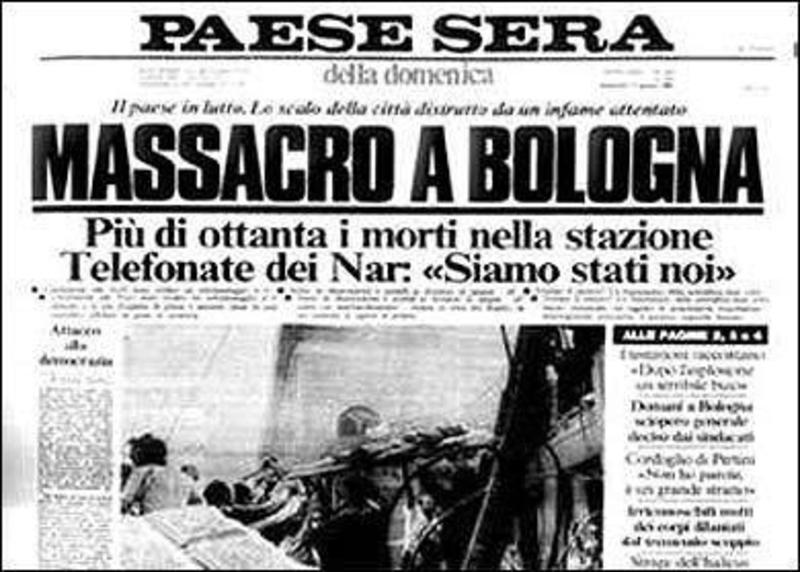
The examples in Italy, well known to Italians, include the Piazza Fontana bombing of 1969, the Piazza della Loggia bombing of 1974, and the Bologna railway bombing of 1980.
These bombings, in which over one hundred civilians were killed and many more wounded, were attributed at the time to marginal left-wing elements of society. However, thanks chiefly to a series of investigations and judicial proceedings, it is now clearly established that the bombings were the work of right-wing elements in collusion with Italian military intelligence, as part of an on-going “strategy of tension” to discredit the Italian left, encourage support for a corrupt status quo, and perhaps move beyond democracy altogether.3 As one of the conspirators, Vincenzo Vinciguerra, later stated, “The December 1969 explosion was supposed to be the detonator which would have convinced the political and military authorities to declare a state of emergency.”4
Vinciguerra also revealed that he and others had also been members of a paramilitary “stay-behind” network originally organized at the end of World War II by the CIA and NATO as “Operation Gladio.”
In 1984, questioned by judges about the 1980 Bologna station bombing, Vinciguerra said: “With the massacre of Peteano, and with all those that have followed, the knowledge should by now be clear that there existed a real live structure, occult and hidden, with the capacity of giving a strategic direction to the outrages…[it] lies within the state itself…There exists in Italy a secret force parallel to the armed forces, composed of civilians and military men, in an anti-Soviet capacity that is, to organise a resistance on Italian soil against a Russian army…A secret organisation, a super-organisation with a network of communications, arms and explosives, and men trained to use them…A super-organisation which, lacking a Soviet military invasion which might not happen, took up the task, on Nato’s behalf, of preventing a slip to the left in the political balance of the country. This they did, with the assistance of the official secret services and the political and military forces.5
Gladio connections to sustained false-flag violence, again involving NATO and the CIA, were subsequently revealed in other countries, notably Belgium and Turkey.6
The original purpose of Gladio was to consolidate resistance in the event of a Soviet takeover. But many of the senior Italians involved in the bombings implicated the CIA and NATO in them as well:
General Vito Miceli, the Italian head of military intelligence, after his arrest in 1974 on a charge of conspiring to overthrow the government, testified “that the incriminated organization, … was formed under a secret agreement with the United States and within the framework of NATO.” Former Italian defense minister Paulo Taviani told Magistrate Casson during a 1990 investigation “that during his time in office (1955-58), the Italian secret services were bossed and financed by ‘the boys in Via Veneto’—i.e. the CIA agents in the U.S. Embassy in the heart of Rome.” In 2000 “an Italian secret service general [Giandelio Maletti] said . . . that the CIA gave its tacit approval to a series of bombings in Italy in the 1970s to sow instability and keep communists from taking power. . . . ‘The CIA wanted, through the birth of an extreme nationalism and the contribution of the far right, particularly Ordine Nuovo, to stop (Italy) sliding to the left,’ he said.”7
Another conspirator, Carlo Digilio, “described how he passed on details of planned bomb attacks to his CIA contact, Captain David Carret, who had told him that the bombing campaign was part of a US plan to create a state of emergency.”8 Daniele Ganser, in his important book Nato’s Secret Armies, has endorsed a Spanish report that in 1990 NATO Secretary General Manfred Wörner (aGerman politician and diplomat) secretly confirmed that NATO’s headquarters, SHAPE, was indeed responsible:
The Supreme Headquarters Allied Powers Europe (SHAPE), directing organ of NATO’s military apparatus, coordinated the actions of Gladio, according to the revelations of Gladio Secretary-General Manfred Wörner during a reunion with the NATO ambassadors of the 16 allied nations.9
Extrapolating from such testimony, Ola Tunander has compared the strategy of tension in Italy, with its false-flag bombing attacks, to “what the Turkish military elite might describe as the correction of the course of democracy by the ‘deep state’ [a Turkish term].”10
 |
| Strategy of Tension |
But I believe it would be too simplistic an analysis to blame the Italian strategy of tension exclusively on Vinciguerra’s “super-organisation which… took up the task [of false-flag bombings], on Nato’s behalf.” There appear to have been other directing forces besides NATO and those elements Vinciguerra was aware of through Italian military intelligence (the SID, later SISMI). It is important to recall that the Italian trials of those convicted for the 1980 Bologna bombing implicated not only Vinciguerra, SISMI, and Gladio, but also elements of the Italian mafia (the Banda della Magliana) and the Italian Masonic Lodge Propaganda-Due (P-2), with links to criminal bankers and the Vatican.11
In short, if we suggest that something like the Turkish deep state was involved in the Italian strategy of tension, this does not suggest a solution to the Italian mystery, so much as a zone, or interlocking network, for further research.
Has a Strategy of Tension Been Exercised in America?
Gladio connections to sustained false-flag violence, again involving NATO and the CIA, were subsequently established in other countries, notably Belgium and Turkey.12 I wish to propose that America, as well as Europe, has also suffered from a similar series of false-flag structural deep events, including bombings, that have, in conformity with the same strategy of tension, systematically moved America into its current condition, a state of emergency.
 |
| Nato headquarters |
Among the false flag structural deep events I wish to consider today are
The John F. Kennedy assassination of 1963, or 11/22, which led to the CIA’s Operation Chaos against the anti-Vietnam War movement. (11/22 was clearly a deep event: many documents in the area of Lee Harvey Oswald’s relations to CIA operations are still being withheld, despite statutory and court orders to release them.13The Robert Kennedy assassination of 1968, followed immediately by emergency legislation which led to state-sponsored violence at the 1968 Democratic Party Convention.The 1993 first World Trade Center bombing and the 1995 Oklahoma City bombing, which led to the Antiterrorism and Effective Death Penalty Act of 1996.9/11 and the subsequent false flag anthrax attacks of 2001, which led to the imposition of Continuity of Government (COG) measures, the Patriot Act, and the proclamation, on September 14, 2001, of a State of Emergency which remains in effect. (In September 2012 it was once again renewed for another year).14
These structural deep events have had a common and cumulative result: the erosion of public or constitutional power, and its progressive replacement by unconstrained repressive force. I have argued elsewhere that
1) as in Italy, all of these events were blamed on marginal left-wing elements, but in fact involved elements inside America’s covert intelligence agencies, along with their shadowy underworld connections.2) some of these structural deep events bore a relationship to the ongoing secret planning – known in the Pentagon as the Doomsday Project – for Continuity of Government (or COG) in an emergency, which entailed its own secret communications network, and arrangements for what (in the Oliver North Hearings) was called “suspension of the American Constitution.”3) in every case, the official response to the deep event was a set of new repressive measures, usually in the form of legislation.4) cumulatively, these events suggest the on-going presence in America of what I have called a “dark force” or “deep state,” analogous to what Vinciguerra described in Italy as a “secret force…occult and hidden, with the capacity of giving a strategic direction to the [successive] outrages.”15
The Oklahoma City Bombing (4/19) and 9/11
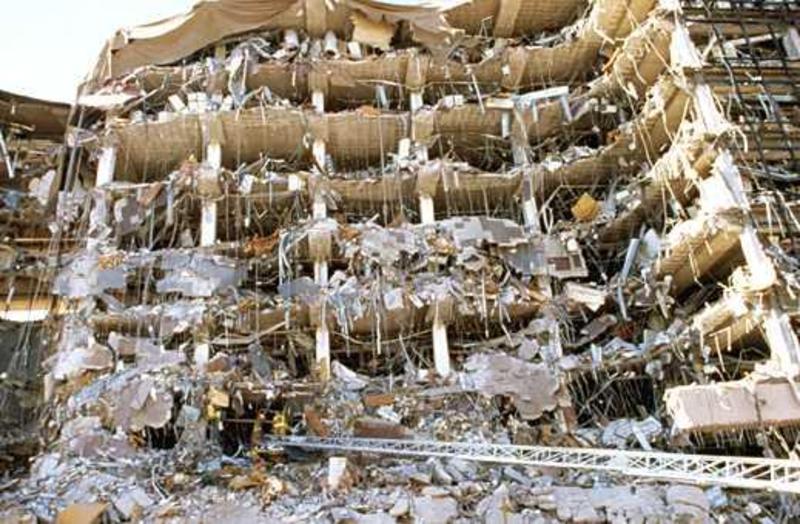
Recently I viewed for a film, “A Noble Lie,” about the 1995 Oklahoma City bombing.16 This gave me a chance, for the first time, to test these hypotheses against the case of Oklahoma City on April 19, 1995, or what I shall call 4/19. More than I could have anticipated, 4/19 fit into and strengthened this analysis.
 |
| Oklahoma City Bombing |
The film “A Noble Lie,” itself points to some striking similarities between the events of 1995 and of 2001. The most obvious is the alleged destruction of a steel-reinforced building by external forces (a truck bomb in the case of the Murrah Building in 1995, flying debris in the case of Building Seven in 2001). Experts in both cases have asserted that the buildings in fact could only have been brought down by cutting charges placed directly against the sustaining columns inside the building. Here for example is a report to Congress from General Benton K. Partin, a retired U.S. Air Force Brigadier General and expert on non-nuclear weapons devices:
When I first saw the pictures of the truck-bomb’s asymmetrical damage to the Federal Building, my immediate reaction was that the pattern of damage would have been technically impossible without supplementing demolition charges at some of the reinforcing concrete column bases…. For a simplistic blast truck-bomb, of the size and composition reported, to be able to reach out on the order of 60 feet and collapse a reinforced column base the size of column A-7 is beyond credulity.17
There is now a broad and growing consensus among architects, engineers, and other experts, that the three buildings which collapsed on 9/11 in the World Trade Center were also most probably destroyed by controlled demolition charges.18


 Posts
Posts


