Showing posts with label HSBC. Show all posts

Wednesday, December 12, 2012

HSBC, too big to jail, is the new poster child for US two-tiered justice system


Guardian
Glenn Greenwald
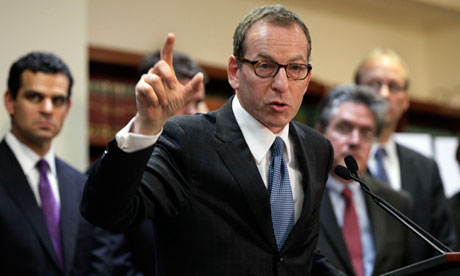
Lanny Breuer, HSBC

Assistant attorney general Lanny Breuer said taking away HSBC's US banking licence could have cost thousands of jobs. Photograph: Richard Drew/AP
(updated below)

The US is the world's largest prison state, imprisoning more of its citizens than any nation on earth, both in absolute numbers and proportionally. It imprisons people for longer periods of time, more mercilessly, and for more trivial transgressions than any nation in the west. This sprawling penal state has been constructed over decades, by both political parties, and it punishes the poor and racial minorities at overwhelmingly disproportionate rates.

But not everyone is subjected to that system of penal harshness. It all changes radically when the nation's most powerful actors are caught breaking the law. With few exceptions, they are gifted not merely with leniency, but full-scale immunity from criminal punishment. Thus have the most egregious crimes of the last decade been fully shielded from prosecution when committed by those with the greatest political and economic power: the construction of a worldwide torture regime, spying on Americans' communications without the warrants required by criminal law by government agencies and the telecom industry, an aggressive war launched on false pretenses, and massive, systemic financial fraud in the banking and credit industry that triggered the 2008 financial crisis.

This two-tiered justice system was the subject of my last book, "With Liberty and Justice for Some", and what was most striking to me as I traced the recent history of this phenomenon is how explicit it has become. Obviously, those with money and power always enjoyed substantial advantages in the US justice system, but lip service was at least always paid to the core precept of the rule of law: that - regardless of power, position and prestige - all stand equal before the blindness of Lady Justice.

It really is the case that this principle is now not only routinely violated, as was always true, but explicitly repudiated, right out in the open. It is commonplace to hear US elites unblinkingly insisting that those who become sufficiently important and influential are - and should be - immunized from the system of criminal punishment to which everyone else is subjected.

Worse, we are constantly told that immunizing those with the greatest power is not for their good, but for our good, for our collective good: because it's better for all of us if society is free of the disruptions that come from trying to punish the most powerful, if we're free of the deprivations that we would collectively experience if we lose their extraordinary value and contributions by prosecuting them.

This rationale was popularized in 1974 when Gerald Ford explained why Richard Nixon - who built his career as a "law-and-order" politician demanding harsh punishments and unforgiving prosecutions for ordinary criminals - would never see the inside of a courtroom after being caught committing multiple felonies; his pardon was for the good not of Nixon, but of all of us. That was the same reasoning hauled out to justify immunity for officials of the National Security State who tortured and telecom giants who illegally spied on Americans (we need them to keep us safe and can't disrupt them with prosecutions), as well as the refusal to prosecute any Wall Street criminals for their fraud (prosecutions for these financial crimes would disrupt our collective economic recovery).

A new episode unveiled on Tuesday is one of the most vivid examples yet of this mentality. Over the last year, federal investigators found that one of the world's largest banks, HSBC, spent years committing serious crimes, involving money laundering for terrorists; "facilitat[ing] money laundering by Mexican drug cartels"; and "mov[ing] tainted money for Saudi banks tied to terrorist groups". Those investigations uncovered substantial evidence "that senior bank officials were complicit in the illegal activity." As but one example, "an HSBC executive at one point argued that the bank should continue working with the Saudi Al Rajhi bank, which has supported Al Qaeda."

Monday, November 5, 2012

HSBC’s money laundering fines to top US$1.5-billion, criminal charges likely


FP Street
Steve Slater
Matt Scuffham

Reuters
HSBC said the U.S. investigation into anti-money laundering 
rule breaches had damaged the bank’s reputation.

The report undoubtedly caused considerable reputational damage to HSBC. The extent to which that has resulted in loss of business is hard to measure, but it has undoubtedly damaged our brand

LONDON — A U.S. fine for anti-money laundering rule breaches could cost HSBC significantly more than US$1.5 billion and is likely to lead to criminal charges, Europe’s biggest bank said on Monday.

HSBC said the U.S. investigation had damaged the bank’s reputation and forced it to set aside a further US$800 million to cover a potential fine for breaches in anti-money laundering controls in Mexico, adding to US$700 million put aside in July.

“It could be significantly higher,” Chief Executive Stuart Gulliver told reporters on a conference call, saying the latest provision was based on discussions with the various U.S. authorities involved in the probe.

The timing of any settlement is in the hands of regulators and is likely to involve the filing of corporate criminal and civil charges, the bank said.

A U.S. Senate report in July slammed HSBC for letting clients shift potentially illicit funds from countries such as Mexico, Iran, the Cayman Islands, Saudi Arabia and Syria. HSBC had warned earlier in the year it could face criminal or civil charges as part of the investigation.

The London-based bank has said the issue was “shameful and embarrassing” after the report criticised a “pervasively polluted” culture at the bank and said HSBC’s Mexican operations had moved US$7 billion into its U.S. operations between 2007 and 2008.

“The report undoubtedly caused considerable reputational damage to HSBC. The extent to which that has resulted in loss of business is hard to measure, but it has undoubtedly damaged our brand,” Gulliver said.

He said a number of staff had left the firm as a result of the investigation and a number had had pay clawed back.

Shares in HSBC were down 1.4% at 617.5 pence by 1130 GMT, slightly weaker than a fall in the European bank index.

“The money laundering provision is a concern, particularly given the uncertainty on what the final figure might be,” said Richard Hunter, head of equities at stockbroker Hargreaves Lansdown.

The issue is another blow for the reputation of British banks, after rival Barclays was fined US$450 million in June for rigging Libor interest rates and the industry has had to set aside more than 12 billion pounds to compensate UK customers for mis-selling insurance products.

Gulliver said it would take time to clean up the mess.

“There’s a whole series of things that came from probably a decade in the 2000 to 2008-09 period that have surfaced now that the industry needs to sort out, remediate, and make sure doesn’t happen again.

”It will take a chunk of time to clean the system and then it will take a little bit longer than that for trust to be restored more fully,“ he said, adding that it was his job to get HSBC back to a position ”where it’s regarded as the best of the bunch“.

HSBC Chairman Douglas Flint will appear before UK lawmakers investigating culture and standards later on Monday. He will be quizzed alongside new Barclays CEO Antony Jenkins and Santander UK boss Ana Botin at 1600 GMT.

COST CUTS, JOB CUT

S HSBC reported an underlying profit – after stripping out the impact of disposals and changes in the value of its own debt – in the July-September quarter of US$5.0 billion, up from a revised US$2.2 billion a year earlier.

It was helped by a bigger-than-expected drop in losses from bad debts and a solid performance by its investment bank arm.

Underlying operating expenses rose by 16% during the quarter from a year ago due to higher compliance and regulatory costs, which the bank said amounted to US$200 million to US$300 million.

Gulliver is well into a three-year restructuring plan to streamline the bank and he said he expects to surpass his target of cutting annual costs by US$3.5 billion, after driving through US$3.1 billion of savings already.

But subdued revenue growth and the higher compliance costs left its underlying cost/income ratio at 63.7% in the third quarter, well above his 48-52% target. Gulliver admitted hitting that was ”proving challenging“, but said he remained committed to delivering it by the end of 2013.

HSBC took another US$357 million charge for mis-selling payment protection insurance in Britain, lifting the total amount set aside to US$2.1 billion. The bank said it paid out US$1 billion in compensation.

Gulliver said more job cuts were likely before the end of 2013 at his bank, whose origins date back to 1865 as a financier of trade between Europe and Asia and operates in 84 countries.

HSBC has cut almost 30,000 jobs in the last two years – close to what Gulliver had predicted under his revamp – although about half of those have been due to disposals. ”In terms of the organic reduction, there’s still some way to go,“ he said.

He has sold or closed 41 businesses as part of that plan, including including selling its U.S. credit card arm and half of its U.S. branches, and said he was about three quarters of the way through that plan.


Saturday, September 22, 2012

Drug war ensnares big banks for letting Mexico cartels stash cash


Prosecutors in the US and Mexico have banks in their crosshairs for helping drug smugglers and money launderers transfer and hold their illegal earnings.

GlobalPost
Nathaniel Parish Flannery

Fake notes were hung out to dry during a protest in
front of HSBC in Mexico City on July 30. The bank was fined for
failing to apply anti-money laundering rules.
On the facade of the tall HSBC bank headquarters here, there’s a dark reflection of the Angel of Independence monument, one of the most iconic landmarks in this capital city.
The towering bank’s central location at the Plaza of Independence is a metaphor for its importance to Mexico’s financial system.
“It’s in the heart of the capital, in the most emblematic part of [the city],” said Myrna de los Santos, a finance professional who works in one of the neighboring glass office buildings. Looking up at HSBC Tower, she said, “This is the bank that’s been accused of laundering money.”
HSBC and other major banks have been accused of helping launder money for the narco criminals seen waging a brutal war in Mexico largely to win drug markets in the United States.
HSBC officials say they are cooperating with investigators. “What happened in Mexico and the US is shameful, it’s embarrassing, it’s very painful for all of us in the firm,” HSBC’s CEO Stuart Gulliver said in a July 30 conference call.
The accusations come as Mexican and US authorities have ramped up crackdowns on transnational crime rings’ vast earnings. Government prosecutors say they are chasing down drug profits and more aggressively targeting the financial institutions that let those profits amass in their vaults.
A US Senate investigation has accused HSBC of laundering $7 billion, transferring funds for Mexican clients through accounts in the Cayman Islands to accounts in the US.

Bank of America allegedly opened and operated accounts for a US-based money laundering racket run by Los Zetas, Mexico’s most violent criminal organization. The Zetas allegedly used Bank of America accounts to buy $4 million worth of horses, and enter and win races, sometimes collecting nearly $1 million per victory, according to a New York Times report. (Bank of America has not been accused of wrongdoing and is reportedly cooperating with a US Federal Bureau of Investigation inquiry into the Zetas activities.)
HSBC, Citi, and Spain’s Banco Santander have all been accused of engaging in business transactions with Mexican money exchange houses that are suspected of money laundering.
HSBC is likely to be the first of these to reach a settlement with US authorities this year. On July 30, the bank announced it had set aside $700 million to cover the possible costs of a settlement of the money laundering investigation.
researches and teaches about organized crime at Mexico City’s ITAM university, told GlobalPost the fact that a respected global bank such as HSBC has been pulled into a money laundering scandal in Mexico “shows that it’s not just a Mexico problem [but rather] an international problem.”
Duncan Wood, who 
The recent investigations build on more than a decade of probes into the global flows of illicit cartel capital. One find, in 2006, was particularly emblematic of how drug trafficking routes and illicit money trails overlap.
In April of that year, Mexican soldiers searched a jet that had landed in a small airport 500 miles east of Mexico City. They found 128 black suitcases stuffed with nearly six tons of cocaine, a quantity with a street value of $100 million, Bloomberg reported. Later, investigators discovered the smugglers had used accounts at Bank of America and Wachovia to buy the plane.
Prosecutors in the US began digging deeper into Wachovia’s other dealings in Mexico. In 2007 securities regulators raided the bank’s headquarters in St. Louis. In 2010, the bank, now a subsidiary of Wells Fargo, agreed to a $160 million settlement with the US Justice Department.
The Wachovia investigation and fine — the largest money laundering settlement ever levied against a US bank — apparently did not serve as a deterrent. As drugs continued to cross into the US, criminal organizations continued to use major banks to transfer and launder their money.
Alejandro Hope, a security analyst and former researcher for Mexico's national intelligence agency, told GlobalPost that out of the estimated $65 billion US drug users pay annually for illegal drugs, “6 to 10 billion dollars per year” cross back into Mexico. Other researchers, such as President Bill Clinton’s former anti-drug czar Barry McCaffrey, claim that the annual figure for illicit funds moved back to Mexico could be much higher.
“There are a lot of diverse findings about the quantity of cash from contraband drug sales that annually crosses from the United States to Mexico, some of these estimates go as high as $40 billion,” Ramon Garcia Gibson, an anti-money laundering consultant in Mexico City, told GlobalPost.
Some of this money is stored in cash. For instance, when police raided alleged Chinese methamphetamine producer Zhenli Ye Gon’s Mexican mansion they found $208 million in paper bills.
Apart from copious cash piles, cartels reinvest profits in building up advanced arsenals and sophisticated trafficking methods, from cross-border smuggling tunnels to submarines. But they also send billions of their earnings back north to bank accounts in the US for safekeeping.

Mexico loses an estimated $50 billion per year — almost 5 percent of its gross domestic product — in illicit money outflows of different types, including money laundering, corruption and tax evasion, according to Global Financial Integrity, a nonprofit research and advocacy group in Washington, DC.
In 2007 and 2008, Mexicans used HSBC to process transactions which helped transfer a total of $7 billion to accounts in the United States, according to a report by nonprofit investigative journalism group ProPublica that analyzed a 355-page US Senate document on HSBC’s activities. The Senate’s investigation revealed that, between 2006 and 2009, the bank’s US arm did not engage in any money laundering monitoring regarding transactions with HSBC banks in other countries around the globe.
Now prosecutors on both sides of the border are cracking down on institutions that have served as conduits for massive cash flow with apparently little or no oversight.
On Jan. 22, 2010 a Mexican judge accused the owners of six money changers in Sinaloa and Tijuana, two cartel hotspots, of laundering drug funds through their accounts at the Mexican units of Banco Santander, Citigroup and HSBC. Then, on June 7, 2012, the US Treasury seized assets belonging to relatives of Joaquin “El Chapo” Guzman, Mexico’s most powerful drug trafficker, a man Forbes estimates to be worth $1 billion.
Duncan Wood, of ITAM, explained that the anti-cartel strategy is simple. “Don’t go for the product, there’s always more product. Go for the money,” he said.
In June, the Mexican Finance Department announced it would cap the amount of cash dollar deposits banks can allow. Mexico’s congress is working to pass a new anti-money laundering bill that would place limits on trades in real estate, jewelry, and automobiles, transactions often used by criminals to hide illicit profits.
Hope, the security analyst, told GlobalPost that “the bill in congress could prove significant” by limiting criminals’ ability to make cash purchases.
In July, HSBC agreed to pay Mexico’s financial market regulator a fine of 379 million pesos ($28 million) for failures in detecting and reporting unusual transactions. The bank could now face hundreds of millions of dollars in money laundering fines and settlements in the US.
In the near future, drugs will continue to cross north into the US and money will be sent south into Mexico. The big banks, though, are likely to try harder to detect and prevent money laundering. HSBC in particular will need to burnish its reputation.
Looking up at the massive logo on Mexico City’s HSBC Tower, de los Santos, the finance professional, said, “they’re going to clean up their name and change their policies, but I wouldn’t put my money there.” 

Tuesday, August 21, 2012

WikiLeaks Cables Call for a Global Bank Bailout

Daily Bail


WikiLeaks Cable: "Systemic Insolvency Is Now The Problem, Global Bank Bailout Needed"


In light of the Assange speech this weekend, we are reposting three wikileaks stories.

This peice was likely missed by many readers when first published. The importance is obvious for those (ourselves and many other blogs) who have made the case since 2008 that we were, and still are, facing a solvency crisis. A tsunami of Fed liquidity and FASB accounting black magic can only do so much. The global banking pig is already wearing lipstick and full make-up and it's still pretty ugly, despite Bernanke's best efforts at printing and pretending his way to future bliss and a spot in the Keynesian hall of fame.

---

Source - UK Guardian

Wikileaks U.S. Embassy cable concerning a March 17, 2008 meeting with Central Bank of England Governor Mervyn King:

Monday, 17 March 2008, 18:27
C O N F I D E N T I A L LONDON 000797
SIPDIS
NOFORN
SIPDIS
EO 12958 DECL: 03/17/2018
TAGS ECON, EFIN, UK
SUBJECT: BANKING CRISIS NOW ONE OF SOLVENCY NOT LIQUIDITY
SAYS BANK OF ENGLAND GOVERNOR
Classified By: AMB RTUTTLE, reasons 1.4 (b) and (d)

1. Since last summer, the nature of the crisis in financial markets has changed. The problem is now not liquidity in the system but rather a question of systemic solvency, Bank of England (BOE) Governor Mervyn King said at a lunch meeting with Treasury Deputy Secretary Robert Kimmitt and Ambassador Tuttle. King said there are two imperatives. First to find ways for banks to avoid the stigma of selling unwanted paper at distressed prices or going to a central bank for assistance. Second to ensure there's a coordinated effort to possibly recapitalize the global banking system. For the first imperative, King suggested developing a pooling and auction process to unblock the large volume of financial investments for which there is currently no market. For the second imperative, King suggested that the U.S., UK, Switzerland, and perhaps Japan might form a temporary new group to jointly develop an effort to bring together sources of capital to recapitalize all major banks.

Systemic Insolvency Is Now The Problem

2. King said that liquidity is necessary but not sufficient in the current market crisis because the global banking system is undercapitalized due to being over leveraged. He said it is hard to look at the big four UK banks (Royal Bank of Scotland, Barclays, HSBC, and Lloyds TSB) and not think they need more capital. A coordinated effort among central banks and finance ministers may be needed to develop a plan to recapitalize the banking system.

Unblocking Illiquid Mortgage-Backed Securities

3. King said it is also imperative to find a way for banks to sell off unwanted illiquid securities, including mortgage backed securities, without resorting to sales at distressed valuations. He said sales at distressed values only serve to lower the floor to which banks must mark down their assets (mark to market), thereby forcing unwarranted additional write downs. He said we need to find an auction system where banks could move paper they want to sell without fear of stigma that the market views selling at a low price as a sign that a bank is in trouble. King said, however, he did not yet know how to structure such an auction and that further dialogue was needed. Kimmitt acknowledged the need to find ways to unblock these markets and said we should remain in touch bilaterally as well as in the G-7, the Financial Stability Forum, and the central banks.

A Possible Approach To Recapitalization

4. The G-7 is almost dysfunctional on an economic level, said King. Key economies are not included, especially those that have large and growing pools of capital. King said that a new international group was needed to address the issue. It could be a temporary group, and he suggested that perhaps the central banks and finance ministers of the U.S., the UK, and Switzerland could coordinate discussions with other countries that have large pools of capital, including sovereign wealth funds, about recycling dollars to recapitalize banks. King said Japan might not be included because it has little to offer. King noted, though that including the Japanese might force their hand in finally marking to market impaired assets. Kimmitt said that he was cautious about starting new groups in the international financial community because of the inevitable debate around whom to include.

5. The King proposals were not casual ideas developed in the course of luncheon conversation. It was clear that his principal objective in the meeting was to outline his outside-the-box thinking for Kimmitt. King included very few details about his proposals and was content to present broad concepts, thereby planting the seeds for future discussion. END COMMENT.

6. Participants: USG: Ambassador Robert Tuttle; Deputy Secretary Kimmitt; Eric Meyer, Office Director for Europe;

SIPDIS Robert Saliterman, Spokesman, International Affairs, U.S. Treasury; Warren Chane, ECONOFF. UK: Mervyn King, Governor, Bank of England; Chris Salmon, Private Secretary.

7. Deputy Secretary Kimmitt has cleared this message.

---

More coverage of this story:

BoE Sought Global Bank Bailout in 2008

The head of the Bank of England had sought to set up a group with the United States, Switzerland and Japan to recapitalize major global banks six months before the financial crisis engulfed them, U.S. diplomatic cables show.

http://www.cnbc.com/id/40654365

Mervyn King plotted a secret bailout of the banking system six months before Gordon Brown decided to take action. The Bank of England governor told U.S. officials in March 2008 that ‘a co-ordinated effort to possibly recapitalise the global banking system’ was needed to save it from collapse, according to documents released by WikiLeaks. Mr Brown did not come up with his master plan to tackle the financial crisis until September 2008 following the collapse of U.S. investment bank Lehman Brothers. The delay raises a major question over his claims that he was the brains behind the bailout and had ‘saved the world’.

http://www.dailymail.co.uk/news/article-1338712/Bank-England-boss-Mervyn-King-Gordon-Brown-bank-bailout-mastermind.html#ixzz18DxwhY3D

LONDON (AP) — U.S. diplomats say Bank of England Governor Mervyn King suggested that Britain, the U.S., Switzerland and possibly Japan bail out the global banking system in March 2008 — some six months before the financial crisis peaked.

In a U.S. embassy cable published by The Guardian on Tuesday, King is reported as telling U.S. ambassador to Britain Robert Tuttle and U.S. Treasury deputy secretary Robert Kimitt that the four countries might form "a temporary new group to jointly develop an effort to bring together sources of capital to recapitalize all major banks."

King suggested the new group would override the "dysfunctional" Group of Seven industrialized nations. But Kimmitt expressed caution about starting new groups because of inclusion debates.

http://www.bloomberg.com/news/2010-12-14/wikileaks-boe-suggested-global-bank-bailout-in-08.html

---

This is a must see:


Monday, August 6, 2012

As Libor Fault-Finding Grows, It Is Now Every Bank for Itself

NYTimes

The Barclays settlement prompted the resignation of top executives,
including the chief executive, Robert E. Diamond Jr., and helped to erase more than
$3 billion of the bank’s market value.
Major banks, which often band together when facing government scrutiny, are now turning on one another as an international investigation into the manipulation of interest rates gains momentum.
With billions of dollars and their reputations on the line, financial institutions have been spreading the blame in recent meetings with authorities, according to government and bank officials with knowledge of the matter. While acknowledging their own wrongdoing, institutions are pointing out actions at other banks that they believe are worse — and in some cases, extend to top executives.

One official involved in the case said that banks are emphasizing that “we’re not as bad as the next guy.”

The Swiss bank UBS, which has a history of regulatory run-ins, has shared e-mails, instant messages and other information suggesting it had colluded with traders at Deutsche Bank,HSBC and the Royal Bank of Scotland to manipulate key interest rates, according to court documents and bank employees. In talks with authorities, HSBC is providing its own account of the activities, according to a lawyer briefed on the matter. Citigroup has also detailed rate manipulation with other banks.

When the British bank Barclays recently negotiated a settlement with authorities, it highlighted that other European institutions took part in the rate-rigging scheme, said officials close to the case. Like UBS, Barclays has provided information on activities involving HSBC and Deutsche Bank.

Several banks are using Barclays’ $450 million settlement as a guidepost in preliminary discussions with authorities. JPMorgan Chase and Citigroup are each emphasizing to authorities that their chief executives were not implicated in the wrongdoing as in the case of Barclays, and therefore the banks deserve to be treated less severely, according to the officials.

A Deutsche Bank manager who oversaw traders is facing scrutiny, according to a person involved in the case. However, a Deutsche Bank spokesman said no managers or top executives had been aware of any rate manipulation, adding that the investigation was continuing.

JPMorgan, Deutsche Bank, HSBC and Citigroup have said they are cooperating with officials.
Authorities around the world are investigating more than 10 big banks for their roles in setting global interest rates like the London interbank offered rate, or Libor. Such benchmarks underpin trillions of dollars of financial products, including mortgages and student loans.

Regulators are examining whether banks colluded to move the rates up or down to get extra profits and limit losses on their trading positions. Some banks are also under investigation for reporting artificially low rates to make themselves appear financially healthier.

When banks first started conducting internal investigations at the behest of regulators two years ago, they figured the potential penalties would be manageable, according to bank officials.

But the size of the Barclays settlement and the growing public outcry have left banks scrambling to limit their culpability as the threat of criminal actions increases. Part of the banks’ problem is that their internal investigations have created a road map that authorities are using to pursue criminal and civil cases.
Those findings provide a detailed portrait of the wrongdoing.

Interviews with dozens of government and bank officials who spoke on the condition of anonymity because the investigation is developing, and a review of court documents and regulatory filings show varying degrees of exposure. Banks like UBS, Deutsche Bank and Citigroup uncovered that employees had worked with traders at other firms to influence rates, according to government and bank officials. A small number of institutions, including Credit Suisse and Bank of America, found more limited actions.
The extent of the evidence has created an every-bank-for-itself attitude.

The financial industry often tries to negotiate a common deal to avoid getting singled out for bad behavior. This year, five banks collectively struck a multibillion-dollar agreement with federal authorities to address foreclosureabuses.

With the rate investigation, institutions are not sharing information or even discussing the case with rivals, according to lawyers involved in the matter. In part, they do not want to appear to have close ties with their rivals, since such cozy relationships are part of the government’s inquiry.
“There is no information-sharing among banks unlike the past 15 years of federal investigations,” said a lawyer involved in the case.

Saturday, August 4, 2012

Keiser Report: Firewalking with Santa Claus & Magic 8 Ball Economics


We discuss artificial superstition, increasing the inflation target to 100% and suicide watch for the too big to fail banks. They also discuss HSBC’s misselling of interest rate swaps and drug cartel money laundering. In the second half, Max interviews author and blogger, James Howard Kunstler of Kunstler.com, about walking on coal and waiting for Santa Claus with Paul Krugman’s magical thinking.


Wednesday, July 18, 2012

HSBC 'sorry' for aiding Mexican drugs lords, rogue states and terrorists

The Guardian
Dominic Rushe

Executive quits in front of US Senate as bank faces massive fines for 'horrific' lapses that resulted in laundering money for drugs cartels and pariah states


Executives with Europe's biggest bank, HSBC, were subjected to a humiliating onslaught from US senators on Tuesday over revelations that staff at its global subsidiaries laundered billions of dollars for drug cartels, terrorists and pariah states.

Executives with Europe's biggest bank, HSBC, were subjected to a humiliating onslaught from US senators on Tuesday over revelations that staff at its global subsidiaries laundered billions of dollars for drug cartels, terrorists and pariah states.

Lawmakers hammered the British-based bank over the scandal, demanding to know how and why its affiliates had exposed it to the proceeds of drug trafficking and terrorist financing in a "pervasively polluted" culture that persisted for years.

A report compiled for the committee detailed how HSBC's subsidiaries transported billions of dollars of cash in armoured vehicles, cleared suspicious travellers' cheques worth billions, and allowed Mexican drug lords buy to planes with money laundered through Cayman Islands accounts.
Other subsidiaries moved money from Iran, Syria and other countries on US sanctions lists, and helped a Saudi bank linked to al-Qaida to shift money to the US.

David Bagley, HSBC's head of compliance since 2002, and who had worked with the bank for more than 20 years, resigned before the committee.
"Despite the best efforts and intentions of many dedicated professionals, HSBC has fallen short of our own expectations and the expectations of our regulators," he said.

The bank has been under investigation for nearly a decade, and faces a massive fine from the US justice department for lapses in its safeguards. Senators Carl Levin and Tom Coburn, who conducted the hearing, said the permanent subcommittee of investigations had examined 1.4m documents as part of its review and thanked the bank for its co-operation.

The bank has apologised for its lapses and said reforms had been put in place. Paul Thurston, chief executive of retail banking and wealth management, who was sent in to try and clear up HSBC's Mexican banking business in 2007, said he was "horrified" by what he found.

"I should add that the external environment in Mexico was as challenging as any I had ever experienced. Bank employees faced very real risks of being targeted for bribery, extortion, and kidnapping – in fact, multiple kidnappings occurred throughout my tenure," he said.

The committee had released a damning report on Monday, which detailed a collapse in HSBC's compliance standards. The report showed executives at the bank has consistently warned of problems. At its Mexican subsidiary, one executive had warned the bank was "rubber-stamping unacceptable risks", according to one email gathered by the committee.

HSBC's Mexican operations moved $7bn into the bank's US operations, and according to its own staff, much of that money was tied to drug traffickers. Before the bank executives testified, the committee heard from Leigh Winchell, assistant director for investigative programs at US immigration & customs enforcement. He said 47,000 people had lost their lives since 2006 as a result of Mexican drug traffickers.

The senators highlighted testimony from Leopoldo Barroso, a former HSBC anti money-laundering director, who told company officials in an exit interview that he was concerned about "allegations of 60% to 70% of laundered proceeds in Mexico" going through HSBC's affiliate.
"In hindsight," said Bagley, "I think we all sometimes allowed a focus on what was lawful and compliant rather than what should have been best practices."

Levin and Coburn directed particular ire at a Cayman Islands subsidiary set up by the Mexico division of HSBC. That bank handled 50,000 client accounts and $2.1bn in holdings, but had no staff or offices. Money from the Cayman Islands was used to buy planes for Mexican drug traffickers, said the senators. Bagley said those accounts were all now in the process of being closed.

"Forget hindsight," said Levin. "Is there any way that should have been allowed to happen?"

"No, senator," said Thurston.

Levin repeatedly said that HSBC must have been aware of the problems. "This is something that people knew was going on at the bank," he said.

Bagley and Thurston said that HSBC's compliance had been fragmented and that oversight had been poor. They said that had now been changed. The bank has now adopted a global compliance structure and doubled the amount of money it is spending on oversight.

"Criminals operate globally and if we are to combat them and stop them from accessing and abusing the financial system, we must look at issues from a global perspective. Institutions which operate internationally, like HSBC, will be targeted by these criminals, and our experience in Mexico vividly demonstrates that you are no stronger than your weakest link," said Thurston.

While much of the hearing focused on Mexico, the senators also slammed the bank for dealings in Iran, Syria, Cuba, and other countries on US sanctions lists. HSBC executives continued to so business with Al Rajhi Bank in Saudi Arabia, even after it emerged that its owners had links to organizations financing terrorism and that one of the bank's founders was an early financial benefactor of al-Qaida.

While Coburn was unsparing of his criticism of HSBC, he thanked the bank for its co-operation and said there were issues at other institutions including Citigroup, Wachovia and Western Union.

But the report comes at a highly sensitive moment for British banks in the US. Following Barclays fine in the Libor-interest rate scandal and the massive losses at JP Morgan Chase's London offices US politicians have become increasingly critical of the UK's financial services sector.
At a recent hearing into the JP Morgan losses, Carolyn Maloney, a Democratic representative from New York, said: "It seems to be that every big trading disaster happens in London."

Monday, July 9, 2012

'Big five' bank customers vent anger by taking their money elsewhere

Guardian
Heather Stewart

ry bank customers have been voting with their wallets and bombarding co-ops, building societies and credit unions with applications for current accounts over the past week, after the NatWest computer meltdown and the Barclays rate-rigging scandal.

Data compiled by the campaign group Move Your Money UK shows an explosion in requests to switch from large high street banks to smaller alternatives that consumers hope will take a more ethical approach. Charity Bank, which lends its savers' money to charities, has seen a 200% increase in depositors; the Ecology Bank has had a 266% jump in applications; and Triodos, a Bristol-based "sustainable bank", a 51% increase.

Credit unions, which are often small institutions investing people's savings in their local economy, have seen week-on-week increases of at least 20%, some of them up to 300%. Evidence of the growing number of switchovers comes as Ed Balls, the shadow chancellor, on Sunday calls on the government to make it easier for consumers to switch to another bank or building society. Speaking on the BBC's Andrew Marr Show, Balls will say that while people are increasingly dissatisfied with their banks, it is still too difficult for customers to switch accounts. He told the Observer: "Ministers are dragging their feet on reforms to improve competition and consumer choice in the banking sector. Consumers must come first. It's time for action."

Consumers have been looking for alternatives to the mainstream banks to protest about the revelation that Barclays traders conspired to fix a key interest rate over a number of years; and the IT chaos that left millions of RBS customers unable to access their accounts.

Since the start of this year, Move Your Money UK estimates that an average of 80,000 savers a month have been leaving the crisis-prone banking giants – a total of almost half a million since the start of 2012. The Co-operative Bank, which has seen a 25% rise in applications over the past week, hopes to capitalise on the public's frustration by trebling its number of branches to 1,000, if it can clinch a deal to buy 632 from Lloyds Banking Group.

Lloyds, which was bailed out by the taxpayer during the financial crisis, was ordered by Brussels to sell the branches when it took over the troubled HBOS.

Co-op's unusual management structure, with a board that included a Methodist minister and a plasterer, had initially caused some concerns at City regulator the Financial Services Authority, but the takeover now looks close to being completed, and Co-op hopes it will enable it to become a major player on the high street. The coalition, which has said it would like to see more competition in the banking sector, is also keen for the Co-op to succeed.

Move Your Money has organised community events and protests to publicise alternatives to the so-called big five — Barclays, Lloyds, HSBC, RBS and Santander. "There's a decline in trust," said spokesman Louis Brooke. "You can lose your trust in a bank because you don't believe they've got enough money, a la Northern Rock, but that's not what's going on here; it's that people no longer see the banks as legitimate institutions."

Monday, September 26, 2011

British Corporation Mass Murdering Ugandans in UN Sanctioned Land Grab

Activist Post
Tony Carlucci


Beneath fraud, media spin, & UN stamps of approval, awaits an unfolding nightmare for the people of Africa and the world. 

The New York Times recently reported in an article titled, "In Scramble for Land, Group Says, Company Pushed Ugandans Out," that the British "New Forests Company" has evicted over 20,000 people from their land in Uganda to make way for tree plantations. Homes were burnt, people, including women and children, were brutalized and murdered during the long eviction process. However, the New York Times states that in this case "the government and the company said the settlers were illegal and evicted for a good cause: to protect the environment and help fight global warming."

The "group" the New York Times is referring to is Oxfam, which published a report titled, "The New Forests Company and its Uganda plantations," detailing the activities of New Forests in Uganda and the evictions the New York Times gingerly describes in its article.

Who is The New Forests Company? 

Meet "New Forests," a UK-based firm that claims to be a "sustainable and socially responsible forestry company with established, rapidly growing plantations and the prospect of a diversified product base for local and regional export markets which will deliver both attractive returns to investors and significant social and environmental benefits." Their corporate website is not short of the color green, nor of African people smiling and prospering, so apparently, we are left to believe, New Forests has made good on their mission statement.


Image: Taken from New Forests' website, they proudly display the swath of destruction their company is responsible for, of course, instead of depicting the displacements, murders, and thuggery they are committing against the people of Africa, they place images of thriving trees.
....

Meet Robert Deveruex, chairman of New Forests, one of the founding shareholders of The Virgin Group and former chairman of Soho House Group. He has spent a great deal of time and energy making what his corporation is doing in Africa appear to have a philanthropic spin. In an August 2010 Guardian article titled, "Robert Devereux donates £4m of art collection to set up African charity," Devereux claims of his New Forests company that it "has a huge community development programme. It's not philanthropy. We go to the community and we say, 'We want to co-invest with you. If you provide what labour and materials you can, we'll provide money for things that you can't get.'" Devereux, however, never mentioned what happens if the community says, "no thanks."


Photo: Robert Devereux, a long time investor, a long time con-artist spinning his company's despoiling of Africa as some sort of cutting-edge investment strategy that makes money and "helps" people. Even as Devereux made his disingenuous statements in 2010 regarding New Forests, the villagers in Uganda he was "helping" had already filed a court case a year earlier protesting the British company's encroachment on their land.
...

Meet New Forests executive director and CEO Julian Ozanne, who previously worked for the Financial Times, advised US and European investment banks on business and political risk in Africa and worked for the global corporate-fascists nexus, the World Economic Forum. Also serving as a New Forest director is Jonathan Aisbitt, chairman of the investment firm, The Man Group, and previously a partner and managing director at the now notorious Goldman Sachs.

There is also Avril Stassen, who is not only a director at New Forests but is also currently a principal at Agri-Vie Investment Advisers, which claims to be "focused on food and agribusiness in Sub-Sahara Africa with a mission to generate an above average investment return, as well as demonstrable socio-economic development impacts through its equity investments in food and agribusinesses." In other words, buying up land in African nations people depend on to live, to instead broaden foreign investors' portfolios and profits, all under the cover of feel good rhetoric and pictures of smiling Africans pasted all over their website and annual reports. A good website that seems to be keeping watch on Agri-Vie is Farmlandgrab.org, which in one short URL explains exactly the game Agri-Vie is playing.

And finally, meet Sajjad Sabur, also a director at New Forests, as well as a managing director at HSBC, heading the mega-bank's "Principal Investments Africa" branch which targets African businesses with management buyouts, growth capital and recapitalization "opportunities." Sabur's HSBC invesment arm has actually invested in New Forests.

Quite clearly, this looks more like the profile of a Wall Street-London corporate-fascist hit team than anything at all involving humanitarian, environmental, or social concerns. And judging by Oxfam's report and the subsequent attempt by the New York Times to mitigate the gravity of what the largest banks in the world are doing to Africa, it seems like a corporate-fascist hit is just what is unfolding in Uganda at New Forests' hands.

Globalization is Modern Day Imperialism by Anglo-American Bankers

Backtracking to New Forests' mission statement, apparently "social responsibility" equates to murdering or displacing tens of thousands of Ugandans in their own nation, and "attractive returns" equates to the extraction and exportation of Ugandan resources for a corporation's shareholders 4,000 miles away. What we are told is of significant "benefit" to society and the environment looks more like a textbook case of imperialism, perpetrated by British, surely new to being socially and environmentally responsible, but certainly not to imperialism nor gimmicks used to mask it behind noble causes.

Friday, September 23, 2011

In Scramble for Land, Group Says, Company Pushed Ugandans Out

New York Times


KICUCULA, Uganda — According to the company’s proposal to join a United Nations clean-air program, the settlers living in this area left in a “peaceful” and “voluntary” manner. 

People here remember it quite differently.

“I heard people being beaten, so I ran outside,” said Emmanuel Cyicyima, 33. “The houses were being burnt down.”

Other villagers described gun-toting soldiers and an 8-year-old child burning to death when his home was set ablaze by security officers.

“They said if we hesitated they would shoot us,” said William Bakeshisha, adding that he hid in his coffee plantation, watching his house burn down. “Smoke and fire.”

According to a report released by the aid group Oxfam on Wednesday, the Ugandan government and a British forestry company forcibly expelled more than 20,000 people from their homes here in recent years, emblematic of a global scramble for arable land.

“Too many investments have resulted in dispossession, deception, violation of human rights and destruction of livelihoods,” Oxfam said in the report. “This interest in land is not something that will pass.” As population and urbanization soar, it added, “whatever land there is will surely be prized.”

Across Africa, some of the world’s poorest people have been thrown off land to make way for foreign investors, often uprooting local farmers so that food can be grown on a commercial scale and shipped to richer countries overseas.

But in this case, the government and the company said the settlers were illegal and evicted for a good cause: to protect the environment and help fight global warming.

The case twists around an emerging multibillion-dollar market trading carbon-credits under the Kyoto Protocol, which contains mechanisms for outsourcing environmental protection to developing nations.
The company involved, New Forests Company, grows forests in African countries with the purpose of selling credits from the carbon-dioxide its trees soak up to polluters abroad. Its investors include the World Bank, through its private investment arm, and the Hongkong and Shanghai Banking Corporation, HSBC.

In 2005, the Ugandan government granted New Forests a 50-year license to grow pine and eucalyptus forests in three districts, and the company has applied to the United Nations to trade under the mechanism. The company expects that it could earn up to $1.8 million a year.

But there was just one problem: people were living on the land where the company wanted to plant trees. Indeed, they had been there a while.

“He was a policeman for King George,” Mr. Bakeshisha said of his father, who served with British forces during World War II in Egypt.

Mr. Bakeshisha, 51, said he was given land in Namwasa forest in Mubende district in 1997 by a local kingdom through his father’s serviceman association. Mr. Bakeshisha lived happily on the property for years, becoming a local administrator and ardent supporter of President Yoweri Museveni. In a neighboring district, people had been living on land the company would later license since the 1970s.

Tensions brewed. The company and government said the residents were living illegally in a forest.

Residents said they had rights. Community members took the company to court in 2009 and a temporary injunction was issued, barring evictions. Nevertheless, Oxfam and residents say, evictions continued.

Residents were given until Feb. 28, 2010, to vacate company premises while soldiers and the police kept surveillance. Company officials visited, too. From time to time a house would be burnt down, villagers said. Then came Feb. 28, a Sunday.

“We were in church,” recalled Jean-Marie Tushabe, 26, a father of two. “I heard bullets being shot into the air.”

“Cars were coming with police,” Mr. Tushabe said, sitting among the ruins of his old home. “They headed straight to the houses. They took our plates, cups, mattresses, bed, pillows. Then we saw them getting a matchbox out of their pockets.”

Homeless and hopeless, Mr. Tushabe said he took a job with the company that pushed him out. He was promised more than $100 each month, he said, but received only about $30.

New Forests says that it takes accusations that settlers were forcibly removed “extremely seriously” and will conduct “an immediate and thorough” investigation.

“Our understanding of these resettlements is that they were legal, voluntary and peaceful and our first hand observations of them confirmed this,” the company said in a response to the Oxfam report.

A Ugandan government spokesman said residents in Namwasa were illegal encroachers, but he acknowledged and deplored the use of violence to remove them, saying it was done by corrupt politicians and police officers operating outside the law.

Olivia Mukamperezida, 28, said her house was among the first in her community to be burned down. One day in late 2009, she said, her eldest son, Friday, was sick at home, so she went out to find medicine. Villagers suddenly told her to rush back. Everything was incinerated.

“I found my house when it was completely finished,” she said. “I just cried.”

Ms. Mukamperezida never found the culprits. She buried Friday’s bones in a grave, but says she does not know if it is still there.


“They are planting trees,” she said.

Armed Troops Burn Down Homes, Kill Children To Evict Ugandans In Name Of Global Warming

Activist Post

Neo-colonial land grabs carried out on behalf of World Bank-backed British company

 Armed troops acting on behalf of a British carbon trading company backed by the World Bank burned houses to the ground and killed children to evict Ugandans from their homes in the name of seizing land to protect against “global warming,” a shocking illustration of how the climate change con is a barbarian form of neo-colonialism.

The evictions were ordered by New Forests Company, an outfit that seizes land in Africa to grow trees then sells the “carbon credits” on to transnational corporations. The company is backed by the World Bank and HSBC. Its Board of Directors includes HSBC Managing Director Sajjad Sabur, as well as other former Goldman Sachs investment bankers.

The company claims residents of Kicucula left in a “peaceful” and “voluntary” manner, and yet the people tell a story of terror and bloodshed.

Villagers told of how armed “security forces” stormed their village and torched houses, burning an eight-year-child to death as they threatened to murder anyone who resisted while beating others.

“We were in church,” recalled Jean-Marie Tushabe, 26, a father of two. “I heard bullets being shot into the air.”

“Cars were coming with police,” Mr. Tushabe said, sitting among the ruins of his old home. “They headed straight to the houses. They took our plates, cups, mattresses, bed, pillows. Then we saw them getting a matchbox out of their pockets.”

“But in this case, the government and the company said the settlers were illegal and evicted for a good cause: to protect the environment and help fight global warming,” reports the New York Times.

An Oxfam report documents how the British outfit has worked with the Ugandan government to forcibly expel over 20,000 people from their homes using terror and violence as part of a lucrative scramble for arable land that can be used to satisfy the multi-billion dollar carbon trading ponzi scheme, which is worth $1.8 million a year to the company.

“I no longer own any land. It’s impossible to feed my children – they have suffered so much. Some days all they eat is porridge from maize flour. When people can’t eat well their bodies become weak – there have been lots of cases of malaria and diarrhoea. Some days we don’t eat anything at all,” said former farmer Francis Longoli, whose land was stolen by New Forests.

As we have previously documented, the manufactured threat of man-made global warming is being used as a tool of neo-colonialism in the third world, not only through the seizure of land and infrastructure, thereby preventing poor nations from using their resources to develop, but by literally starving poverty-stricken people to death.

Climate change alarmism and implementation of global warming policies is a crime of the highest nature, because it is already having a genocidal impact in countries like Haiti, where the doubling of food prices is resulting in a substantial increase in starvation, poverty and death, with the population being forced to live on mud pies.

As a National Geographic Report confirmed, “With food prices rising, Haiti’s poorest can’t afford even a daily plate of rice, and some must take desperate measures to fill their bellies,” by “eating mud,” partly as a consequence of “increasing global demand for biofuels.”

In April 2008, World Bank President Robert Zoellick admitted that biofuels were a “significant contributor” to soaring food prices that have led to poor people dying from starvation as a result of biofuels dominating land that would normally be used to harvest food.

Even man-made global warming advocate George Monbiot admits that promotion of biofuels “is causing starvation in the poor world,” particularly in Swaziland, where the decision to allocate several thousand hectares of farmland to ethanol production despite the country being in the grip of a famine was labeled “a crime against humanity” by Jean Ziegler, the UN’s special rapporteur.

But it’s not just biofuels, a product of global warming alarmism, that are unleashing a genocide against black people in poorer countries, it’s the whole anti-development mantra embraced by climate change activists that is being enforced by supranational organizations like the World Bank and the IMF in the name of reducing carbon dioxide, the evil life-giving gas that plants breathe and humans exhale.

Indeed, poorer countries rejected the 2009 Copenhagen climate agreement precisely because it discriminated against third world nations.

In addition, the Obama administration, firmly supported by Al Gore, last year ordered the World Bank to keep “developing” countries underdeveloped by blocking them from building coal-fired power plants, ensuring that poorer countries remain in poverty as a result of energy demands not being met.

By preventing poor nations from becoming self-sufficient in blocking them from producing their own energy, the Obama administration is ensuring that millions more will die from starvation and lack of access to hospitals and medical treatment.

While ignorant environmentalist leftists preach all day about the effects of global warming having the most impact on poorer countries, it is in fact the poorer countries and their people who are suffering most from global warming alarmism, and predators like the banker-backed New Forests Company.

The seizure of arable land in the name of “global warming” is set to become big business, which is why the United Nations recently announced it is preparing to roll out an army of green helmeted “climate peacekeepers” to intervene in poorer countries to protect “shrinking resources”.

Transnational corporations, in league with western governments and offshore banks, have seized upon the climate change scam to carry out genocidal policies and land grabs in the pursuit of selling carbon credits to other transnational corporations who then merely pass on the cost to the consumer.

Paul Joseph Watson is the editor and writer for Prison Planet.com. He is the author of Order Out Of Chaos. Watson is also a regular fill-in host for The Alex Jones Show.