Showing posts with label Glenn Greenwald. Show all posts

Sunday, December 16, 2012

The U.S. and Israel have made a Joke of the United Nations Security Council


Global Research
Glenn Greenwald
Kourosh Ziabari
UNGlenn Greenwald is a prominent American journalist, author, lawyer and blogger. His writings and articles have appeared on several newspapers and magazines including The New York Times, the Los Angeles Times, The American Conservative, The National Interest and In These Times. Greenwald has received different awards including the first Izzy Award for independent journalism in 2009, and the 2010 Online Journalism Award for Best Commentary.

Until a few months ago, he was a columnist and blogger for Salon.com, but he left his job there and continued cooperating with The Guardian newspaper which he has been contributing to since June 2011.

Greenwald has published four books which include “How Would a Patriot Act?” and “A Tragic Legacy.” A progressive journalist, Glenn Greenwald is an outspoken critic of the U.S. military expeditions in Afghanistan, Iraq and Libya and its war threats against Iran.
He has written extensively on the underground operations taken by Israel and the United States to empower and finance the exiled Iranian terrorist group MKO which has declared as one of its key objectives the overthrowing of Iranian government. With regards to the U.S. Department of State’s decision in taking the name of MKO off the list of foreign terrorist organizations, he says: “[t]his shows that anything the United States government says about terrorism and really the whole concept of terrorism itself should be viewed as nothing more than a ridiculous joke. MKO is a classic group that is a terrorist organization. They have engaged in violence against innocent civilians, they have devoted themselves to overthrow a government using violence and there are credible reports that they are the ones who are working with Israelis and are behind the assassination of civilian scientists in Iran that included the shooting of not only the scientists, but also in two cases their wives.”

I had the opportunity to talk to Glenn Greenwald for an exclusive interview which was originally appeared in Persian on Tasnim News Agency. What follows is the full text of my interview with Glenn Greenwald in which we discussed a variety of topics pertaining to the international political and military developments.

Q: What do you think about President Obama administration’s plans for shaping a new Middle East based on the national interests of the United States and dominating the vast oil reserves of these countries?

 A: A crucial part of the Obama administration’s strategy and the strategies of all the prior administrations in the United States was to basically put into place dictatorships in the Muslim world that would keep the population suppressed and serve the interests of the U.S. government, particularly in the countries with remarkable oil and energy resources. So you see the relationships the United States has with the [Persian] Gulf states such as Qatar, United Arab Emirates, Saudi Arabia and Jordan. These are the governments which suppress their population, but serve as loyal allies of the United States and make oil available to the U.S. and the Obama administration continues supporting them.

Q: In the recent months, we have been witness to the continued killing of the pro-democracy protesters and imprisonment of political activists in Bahrain. However, the U.S. government hasn’t taken any practical steps to stop bloodshed and persuade the Al Khalifa regime to stop using force and violence. What’s your idea in this regard?

A: Well, this is a perfect example of what I was describing. The governments which I named and the Bahraini government are unbelievably oppressive. They murder protesters who are demonstrating peacefully, put people in prison and torture them and the Obama administration does nothing about that and continues to strengthen that regime through financing it and even sending it a lot of arms, while the regime is cracking down on the citizens in such a brutal way. The reason the U.S. government supports Bahrain is that the regime allows the U.S. to maintain a very large fleet of naval resources off the coast of Bahrain that can be used to threaten Iran and that generally allows the U.S. government to dominate the [Persian] Gulf region, and so in extreme for the regime in Bahrain, that is basically the puppet and client government of the United States, the U.S. government supports the regime as it murders its own citizens and suppresses of all forms of freedoms. And Bahrain is a perfect example of the strategy the Obama administration has adopted to just dominate the region militarily and help the dictators of the region suppress their populations.

Q: One of the electoral promises of President Obama was to close the Guantanamo bay detention facility within one year after being elected. However, on January 7, 2011, he signed the 2011 Defense Authorization Bill which placed restrictions on the transferring of detainees to the U.S. or other countries, thus impeding the closure of the underground detention camp. What’s your take on that?

 A: The excuse the Obama administration gave was that the people in the Congress refused to allow Obama to close down Guantanamo. But the truth is that from the beginning, Obama’s plan was to keep the system of Guantanamo in place and transfer the detainees to the U.S. while people from all around the Muslim world still are allowed to remain in prison without charges of any kind and without due processes at any time. But to remove them from Guantanamo and placing them in a new prison inside the United States would only add some sort of a symbolic aspect to it. So it was always the Obama administration’s plan to keep the Guantanamo open. They simply wanted to move it, not to close it. And this Defense Authorization Bill which you ask about was passed in December 2010 and January 2011 is a sort of legislation that empowers the president whoever he wants on accusations of terrorism, without having to charge that person with any crime, without having to in any way offer the person the opportunity to contest the allegations or present compelling evidence, and President Obama has signed a law that actually strengthened this system of indefinite lawless detention.

Q: What’s your perspective on the U.S. drone attacks on Pakistan, Yemen and Somalia and its violation of Iran’s airspace last year in December 2011 and in the last week? 

 A: The drone attacks on Pakistan, Yemen and Somalia have repeatedly killed all sorts of innocent civilians; women, children and innocent men, and the Obama administration simply believes that it has the right to kill anyone it wants anywhere in the world regardless of who dies, and this is the policy that the Obama administration has actually pursued even more aggressively than the Bush administration and the drone attacks have increased significantly under President Obama. He has used drones on six different Muslim countries; Iraq, Afghanistan, Pakistan, Libya, Somalia and Yemen. I should point out that President Obama has extremely aggressive beliefs that in the name of combating terrorism, he can kill whoever he wants or attack anyone he wants without regard to any nation’s sovereignty. The ironic part about that is that it’s precisely the drone attacks which cause terrorism in the first place.

Wednesday, December 12, 2012

HSBC, too big to jail, is the new poster child for US two-tiered justice system


Guardian
Glenn Greenwald
Lanny Breuer, HSBC

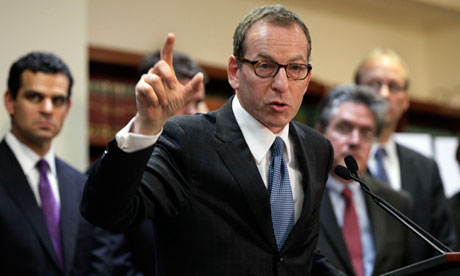
Assistant attorney general Lanny Breuer said taking away HSBC's US banking licence could have cost thousands of jobs. Photograph: Richard Drew/AP
(updated below)

The US is the world's largest prison state, imprisoning more of its citizens than any nation on earth, both in absolute numbers and proportionally. It imprisons people for longer periods of time, more mercilessly, and for more trivial transgressions than any nation in the west. This sprawling penal state has been constructed over decades, by both political parties, and it punishes the poor and racial minorities at overwhelmingly disproportionate rates.

But not everyone is subjected to that system of penal harshness. It all changes radically when the nation's most powerful actors are caught breaking the law. With few exceptions, they are gifted not merely with leniency, but full-scale immunity from criminal punishment. Thus have the most egregious crimes of the last decade been fully shielded from prosecution when committed by those with the greatest political and economic power: the construction of a worldwide torture regime, spying on Americans' communications without the warrants required by criminal law by government agencies and the telecom industry, an aggressive war launched on false pretenses, and massive, systemic financial fraud in the banking and credit industry that triggered the 2008 financial crisis.

This two-tiered justice system was the subject of my last book, "With Liberty and Justice for Some", and what was most striking to me as I traced the recent history of this phenomenon is how explicit it has become. Obviously, those with money and power always enjoyed substantial advantages in the US justice system, but lip service was at least always paid to the core precept of the rule of law: that - regardless of power, position and prestige - all stand equal before the blindness of Lady Justice.

It really is the case that this principle is now not only routinely violated, as was always true, but explicitly repudiated, right out in the open. It is commonplace to hear US elites unblinkingly insisting that those who become sufficiently important and influential are - and should be - immunized from the system of criminal punishment to which everyone else is subjected.

Worse, we are constantly told that immunizing those with the greatest power is not for their good, but for our good, for our collective good: because it's better for all of us if society is free of the disruptions that come from trying to punish the most powerful, if we're free of the deprivations that we would collectively experience if we lose their extraordinary value and contributions by prosecuting them.

This rationale was popularized in 1974 when Gerald Ford explained why Richard Nixon - who built his career as a "law-and-order" politician demanding harsh punishments and unforgiving prosecutions for ordinary criminals - would never see the inside of a courtroom after being caught committing multiple felonies; his pardon was for the good not of Nixon, but of all of us. That was the same reasoning hauled out to justify immunity for officials of the National Security State who tortured and telecom giants who illegally spied on Americans (we need them to keep us safe and can't disrupt them with prosecutions), as well as the refusal to prosecute any Wall Street criminals for their fraud (prosecutions for these financial crimes would disrupt our collective economic recovery).

A new episode unveiled on Tuesday is one of the most vivid examples yet of this mentality. Over the last year, federal investigators found that one of the world's largest banks, HSBC, spent years committing serious crimes, involving money laundering for terrorists; "facilitat[ing] money laundering by Mexican drug cartels"; and "mov[ing] tainted money for Saudi banks tied to terrorist groups". Those investigations uncovered substantial evidence "that senior bank officials were complicit in the illegal activity." As but one example, "an HSBC executive at one point argued that the bank should continue working with the Saudi Al Rajhi bank, which has supported Al Qaeda."

Monday, August 20, 2012

US drone strikes target rescuers in Pakistan – and the west stays silent

Guardian
Glenn Greenwald


The US government has long maintained, reasonably enough, that a defining tactic of terrorism is to launch a follow-up attack aimed at those who go to the scene of the original attack to rescue the wounded and remove the dead. Morally, such methods have also been widely condemned by the west as a hallmark of savagery. Yet, as was demonstrated yet again this weekend in Pakistan, this has become one of the favorite tactics of the very same US government.

A 2004 official alert from the FBI warned that "terrorists may use secondary explosive devices to kill and injure emergency personnel responding to an initial attack"; the bulletin advised that such terror devices "are generally detonated less than one hour after initial attack, targeting first responders as well as the general population". Security experts have long noted that the evil of this tactic lies in its exploitation of the natural human tendency to go to the scene of an attack to provide aid to those who are injured, and is specifically potent for sowing terror by instilling in the population an expectation that attacks can, and likely will, occur again at any time and place:
"'The problem is that once the initial explosion goes off, many people will believe that's it, and will respond accordingly,' [the Heritage Foundation's Jack] Spencer said … The goal is to 'incite more terror. If there's an initial explosion and a second explosion, then we're thinking about a third explosion,' Spencer said."
A 2007 report from the US department of homeland security christened the term "double tap" to refer to what it said was "a favorite tactic of Hamas: a device is set off, and when police and other first responders arrive, a second, larger device is set off to inflict more casualties and spread panic." Similarly, the US justice department has highlighted this tactic in its prosecutions of some of the nation's most notorious domestic terrorists. Eric Rudolph, convicted of bombing gay nightclubs and abortion clinics, was said to have "targeted federal agents by placing second bombs nearby set to detonate after police arrived to investigate the first explosion".

In 2010, when WikiLeaks published a video of the incident in which an Apache helicopter in Baghdad killed two Reuters journalists, what sparked the greatest outrage was not the initial attack, which the US army claimed was aimed at armed insurgents, but rather the follow-up attack on those who arrived at the scene to rescue the wounded. Fromthe Guardian's initial report on the WikiLeaks video:
"A van draws up next to the wounded man and Iraqis climb out. They are unarmed and start to carry the victim to the vehicle in what would appear to be an attempt to get him to hospital. One of the helicopters opens fire with armour-piercing shells. 'Look at that. Right through the windshield,' says one of the crew. Another responds with a laugh.
"Sitting behind the windscreen were two children who were wounded. 
"After ground forces arrive and the children are discovered, the American air crew blame the Iraqis. 'Well it's their fault for bringing kids in to a battle,' says one. 'That's right,' says another. 
"Initially the US military said that all the dead were insurgents."
In the wake of that video's release, international condemnation focused on the shooting of the rescuers who subsequently arrived at the scene of the initial attack. The New Yorker's Raffi Khatchadourian explained:
"On several occasions, the Apache gunner appears to fire rounds into people after there is evidence that they have either died or are suffering from debilitating wounds. The rules of engagement and the law of armed combat do not permit combatants to shoot at people who are surrendering or who no longer pose a threat because of their injuries. What about the people in the van who had come to assist the struggling man on the ground? The Geneva conventions state that protections must be afforded to people who 'collect and care for the wounded, whether friend or foe.'"
He added that "A 'positively identified' combatant who provides medical aid to someone amid fighting does not automatically lose his status as a combatant, and may still be legally killed," but – as is true for drone attacks – there is, manifestly, no way to know who is showing up at the scene of the initial attack, certainly not with "positive identification" (by official policy, the US targets people in Pakistan and elsewhere for death even without knowing who they are). Even commentators who defendedthe initial round of shooting by the Apache helicopter by claiming there was evidence that one of the targets was armed typically noted, "the shooting of the rescuers, however, is highly disturbing."

But attacking rescuers (and arguably worse, bombing funerals of America's drone victims) is now a tactic routinely used by the US in Pakistan. In February, the Bureau of Investigative Journalismdocumented that "the CIA's drone campaign in Pakistan has killed dozens of civilians who had gone to help rescue victims or were attending funerals." Specifically: "at least 50 civilians were killed in follow-up strikes when they had gone to help victims." That initial TBIJ report detailed numerous civilians killed by such follow-up strikes on rescuers, and established precisely the terror effect which the US government has long warned are sown by such attacks:
"Yusufzai, who reported on the attack, says those killed in the follow-up strike 'were trying to pull out the bodies, to help clear the rubble, and take people to hospital.' The impact of drone attacks on rescuers has been to scare people off, he says: 'They've learnt that something will happen. No one wants to go close to these damaged building anymore.'"
Since that first bureau report, there have been numerous other documented cases of the use by the US of this tactic: "On [4 June], USdrones attacked rescuers in Waziristan in western Pakistan minutes after an initial strike, killing 16 people in total according to the BBC. On 28 May, drones were also reported to have returned to the attack in Khassokhel near Mir Ali." Moreover, "between May 2009 and June 2011, at least 15 attacks on rescuers were reported by credible news media, including the New York Times, CNN, ABC News and Al Jazeera."

In June, the UN special rapporteur on extrajudicial killings, summary or arbitrary executions, Christof Heyns, said that if "there have been secondary drone strikes on rescuers who are helping (the injured) after an initial drone attack, those further attacks are a war crime." There is no doubt that there have been.
(A different UN official, the UN special rapporteur on human rights and counterterrorism, Ben Emmerson, this weekend demanded that the US "must open itself to an independent investigation into its use of drone strikes or the United Nations will be forced to step in", and warned that the demand "will remain at the top of the UN political agenda until some consensus and transparency has been achieved". For many American progressives, caring about what the UN thinks is so very 2003.)

The frequency with which the US uses this tactic is reflected by this December 2011 report from ABC News on the drone killing of 16-year-old Tariq Khan and his 12-year-old cousin Waheed, just days after the older boy attended a meeting to protest US drones:
"Asked for documentation of Tariq and Waheed's deaths, Akbar did not provide pictures of the missile strike scene. Virtually none exist, since drones often target people who show up at the scene of an attack."
Not only does that tactic intimidate rescuers from helping the wounded and removing the dead, but it also ensures that journalists will be unwilling to go to the scene of a drone attack out of fear of a follow-up attack.

This has now happened yet again this weekend in Pakistan, which witnessed what Reuters calls "a flurry of drone attacks" that "pounded northern Pakistan over the weekend", "killing 13 people in three separate attacks". The attacks "came as Pakistanis celebrate the end of the holy month of Ramadan with the festival of Eid al-Fitr." At least one of these weekend strikes was the type of "double tap" explosion aimed at rescuers which, the US government says, is the hallmark of Hamas:
"At least six militants were killed when US drones fired missiles twice on Sunday in North Waziristan Agency. 
"In the first strike, four missiles were fired on two vehicles in the Mana Gurbaz area of district Shawal in North Waziristan Agency, while two missiles were fired in the second strike at the same site where militants were removing the wreckage of their destroyed vehicles."
An unnamed Pakistani official identically told Agence France-Presse that a second US drone "fired two missiles at the site of this morning's attack, where militants were removing the wreckage of their two destroyed vehicles". (Those killed by US drone attacks in Pakistan are more or less automatically deemed "militants" by unnamed "officials", and then uncritically called such by most of the western press – a practice that inexcusably continues despite revelations that the Obama administrationhas redefined "militants" to mean "all military-age males in a strike zone".)

It is telling indeed that the Obama administration now routinely uses tactics in Pakistan long denounced as terrorism when used by others, and does so with so little controversy. Just in the past several months, attacks on funerals of victims have taken place in Yemen (purportedly by al-Qaida) and in Syria (purportedly, though without evidence, by the Assad regime), and such attacks – understandably – sparked outrage. Yet, in the west, the silence about the Obama administration's attacks on funerals and rescuers is deafening.

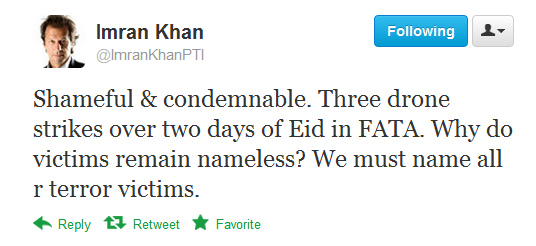
But in the areas targeted by the US with these tactics, there is anything but silence. Pakistan's most popular politician, Imran Khan, has generated intense public support with his scathing denunciations of US drone attacks, and tweeted the following on Sunday:
Khan

As usual, US policies justified in the name of fighting terrorism – aside from being rather terroristic themselves – are precisely those which fuel the anti-American hatred that causes those attacks.
The reason for the silence about such matters, and the reason commentary of this sort sparks such anger and hostility, is two-fold: first, the US likes to think of terror as something only "others" engage in, not itself, and more so; second, supporters of Barack Obama, the 2009 Nobel Peace Prize laureate, simply do not want to think about him as someone who orders attacks on those rescuing his victims or funeral attendees gathered to mourn them.

That, however, is precisely what he is, as this mountain of evidence conclusively establishes.


Saturday, December 31, 2011

Progressives and the Ron Paul fallacies

Salon
Glenn Greenwald

As I’ve written about before, America’s election season degrades mainstream political discourse even beyond its usual lowly state. The worst attributes of our political culture — obsession with trivialities, the dominance of horserace “reporting,” and mindless partisan loyalties — become more pronounced than ever. Meanwhile, the actually consequential acts of the U.S. Government and the permanent power factions that control it — covert endless wars, consolidation of unchecked power, the rapid growth of the Surveillance State and the secrecy regime, massive inequalities in the legal system, continuous transfers of wealth from the disappearing middle class to large corporate conglomerates — drone on with even less attention paid than usual.

Because most of those policies are fully bipartisan in nature, the election season — in which only issues that bestow partisan advantage receive attention — places them even further outside the realm of mainstream debate and scrutiny. For that reason, America’s elections ironically serve to obsfuscate political reality even more than it usually is.

This would all be bad enough if “election season” were confined to a few months the way it is in most civilized countries. But in America, the fixation on presidential elections takes hold at least eighteen months before the actual election occurs, which means that more than 1/3 of a President’s term is conducted in the midst of (and is obscured by) the petty circus distractions of The Campaign. Thus, an unauthorized, potentially devastating covert war — both hot and cold — against Iran can be waged with virtually no debate, just as government control over the Internet can be inexorably advanced, because TV political shows are busy chattering away about Michele Bachmann’s latest gaffe and minute changes in Rick Perry’s polling numbers.

Then there’s the full-scale sacrifice of intellectual honesty and political independence at the altar of tongue-wagging partisan loyalty. The very same people who in 2004 wildly cheered John Kerry — husband of the billionaire heiress-widow Teresa Heinz Kerry — spent all of 2008 mocking John McCain’s wealthy life courtesy of his millionaire heiress wife and will spend 2012 depicting Mitt Romney’s wealth as proof of his insularity; conversely, the same people who relentlessly mocked Kerry in 2004 as a kept girly-man and gigolo for living off his wife’s wealth spent 2008 venerating McCain as the Paragon of Manly Honor.

That combat experience is an important presidential trait was insisted upon in 2004 by the very same people who vehemently denied it in 2008, and vice-versa. Long-time associations with controversial figures and inflammatory statements from decades ago either matter or they don’t depending on whom it hurts, etc. etc. During election season, even the pretense of consistency is proudly dispensed with; listening to these empty electioneering screeching matches for any period of time can generate the desire to jump off the nearest bridge to escape it.

Then there’s the inability and/or refusal to recognize that a political discussion might exist independent of the Red v. Blue Cage Match. Thus, any critique of the President’s exercise of vast power (an adversarial check on which our political system depends) immediately prompts bafflement (I don’t understand the point: would Rick Perry be any better?) or grievance (you’re helping Mitt Romney by talking about this!!). The premise takes hold for a full 18 months — increasing each day in intensity until Election Day — that every discussion of the President’s actions must be driven solely by one’s preference for election outcomes (if you support the President’s re-election, then why criticize him?).
Worse still is the embrace of George W. Bush’s with-us-or-against-us mentality as the prism through which all political discussions are filtered. It’s literally impossible to discuss any of the candidates’ positions without having the simple-minded — who see all political issues exclusively as a Manichean struggle between the Big Bad Democrats and Good Kind Republicans or vice-versa — misapprehend “I agree with Candidate X’s position on Y” as “I support Candidate X for President” or “I disagree with Candidate X’s position on Y” as “I oppose Candidate X for President.” Even worse are the lying partisan enforcers who, like the Inquisitor Generals searching for any inkling of heresy, purposely distort any discrete praise for the Enemy as a general endorsement.

So potent is this poison that no inoculation against it exists. No matter how expressly you repudiate the distortions in advance, they will freely flow. Hence: I’m about to discuss the candidacies of Barack Obama and Ron Paul, and no matter how many times I say that I am not “endorsing” or expressing supporting for anyone’s candidacy, the simple-minded Manicheans and the lying partisan enforcers will claim the opposite. But since it’s always inadvisable to refrain from expressing ideas in deference to the confusion and deceit of the lowest elements, I’m going to proceed to make a couple of important points about both candidacies even knowing in advance how wildly they will be distorted.
* * * * *
The Ron Paul candidacy, for so many reasons, spawns pervasive political confusion — both unintended and deliberate. Yesterday, The Nation‘s long-time liberal publisher, Katrina vanden Heuvel, wrote this on Twitter:


That’s fairly remarkable: here’s the Publisher of The Nation praising Ron Paul not on ancillary political topics but central ones (“ending preemptive wars & challenging bipartisan elite consensus” on foreign policy), and going even further and expressing general happiness that he’s in the presidential race. Despite this observation, Katrina vanden Heuvel — needless to say — does not support and will never vote for Ron Paul (indeed, in subsequent tweets, she condemned his newsletters as “despicable”). But the point that she’s making is important, if not too subtle for the with-us-or-against-us ethos that dominates the protracted presidential campaign: even though I don’t support him for President, Ron Paul is the only major candidate from either party advocating crucial views on vital issues that need to be heard, and so his candidacy generates important benefits.