Showing posts with label Housing Bubble. Show all posts

Tuesday, October 2, 2012

N.Y. AG sues J.P. Morgan over mortgage securities


MarketWatch
Ronald D. Orol


WASHINGTON (MarketWatch) — New York Attorney General Eric Schneiderman late Monday filed a lawsuit against J.P. Morgan Chase & Co. in civil court, alleging widespread fraud in the sale of mortgage-backed securities.
The suit relates to mortgage-backed securities issued by Bear Stearns & Co., which was acquired by J.P. Morgan JPM +1.21%  in 2008 when the firm collapsed amidst the financial crisis.
The complaint argues that Bear Stearns defrauded “thousands of investors.”
The charges, which came partly as a result of a federal mortgage task force formed in January by the Justice Department, assert that the misconduct was in connection with the firm’s “due diligence and quality control processes” that “constituted a systemic fraud on thousands of investors.”

The complaint alleges that Bear Stearns and its mortgage unit “committed multiple fraudulent and deceptive acts” in promoting and selling residential mortgage-backed securities. It alleges that the bank “systematically failed to fully evaluate the loans” while leading investors to believe that the securities have been “carefully evaluated.”
Dennis Kelleher, president of advocacy group Better Markets, said in a statement that he hopes the lawsuit is the first of many and that lawbreakers on Wall Street will be punished.
“Finally! A major Wall Street bank has been sued for fraud for its reckless lending that helped cause the 2008 financial collapse,” Kelleher said in a statement. “Wall Street is a high crime area, but no one has been held accountable. The creation, sale and distribution of worthless toxic mortgages was at the core of the financial crisis.”


Tuesday, March 6, 2012

Trial of former prime minister of Iceland begins

Guardian

Geir Haarde charged with negligence over failure to prevent collapse of Iceland's main bank

Iceland's former prime minister will appear in court to answer charges over his role in the 2008 financial crisis.

Geir Haarde became a symbol of the get-rich bubble for Icelanders, many of whom lost their jobs and homes after the country's main commercial bank collapsed, sending inflation soaring and its currency into a nosedive. Haarde is accused of negligence in failing to prevent the financial implosion from which the island country is still struggling to emerge.

Haarde's trial – the culmination of a long fight by the politician to avoid prosecution – marks a new chapter in the aftermath of the meltdown: accountability. The former prime minister has rejected the charges, calling them "political persecution" and insisting he will be vindicated when he appears at the Landsdómur, a special court convened for the first time in Iceland's history to try him.

Legal experts say he has a strong chance of beating the charges, because of the strength of his legal team, growing sympathy for a politician alone in shouldering blame, and because the court's structure – laid out in 1905 – is flawed because it allows lawmakers, not lawyers, to press charges.

In the immediate aftermath of the crisis, as unemployment and inflation skyrocketed, many sought to apportion blame for the havoc across the 330,000-strong nation. A wave of public protests forced Haarde out of government in 2009.

Some have argued that Iceland's financial meltdown was tied to the global crisis, and that the government could not have predicted or prevented it. But a parliament-commissioned report put much of the blame on Haarde and his government, saying that officials "lacked both the power and the courage to set reasonable limits to the financial system".

It was up to lawmakers whether to indict those officials. After heated debate, Haarde was referred to the special court. Legal experts say such a vote makes the road ahead particularly rocky.

"This whole scenario has demonstrated that we need to change the system," said Robert Spano, law professor at the University of Iceland.

Politicians are not trained in determining if there is an adequate basis for prosecution, said Spano. The financial crisis – which he likened to "a national natural disaster created by humans" had emotional connotations for Icelanders and politicians alike, which could have affected the vote, Spano added.

Saturday, December 3, 2011

Foreclosure fraud whistleblower found dead

End the Lie
Madison Ruppert


Tracy Lawrence, a 43-year-old notary who blew the whistle on the immense robo-signing scandal was found dead in her home on Monday morning after failing to appear in court.

Lawrence had pled guilty to one count of notary fraud last Monday after coming forward earlier this month and confessing to notarizing roughly 25,000 documents in a fraudulent foreclosure scheme.
The Los Angeles Times reported that Lawrence admitted to notarizing the documents for a Florida-based company used by most major banks to process home repossessions called Lender Processing Services.
After Lawrence did not show up in court at 8:30 AM Monday for her sentencing hearing and her attorney did not speak to her for over an hour, the Senior Deputy Attorney General, Robert Giunta requested a bench warrant.

The judge denied Giunta’s request for a warrant for Lawrence’s arrest but after her lawyer voiced concern over Lawrence’s wellbeing, police were dispatched to Lawrence’s home.

Police then discovered Lawrence’s body in her home. Las Vegas Metro Homicide Detectives are now working the case.

According to local Las Vegas NBC affiliate KSNV MyNews3, it is currently unclear if Lawrence’s death was the result of a suicide or if it was due to natural causes.

Yesterday, Las Vegas Homicide Detectives said that they had ruled out homicide as a possible cause of death.

Gary Trafford and Geraldine Sheppard, title officers living in California, are allegedly responsible for the so-called robo-signing scheme which involved forging signatures on notices of default numbering in the tens of thousands between the years of 2005 and 2008.
Nevada’s Attorney General is negotiating the terms of surrender for Trafford and Shepard who are expected to surrender at some point in December.

A major red flag is raised in this case when one considers the fact that Lawrence’s charge of one count of notarizing the signature of a person not in her presence carries a sentence of up to one year of jail and a fine of up to $2,000.

Compare this with the indictments against Trafford and Sheppard which are 606 counts of offering false instruments for recording, false certification on certain instruments and notarization of the signature of a person not in the presence of a notary public.

Unless Lawrence was depressed or otherwise psychologically unstable, suicide seems like a highly unlikely explanation, although so few details have been released that it is impossible to tell and anything is pure speculation at this point.

Lender Processing Services acknowledged that the signing protocol on some of the documents was flawed and President and CEO Hugh Harris stated in an official press release dated November 17th, “I am deeply committed to ensuring that LPS meets rigorous standards of professional conduct and operating excellence.”

“I have full confidence in the ability of our leadership team and over 8,000 dedicated employees to deliver on that commitment,” Harris added.

Friday, October 14, 2011

THE PUBLIC OPTION IN BANKING: ANOTHER LOOK AT THE GERMAN MODEL

Ellen Brown

Children playing with money at the height of
inflation in Germany
Publicly-owned banks were instrumental in funding Germany’s “economic miracle” after the devastation of World War II. Although the German public banks have been targeted in the last decade for takedown by their private competitors, the model remains a viable alternative to the private profiteering being protested on Wall Street today.

One of the demands voiced by protesters in the Occupy Wall Street movement is for a “public option” in banking. What that means was explained by Dr. Michael Hudson, Professor of Economics at the University of Missouri in Kansas City, in an interview by Paul Jay of the Real News Network on October 6:

[T]he demand isn’t simply to make a public bank but is to treat the banks generally as a public utility, just as you treat electric companies as a public utility. . . . Just as there was pressure for a public option in health care, there should be a public option in banking. There should be a government bank that offers credit card rates without punitive 30% interest rates, without penalties, without raising the rate if you don’t pay your electric bill. This is how America got strong in the 19th and early 20th century, by essentially having public infrastructure, just like you’d have roads and bridges. . . . The idea of public infrastructure was to lower the cost of living and to lower the cost of doing business.

We don’t hear much about a public banking option in the United States, but a number of countries already have a resilient public banking sector. A May 2010 article in The Economist noted that the strong and stable publicly-owned banks of India, China and Brazil helped those countries weather the banking crisis afflicting most of the world in the last few years.

In the U.S., North Dakota is the only state to own its own bank. It is also the only state that has sported a budget surplus every year since the 2008 credit crisis. It has the lowest unemployment rate in the country and the lowest default rate on loans. It also has oil, but so do other states that are not doing so well. Still, the media tend to attribute North Dakota’s success to its oil fields.

However, there are other Western public banking models that are successful without oil booms. Europe has a strong public banking sector; and leading it is Germany, with eleven regional public banks and thousands of municipally-owned savings banks. Germany emerged from World War II with a collapsed economy that had degenerated into barter. Today it is the largest and most robust economy in the Eurozone. Manufacturing in Germany contributes 25% of GDP, more than twice that in the UK. Despite the recession, Germany’s unemployment rate, at 6.8%, is the lowest in 20 years. Underlying the economy’s strength is its Mittelstand—small to medium sized enterprises—supported by a strong regional banking system that is willing to lend to fund research and development.

Tuesday, June 14, 2011

How Bankers use the Debt Crisis to Roll Back the Progressive Era

Global Research
Prof. Michael Hudson

              Financial strategists do not intend to let today’s debt crisis go to waste. Foreclosure time has arrived. That means revolution – or more accurately, a counter-revolution to roll back the 20th century’s gains made by social democracy: pensions and social security, public health care and other infrastructure providing essential services at subsidized prices or for free. The basic model follows the former Soviet Union’s post-1991 neoliberal reforms: privatization of public enterprises, a high flat tax on labor but only nominal taxes on real estate and finance, and deregulation of the economy’s prices, working conditions and credit terms.

           What is to be reversed is the “modern” agenda. The aim a century ago was to mobilize the Industrial Revolution’s soaring productivity and technology to raise living standards and use progressive taxation, public regulation, central banking and financial reform to distribute wealth fairly and make societies more equal. Today’s financial aim is the opposite: to concentrate wealth at the top of the economic pyramid and lower labor’s returns. High finance loves low wages.

           The political lever to achieve this program is financial. The European Union (EU) constitution prevents central banks from financing government deficits, leaving this role to commercial banks, paying interest to them for creating credit that central banks readily monetize for themselves in Britain and the United States. Governments are to go into debt to bail out banks for loans gone bad – as do more and more loans as finance impoverishes the economy, stifling its ability to pay. Yet as long as we live in democracies, voters must agree to pay. Governments are sovereign and debt is ultimately a creature of the law and courts.

           But first they need to understand what is happening. From the bankers’ perspective, the economic surplus is what they themselves end up with. Rising consumption standards and even public investment in infrastructure are seen as deadweight. Bankers and bondholders aim to increase the surplus not so much by tangible capital investment increasing the overall surplus, but by more predatory means, headed by rolling back labor’s gains and stiffening working conditions while gaining public subsidy. Banks “create wealth” by providing more credit (that is, debt leverage) to bid up asset prices for real estate and enterprises already in place – assets that either are being foreclosed on or sold off under debt pressure by private owners or governments. One commentator recently characterized the latter strategy of privatization as “tantamount to selling the family silver only to have to rent it back in order to eat dinner.”[1]

           Fought in the name of free markets, this counter-revolution rejects the classical ideal of markets free of unearned income paid to special interests. The financial objective is to squeeze out a surplus by maximizing the margin of prices over costs. Opposing government enterprise and infrastructure as the road to serfdom, high finance is seeking to turn public infrastructure into rent-extracting tollbooths to extract economic rent (the “free lunch economy”), while replacing labor unions with non-union labor so as to work it more intensively.

           This new road to neoserfdom is an asset grab. But to achieve it, the financial sector needs a political grab to replace democracy with financial technocrats. Their job is to pretend that there is no revolution at all, merely an increase in “efficiency,” “creating wealth” by debt-leveraging the economy to the point where the entire surplus is paid out as interest to the financial managers who are emerging as Western civilization’s new central planners.

           Frederick Hayek’s Road to Serfdom portrayed a dystopia of public officials seeking to regulate the economy. In attacking government so one-sidedly, his ideological extremism sought to replace the checks and balances of mixed economies with a private sector “free” of regulation and consumer protection. His vision was of a post-modern economy “free” of the classical reforms to bring market prices into line with cost value. Instead of purifying industrial capitalism from the special rent extraction privileges bequeathed from the feudal epoch, Hayek’s ideology opened the way for unchecked financial power to make a travesty of “free markets.”

           The European Union’s financial planners claim that Greece and other debtor countries have a problem that is easy to cure by imposing austerity. Pension savings, Social Security and medical insurance are to be downsized so as to “free” more debt service to be paid to creditors. Insisting that Greece only has a “liquidity problem,” European Central Bank (ECB) extremists deem an economy “solvent” as long as it has assets to privatize. ECB executive board member Lorenzo Bini Smaghi explained the plan in a Financial Times interview:

FT: Otmar Issing, your former colleague, says Greece is insolvent and it “will not be physically possible” for it to repay its debts. Is he right?

LBS: He is wrong because Greece is solvent if it applies the programme. They have assets that they can sell and reduce their debt and they have the instruments to change their tax and expenditure systems to reduce the debt. This is the assessment of the IMF, it is the assessment of the European Commission.

           Poor developing countries have no assets, their income is low, and so they become insolvent easily. If you look at the balance sheet of Greece, it is not insolvent.

           The key problem is political will on the part of the government and parliament. Privatisation proceeds of 50bn euros, which is being talked about – some mention more - would reduce the peak debt to GDP ratio from 160 per cent to about 140 per cent or 135 per cent and this could be reduced further.[2]

           A week later Mr. Bini Smaghi insisted that the public sector “had marketable assets worth 300 billion euros and was not bankrupt. ‘Greece should be considered solvent and should be asked to service its debts,’ ... signaling that the bank remained firmly opposed to any plan to allow Greece to stretch out its debt payments or oblige investors to accept less than full repayment, a so-called haircut.”[3] Speaking from Berlin, he said that Greece “was not insolvent.” It could pay off its bonds owed to German bankers ($22.7 billion), French bankers ($15 billion) and the ECB (reported to be on the hook for $190 billion) by selling off public land and ports, water and sewer rights, ownership of the telephone system and other basic infrastructure. In addition to getting paid in full and receiving high interest rates reflecting “market” expectations of non-payment, the banks would enjoy a new credit market financing privatization buy-outs.

           Warning that failure to pay would create windfall gains for speculators who had bet that Greece would default, Mr. Bini Smaghi refused to acknowledge the corollary: to pay the full amount would create windfalls for those who bet that Greece would be forced to pay. He also claimed that:
“Restructuring of Greek debt would ... discourage Greece from modernizing its economy.” But the less debt service an economy pays, the more revenue it has to invest productively. And to “solve” the problem by throwing public assets on the market would create windfalls for distress buyers. As the Wall Street Journal put matters bluntly: “Greece is for sale – cheap – and Germany is buying. German companies are hunting for bargains in Greece as the debt-stricken government moves to sell state-owned assets to stabilize the country’s finances.”[4]

           Rather than raising living standards while creating a more egalitarian and fair society, the ECB’s creditor-oriented “reforms” would roll the time clock back to oligarchy. Not the post-feudal oligarchy of landlords owning land conquered militarily, but a financial oligarchy accumulating banking claims and bonds growing inexorably and exponentially, leaving little over for the rest of the economy to invest or consume.

The distinction between illiquidity and insolvency

           If a homeowner loses his job and cannot pay his mortgage, he must sell the house or see the bank foreclose. Is he insolvent, or merely “illiquid”? If he merely has a liquidity problem, a loan will help him earn the funds to pay down the debt. But if he falls into the negative equity that now plagues a quarter of U.S. real estate, taking on more loans will only deepen his net deficit. Ending this process by losing his home does not mean that he is merely illiquid. He is in distress, and is suffering from insolvency. But to the ECB this is merely a liquidity problem.

           The public balance sheet includes land and infrastructure as if they are surplus assets that can be forfeited without fundamentally changing the owner’s status or social relations. In reality it is part of the means of survival in today’s world, at least survival as part of the middle class.

           For starters, renegotiating his loan won’t help an insolvency situation such as the jobless homeowner above. Lending him the money to pay the bank interest (along with late fees and other financial penalties) or stretching out the loan merely will add to the debt balance, giving the foreclosing bank yet a larger claim on whatever property the debtor may have available to grab.

           But the homeowner is in danger of being homeless, living on the street. At issue is whether solvency should be defined in the traditional common-sense way, in terms of the ability of income to carry one’s current obligations, or a purely balance-sheet approach taken by creditors seeking to extract payment by stripping assets. This is Greece’s position. Is it merely a liquidity problem if the government is told to sell off $50 billion in prime tourist sites, ports, water systems and other public assets in order to pay foreign creditors?

           At issue is language regarding the legal rights of creditors vis-à-vis debtors. The United States has long had a body of law regarding this issue. A few years ago, for instance, the real estate speculator Sam Zell bought the Chicago Tribune in a debt-leveraged buyout. The newspaper soon went broke, wiping out the employees’ stock ownership plan (ESOP). They sued under the fraudulent conveyance law, which says that if a creditor makes a loan without knowing how the debtor can pay in the normal course of business, the loan is assumed to have been made with the intent of foreclosing on property, and is deemed fraudulent.

           This law dates from colonial times, when British speculators eyed rich New York farmland. Their ploy was to extend loans to farmers, and then call in the loans when the farmer’s ability to pay was low, before the crop was harvested. This was indeed a liquidity problem – which financial opportunists turned into an asset grab. Some lenders, to be sure, created a genuine insolvency problem by making loans beyond the ability of the farmers to pay, and then would foreclose on their land. The colonies nullified such loans. Fraudulent conveyance laws have been kept on the books since the United States won its independence from Britain.

           Creditors today are using debt leverage to force Greece to sell off its public domain – having extended credit beyond its ability to pay. So the question now being raised is whether the nation should be deemed “solvent” if the only way to carry its public debt (that is, roll it over by replacing bad old loans with newer and more inexorable obligations) is to forfeit its land and basic infrastructure. This would fundamentally alter the relationship between public and private sectors, replacing its mixed economy with a centrally planned one – planned by financial predators with little care that the economy is polarizing between rich and poor, creditors and debtors.

The financial road to serfdom

           Financial lobbyists are turning the English language – and economic terminology throughout the world – into a battlefield. Creditors are to be permitted to take the assets of insolvent debtors – from homeowners and companies to entire nations – as if this were a normal working of “the market” and foreclosure was simply a way to restore “liquidity.” As for “solvency,” the ECB would strip Greece clean of its public sector’s assets. Bank officials have spoken of throwing potentially 150 billion euros of property onto the market.

           Most people would think of this as a solvency problem. Solvency means the ability to maintain the kind of society one has, with existing public/private checks and balances and living standards. It is incompatible with scaling down pensions, Social Security and medical insurance to save bondholders and bankers from taking a loss. The latter policy is nothing less than a political revolution.

           The asset stripping that Europe’s bankers are demanding of Greece looks like a dress rehearsal to prevent the “I won’t pay” movement from spreading to “Indignant Citizens” movements against financial austerity in Spain, Portugal and Italy. Bankers are trying to block governments from writing down debts, stretching out loans and reducing interest rates.

           When a nation is directed to replace its mixed economy by transferring ownership of public infrastructure and enterprises to a financial class (mainly foreign), this is not merely “restoring solvency” by using long-term assets to pay short-term debts to maintain its balance-sheet net worth. It is a radical transformation to a centrally planned economy, shifting control out of the hands of elected representatives to those of financial managers whose time frame is short-term and extractive, not long-term and protective of social equity and basic needs.

           Creditors are demanding a political transformation to replace democratic lawmakers with technocrats appointed by foreign bankers. When the economic surplus is pledged to bankers rather than invested at home, we are not merely dealing with “insolvency” but with an aggressive attack. Finance becomes a continuation of war, by economic means that are to be politicized. Acting on behalf of the commercial banks (from which most of its directors are drawn, and to which they intend to “descend from heaven” to take their rewards after serving their financial class), the European Central Bank insists on a political revolution to replace democratic government by a technocratic elite – not of industrial engineers, but of “financial engineers,” a polite name for asset stripping financial warriors. If Greece does not comply, they threaten to wreak domestic financial havoc by “pulling the plug” on Greek banks. This “carrot and stick” approach threatens that if Greece does not sign on, the ECB and IMF will withhold loans needed to keep its banking system solvent. The “carrot” was provided on May 31 they agreed to provide $86 billion in euros if Greece “puts off for the time being a restructuring, hard or soft,” of its public debt.[5]

           It is a travesty to present this revolution simply as a financial exercise in solving the “liquidity problem” as if it were compatible with Europe’s past four centuries of political and classical economic reforms. This is why the Syntagma Square protest in front of Parliament has been growing each week, peaking at over 70,000 last Sunday, June 5.

           Some protestors drew a parallel with the Wisconsin politicians who left the state to prevent a quorum from voting on the anti-labor program that Governor Walker tried to ram through. The next day, on June 6, thirty backbenchers of Prime Minister George Papandreou’s ruling Panhellenic Socialist party (Pasok) were joined by some of his own cabinet ministers threatening “to resign their parliamentary seats rather than vote through measures to cut thousands of public sector jobs, increase taxes again and dispose of 50bn euro of state assets, according to party insiders. ‘The biggest issue for the party is stringent cuts in the public sector ... these go to the heart of Pasok’s model of social protection by providing jobs in state entities for its supporters,’ said a senior Socialist official.”[6]

           Seeing the popular reluctance to commit financial suicide, Conservative Opposition leader Antonis Samaras also opposed paying the European bankers, “demanding a renegotiation of the package agreed last week with the ‘troika’ of the EU, IMF and the European Central Bank.” It was obvious that no party could gain popular support for the ECB’s demand that Greece relinquish popular rule and “appoint experienced technocrats to half a dozen essential ministries to implement the EU-IMF programme.”[7]

           ECB President Trichet depicts himself as following Erasmus in bringing Europe beyond its “strict concept of nationhood.” This is to be done by replacing elected officials with a bureaucracy of cosmopolitan banker-friendly planners. The debt problem calls for new “monetary policy measures – we call them ‘non standard’ decisions, strictly separated from the ‘standard’ decisions, and aimed at restoring a better transmission of our monetary policy in these abnormal market conditions.” The task at hand is to make these conditions a new normalcy – and re-defining solvency to reflect a nation’s ability to pay debts by selling the public domain.

           The ECB and EU claim that Greece is “solvent” as long as it has assets to sell off. But if populations in today’s mixed economies think of solvency as existing under existing public/private proportions, they will resist the financial sector’s attempt to proceed with buyouts and foreclosures until it possesses all the assets in the world, all the hitherto public and corporate assets and those of individuals and partnerships.

           To minimize opposition to this dynamic the financial sector’s pet economists understate the debt burden, pretending that it can be paid without disrupting economic life and, in the Greek case for example, by using “mark to model” junk accounting and derivative swaps to simply conceal its magnitude. Dominique Strauss-Kahn at the IMF claims that the post-2008 debt crisis is merely a short-term “liquidity problem” and one of lack of “confidence,” not insolvency reflecting an underlying inability to pay. Banks promise that everything will be all right when the economy “returns to normal” – as if it can “borrow its way out of debt,” Bernanke-style.

           This is what today’s financial warfare is about. At issue is the financial sector’s relationship to the “real” economy. From the latter’s perspective the proper role of credit – that is, debt – is to fund productive capital investment and spending, because it is out of the economic surplus that debts are paid. This requires a financial regulatory system and tax system to maximize growth. But that is precisely the fiscal policy that today’s financial sector is fighting against. It demands preferential tax-deductibility for interest to encourage debt financing rather than equity. It has disabled truth-in-lending laws and regulations to keeping interest rates and fees in line with costs of production. And it blocks governments from having central banks to freely finance their own operations and provide economies with money. And to cap matters it now demands that democratic society yield to centralized authoritarian financial rule.

Finance and democracy: from mutual reinforcement to antagonism

           The relationship between banking and democracy has taken many twists over the centuries. Earlier this year, democratic opposition to the ECB and IMF attempt to impose austerity and privatization selloffs succeeded when Iceland’s President Grímsson insisted on a national referendum on the Icesave debt payment that Althing leaders had negotiated with Britain and the Netherlands (if one can characterize abject capitulation as a real negotiation). To their credit, a heavy 3-to-2 majority of Icelanders voted “No,” saving their economy from being driven into the debt peonage.

           Democratic action historically has been needed to enforce debt collection. Until four centuries ago royal treasuries typically were kept in the royal bedroom, and loans to rulers were in the character of personal debts. Bankers repeatedly found themselves burned, especially by Habsburg and Bourbon despots on the thrones of Spain, Austria and France. Loans to such rulers were liable to expire upon their death, unless their successors remained dependent on these same financiers rather than turning to their rivals. The numerous bankruptcies of Spain’s autocratic Habsburg ruler Charles V exhausted his credit, preventing the nation from raising funds to defeat the rebellious Low Countries to the north.

           The problem facing bankers was how to make loans permanent national obligations. Solving this problem gave an advantage to parliamentary democracies. It was a major factor enabling the Low Countries to win their independence from Habsburg Spain in the 16th century. The Dutch Republic committed the entire nation to pay its public debts, binding the people themselves, through their elected representatives who earmarked taxes to their creditors. Bankers saw parliamentary democracy as a precondition for making sound loans to governments. This security for bankers could be achieved only from electorates having at least a nominal voice in government. And raising war loans was a key element in military rivalry in an epoch when the maxim for survival was “Money is the sinews of war.”

           As long as governments remained despotic, they found that their ability to incur more debt was limited. At this time “the legal position of the King qua borrower was obscure, and it was still doubtful whether his creditors had any remedy against him in case of default.”[8] Earlier Dutch-English financing had not satisfied creditors on this count. When Charles I borrowed 650,000 guilders from the Dutch States-General in 1625, the two countries’ military alliance against Spain helped defer the implicit constitutional struggle over who ultimately was liable for British debts.

           The key financial achievement of parliamentary government was thus to establish nations as political bodies whose debts were not merely the personal obligations of rulers, but truly public and binding regardless of who occupied the throne. This is why the first two democratic nations, the Netherlands and Britain after its 1688 dynastic linkage between Holland and Britain in the person of William I, and the emergence of Parliamentary authority over public financing. They developed the most active capital markets and became Europe’s leading military powers. “A funded debt could not be formed so long as the King and Parliament were fighting for the mastery,” concludes the financial historian Richard Ehrenberg. “It was only after the [1688] revolution that the English State became what the Dutch Republic had long been – a real corporation of individuals firmly associated together, a permanent organism.”[9]

           In sum, nations emerged in their modern form by adopting the financial characteristics of democratic city?states. The financial imperatives of 17th-century warfare helped make these democracies victorious, for the new national financial systems facilitated military spending on a vastly extended scale. Conversely, the more despotic Spain, Austria and France became, the greater the difficulty they found in financing their military adventures. Austria was left “without credit, and consequently without much debt” by the end of the 18th century, the least credit-worthy and worst armed country in Europe, as Sir James Steuart noted in 1767.[10] It became fully dependent on British subsidies and loan guarantees by the time of the Napoleonic Wars.

           The modern epoch of war financing therefore went hand in hand with the spread of parliamentary democracy. The situation was similar to that enjoyed by plebeian tribunes in Rome in the early centuries of its Republic. They were able to veto all military funding until the patricians made political concessions. The lesson was not lost on 18th-century Protestant parliaments. For war debts and other national obligations to become binding, the people’s elected representatives had to pledge taxes. This could be achieved only by giving the electorate a voice in government.

           It thus was the desire to be repaid that turned the preference of creditors away from autocracies toward democracies. In the end it was only from democracies that they were able to collect. This of course did not necessarily reflect liberal political convictions on the part of creditors. They simply wanted to be paid.

           Europe’s sovereign commercial cities developed the best credit ratings, and hence were best able to employ mercenaries. Access to credit was “their most powerful weapon in the struggle for their freedom,” notes Ehrenberg, in an age whose “growth in the use of fire?arms had forced them to surround themselves with stronger fortifications.”[11] The problem was that “Anyone who gave credit to a prince knew that the repayment of the debt depended only on his debtor's capacity and will to pay. The case was very different for the cities, who had power as overlords, but were also corporations, associations of individuals held in common bond. According to the generally accepted law each individual burgher was liable for the debts of the city both with his person and his property.”

           But the tables are now turning, from Icelandic voters to the large crowds gathering in Syntagma Square and elsewhere throughout Greece to oppose the terms on which Prime Minister Papandreou has been negotiating an EU bailout loan for the government – to bail out German and French banks. Now that nations are not raising money for war but to subsidize reckless predatory bankers, Jean-Claude Trichet of the ECB recently suggested taking financial policy out of the hands of democracy.

           But if a country is still not delivering, I think all would agree that the second stage has to be different. Would it go too far if we envisaged, at this second stage, giving euro area authorities a much deeper and authoritative say in the formation of the country’s economic policies if these go harmfully astray? A direct influence, well over and above the reinforced surveillance that is presently envisaged? ...
           At issue is sovereignty itself, when it comes to government responsibility for debts. And in this respect the war being waged against Greece by the European Central Bank (ECB) may best be seen as a dress rehearsal not only for the rest of Europe, but for what financial lobbyists would like to bring about in the United States.


Notes

[1] Yves Smith, “Wisconsin’s Walker Joins Government Asset Giveaway Club (and is Rahm Soon to Follow?)” Naked Capitalism, February 22, 2011.
[2] Ralph Atkins, “Transcript: Lorenzo Bini Smaghi,” Financial Times, May 30, 2011.
[3] Jack Ewing, “In Asset Sale, Greece to Give Up 10% Stake in Telecom Company,” The New York Times, June 7, 2011.
[4] Christopher Lawton and Laura Stevens, “Deutsche Telekom, Others Look to Grab State-Owned Assets at Fire-Sale Prices,” Wall Street Journal, June 7, 2011.
[5] Landon Thomas Jr., “New Rescue Package for Greece Takes Shape,” The New York Times, June 1, 2011.
[6] Kerin Hope, “Rift widens on Greek reform plan,” Financial Times, June 7, 2011.
[7] Ibid. See also Kerin Hope, “Thousands protest against Greek austerity,” Financial Times, June 6, 2011: “‘Thieves, thieves ... Where did our money go?’ the protesters shouted, blowing whistles and waving Greek flags as riot police thickened ranks around the parliament building on Syntagma square in the centre of the capital. ... Banners draped nearby read ‘Take back the new measures’ and ‘Greece is not for sale’ – a reference to the government’s plans to include state property and real estate for tourist development in the privatisation scheme.”
[8] Charles Wilson, England’s Apprenticeship: 1603-1763 (London: 1965), p. 89.
[9] Richard Ehrenberg, Capital and Finance in the Age of the Renaissance (1928), p. 354.
[10] James Steuart, Principles of Political Oeconomy (1767), p. 353.
[11] Ehrenberg, op. cit., pp. 44f., 33.

Monday, February 21, 2011

Barack Obama to Turn over Entire Mortgage Industry to the Banks that Used Credit Default Swaps

Truthdig
Robert Scheer

A most dastardly deed occurred last Friday when the Obama administration issued a 29-page policy statement totally abandoning the federal government’s time-honored role in helping Americans achieve the goal of homeownership. Instead of punishing the banks that sabotaged the American ideal of a nation of stakeholders by “securitizing” our homesteads into poker chips to be gambled away in the Wall Street casino, Barack Obama now proposes to turn over the entire mortgage industry to those same banks.

The proposal, originated by Treasury Secretary Timothy Geithner, involves nothing less than a total “winding down” of the 80-year-old federal housing program, setting instead a new goal of a two-tiered America in which the masses are content to be mere renters of the American Dream. Such a deal for a country where, as the report concedes, “Half of all renters spend more than a third of their income on housing, and a quarter spend more than half.”

This is the same Geithner who during his tenure in the Clinton Treasury Department championed the total deregulation of the then-emerging market in collateralized debt obligations that sliced and diced people’s home mortgages into the toxic securities that created what his new report calls the greatest economic crisis since the Great Depression. Later, as president of the New York Fed, he cheered on the banks as they went hog-wild, conning folks into buying homes they couldn’t afford and stuffing them into the incomprehensible securities that form the rot at the core of our bankrupt economy.  

This is a made-in-the-U.S. nightmare that we inflicted on the world, thanks to an explosion in those toxic securities brought on by the deregulation that most of the Obama economic brain trust supported when they worked for President Bill Clinton and during the ensuing bubble years when they enriched themselves. As the report admits: “The U.S. is … the only high income country in which securitization plays a major role in housing finance.” Yet instead of ending that practice Obama now calls for more of the same: “The Administration believes the securitization market should continue to play a key role in housing finance.” 

Indeed, the plan’s goal of eliminating Fannie Mae and Freddie Mac will dry up the alternative public funding that has provided a source of mortgage support ever since President Franklin Delano Roosevelt launched Fannie Mae to check the power of the banks over mortgages. Now Obama proposes to eliminate that check and leave would-be homeowners to the tender mercy of the banking giants.

Of course Fannie Mae and Freddie Mac also bear responsibility for the meltdown. They had morphed into for-profit enterprises and, just as with the Wall Street firms, the massive bonuses paid out to their top executives were contingent on the value of their stock prices, which in turn were fattened by the sale of those same toxic assets. As the Obama report puts it, “Fannie Mae and Freddie Mac’s profit-maximizing structure undermined their public mission.” What the administration should have proposed is to return the government-sponsored housing agencies to their original function as nonprofit entities supplementing, rather than aping, the practices of greedy bankers.

It wasn’t meant to end this way, and key Democrats, quite a few of them Clinton alums now in the Obama administration, bear the responsibility for the sad fate of Roosevelt’s dream. As the Obama proposal concedes: “Improving how housing was financed was an important part of these broader Depression-era reforms. In the 1930s, following severe mortgage market disruptions, widespread foreclosures, and sinking homeownership rates, the government created the Federal Housing Administration (FHA), Fannie Mae, the Federal Home Loan Banks (FHLBs) and several decades later, Freddie Mac to help promote secure and sustainable homeownership for future generations of Americans. Fannie Mae and Freddie Mac held true to their original mission for many years.” What the report then neglects to discuss is the demise of Roosevelt’s grand experiment at the hands of Democratic Party hustlers who turned the agencies away from their “original mission” and into their personal piggy banks while getting Democrats in Congress to approve regulations enabling their greed.

The folks around President Obama know this sad tale well because some of them were principal actors in the housing agencies’ betrayal of the public trust. Just take the case of Tom Donilon, whom Obama recently appointed to the highly sensitive position of national security adviser. It was Donilon who was the top legal counsel and lobbyist for Fannie Mae from 1999 to 2005, a period when the agency went off the tracks in backing Countrywide and other private-sector bandits in their irresponsible rip-off scams. “He was in charge of the lobbyists. … That process involved using the Hill to rein in the regulators,” noted Stephen Blumenthal, who, as director of the Office of Federal Housing Enterprise Oversight, was hindered by Donilon’s lobbying. As the report concedes without mentioning Donilon’s role, “Over the years, Fannie Mae and Freddie Mac’s aggressive lobbying efforts had successfully defeated efforts to bring them under closer supervision.” 

Donilon, who received $10 million in the three years leading up to the scandal of 2004, when Fannie Mae was fined $400 million for juggling its books to enhance executive bonuses, will never have any trouble financing a home purchase. Not so the tens of millions of Americans who have lost their homes because of his reprehensible actions and the many more in the future who will be denied government support in trying to get a place of their own. 

Sunday, February 6, 2011

Almost A Total Dollar Devaluation By The Fed

Liberty News Radio

By: Bob Chapman
Featured Liberty News Radio Columnist

The Euro zone participants who have financial problems, Greece, Ireland, Portugal, Belgium, Spain and Italy are expected to deflate via austerity and at the same time be more competitive. This is supposed to be accomplished quickly so that overhanging debt can be extinguished. This, of course, is an impossible task. You have the IMF demanding austerity and EU members demanding growth.

The problems of the southern European states are similar to those of the states and municipalities in the US. The product of years of living beyond their means, and being accommodated by banks who knew they should have never been making the loans they were making. These entities cannot print money to solve their problems and they cannot grow fast enough to service current levels of debt, never mind service additional debt necessary to spark growth. They cannot manipulate their money supplies, because they have no control over them. They have no control over interest rates as well. They either find a way to pay the debt or they default. The only other alternative is to find someone to lend to them. That usually takes place at higher interest rates, due to the risk to the lender. These conditions are truly a quandary.

Each nation and state had its own set of problems. The most obvious was and is living beyond their means. Some had uncompetitive economies and some had one interest rate fits all, a condition that tricks unsuspecting countries into borrowing more than they can afford. Some had real estate and stock market bubbles; some had slow growth in part caused by lack of increasing productivity. Some had anemic savings or an economy dependent on loans from bankers who used a fractional banking system that they in error over-expanded. That is the way it was and still is.

We ask ourselves how did so many nations do the same stupid things and why would bankers use disastrous levels of leverage and lending? We certainly cannot totally ascribe it to greed or stupidity. Bankers are not stupid people. The policies followed by these nations were promulgated by the Federal Reserve and the City of London to bring about a crisis that would lead to world government. This is what this whole orchestration is all about.

As the Treasury’s debt figure wanders above $14 trillion, the question arises again will the US dollar remain the world’s reserve currency? The Fed says they’ll spend $900 billion by April or is it June? On the other hand a little bird told us they have already spent $1.7 trillion in their quest to fund the Treasury and Agencies.

The municipal market, as we predicted three years ago, is getting killed. Yields are up by .30% in January after having seen yields fall 1.50% since last October. The bond program Build America bonds is now over and that will keep municipalities from selling more bonds. The yields will be substantially higher, so you will see very few issues hit the market.

In California, Governor Moonbeam Jerry Brown, wants to raise taxes like Illinois has, but those terrible Republicans are blocking him from doing so because any tax increases must be approved by the taxpayers. As you are aware Fed Chairman Bernanke has ruled out bailouts for state or local entities. In addition, elitist Newt Gingrich is pushing for legislation to allow states to go bankrupt. That means all or part of pensions and benefits will be wiped out. If such a bill looked like it was being passed, munis and state bonds would again collapse for fear of default or partial default.

In Europe the Chinese have made it clear that they are buying euro debt bonds. As a result yields have fallen and the euro has rallied from $1.30 to $1.38 in a short period of time. The big question is how much are they prepared to buy and will their purchases make a major difference in the sovereign obligations of the problem countries? As we reflect we can now understand why Chancellor Merkle was so vehement when she announced that Germany would defend the euro. She had to have known that the Asian cavalry was on the way.

The Federal Reserve became law in 1913 and has since that time managed to assist the dollar in losing 95% of its value via its profligate issuance of money and credit. The express purpose of the Fed’s creation was to end panics, depression, recession and business cycles. It has failed to accomplish any of those things and as a result the purchasing power of the US dollar has been destroyed.

This experience has been a far cry from stability. We wonder what the House and Senate were thinking about when they passed such legislation in as much as the Constitution says that only gold and silver can be used as legal tender for payment. That is why the dollar had gold backing until August 15, 1971. The departure was caused by growing US debt and the ability of foreign nation dollar holders to redeem their dollars gained in trade for gold. Thus, you can see the Federal Reserve note is a fiat currency, one having no value or backing other than the good word of a bevy of American and foreign bankers.

There has never been any doubt in our minds that the Fed is unconstitutional. Over the past 50 to 100 years there has been little protest regarding its unconstitutionality until the last several years. Polls now show 70% of Americans want it done away with. The natural question is why did it take so long for people to understand that a group of bankers had been issued a license to steal. The answer has to be a lack of education. It has been a long hard struggle to make people understand how the fruits of their labors were being stolen by a band of common criminals. The people still collectively do not understand that these bankers own them and their country. They accomplish this by buying 95% of our legislators via campaign contributions, lobbying and by other illicit means. They also control the corporations that provide jobs in manufacturing and services. As they set out to control financial America so many years ago they also set out to control the educational process. That is one of the reasons nothing is discussed as to the true mission of the Fed. That is to totally control America society.

The Fed in control of the monetary system has been instrumental in the accumulation of debt by the US government. It does that by buying Treasury and Agency securities. The cash deficit should be in excess of $2 trillion in fiscal 2011 ending on September 30th. One of the things that most investors do not realize is that government does not use GAAP, which US corporations use. Companies have to report cash losses and non-cash losses from the increase in liabilities on there balance sheet. That means the unfunded liabilities such as Social Security and Medicare, etc. would take the liabilities up to $105 trillion.

Unfortunately, Fed funds rates are approximately zero. In 2003 they were 1% for the same reason, which is to pump up the economy. If you couple zero rates and major creation of money and credit you have a toxic mess. That is reflected in the dotcom and real estate booms and bubbles. As a result the net worth of Americans fell 9% during that period. As we wrote previously the rally and problems in the economy and the bear market rally we are deeply involved in will eventually collapse. Just be patient. Yes, that is correct, we never escaped the underlying recession. That means it takes two salaries to replicate purchasing power people had in 1971. This fact is deliberately hidden by government by it producing bogus statistics for CPI, COLA, PPI and employment. We will spare you the details, but bogus covers it all. The government says CPI inflation is 1-1/2%, we say it’s 6-3/4%. They say U6 is 16-7/8%, we say it is 22-1/4%. We are losing about 7% a year. That is why buyers of 10-year T-notes at 3.5% is such a guaranteed loser. The bottom line is the powers believe government should be purging the system, but they won’t do that. They want the game and profits to last as long as possible so they can loot the maximum from the American people. The US doesn’t have the choices they had in 1982, as the world’s largest creditor. Today it is the largest debtor and debt is 89% of GDP. Increasing interest rates won’t help unless you are thinking in terms of 25% to 30% and looking at a real purge. That is what the system has to have, but those in power are unwilling to do that. As a result we could have years of depression.

In 1968 and again in 1980 inflation climbed and so did gold and silver and the shares. This time you will need much higher rates to stop inflation. In addition if we go to QE3 and another $2.5 trillion in spending we could have hyperinflation. It also won’t be long before 25% of tax revenues will be devoted to paying interest on debt. Interest rates are headed higher, so those numbers could change considerably over the next few years. The 10-year US T-note has moved from 2.20% to 3.64%. It is a fact that interest rates are rising in spite of massive buying of long dated paper by the Fed. Rates will move slowly higher to offset the damage caused by artificially low rates used by the Fed to keep the economy from collapsing along with the unbridled issuance of money and credit from out of thin air. Estimates are for 10% rates in 2 to 3 years. We see 10% in 2 to 3 years dependent on how much liquidity is dumped into the system. The unpleasantness has only begun.

Thursday, February 3, 2011

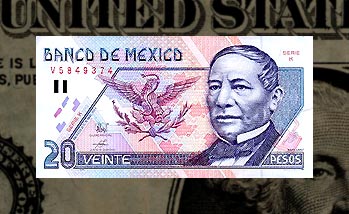
Mexican Government successfully sheds the US Dollar from its economy

People's Voice

Mexico has always considered the US dollar almost a secondary currency to their Peso as the fact that billions of US dollars spent their way through the Mexican economy in 2009 and 2010 which speaks for itself, but sometimes even the best of friendships come to an end.


The Mexican government in September 2010 enacted a new law which basically restricts the use of US Dollars for almost all purchases inside of Mexico.


In early 2010 travelers and visitors could shop at many of the large US corporations inside of Mexico such as Wal-Mart, Home Depot or even one of the hundreds of American food establishments such as McDonalds or Dominoes Pizza and pay for their meal using US Dollars but under the new law using US Dollars is no longer an option.

Just image the surprise of many Americans being told by Wal-Mart that US Dollars are no longer accepted at their store especially since Wal-Mart is one of the most iconic “American” businesses in the world with such buying power that they set the prices which manufactures must sell them their items for.


Wal-Mart´s buying power is so well known in fact that most people would normally be able to safely assume that with such buying power that Wal-Mart could also force almost any country into allowing them to accept the US Dollar to further their in store sales, but apparently not even Wal-Mart is that powerful.

Therefore it was no surprise that when this story broke in late September of 2010 that Mexico was no longer accepting US Dollars the internet was abuzz with conspiracy theories claiming a banking holiday was in short order or the crash of the US dollar was intimate while others were raising the “BS” flag and claiming Mexico would never stop accepting US Dollars because those dollars were its economic life support but as the year closed out and those “end of the world” predictions didn’t come to pass and the fact Mexico did stop accepting the dollar, well that only left many people wondering what really was going on south of the border.


The Mexican government had made it clear that they will no longer allow ANY businesses to accept US dollars including American companies regardless of the operation or who is paying in American dollars. That’s right, this means if you’re a US citizen and fly into Mexico for vacation or business your hotel is no longer allowed to exchange cash dollars into pesos at the front desk which was customary up until 2011.


Also in Mexico if you travel to a local bank regardless of the bank name or national origin including HSBC from China which is the fastest growing bank in Mexico you are no longer able to exchange US Dollars for pesos. Only account holders at banks have the option of depositing US Dollars into their bank accounts but this is for deposits only and not exchange and then you have to have a special type of account set up that is more costly. Of course even if you do have a special account that allows you to deposit US dollars your bank will charge you a service free for depositing foreign currency into your account and then probably another service fee for a withdrawal but that’s another issue all together.

Ok so many readers are probably asking if the banks no longer exchange money or business are no longer allowed to accept US Dollars then what is a person who has US dollars suppose to do.


For those who have traveled to Mexico there is a good chance you are familiar with Casa de Cambios which are small exchange centers for US dollars and often littered on every corner of any large tourist city or the closer to the border you are, however these Casa de Cambios themselves have come under strict new regulation as well as have been greatly reduced in numbers as more are closing every day faster than “one hour” Kodak film processing centers or Blockbuster video locations.


Part of the new regulations is that anyone exchanging money for any reason must now present a valid government ID which is copied and placed on file with a copy of the transaction and amount of money being exchanged. This additional paperwork and hassles now mean higher operational costs for these businesses which in turn mean those costs will be passed onto the consumers who are often the one that end up paying for everything anyway.


Another drawback is that since there are now fewer Casa de Cambios this means less competition and so the exchange rate doesn’t have to be as competitive or even what the banks posted exchange rate is, after all you really have no other option in exchanging your US dollars. Gone are the days of such advantageous exchange rates that allowed anyone exchanging US Dollars into Pesos additional purchasing power by walking away with more for your money south of the border.


The Mexican government wants everyone to believe that these new laws were enacted because the war on drugs and the inability to track all these US Dollars floating around their economy which they claim the drug cartels are using in a black market way but a closer look indicates something completely different.

As the dollar continues to lose purchasing power so does the ever enjoyed exchange rate the US Dollar held for so long. This is a way to actually help devalue the US Dollar while protecting the Mexican economy from going down with the US financial Titanic that has been taking on way too much water in the form of overspending and red ink.


With the value of the dollar sliding lower each day there are some experts who are predicting the US Dollar to reach a point that it will either collapse or need to be reevaluated but either way the Peso is expected to be worth more than the US Dollar and this looks like it will happen sometime very soon at the rate of how things are changing for the Dollar around the world.


This is why it looks as if the Mexican government is doing everything it can to remove as many US Dollars from their economy so there are fewer US Dollars in circulation inside of Mexico so that when the US Dollar does finally go by the wayside there will be less of a direct affect on the Mexican Economy as a whole.

It has now been almost 5 full months since this law took effect and Mexico has been successful in eliminating millions of US fiat Dollars out of its economy and taking steps to vamp up the removal of all remaining dollars by recently instigating even stricter rules at the Casa de Cambios preventing them from exchanging more than $300.00 dollars per transactions. This means it will be much more difficult for Mexicans to send US Dollars home to their families without enriching the pockets of the bankers and the money transfer companies. These caps on exchanging Dollars will also cause the people to want to get away from the dollar faster as it’s more difficult and costly to do business with dollars.


On a side note it´s also important to note that the Mexican economy grew at a rate of just over 5% in 2010 and by the year’s end many large companies in Mexico were reporting stronger than ever revenue and sales at rates not seen in many years. Many large companies are actually in hiring frenzies and some companies are desperate to fill slots with qualified workers.


Now while some will argue that any cash regardless if it is drug money or laundered is actually good for an economy but most people can also understand it’s not good if that cash you have is losing its value so fast that it isn’t going to be worth the paper it’s printed on so it´s best to get rid of that money as fast as you can.


There has been a rush to sell off US Dollars inside Mexico because the people are sensing a coming financial storm with the US Dollar and they too don’t want to be stuck with worthless paper or allowing that worthless paper to drag down their economy especially while their overall economy is going through a growth trend but until that time does come you will still be able to use your credit and debit cards as those funds are simply automatically converted at the time of a transaction but are not physically in the economic system as fiat paper money but rather electronic funds.


A good conspiracy theorist will argue the point that the removal of paper money and forcing people into electronic transactions and requiring those who do use cash to provide ID to be Orwellian and that the bankers come out winning might have a point to some degree but in Mexico the fiat currency in the form of Peso bills can still be used for most transactions. The irony is that many Americans for so long often use to complain about how so many Mexicans living in the United States were sending US Dollars back to Mexico and how it hurt the US economy. The irony is now those Americans are getting their wish that little if any US dollars are being sent to Mexico and in turn this is actually greatly helping the Mexican economy while drastically hurting and aiding in the devaluation of the US dollar.

SO for those planning to travel to Mexico be sure to take your Kevlar and your American Express card (don’t leave home without it) and remember Visa is everywhere you want it to be, even in Mexico where the Dollar is no longer accepted.
-###-

Von Helman
Staff writer