Showing posts with label Nicolas Sarkozy. Show all posts

Wednesday, January 9, 2013

Nicolas Sarkozy ordered the assassination of Hugo Chavez


Voltaire


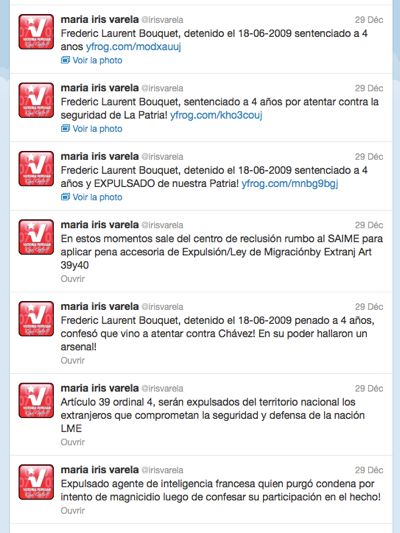
The Venezuelan Minister of Correctional Services, Iris Varela, has announced on her Twitter account the expulsion of a French citizen known as Frédéric Laurent Bouquet, December 29, 2012

Mr. Bouquet (photo) had been arrested in Caracas on June 18, 2009, with three Dominican nationals in possession of an arsenal. In the apartment he had acquired, forensic police seized 500 grams of C4 explosives, 14 assault rifles including 5 with telescopic lenses, 5 with laser sighting and one with a silencer, special cables, 11 electronic detonators, 19,721 cartridges of different calibers, 3 machine guns, 4 hand guns of different calibers, 11 radios, 3 walkie talkies and a radio base, five 12-gauge shotguns, 2 bulletproof vests, 7 military uniforms, 8 grenades, one gas mask, one combat knife and 9 bottles of gunpowder.

During his trial, Mr. Bouquet admitted he had been trained in Israel and was an agent of French military intelligence service (DGSE). He admitted planning an attack to assassinate Constitutional President Hugo Chavez.

Mr. Bouquet had been sentenced to four years in prison for "illegal possession of weapons." He served his sentence. He was taken from his cell by Ordinance No. 096-12 of trial judge Yulismar Jaime, then was expelled for "undermining national security" under Article 39 paragraph 4 of the Migration and Foreigners Act.
JPEG - 51.9 kb
Venezuelan authorities had so far refrained from communicating on this subject. The facts were confirmed by the spokesman of the Quai d’Orsay, Philippe Lalliot. The French Embassy in Caracas declined to comment.

From our investigation we can conclude that:

- (1) President Nicolas Sarkozy had ordered the assassination of his counterpart Hugo Chavez;

- (2) the operation was a fiasco;

- (3) France granted substantial compensation to stifle this matter during Mr Sarkozy’s term in office.

Tuesday, November 20, 2012

Sacraficing The Will Of The People On The Altar of The Euro


Testosterone Pit

The Eurozone debt crisis is exacting its toll. Convoluted undemocratic taxpayer-funded bailouts of bondholders and banks designed to keep the Eurozone together can’t kick the can down the road far enough. But the price has been huge, and people have expressed their anger in massive protests. Now, these efforts are also tearing up the fabric of the 27-member European Union: the first one out may be the UK.

If offered a referendum, 56% of the British would vote for a UK exit from the EU (with 34% definitely and 22% probably). Only 30% would vote to keep the UK in the EU. It wouldn’t even be close! It would be a landslide. Thus, if it came to a referendum today, the UK, a cornerstone of the EU, would bail out.

The EU has little patience with the will of the people. In most member states, decisions such as ratification of EU treaties, scrapping one’s own currency, or bailing out holders of sovereign bonds are made by parliamentary vote. But in instances, when people were finally given a vote, they had a nasty tendency to surprise the elite—the politicians, bankers, and unelected bureaucrats that run the show.

The Lisbon Treaty, the chef d’œuvre of the EU’s political elite, was supposed to repeal existing treaties and replace them with a European Constitution that would transfer significant national sovereignty to unelected EU bureaucrats and their institutions. Negotiations started in 2001, and by 2005, a majority of member states had ratified it by parliamentary vote.

But in France, the people got an opportunity to ratify it by referendum—after parliament had passed it with 93% of the votes. What should have been a cakewalk turned into an epic battle that split the Socialist Party in two. And the people, who loved their sovereignty and wanted to hang on to it, “unexpectedly” killed the thing by a margin of 55% to 45%. In the Netherlands, a similar scenario played out. 2005 was the year that referendum became a dreadful word in the European political lexicon.

The lesson was unforgettable: don’t let the riffraff decide. Such matters should be handled by politicians, bankers, and unelected bureaucrats. And so they did damage control. Many of the measures in the failed constitution were revived as reforms in a watered-down treaty. That was in 2008. As a precaution, the uppity people in France and the Netherlands weren’t allowed to vote on it. Irish voters were, however. And they killed it. They too wanted to hang on to their sovereignty.

But then the financial crisis hit. The Irish got scared. Their banks were in trouble. The economy was going south. So the referendum was re-run after the Irish government had negotiated some concessions, and the people changed their mind (the treaty became effective December 1, 2009).


Wednesday, April 25, 2012

Anders Behring Breivik, Islam, And Israel

Resistance Radio
Brit Dee

The trial of Norwegian mass-murderer Anders Behring Breivik has today entered its second week, with many interesting but chilling details having been revealed about the bombing in Oslo and subsequent shootings on the island of Utøya.

Perhaps most interestingly of all, Breivik has provided a clear explanation of exactly what he hoped to achieve through his acts of terrorism. Immediately after the attack, some commentators speculated that the tragedy would be exploited by the political elite, to demonise moderate nationalists - "patriots" who reject mass immigration and the erosion of national culture - and to stifle debates on such issues. This, it seems, is exactly what Breivik hoped for. During the third day of his trial, The Guardian reported how Breivik insisted that his goal (in the short to medium term) was to make pariahs of Europe's nationalists – the very people with whom you might expect him to feel kinship. "I thought I had to provoke a witchhunt of modern moderately conservative nationalists," he said. Then he claimed that this curious strategy had already borne fruit, citing the example of Norway's prime minister, Jens Stoltenberg, who he said had given a speech since the attacks saying that critics of immigration were wrong. The effect of this "witchhunt", said Breivik, would be to increase "censorship" of moderately nationalist views, which would "increase polarisation". The effect of this, he said, would eventually lead to "more radicalisation as more will lose hope and lose faith in democracy". Ultimately, he said, these new radicals would join the war he has started to protect the "indigenous people" of Norway and western Europe.

Whilst Jens Stoltenberg's speech may give the impression that Breivik's strategy is indeed going to plan, other evidence suggests that nationalist parties and policies have not suffered at all in the wake of the Norwegian terror attacks. Last week Geert Wilder's fervently anti-Islam Freedom Party, the third largest party in the Netherlands, brought down the Dutch coalition government after withdrawing its support for EU-imposed budget cuts. In France, Marine Le Pen's equally strongly anti-Islam National Front won a record 18 percent of the vote in the first round of presidential elections. Le Pen claims to be fighting the "Islamisation" of France, a position for which there is evidently considerable support, particularly in the aftermath of Mohamed Merah's "Al Qaeda" shootings in Toulouse last month (the fact that Merah was likely an asset being handled by the French authorities of course being rarely mentioned).

Indeed, the far-right appears to be in the ascendancy, and even courted by the mainstream. French President Nicolas Sarkozy, knowing that he will have to attract National Front votes if he stands any chance of re-election, said after the first round that NF voters "must be respected", as their votes were "a vote of suffering, a crisis vote". Comments bluntly critical of Islam, previously the preserve of the far-right, have also been made by leading mainstream politicians in other European countries. Last week the leader of Angela Merkel’s Christian Democrats in parliament, Volker Kauder, described Islam as "not part of our tradition and identity in Germany and so does not belong in Germany", though he was careful to add "But Muslims do belong in Germany. As state citizens, of course, they enjoy their full rights."

Friday, March 23, 2012

Toulouse Fallout 'Plays Into Sarkozy's Hands'

Der Spiegel

Following the death of the Toulouse terror suspect on Thursday, attention is now turning to what his crimes will mean for France's future. With a presidential election just weeks away, candidates managed a dignified sense of national unity during the crisis. But German commentators say that could quickly change.

It took just days for French police to track down Mohamed Merah, the 23-year-old Frenchman of Algerian descent responsible for killing seven people in southern France over the past week, including three children at a Jewish school.

Conservative French President Nicolas Sarkozy, who has been struggling against his Socialist Party contender in the presidential election, has been praised for the quick success in detecting and stopping Merah as well as the statesmen-like behavior he has shown so far -- with his appearances at the Ozar Hatorah school in Toulouse, at the coffins of the victims before they were transferred to Israel, at the hospital beds of injured police and at the memorial ceremony for the murdered soldiers. Observers say that, instead of the biting and hyperactive Sarkozy many had experienced during the election campaign, in recent days they have seen a dignified man worthy of the country's highest office.

Sarkozy's success culminated on Thursday, when police ended the siege at the apartment where Merah had been holed up for 30 hours. With his death, many are asking what impact the attacks by an apparent homegrown terrorist will have on the presidential election, with the first round of voting just one month away. Will Sarkozy get a bump in the polls for his swift response? Will Socialist Party candidate François Hollande suffer because he was unable to present himself in the same role that Sarkozy could as president? Or will far-right candidate Marine Le Pen, who has run a campaign filled with anti-Muslim sentiment, get a boost from the terrible crimes?

Initially, Le Pen, the leader of the far-right National Front, had remained silent over the attacks, but on Thursday the candidate lashed out at Sarkozy, saying it had been a "luxury" for police to wait 30 hours before storming Merah's apartment. Le Pen also criticized the fact that the authorities had failed to stop Merah before he acted, given that he had already been prosecuted several times.

Europe 'No evidence' of Mohamed Merah terror link, says French official

The Independent

 There is no evidence that gunman Mohamed Merah had links with al-Qa'ida or other terror groups, a French official says.


The official, who is close to the investigation into Merah's killing spree, said there is no sign he had "trained or been in contact with organised groups or jihadists".

Merah had travelled to Afghanistan and Pakistan, and prosecutors said Merah had claimed he had been in contact with al-Qa'ida.

A little-known group claimed responsibility for the killings but the official said the claim appeared opportunistic.

Merah was killed in a gunfight with police yesterday after a 32-hour siege at his apartment in Toulouse.
The official said Merah might have made the claim because al-Qa'ida is a well-known "brand." Authorities have "absolutely no element allowing us to believe that he was commissioned by al-Qa'ida to carry out these attacks".

Investigators looking for possible accomplices decided to keep Merah's older brother, his mother and the brother's girlfriend in custody for another day for further questioning, the Paris prosecutor's office said.

Saturday, February 18, 2012

UK to take major role in making new 'eurodrones'

The Independent
John Lichfield
Nigel Morris


Plans to build a new generation of "fighter drones" that can wage war by remote control are set to be agreed today by Britain and France. David Cameron and President Nicolas Sarkozy are preparing to put their recent tensions behind them to launch proposals for the pilotless stealth aircraft at a summit in Paris. In a second agreement, they will promise closer co-operation on civil nuclear power.

Western nations increasingly regard the deployment of drones to launch surgical strikes on targets as a way of keeping military casualties to a minimum.

Several senior al-Qa'ida figures have been killed by unmanned American drones flying over Pakistan, while British drone missions could begin within months over Afghanistan. Critics claim the aircraft can cause "collateral damage" among civilians and that the low risk to service personnel from their use can encourage countries to turn to military force rather than diplomacy.

But the two leaders are preparing to put any qualms to one side as they sign a letter of intent of cross-Channel cooperation on the project.

Under the plan, Britain's BAE and the French planemaker Dassault – rivals in the battle for sales of the present generation of fighter planes – will be asked to collaborate in the creation of a prototype of a Star Wars-type, ground-controlled "fighter drone" by 2020. Mr Cameron and Mr Sarkozy are expected to present the project as proof of continuing – or revived – Anglo-French friendship despite last year's rift over tighter fiscal discipline in the eurozone.

The Paris summit, delayed from last November, will be the first lengthy one-on-one meeting between the two leaders since Mr Cameron vetoed an EU-wide fiscal pact in early December.

Mr Cameron will be accompanied by Nick Clegg, the Deputy Prime Minister, William Hague, the Foreign Secretary, Philip Hammond, the Defence Secretary, and Ed Davey, the Energy Secretary. The two governments will sign a declaration signalling their commitment to nuclear power as a source of safe and affordable energy that will also help cut carbon emissions.

Under the agreement, British and French public and private sector bodies in the civil nuclear power industry will work more closely on education and training, research and development and security. The two sets of ministers will also discuss cooperation in transport. Mr Cameron last night stressed the "strength and depth of Britain's ties with France". He said: "Our commercial relationship is deep and growing with exports increasing and French investment sustaining almost 10,000 jobs in the UK. Our militaries are working together on cutting-edge military technology. This relationship is vital for the national security and the prosperity of both Britain and France."

The Franco-British "fighter drone" would take aerial combat into a new age, replacing all the "conventional" piloted fighter-planes now on offer. The two governments are thought to be ready to put a modest amount of public cash into the project at this stage.

The possibility of French and British co-operation on a drone aircraft – or Unmanned Aerial Vehicle (UAV) – was first mentioned in November 2010 when Mr Cameron and Mr Sarkozy signed a defence treaty committing the two countries to co-operate in military deployment and research. French sources said yesterday that German or Italian, or wider European, participation in the project would be welcomed. But the newspaper Les Echos reported yesterday the letter of intent to be signed by Mr Sarkozy and Mr Cameron was intended as a signal that the project would be under Anglo-French leadership.

Friday, November 11, 2011

War Clouds Form over Iran

Global Research
Wayne Madsen

Israel’s all-powerful lobby in Washington, the American Israel Public Affairs Committee (AIPAC), an organization composed of Israeli collaborators, infiltrators, and outright traitors to the United States, is steamrolling through the House of Representatives H.R. 1905, which would prohibit the President of the United States, the Secretary of State, members of the U.S. Foreign Service, or any special envoy from engaging in any sort of diplomatic contact, official or unofficial, with any member or agent of the government of Iran. Only when the President informs the requisite committees may he proceed with engaging on diplomatic contact with Iran. Israel has de facto control over the foreign affairs committees of Congress, so any White House notification of the need to contact Iranian officials would be instantly transmitted to Binyamin Netanyahu’s office in Jerusalem and Israel would then circumvent any U.S.-Iranian contact. AIPAC, with its resolution, is further making the United States a vassal of the Jewish state.

Israel’s strategy is to make certain that its plans to attack Iran’s nuclear facilities and, perhaps other targets, meet no opposition from diplomatic circles in the United States... Israel has placed its own interests well beyond and in contravention of those of the United States.

Faced with the prospect of an Israeli attack on Iran, backed by Saudi Arabia – Israel’s secret ally in the region – has had ripple effects across the Middle East and Asia.

Countries in Asia are scrambling to join the Shanghai Cooperation Organization (SCO) as full members. Confronted by a belligerent United States, NATO, and Israel intent on toppling the governments of Syria and Iran, the economic, cultural, and de facto collective security pact that comprises Russia, China, Kazakhstan, Kyrgyzstan, Uzbekistan, and Tajikistan announced after its prime ministers' summit in St. Petersburg that SCO would soon be opening its doors for full membership for Pakistan, Iran, and India. The Asian nations want to freeze the United States out of interference in Asia.

Ahead of the St. Petersburg summit, Russia and China strongly warned the West against any military attack on Iran. The words being used in international diplomacy are reminiscent of the Cold War era, however, it is the West that is playing to role of the aggressor, albeit an aggressor led around by Israel and its intelligence spies and assets embedded in the upper echelons of governments in Washington, London, Paris, Berlin, and within the United Nations hierarchy.

Even America's vassal state of Afghanistan, eager to break free of the bonds of NATO and Washington, has attained observer status in SCO. Recent comments by the deputy commander of NATO training in Afghanistan, U.S. Army Major General Peter Fuller, that the Afghan government leadership is erratic, ungrateful, and isolated from reality because President Hamid Karzai said Afghanistan would side with Pakistan in an American war on Pakistan, resulted in Fuller’s firing. Fuller’s comments also resulted in Karzai asking for observer status in SCO as American aggression against the Muslim world and opposition to sovereignty for Palestine has seen Washington’s standing around the world plummet.

Another nation where the CIA, Pentagon, has their agents creeping and crawling, Mongolia, is also a SCO observer. There are also SCO "partners in dialogue" -- nations that could attain SCO observer or membership status in the future. Partners in dialogue nations include Belarus, Sri Lanka, and one that should worry Tel Aviv and Washington, Turkey, a NATO member. Moscow and Ankara agree that Turkey should eventually become a full SCO member. Turkey has close historical and cultural links with the Turkic nations of central Asia and with many of the autonomous Turkic republics of Russia, including Tuva, Bashkortostan, and Adygeya.

Tuesday, November 8, 2011

Euro Zone Considers Solution of Last Resort

Der Spiegel

The ink on the most recent European Union summit agreement was hardly dry before it became clear that it was insufficient. With investors now increasingly wary of Italy, the consensus is growing that the European Central Bank -- and the IMF -- will have to play an even greater role. But will it be enough? By SPIEGEL Staff

When government heads from Germany and the US get together, protocol usually calls for as much pomp as possible: honor guards, hymns, flag parades and the like.

But the tone was decidedly more businesslike at the G-20 summit in Cannes last Thursday. German Chancellor Angela Merkel and US President Barack Obama, together with US Treasury Secretary Timothy Geithner and German Finance Minister Wolfgang Schäuble, met in a mundane conference room at the five-star Intercontinental Carlton Hotel. The group had serious issues to discuss.

Merkel reported on the results of a meeting held a day earlier -- during which she and French President Nicolas Sarkozy had told Greek Prime Minister Georgios Papandreou exactly what they thought about his (now cancelled) plans to hold a national referendum on the euro bailout package. Obama and Geithner, however, were not impressed. The euro crisis continues to worsen, the pair grumbled. It is time, they said, for Europe to finally take decisive action. The decisions taken at the European Union summit in late October were not enough, they complained.

In response, Merkel and Schäuble recited the long list of measures the Europeans had recently initiated. But in reality, they had little to offer in reply to Washington's analysis. The euro crisis, Obama warned, now threatens the global economy.

Too little, too late. That has been the global public's assessment of European efforts to rescue its currency -- for the last one and a half years. And there is every indication that it will remain that way, even after the most recent G-20 meeting. Indeed, concurrent to the meeting in Cannes, the euro zone experienced what was likely the most ridiculous week of events since the crisis began: a Greek referendum announced on Monday, a reversal on Thursday, a national unity coalition promised in Athens on Friday and Papandreou's resignation on Sunday. Things changed almost by the hour, it seemed. And there is still little reason for optimism.

Half-Hearted and Half-Baked

Greece will keep the euro for the time being -- that much is certain. But it also seems clear that this is neither a guarantee of economic health in Greece nor a secure future for the common currency. On the contrary, there were growing doubts on financial markets last week as to whether the resolutions reached at the late-October European summit would be sufficient.

At that meeting, European leaders leveraged their bailout fund to more than a trillion euros. But what was celebrated a week ago as a "tour de force" and a "breakthrough" is now viewed as half-hearted and half-baked. Hardly a politician or economic expert believes that Greece can be rehabilitated under the more current plan from Brussels. And now there are also growing concerns about Italy. Interest rates for Italian treasury bonds reached a new record high last week, and the managers of the European Financial Stability Facility (EFSF) were unwilling to risk tapping the global financial markets. The planned issue of a new EFSF bond was cancelled at the last minute.

Not surprisingly, the mood was grim among the leaders gathered on the French Riviera last week for the G-20 summit. The conclusion, after countless discussions about the crisis, was that much more radical measures are needed. The International Monetary Fund (IMF) and the European Central Bank (ECB) are to take over the management of the debt crisis in the future, and Germany's currency reserves are no longer off limits. Last week Germany's central bank, the Bundesbank, narrowly managed to prevent portions of those reserves from being used to fill the IMF coffers.

Can the "big bazooka" that US politicians, in particular, like to invoke actually save the euro? Many economists are skeptical, because it is primarily economic imbalances that are creating ever-widening rifts between countries in the European currency area. The economic divide between the north, with its strong export economies, and the south, with its high consumption, has grown even further. At the same time, citizens are losing confidence in Europe's ability to manage the crisis.

'Run For Your Lives'

"Run for your lives" is the new motto in Europe, and not just among banks and insurance companies, which are selling off southern European bonds as quickly as they can, but also among ordinary holders of savings accounts. Banks and regulatory agencies are noticing that anxious citizens throughout Europe are trying to bring their money to safety. The flight of capital from Italy, Spain and Greece is in full swing.

Since the beginning of the crisis, ordinary Greeks have withdrawn about €50 billion ($69 billion) from their accounts, or a fifth of total deposits. In May, when the first rumors about a possible withdrawal from the euro zone were making the rounds, the Greeks withdrew €1.5 billion from their accounts within 48 hours. And it is no longer just the rich who are moving their money to a safe place. A Greek nun recently closed her convent's bank account, telling the bank employee that she needed the €700,000 in the account for renovations. But when pressed by the bank employee, she finally admitted that she was worried about her order's assets.

Tuesday, September 27, 2011

Palestine Self-Determination: UN Bid Heralds Death of Palestine’s Old Guard New leaders will spurn two states

Global Research
Jonathon Cook

Amid the enthusiastic applause in New York and the celebrations in Ramallah, it was easy to believe -- if only a for minute -- that, after decades of obstruction by Israel and the United States, a Palestinian state might finally be pulled out of the United Nations hat. Will the world’s conscience be midwife to a new era ending Israel's occupation of the Palestinians?

It seems not.

The Palestinian application, handed to UN Secretary-General Ban Ki-Moon last week, has now disappeared from view -- for weeks, it seems -- while the United States and Israel devise a face-saving formula to kill it in the Security Council. Behind the scenes, the pair are strong-arming the Council’s members to block Palestinian statehood without the need for the US to cast its threatened veto.

Whether or not President Barack Obama wields the knife with his own hand, no one is under any illusion that Washington and Israel are responsible for the formal demise of the peace process. In revealing to the world its hypocrisy on the Middle East, the US has ensured both that the Arab publics are infuriated and that the Palestinians will jump ship on the two-state solution.

But there was one significant victory at the UN for Mahmoud Abbas, the head of the Palestinian Authority, even if it was not the one he sought. He will not achieve statehood for his people at the world body, but he has fatally discredited the US as the arbiter of a Middle East peace.

In telling the Palestinians there was “no shortcut” to statehood -- after they have already waited more than six decades for justice -- the US President revealed his country as incapable of offering moral leadership on the resolution of the Israeli-Palestinian conflict. If Obama is this craven to Israel, what better reception can the Palestinians hope to receive from a future US leader?

One guest at the UN had the nerve to politely point this out in his speech. Nicholas Sarkozy, the French president who himself appears to be wavering from his original support for a Palestinian state, warned that US control of the peace process needed to end.

“We must stop believing that a single country, even the largest, or a small group of countries can resolve so complex a problem,” he told the General Assembly. His suggestion was for a more active role for Europe and the Arab states at peace with Israel.

Sarkozy appeared to have overlooked the fact that responsibility for solving the conflict was widened in much this way in 2002 with the creation of the Quartet, comprising the US, the European Union, Russia and the United Nations.

The Quartet’s formation was necessary because the US and Israel realised that the Palestinian leadership would not continue playing the peace process game if oversight remained exclusively with Washington, following the Palestinians' betrayal by President Bill Clinton at Camp David in 2000. The Quartet’s job was to restore Palestinian faith in -- and buy a few more years for -- the Oslo process.

However, the Quartet quickly discredited itself too, not least because its officials never strayed far from the Israeli-Washington consensus. Last week senior Palestinian negotiator Nabil Shaath spoke for most Palestinians when he accused the Quartet’s envoy, Tony Blair, of sounding like an “Israeli diplomat” as he sought to dissuade Abbas from applying for statehood.

And true to form, the Quartet responded to the Palestinians’ UN application by limply offering Abbas instead more of the same tired talks that have gone nowhere for two decades.

The Palestinian leadership’s move to the UN, effectively bypassing the Quartet, widens the circle of responsibility for Middle East peace yet further. It also neatly brings the Palestinians’ 63-year plight back to the world body.

But Abbas’ application also exposes the UN’s powerlessness to intervene in an effective way. Statehood depends on a successful referral to the Security Council, which is dominated by the US. The General Assembly may be more sympathetic but it can confer no more than a symbolic upgrading of Palestine’s status, putting it on a par with the Vatican.

So the Palestinian leadership is stuck. Abbas has run out of institutional addresses for helping him to establish a state alongside Israel. And that means there is a third casualty of the statehood bid – the Palestinian Authority. The PA was the fruit of the Oslo process, and will wither without its sustenance.

Instead we are entering a new phase of the conflict in which the US, Europe, and the UN will have only a marginal part to play. The Palestinian old guard are about to be challenged by a new generation that is tired of the formal structures of diplomacy that pander to Israel’s interests only.

The young new Palestinian leaders are familiar with social media, are better equipped to organise a popular mass movement, and refuse to be bound by the borders that encaged their parents and grandparents. Their assessment is that the PA – and even the Palestinians’ unrepresentative supra-body, the PLO – are part of the problem, not the solution.

Till now they have remained largely deferential to their elders, but that trust is fast waning. Educated and alienated, they are looking for new answers to an old problem.

They will not be seeking them from the countries and institutions that have repeatedly confirmed their complicity in sustaining the Palestinian people’s misery. The new leaders will appeal over the heads of the gatekeepers, turning to the court of global public opinion. Polls show that in Europe and the US, ordinary people are far more sympathetic to the Palestinian cause than their governments.

The first shoots of this revolution in Palestinian politics were evident in the youth movement that earlier this year frightened Abbas’ Fatah party and Hamas into creating a semblance of unity. These youngsters, now shorn of the distracting illusion of Palestinian statehood, will redirect their energies into an anti-apartheid struggle, using the tools of non-violent resistance and civil disobedience. Their rallying cry will be one person-one vote in the single state Israel rules over.

Global support will be translated into a rapid intensification of the boycott and sanctions movement. Israel’s legitimacy and the credibility of its dubious claim to being a democracy are likely to take yet more of a hammering.

Events at the UN are creating a new clarity for Palestinians, reminding them that there can be no self-determination until they liberate themselves from the legacy of colonialism and the self-serving illusions of the ageing notables who now lead them. The old men in suits have had their day.

Jonathan Cook won this year's Martha Gellhorn Special Prize for Journalism. His latest books are “Israel and the Clash of Civilisations: Iraq, Iran and the Plan to Remake the Middle East” (Pluto Press) and “Disappearing Palestine: Israel's Experiments in Human Despair” (Zed Books). His website is www.jkcook.net.

Thursday, September 22, 2011

President Obama: Palestinian Statehood Must Be Achieved Through Talks With Israel

Free Internet Press

U.S. President Barack Obama has infuriated Palestinian leaders with a lengthy defense of the U.S. threat to veto the Palestinian bid for statehood at the United Nations while praising revolutions in other parts of the Arab world.

President Obama told the opening of the U.N. General Assembly in New York that negotiations between Israel and the Palestinians, not Security Council resolutions, is the way to ensure a lasting peace. But he was challenged by the French president, Nicolas Sarkozy, who said that U.S. leadership on the issue has failed and called for a new initiative involving Europe and Arab states to see the birth of a Palestinian state within a year.

President Obama said he believes "that the Palestinian people deserve a state of their own", and that that vision had been delayed for too long. But he offered no new initiatives and, tellingly, did not repeat earlier calls – for which he has come under fire – for negotiations to be based on the borders at the time of the 1967 war, with agreed land swaps.

The U.S. President, who went from his speech to a meeting with Israeli Prime Minister  Binyamin Netanyahu, was dismissive of the plan put forward by the Palestinian leader, Mahmoud Abbas, to ask the security council on Friday to recognize Palestine as a state. The U.S. has said it will veto such a move.

"Peace will not come through statements and resolutions at the U.N. – if it were that easy, it would have been accomplished by now. Ultimately, it is Israelis and Palestinians who must live side by side. Ultimately, it is Israelis and Palestinians – not us – who must reach agreement on the issues that divide them: on borders and security, on refugees and Jerusalem," he said as Abbas shook his head.

President Obama spoke about the U.S.'s "unshakeable" commitment to Israel's security, and said that any lasting peace must recognize the Jewish state's "very real security concerns". He spoke at length about Israeli suffering, but to the consternation of the Palestinians made no mention of the difficulties of life under occupation, or the impact of expanding Jewish settlements in the West Bank and East Jerusalem.

The president said: "Let's be honest: Israel is surrounded by neighbors that have waged repeated wars against it. Israel's citizens have been killed by rockets fired at their houses and suicide bombs on their buses. Israel's children come of age knowing that throughout the region, other children are taught to hate them.

"Israel, a small country of less than 8 million people, looks out at a world where leaders of much larger nations threaten to wipe it off of the map. The Jewish people carry the burden of centuries of exile, persecution, and the fresh memory of knowing that six million people were killed simply because of who they were.

"Friends of the Palestinians do them no favors by ignoring this truth, just as friends of Israel must recognize the need to pursue a two state solution with a secure Israel next to an independent Palestine."

President Obama's failure to offer any new hope of progress toward a Palestinian state stood in sharp contrast to his praise of the quest for freedom in parts of the Arab world and beyond.

"Something is happening in our world. The way things have been is not the way they will be. The humiliating grip of corruption and tyranny is being pried open," he said.

Sarkozy said the "miracle" of the Arab spring is a reminder of the moral and political obligation to resolve the Israeli-Palestinian conflict. But, without naming the U.S., he said that its oversight of years of failed negotiations means a new approach is required.

Sarkozy said: "We can wait no longer. The method is no longer working? Change the method. Cease believing that a single country or a small group of countries can solve a problem of such complexity."

Sarkozy called for a fresh set of negotiations, with wider involvement of European and Arab nations, based on a timetable that would see the borders of a Palestinian state agreed within six months and a final deal within a year.

"We should not look for the perfect solution. Choose the path of compromise," he said.

Sarkozy also said that the Palestinians were mistaken to seek full recognition as a state by the U.N. Security Council. He warned that if the bid went ahead and it was vetoed by the U.S. violence could be caused. The French president said the Palestinians should instead ask to be admitted as an observer state to the general assembly, a move he said would give them hope.

A senior Palestinian official said privately that Obama's speech was a "disaster", and that the Palestinian leadership has lost confidence in him to be a neutral intermediary. He said that the Palestinians will go ahead with their application to the U.N. Security Council on Friday but expect a vote on the issue to be put on hold. They will then consider whether to ask the general assembly for observer status.

Obama's speech was also greeted with despair in the West Bank.

Mustafa Barghouti, an independent politician and former Palestinian presidential candidate, said he was disappointed.

"It clearly shows the double standards of the US when it comes to the Palestinian issue. Obama spoke about freedom, human rights, justice in South Sudan, Tunisia, Egypt – but not for the Palestinians," he said.

"His version of reality is wrong. He claims that Israel is the victim in this conflict and that's not true. He doesn't see that this is not a struggle between two equal sides, but between an oppressor and the oppressed, and occupier and the occupied."

A Ramallah shop owner, Marwan Jubeh, said: "Israel and the U.S. are one and the same: the U.S. is Israel, and Israel is the U.S. Israel doesn't want to give the Palestinians anything and Obama can't do anything without Israel because Congress is pro-Israel."

In contrast, Netanyahu praised Obama when the two met after the U.S. president's speech. The Israeli prime minister described Obama's pledge to block the Palestinian move at the U.N. Security Council as a "badge of honor".

Netanyahu said he is ready for talks with the Palestinians but he was skeptical about what they could achieve.

"I think the Palestinians want to achieve a state but they're not prepared yet to make peace with Israel," he said.

Sunday, August 28, 2011

The West Wants to take Control of Libya's Oil Wealth

Global Research
Prof. Michel Chossudovsky

Interview with Michel Chossudovsky, Director of Centre for Research on Globalization.


While Libyan revolutionaries have not yet won the war in the oil-rich country, Western powers are already discussing the post-Gaddafi period on such issues as how the interim government there needs to honor its oil contracts. 

In case of internal fighting in Libyan crisis, will the US and its coalition NATO allies deploy boots on the ground to protect their oil interests? 

In a Press TV interview, Michel Chossudovsky, Director of Center for Research on Globalization, shed more light into the development. The following is a rush transcription of the interview: 

Press TV: Western powers have said the international  community will support the political transition to a free and democratic Libya: In what form will this "support" come? A "Western" democracy imposed on Libyans? What is that going to means for the Libyans? They used the same language when they attacked Afghanistan 10 years ago and Iraq 8 years ago. The US still insists it soldiers should have immunity in these countries. How will it be in Libya? 

Chossudovsky: Well I think we have to understand both the nature of this military operation, the covert intelligence behind the rebels, as well as the extensive bombings of civilians infrastructure, residential areas, as well as schools, universities, hospitals which has taken place in the course of the last few months. 

And particularly virtually continuous bombings, at night in Tripoli in the course of last few days. We are talking about 20,000 sorties, 8,000 strike sorties, In another words what has happened in the course of these last months, particularly in a last few weeks, is the destruction of an entire country, its infrastructure, institutions, very targeted, involving a lot of civilian casualties. 

In other words, the Western "pro democracy" NATO supported rebels, as well as the NATO supported heads of states and heads of governments, they have blood on their hands, they have a lot  of blood on their hands, because they have killed a lot of women and children. 

Our correspondent has been reporting form the Rixos Hotel, just a few hours ago, he and several other Journalists, were extracted from the hotel, they were liberated from the Hotel, which they were held for several days, and they are safe now. 

Chossudovsky. But I can tell you, my understanding is, first of all this is not a revolution. These are NATO trained gunman, and they are Al Qaeda related paramilitaries, mercenaries. 

They have very little support within civil society in Libya. Whether we like the Gaddafi regime or not, I do not think that this is the issue. The large majority of the population are against the rebellion, and the only thing that sustains the rebellion, are the NATO bombings. And these are criminal bombings; let's say what they are. They are in derogation of international law, actions that are criminal in terms of their consequences: the killings of children, the killing of people in their own homes, and this has been well documented.

And what is criminal in this process, is the fact that this war is presented to the media as a humanitarian operation, 

Realities are turned upside down.  We are told, that war is peace, The lie becomes the truth, essentially that is what has happened. 

Press TV: But the way this operation is going on Professor, many Western countries including France, they talked about the success of this operation and its knock off effect in the region. Doesn't that pose the threat of abuse of what is called RTP, the Right to Protect under humanitarian motives for their own gains, and in terms of RTP of other countries, such as Yemen, Bahrain, Saudi Arabia? If that is the way to go about it why don't they mention those countries? Why mentions only Syria, as French President Sarkozy said in his meeting with NTC? 

Chossudovsky: Well you know, I have been studying dictatorship for more than 30 years, I've lived in Latin America. 

The US has never been concerned with the actions of dictators. In fact it was the US which installed the dictators. As long as the dictators follow their orders, and establish a proxy state and serve US interests, they will continue their support.. 

Monday, August 1, 2011

'NATO declares international anarchy'


Italian Prime Minister Silvio Berlusconi has said that it was the US pressure that forced his country to join NATO's military operations in Libya.

Press TV talks with Dr. Webster Griffin Tarpley, an author and historian to discuss the latest developments in Libya.

Press TV: How long will NATO continue its air raids, more importantly how much longer will Muammer Gaddafi stay in power.

Tarpley: I think Gaddafi is destined to stay in power for quite a while. I think he is likely to view the fall of people like [French president Nicolas] Sarkozy, [British Prime Minister David] Cameron, maybe [US President Barack] Obama, and maybe some others.

NATO would like to continue their attacks but the problem they have is that they are going to run up against this mid-September deadline that is built into this United Nation Security Council Resolution, and at that point they will need a new resolution, and I will be very surprised if Russia decides to put more eggs on its face by not vetoing such a resolution.

We also have to look at the fact that the coalition is falling apart. As of right now, Libya time, Norway has dropped out of the coalition. Over here we have got Anne-Marie Slaughter, who is a leading hawk, one of the first advocates for the bombing under the humanitarian cover now saying it's time to compromise. She is basically admitting defeat.

As a result of the death of [Chief General Abdel Fattah] Younes, there are now so many questions about the terrorist faction fights among the top hunt shows of the rebel council there in Benghazi that the British press is saying that Cameron won't be able to continue. [Italian Prime Minister Silvio] Berlusconi says that the he didn't want to do it, he was forced to do it by Obama, and he was talked into it by President [Giorgio] Napolitano of Italy, who is interestingly enough is an old communist who is now become a war monger for NATO.

So, if you look at this coalition it is in total disarray. One other thing, if you are following the House of Representatives in this budget fight, when that gets over with, you are going to have a lot of mad Tea Party Republicans looking for an issue they can use against Obama. I have an idea, Libya and Obama's violation of the War Powers Act might be that issue.

Press TV: Do you think the revolutionaries can capture Brega and is that key point holding Gaddafi in power?

Tarpley: Again I can't accept this terminology, because people working for NATO and the CIA and Al-Qaeda are not certainly the revolutionaries. The Libyan revolution is what has been in power for the past 40 years. I don't think a few hundred yards or a few kilometers here or there is going to make much difference. If you have been to Tripoli, as I have just seen, that there is a solid base of support for Gaddafi.

We have now got NATO bombing the television station. I am horrified. These are people that I know. You have got a guy there called Dr. Shakir, he is known as the Larry King of Libya with his late night interview program. I was honored to be his guest, little bit more than a month ago.

Now, that is declared terrorism, NATO now says that a peaceful television broadcast is terrorism and they get to kill the people involved. I really wonder whether Western journalists want to go down that path because some Libyan television journalists have been killed. This is now NATO declaring international anarchy. They can kill anybody they want to. That's the kind of dangerous situation out of which larger wars have been known to grow.

Press TV: If the US wants to help Libya it can overthrow Gaddafi's regime quickly why are they allowing these civilian deaths to rise, and how long will this continue?

Tarpley: I don't see any where the United States could overthrow Gaddafi. I think that's much harder to do as we have found out. NATO has been trying to eliminate physically as hard as they could and they have failed. I think the attack on the television station is an example of NATO lashing out as they realized the defeat, actual defeat, political defeat, and the collapse of the coalition is staring them right in the face, because the center of gravity of the attacking forces, is the attacking coalition.

The only think you can do beyond that is a ground invasion which is specifically forbidden by the UN Security Council Resolution. And if you want Obama impeached watch that. It will go very fast if he tries to send the marines into Libya. The place is, in a certain way, an armed camp, there is one to two million Kalashnikovs in the hands of average people. There is a tribal organization which is made to order for guerrilla warfare, I can't think of any place that will be more difficult to invade, than Tripoli and its environs and that is based on firsthand experience. 


Help Us Transmit This Story


    Add to Your Blogger Account
    Put it On Facebook
    Tweet this post
    Print it from your printer
     Email and a collection of other outlets
     Try even more services


Wednesday, July 27, 2011

World NATO war crime: Libya water supply

Pravda

A NATO terrorist attack has hit a water pipes factory in al-Brega, murdering six guards, this being the factory which makes pipes for the great man-made irrigation system across the desert which brings water to seventy per cent of Libyan homes, according to sources in Libya. The factory was hit after the water supply network was destroyed on Friday.

July 22 2011. A date for humanity to remember. NATO hit the Libyan water supply pipeline. It will take months to repair. Then on Saturday they hit the pipeline factory producing pipes to repair it.

Since when is a water pipes factory in al-Brega a legitimate target to impose a no-fly zone to protect civilians? Sine when is the water supply pipeline itself a legitimate target?

NATO has committed another war crime, targeting a civilian water supply network which brings water to 70% of Libya's population, according to Pravda.Ru sources in Libya. The general manager of the Man Made River Corporation which controls the pipeline reports it was hit in a NATO strike on Friday. In another clear violation of the law, a consignment from Italy of 19 000 AK-47's was caught in Ajdabiyah by the Libyan authorities, according to Libyan military sources.

Monday, July 25, 2011

After Oslo: Time to Crack Down On Mossad Terrorism

Strategic Culture Foundation
Wayne Madsen

Israel’s most secret and tried-and-true weapon is the “false flag” terrorist attack.

State-sponsored terrorism is defined by Encyclopedia Britannica as the “systematic use of violence to create a general climate of fear in a population and thereby to bring about a particular political objective [and] is employed by governments -- or more often by factions within governments -- against that government's citizens, against factions within the government, or against foreign governments or groups.”

On July 22, a bomb, said to be an Oklahoma City-type explosive device, crafted with fertilizer and diesel fuel, blew up in downtown Oslo, Norway, in the heart of the government district. Shortly thereafter, a man dressed in a Norwegian police uniform opened fire on a Labor Party youth camp on the island of Utoya in Tyri fjord. Access to the island was by boat only.  Over 100 people were killed in the twin terror attacks.

Almost immediately, the world’s corporate media began pushing the story that those who were responsible for the blast and mass shooting were associated with “Al Qaeda” and other radical Islamist groups. CNN’s Washington, DC chief anchor Wolf Blitzer, a former spokesman for the powerful American Israel Public Affairs Committee (AIPAC) lobby and a correspondent for the Jerusalem Post, began his late afternoon program by pointing to “Al Qaeda” and radical Islamists as the chief culprits for the terrorist attacks in Norway.

CNN paraded out a number “experts,” in actuality, propagandists for the Israeli agenda linked to neo-conservative outlets and the Pentagon’s “terrorism industrial complex,” before the cameras to advance the radical Islamist meme even as Norwegian authorities pinned blame on the attack on at least one perpetrator, a Norwegian named Anders Behring Breivik. CNN constantly showed footage of frightened people in downtown Oslo running for their lives from the site of the blast, as well as still photograph of a pall of light-brown smoke over downtown Oslo. Of course, CNN’s intention was to evoke memories of the 9/11 attack in Manhattan.

Breivik, who sometimes anglicized his name as Andrew Berwick in his numerous web postings, was said to be a right-wing Islamophobe who sympathized with Zionism and who was a Freemason… Breivik was also reported to be a fundamentalist Christian but he adopted a stance against the Lutheran Church, the state church of Norway, and argued for a “collective” counter-reformation to return the Protestant churches to the control of the Vatican and the Pope. Breivik lambasted the Lutheran Church and other mainstream Protestant churches, condemning “Priests in jeans who march for Palestine.”

More incredibly, the London tabloid of Rupert Murdoch’s scandal-plagued News International, The Sun, went to press with the following false headline: “Norway’s 911: ‘Al Qaeda’ Massacre.” On March 29, 2011, Harvard Law School’s extremist Zionist Professor Alan Dershowitz penned a piece in the Murdoch-owned Wall Street Journal, a newspaper that actively discriminates against the hiring of non-Jews as reporters and editors in violation of U.S. civil rights and equal opportunity employment laws, in which he called Norway anti-Semitic. Dershowitz cited as an example former Norwegian Prime Minister Kare Willock’s criticism of President Barack Obama’s choice of Rahm Emanuel as his chief of staff because he is Jewish. In fact, Emanuel’s pro- Israeli sympathies as a former member of the Israel Defense Force are what prompted many political observers in Washington and elsewhere to question his primary loyalty to the United States.

A network of Israeli bloggers pushed a claim of responsibility on a previously-unknown group called Ansar al-Jihad al-Alami (the Helpers of the Global Jihad). The group’s claims were picked up and run by several corporate media outlets and then pulled when it was discovered the claim was a hoax. Mossad has a program to distribute bogus claims of responsibility for Islamist terrorist attacks via “Jihadist” websites that are actually operated by the Mossad and a network of “hasbaratchiks,” Israeli and foreign Jews who act as propagandists on the web. These hasbara (propaganda) agents and volunteers operate through such programs as Megaphone and GIYUS (“Give Israel Your United Support.”) After the attempt to blame the Norway attacks on Islamists failed, the “hasbaratchiks” shifted to “sock puppet” troll mode, posting comments on blogs that criticized allegations that Mossad and Zionists were behind the Norway attacks, emphasizing that such beliefs were “anti-Semitic” and wild “conspiracy theories.” Some Israeli “sock puppets” even offered lunatic suggestions that Breivik was planted by Islamists to make Israel and Zionists look bad.

When the “Islamist” connection to the holocaust in Norway was shown to be non-existent after Norwegian security and police agencies began looking at the evidence, the corporate media switched its propaganda line from “radical Islam” being responsible to “far –right extremism” opposed to multiculturalism and immigration in Europe as the culprit. Even outlets that in the past had been known for their independence from the corporate media line, including Al Jazeera and RT [formerly known as Russia Today], echoed the line that Breivik primarily represented right-wing opposition to Muslim immigrants in Europe. Al Jazeera repeated the line that Breivik was a “lone madman,” the insinuation being that he was not linked to any wider network. While Breivik certainly was associated with the far-right xenophobic elements in Norway, Europe, and North America, there was no mention by the corporate media of his admiration for such American Zionist Islamophobes as Richard Pipes and Pam Geller. Geller led the bigoted anti-Muslim campaign against an Islamic Center near the site of “Ground Zero,” the former World Trade Center site, in lower Manhattan. Breivik posted a number of his anti-Muslim and pro-Zionist screeds on the Norwegian website www.document.no, which is operated by Hans-Kristian Rustad, a Norwegian pro-Israeli journalist.

No corporate media outlets reported that the brand of far-right extremism of Breivik is closely associated with Zionist-supported far-right anti-immigrant political parties and movements in Western Europe, including the mis-named Progress Party of Norway, the Dutch Freedom Party of Islamophobe Geert Wilders, the Sweden Democrats, Finland’s True Finns Party, the Danish People’s Party, the English Defense League, the Pro-Germany Citizen’s Movement, and a pan-Nordic fascist terrorist group called “Nordiske.” Breivik also expressed support for the Tea Party in the United States…


 The European anti-Muslim xenophobic network is linked to the notorious publication of Prophet Muhammad cartoons by the neo-conservative Danish newspaper Jyllands-Posten and Norway’s Dagbladet. The Euro-xenophobes are supported by the longtime Zionist Bernard-Henri Levy, the French philosopher who is a friend of French President Nicolas Sarkozy, and disgraced former International Monetary Fund managing director Dominique Strauss-Kahn. It is noteworthy that Levy is one of the major backers of the Libyan rebels fighting Muammar Qaddafi. Norway announced it was pulling its aircraft from the NATO campaign in Libya at the end of July. Norway also announced its support for Palestine’s sovereignty resolution in the UN General Assembly in September.

As more and more evidence pointed to Oslo being yet another example of a state-sponsored terrorist attack by Israel’s Mossad, the corporate media studiously avoided mentioning how the Norwegian government through its recent actions, had become a major problem for Israel and its allies abroad, especially on the Palestine sovereignty issue… In addition, Norwegian police and intelligence are painfully aware of Mossad’s past operations in Norway, including the infamous Lillehammer Affair in 1973. On July 21, 1973, Mossad agents assassinated Ali Hassan Salameh, a Moroccan waiter in Lillehammer, wrongly believing he was the operations chief for the Palestinian terrorist group “Black September.” Norwegian police arrested the Mossad agents who killed Salameh and uncovered an intricate network of Mossad safe houses, phone numbers, and Norwegian sleeper agents for Mossad.

Just as was the case with the coordinated bombings of Madrid trains on March 22, 2004 and London buses and trains on July 7, 2005, viewed by European security services as being the work of not “Al Qaeda” but domestic “radicals,” there was no link to Islamist radicals with the attacks in Norway. However, there was every indication that the attack on Norway was intended to shake up the Norwegian population and damage the reputation of the left-of-center Norwegian government of Prime Minister Jens Stoltenberg.

The corporate media insisted that Breivik was solely responsible for Norway’s worst violent attack since World War II. Norwegian police reports that a second gunman, described as having “thick dark hair and a non-Nordic appearance,” were suppressed in much of the corporate media. The time line of the Oslo attack causes anyone’s imagination to be stretched on being sold a “lone gunman/bomber” theory.

Monday, July 11, 2011

Libya: A campaign built on sand

The Daily Telegraph
Con Coughlin

Four months ago, when David Cameron led the international call for military intervention in Libya, the general assumption within government circles was that Col Muammar Gaddafi, the Libyan dictator, would realise the game was up the moment Nato warplanes began bombing his forces.

It did not seem to matter to Mr Cameron and his principal allies in the anti-Gaddafi campaign that the main purpose of UN Security Council resolution 1973, which provided the legal justification for military action, was to protect anti-Gaddafi rebels from the possibility of being massacred by forces loyal to their leader.

Together with French President Nicolas Sarkozy and US President Barack Obama, Mr Cameron demanded that the military offensive would end only when Gaddafi was removed from power, so confident was he in the operation's likely outcome. At a stroke an operation conceived on the basis of liberal interventionism had been transformed into one determined to achieve regime change.

And it is to this end that Nato has undertaken a sophisticated bombing campaign designed as much to intensify the pressure on Gaddafi's regime to give up its vice-like grip on power as to protect Libya's civilian population. Apart from taking out Gaddafi's air defences and launching thousands of raids against pro-Gaddafi forces, the campaign has increasingly targeted the regime itself, bombing the Libyan dictator's Bab al-Azizia barracks and vital fuel supply lines.

Yet, more than three months into the Nato offensive, Gaddafi remains as resolutely in power in Tripoli today as he was when the first bombs were dropped in March. In recent days, we have seen the extent of the support he continues to enjoy when thousands of his own supporters turned out in Tripoli to hear an address by the Libyan leader.

Meanwhile, Saif al-Islam, his son and heir apparent, appeared on French television to taunt those responsible for prosecuting the Nato offensive. "We will never surrender," he said in an interview. "We will fight. It's our country. To tell my father to leave the country, it's a joke."

While the Gaddafi clan appears to have lost none of its resolve, the same cannot be said for the Nato member states and Arab nations that originally backed the intervention, but are now desperately seeking an exit route. From the start of the military offensive, Nato's operations have been severely hampered by the fact that only half a dozen countries have been prepared to conduct combat operations.

This has meant that the lion's share of the more than 9,000 sorties have been flown by British and French warplanes, with Denmark, Norway, Belgium, Jordan and Qatar also making valuable contributions to the war effort.

But many other Nato nations, particularly Germany, have been unhappy from the outset at the demands made by the likes of Mr Cameron that Gaddafi's removal, rather than the protection of Libyan civilians, is the ultimate goal. They have done their best to frustrate the military operation by refusing to contribute vital equipment, such as tankers used for mid-air refuelling, and regularly objecting to attacks on targets that are not deemed to pose a direct threat to Libya's civilian population.

Now the simmering tensions that have severely hampered the effectiveness of the Nato mission have broken into the open with Silvio Berlusconi, the Italian prime minister, claiming he was against the operation from the start. "I am against this intervention, which will end in a way that no one knows," he said.

Mr Berlusconi's comments are highly significant, as Nato is relying heavily on Italy's cooperation to maintain its air operations against Libya. Nato's operational headquarters is in Naples, while most of the combat missions are flown from air bases in southern Italy. Italian officials have already indicated that they do not want a further 90-day extension of Nato's deadline for military operations, which is due to expire in late September.

Tuesday, May 31, 2011

Libyan lawsuit filed against Sarkozy

PressTV

Two French lawyers are to take legal action against French President Nicolas Sarkozy for crimes against humanity over NATO-led military operations in Libya.

Attorneys Jacques Verges and Roland Dumas have offered to represent Libyan families that have fallen victim to NATO strikes against Sarkozy, AFP reported.

“The two lawyers are going to file a complaint in the French courts in the name of the Libyan families,” a Libyan justice ministry official Ibrahim Boukhzam said.

Verges denounced a French state led by “hoodlums and killers,” adding that he and Dumas were “going to break the wall of silence.”

Dumas has further condemned his country's actions against a “sovereign country” and said he would be willing to defend Gaddafi if he were to be brought before the International Criminal Court (ICC).

During a visit to Tripoli, Dumas and Verges accused NATO forces of killing civilians instead of protecting them.

French warplanes were the first to strike Muammar Gaddafi's forces after a UN resolution calling for the protection of Libyan civilians and a no-fly zone was passed.

Sarkozy announced the launch of military actions in Libya, backed by Western and Arab allies, on March 19.

According to the Libyan government, hundreds of civilians have been killed by NATO strikes. NATO claims that it has targeted areas under the control of pro-Gaddafi force. 

Thursday, April 21, 2011

Lies about the war on Libya

Intifada-Palesine
Thierry Meryssan

Hillary Clinton, Nicolas Sarkozy and
Alain Juppé at the Paris summit on Libya.
It has been said that truth is the first casualty of war. The Libyan military operations and Resolution 1973, which functions as their legal basis, are not an exception to the rule. These are presented to the public as a necessary measure to protect the civilian population against indiscriminate repression at the hands of Colonel Gaddafi. In reality they are classic imperial goals. Let us look at the following elements for clarification.

Crimes Against Humanity

To paint a black picture of the situation, the Atlanticist press pretended that the hundreds of thousands of people who were fleeing from Libya were doing so to escape from a massacre. Press agencies reported on thousands of deaths and spoke of “crimes against humanity“. Resolution 1970 referred to the Prosecutor of the International Criminal Court “the widespread and systematic attacks against the civilian population“.

In fact, the Libyan conflict can be read both in political terms and from a tribal perspective. Immigrant workers were the first to fall victim, being brutally forced to leave the country. The clashes between Gaddafi’s supporters and the insurrection have certainly been bloody, but never in the purported proportions. There has never been a systematic repression against civilian population.

Support for the “Arab Spring”

During his speech before the Security Council, French Foreign Minister Alain Juppé sang the praises of the “Arab Spring” in general and the Libyan insurrection in particular.
His lyrical speech cloaked dark intentions. Juppé didn’t utter a single word about the bloody repressions in Yemen and Bahrain, yet he paid tribute to King Mohamed VI of Morocco as if he were one of the revolutionary agents of change [1] thus contributing to worsen France’s already disastrous image in the Arab world thanks to the President Sarkozy.

Support from the African Union and the Arab League

Since the beginning of these events, France, Great Britain and the United States have persisted in denying the fact that this is a West-sponsored war, although French Interior Minister Claude Guéant did refer to Nicolas Sarkozy’s “crusade“ [2].

The three countries in question brought into play the alleged support from the African Union and from the Arab League. In reality, however, the African Union condemned the repression and recognised the legitimacy of the democratic claims but invariably pronounced itself against a foreign armed intervention

Recognition of the Libyan National Transitional Council

There are three rebellious regions in Libya. A National Transitional Council was constituted in Benghazi; it then merged with a Provisional Government set up by Gaddafi’s Minister of Justice, who subsequently aligned with the rebels [4]. According to the Bulgarian authorities, this is the same character who arranged for the torture of the Bulgarian nurses and the Palestinian medic that were held by the Libyan regime for an extended period of time.

By recognizing the Libyan National Transitional Council and absolving its new president, the Western coalition picked their own interlocutors and foisted them on the rebels as their leaders. This enabled the coalition to weed out the revolutionary nasserists, khomeinists and communists.

The coalition’s aim was to be ahead of the game and avoid what had happened in Tunisia and Egypt when they imposed a government tied to the official Party without Ben Ali or a Suleiman government without Mubarak, both of which were also ousted by the revolutionaries in the end.

Arms Embargo

If the objective were to protect the population, the embargo would have been crafted to target the mercenaries and the weapons funneled to the Gaddafi regime. Instead, the embargo was extended to the rebels to prevent any possible victory. Therefore, this is obviously about stopping the revolution in its tracks.

No flight zone

If the objective were to protect the civilian population, the no-fly zone would have been limited to the rebel territory (as was done in Iraq with Kurdistan). In fact, the restriction affects the entire national territory. In this way the coalition hopes to maintain the balance of power between the forces on the ground and divide the country in 4 areas: the 3 rebel areas and the area loyal to Gaddafi. This de facto division of Libyan territory goes hand in hand with the one in Sudan and the Ivory Coast, which mark the first stages of the “Remodeling of Africa”.

Assets freeze

If the objective were to protect the civilian population, only the personal assets of the Gaddafi family plus those belonging to the regime’s dignitaries would have been frozen to prevent them from violating the arms embargo. But the freeze has also been enforced against the assets of the Libyan state. Now, it just so happens that Libya – a wealthy oil-producing country – possesses considerably large assets, part of which are invested in the Bank of the South, an institution dedicated to the funding of projects in the Third World.

As pointed out by Venezuelan President Hugo Chavez, freezing the assets will not protect the civilians. The real aim here is to re-establish the monopoly of the World Bank and the International Monetary Fund.

Coalition of the willing

If the objective were to protect the civilian population, the organisation in charge of implementing Resolution 1973 should have been the UN. Instead, the military operations were being coordinated by the US AfriCom and currently by NATO [5] It was precisely for that reason that Turkish Foreign Minister Ahmet Davutoglu was incensed at the French initiative and requested an explanation from NATO.


Less diplomatically, Russian Prime Minister Vladimir Putin referred to Resolution 1973 as “is flawed and inadequate. If one reads it, then it immediately becomes clear that it authorises anyone to take any measures against a sovereign state. All in all, it reminds me of a medieval call to crusade,” he concluded. [6]


Thierry Meyssan is a French political analyst, founder and chairman of the Voltaire Network and the Axis for Peace conference. He publishes columns dealing with international relations in daily newspapers and weekly magazines in Arabic, Spanish and Russian. Last books published in English : 9/11 the Big Lie and Pentagate.

Libya rebels to get $25m of US military equipment under Pentagon proposal

Blackslisted News/UK Guardian

Refugees on Tunisian Border
The US plans to send $25m worth of non-lethal equipment to the rebel opposition in eastern Libya, in a move likely to further entangle the west in the two-month-old civil war.

The proposal to send surplus Pentagon equipment, including vehicles, medical supplies, protective vests, binoculars and radios, follows Italy's decision to join Britain and France in sending military advisers to the Libyan opposition and a French pledge to intensify air strikes.

The Libyan government has warned that such moves will further prolong the conflict and "encourage the other side to be more defiant".

The US plan, which must be approved by President Barack Obama, is to send "non-lethal assistance" to the Transitional National Council in Benghazi, the de facto opposition government which has not been recognised by Washington. The dispatch of the surplus US stock does not need approval from Congress.

As Nato air strikes were reported to have hit Libyan government targets near Ajdabiya in the east, and south of Tripoli in the west, the French president, Nicolas Sarkozy, promised to escalate military action to protect civilians. He told opposition leader Mustafa Abdel-Jalil: "We will intensify the strikes. We will help you."

Rebel fighters have repeatedly appealed to Nato and the international community to step up its bombardment of Libyan government forces and military targets. Nato insists its air strikes have been effective in reducing Gaddafi's military capability, but the action has failed to help the rebels advance.
Rebels in the besieged city of Misrata have also demanded ground troops to protect civilians, but the international community is wary of the political and military risks that such a step would entail.

However, the international force of military advisers grew after Italy said it was sending 10 experts to Benghazi to work alongside the 20 sent by the UK and up to 10 dispatched by France. The teams are expected to assist opposition forces with logistics and organisation but will not train soldiers.

Liam Fox, the UK's defence secretary, said many of the Libyan rebels "have no military experience, they have little understanding of weaponry or military tactics. The best way we can assist them is to give them some technical capabilities in how to organise themselves."

The Libyan regime has insisted it is ready and willing to negotiate a ceasefire which, it says, must include an end to Nato air strikes.

In an interview with the Guardian, the foreign minister, Abdul Ati al-Obeidi, said: "If there is a real ceasefire and these bombs stop, we could have a real dialogue among Libyans. It cannot be done with what is going on now."

It was not true, he said, that the Libyan government was not serious about a ceasefire, as critics have claimed. But, he added, a ceasefire needed a "mutual understanding and a mediator".

In a markedly conciliatory tone, he said a ceasefire could pave the way for a political agreement to end the conflict, which could lead to free elections, supervised by the United Nations, within six months.
Obeidi said discussions within the regime about reform had included "whether the leader [Muammar Gaddafi] should stay and in what role, and whether he should retire". Gaddafi's future has become a pivotal issue between the regime and the opposition, which has demanded his departure.

"Everything will be on the table," said Obeidi. But he warned the international community against setting Gaddafi's departure as a precondition for a deal.

"The US, Britain and France – sometimes those countries contradict themselves. They talk about democracy, but when it comes to Libya, they say he [Gaddafi] should leave. It should be up to the Libyan people. This should not be dictated from any other head of state. It is against the principle of democracy."

The US and most European countries have made it clear that Gaddafi must relinquish power as part of any negotiated settlement to the civil war that has divided Libya and dominated the international diplomatic agenda for two months.

The rebel opposition in the east of the country also insists on Gaddafi's departure as a precondition for peace talks.

Obeidi said that Britain, France "and to a certain extent the US" were discouraging moves towards a peaceful resolution "by continuing bombardment, arming the other side and making them more defiant.
"The more the west gives arms, the more they will plant hatred. We do not want to be another Iraq or Somalia. The west could advise the other side to listen to commonsense and study the peace initiatives."

Fighting continued in Misrata yesterday as aid ships tried to dock to deliver humanitarian supplies and evacuate civilians. Nato planes were reported to be flying over the city, which has been under siege by government forces for two months, but they did not carry out air strikes.

There has also been heavy fighting in the Western Mountains region, close to the Tunisian border, in the last few days. Up to 11,000 people have fled the area, according to UNHCR, the UN agency for refugees.