


 Posts
Posts


Welcome to 9-11 Movies
-
The idea behind this site is to present the most rudimentary, simplified,
common-sense information about the anomalies that fuel our doubts about the
offic...
Showing posts with label Noam Chomsky. Show all posts
Showing posts with label Noam Chomsky. Show all posts
Saturday, August 11, 2012
Saturday, July 14, 2012
Opposition to Iran War gaining Momentum
Global Research
 While Israeli leaders have historically demonstrated that they are insane and reckless enough to commit such a malicious and lethal blunder as launching a military strike on Iran, the international opposition to war against Iran is progressively gaining momentum.
Several prominent academicians, peace activists, artists, journalists and even Nobel Prize laureates have stood shoulder by shoulder with the international organizations to voice their dismay and alarm at the renewed war rhetoric of Israel against Iran and its possible plans for launching a military strike on Iran's nuclear facilities following the unsuccessful conclusion of nuclear talks between Iran and the representatives of six world powers in Moscow.
Israel has perpetually been at the forefront of defying Iran's peaceful nuclear program while according to the Federation of American Scientists, possesses up to 200 nuclear warheads itself. So far, the UN nuclear watchdog has failed to present hard evidence proving that Iran's nuclear program has deviated toward military purposes; however, under the pressure of Israel, the United States and their European cronies, the United Nations Security Council has imposed four rounds of sanctions on Iran and the EU has recently implemented its comprehensive oil embargo against Iran on which its member states had reached an agreement in January this year.
In dealing with Iran's nuclear program, threats of military operation and economic sanctions have been the two sides of the same coin for the U.S., Israel and EU. From one hand, they impose hard-hitting sanctions to derail Iran's economy, create instability in the country and sow the seeds of discord and disagreement between the people and the government, and from the other hand, they vehemently talk of a possible military expedition so as to demoralize the country's statesmen, forcing them into giving up the nuclear program and also make other political and economic concessions.
However, there are still people of conscience in the world who have lend their hands to oppose the hawkish policies of Israel and outspokenly voiced their opposition to a possible war with Iran which will portend incredible insecurity for the Middle East, bring the oil prices to a historically unprecedented price and inevitably engage many regional countries which are by far unwilling to see another catastrophic confrontation in a tumultuous Middle East.
Among the Nobel Prize laureates who advocated against potential military strike on Iran are the Irish Mairead Corrigan-Maguire and Betty Williams who have also been strong opponents of the Israeli occupation of the Gaza Strip and West Bank, the late Nobel Prize laureate in literature Harold Pinter and American peace activist Jody Williams.
Another strong opponent of a war against Iran is the legendary linguist and political commentator, Noam Chomsky, who is said to be the mostly cited author writing in English after William Shakespeare.
In a recent article for the AlterNet website, Chomsky has argued that it is Israel, and not Iran, that is perceived by the majority of Arab people to be the most dangerous threat to the Middle East. He says that the Non-Aligned Movement, consisted of about 120 countries has frankly supported Iran's right to enrich uranium for research and medical purposes, and that the majority of Americans, as indicated by public opinion polls, oppose an Israeli or American war against Iran. He even cites polls in which the participants have expressed their belief that the world will be a safer place if Iran had nuclear weapons, while Iran has always rejected the claims that it intends to develop nuclear technology for military purposes: "Europeans regard Israel as the greatest threat to world peace. In the Arab world, Iran ... is seen as a threat only by a very small minority. Rather, Israel and the U.S. are regarded as the pre-eminent threat. A majority think that the region would be more secure if Iran had nuclear weapons: In Egypt on the eve of the Arab Spring, 90 percent held this opinion, according to Brookings Institution/Zogby International polls. Western commentary has made much of how the Arab dictators allegedly support the U.S. position on Iran, while ignoring the fact that the vast majority of the population opposes it – a stance too revealing to require comment."
Kourosh Ziabari
Several prominent academicians, peace activists, artists, journalists and even Nobel Prize laureates have stood shoulder by shoulder with the international organizations to voice their dismay and alarm at the renewed war rhetoric of Israel against Iran and its possible plans for launching a military strike on Iran's nuclear facilities following the unsuccessful conclusion of nuclear talks between Iran and the representatives of six world powers in Moscow.
Israel has perpetually been at the forefront of defying Iran's peaceful nuclear program while according to the Federation of American Scientists, possesses up to 200 nuclear warheads itself. So far, the UN nuclear watchdog has failed to present hard evidence proving that Iran's nuclear program has deviated toward military purposes; however, under the pressure of Israel, the United States and their European cronies, the United Nations Security Council has imposed four rounds of sanctions on Iran and the EU has recently implemented its comprehensive oil embargo against Iran on which its member states had reached an agreement in January this year.
In dealing with Iran's nuclear program, threats of military operation and economic sanctions have been the two sides of the same coin for the U.S., Israel and EU. From one hand, they impose hard-hitting sanctions to derail Iran's economy, create instability in the country and sow the seeds of discord and disagreement between the people and the government, and from the other hand, they vehemently talk of a possible military expedition so as to demoralize the country's statesmen, forcing them into giving up the nuclear program and also make other political and economic concessions.
However, there are still people of conscience in the world who have lend their hands to oppose the hawkish policies of Israel and outspokenly voiced their opposition to a possible war with Iran which will portend incredible insecurity for the Middle East, bring the oil prices to a historically unprecedented price and inevitably engage many regional countries which are by far unwilling to see another catastrophic confrontation in a tumultuous Middle East.
Among the Nobel Prize laureates who advocated against potential military strike on Iran are the Irish Mairead Corrigan-Maguire and Betty Williams who have also been strong opponents of the Israeli occupation of the Gaza Strip and West Bank, the late Nobel Prize laureate in literature Harold Pinter and American peace activist Jody Williams.
Another strong opponent of a war against Iran is the legendary linguist and political commentator, Noam Chomsky, who is said to be the mostly cited author writing in English after William Shakespeare.
In a recent article for the AlterNet website, Chomsky has argued that it is Israel, and not Iran, that is perceived by the majority of Arab people to be the most dangerous threat to the Middle East. He says that the Non-Aligned Movement, consisted of about 120 countries has frankly supported Iran's right to enrich uranium for research and medical purposes, and that the majority of Americans, as indicated by public opinion polls, oppose an Israeli or American war against Iran. He even cites polls in which the participants have expressed their belief that the world will be a safer place if Iran had nuclear weapons, while Iran has always rejected the claims that it intends to develop nuclear technology for military purposes: "Europeans regard Israel as the greatest threat to world peace. In the Arab world, Iran ... is seen as a threat only by a very small minority. Rather, Israel and the U.S. are regarded as the pre-eminent threat. A majority think that the region would be more secure if Iran had nuclear weapons: In Egypt on the eve of the Arab Spring, 90 percent held this opinion, according to Brookings Institution/Zogby International polls. Western commentary has made much of how the Arab dictators allegedly support the U.S. position on Iran, while ignoring the fact that the vast majority of the population opposes it – a stance too revealing to require comment."
Monday, July 2, 2012
Economic Sanctions portray West's Duplicity on Iran
Global Research
Kourosh Ziabari
 As Iran refuses to bow down to the illegitimate demands of the United States, Israel and their European allies to abandon its peaceful nuclear program, the inhumane economic sanctions against Tehran are being intensified, putting an excessive and unjustifiable pressure on the ordinary Iranian citizens who are unquestionably the victims of the West's hostility and antagonism toward the Islamic Republic.
Since Iran ended its voluntary suspension of uranium enrichment in August 2005, the United States and its European allies have made several efforts to put huge economic and political pressure on Iran and force it into giving up its nuclear rights. Before August 2005, Iran for two years had temporarily suspended uranium enrichment as a confidence-building measure in return for assurances by the representatives of EU that it can keep up with its civilian nuclear program while the negotiations between the two sides were underway. But the EU three bloc members consisting of France, Germany and the UK retreated from their commitments and demanded that Iran should halt its uranium enrichment program permanently. In this juncture, Iran found out that the European negotiators have been insincere in their stance and that it should revise its cooperation with them.
Now, it has been more than seven years that Iran is under lethal international pressure to discard its nuclear program while no single page of evidence has been put forward indicating that Iran is after producing atomic weapons as the United States and EU members claim. Ironically, Israel, the sole possessor of nuclear weapons in the Middle East, has not been asked even once to open its doors to the inspectors of UN's nuclear watchdog and allow them to monitor its underground, illicit nuclear facilities.
During the course of past seven years, the United Nations Security Council passed seven anti-Iranian resolutions and imposed four rounds of economic sanctions on Iran under the intimidation and coercion of the United States and its cronies. These sanctions range from ban on the sales of "dual-use" technologies to travel restriction for hundreds of individuals who are involved in Iran's nuclear program. These sanctions also penalize banks which transfer monies needed for the progress of Tehran's nuclear program. Interestingly, some of these sanctions also include a ban on the sale of medial equipments and pharmaceutical products to Iran.
The fact that Iran should fall victim to the unfair sanctions of the West over its nuclear program portrays the duplicity and dishonesty of the United States and its European allies. They have stated that they need guarantees showing Iran will never deviate from the peaceful path of its nuclear program. Iran has provided them with these guarantees again and again, but they have never taken any positive step to build trust and ease the tensions. They have stepped up their pressure, doubled the sanctions and caused more troubles.
Albeit it should be kept in mind that Iranian people are not unfamiliar with the tough economic sanctions and hostilities of the West. Since the Islamic Revolution toppled the U.S.-installed Shah of Iran in 1979, a number of Western states imposed a set of multifaceted sanctions on Iran, directly affecting the lives of innocent citizens and deteriorating their living conditions. These immoral sanctions, for example, targeted Iran's aviation industry as the U.S. and European states refused to sell newly-produced civilian aircrafts to Iran and the country's fleet set about to age gradually. Now that Iran is unable to buy first-hand, safe aircrafts as a result of the sanctions, tens of Iranians die every year in painful air crashes of the country's outdated, obsolete airplanes.
Unfortunately, the international human rights activists have never spoken a single word in condemnation of the restrictions surrounding the sale of civilian aircrafts to Iran which is directly related to the safety and lives of thousands of Iranians who use Iranian airlines' fleet. Only recently, the dexterous Iranian pilot and peace activist Captain Hooshang Shahbazi delivered a speech before the UN Human Rights Council in Geneva and called on the international community to pay attention to the cause of Iranian people and persuade the U.S. President and other Western officials to end the ban of civilian aircrafts for Iran. "Unfortunately sanctions imposed by the Western countries on civilian airlines in Iran have caused a considerable number of plane crashes and led to the death of hundreds of passengers, which according to the aviation statistics is above the average death toll from such unfortunate accidents in the world... Civil aviation and people's lives have nothing to do with military issues. The principle of using equal air transportation facilities and services all around the world is undoubtedly a right. It isn't fair for ordinary people to be victims of political tensions and lose their lives to such issues," said Capt. Shahbazi in parts of his speech.
At the end of his speech, Capt. Shahbazi addresses the U.S. President and challenged his sincerity in talking of friendship with the Iranian people: "Mr. Obama! How am I supposed to believe your sincerity when you send your message of fraternity and friendship to Iranian people during the Persian New Year, Nowrouz, yet the next day move to endanger the lives of my countrymen by extending the sanctions on selling civilian airplane spare parts?"
Now, after 33 years since the victory of Islamic Revolution, the sanctions remain in place and are even being strengthened. The foreign ministers of European Union have recently reached an agreement over imposing an inclusive oil embargo on Iran and cutting their imports from the country. They are also traveling to different Asian and African countries and lobbying to persuade the other trade partners of Iran such as Japan, India, South Korea and South Africa to join their sanctions regime. In their own calculation, they are intended to isolate Iran and convince the Iranian authorities that their nuclear program will be costly and damaging for them. However, they're most probably intentionally overlooking the fact that these sanctions and pressures first of all harm the very people for whom they express sympathy and toward whom they extend a fake hand of friendship.
They are the Iranian people who are facing trouble finding foreign medicine needed to cure their diseases as a result of the sanctions. They are the Iranian people who face discrimination and limitation in traveling to other countries as a result of the sanctions. They are the Iranian people who face problems in their industrial occupations and cannot import accouterments and devices needed for their work as a result of the sanctions. They are the Iranian people who should grapple with the inflation stemming from the sanctions which force the government to buy the goods and products with a tripled price from third parties.
The economic sanctions of the West against Iran clearly violate the principles of human rights and by no means can be justified. If the West is afraid of a nuclear Middle East, the disaster has already taken place. Israel possesses up to 200 nuclear warheads and can shoot them to wherever it wishes at any time. The problem with Iran, as Noam Chomsky once said, is that "Iran is too independent and disobedient."
Kourosh Ziabari
Since Iran ended its voluntary suspension of uranium enrichment in August 2005, the United States and its European allies have made several efforts to put huge economic and political pressure on Iran and force it into giving up its nuclear rights. Before August 2005, Iran for two years had temporarily suspended uranium enrichment as a confidence-building measure in return for assurances by the representatives of EU that it can keep up with its civilian nuclear program while the negotiations between the two sides were underway. But the EU three bloc members consisting of France, Germany and the UK retreated from their commitments and demanded that Iran should halt its uranium enrichment program permanently. In this juncture, Iran found out that the European negotiators have been insincere in their stance and that it should revise its cooperation with them.
Now, it has been more than seven years that Iran is under lethal international pressure to discard its nuclear program while no single page of evidence has been put forward indicating that Iran is after producing atomic weapons as the United States and EU members claim. Ironically, Israel, the sole possessor of nuclear weapons in the Middle East, has not been asked even once to open its doors to the inspectors of UN's nuclear watchdog and allow them to monitor its underground, illicit nuclear facilities.
During the course of past seven years, the United Nations Security Council passed seven anti-Iranian resolutions and imposed four rounds of economic sanctions on Iran under the intimidation and coercion of the United States and its cronies. These sanctions range from ban on the sales of "dual-use" technologies to travel restriction for hundreds of individuals who are involved in Iran's nuclear program. These sanctions also penalize banks which transfer monies needed for the progress of Tehran's nuclear program. Interestingly, some of these sanctions also include a ban on the sale of medial equipments and pharmaceutical products to Iran.
The fact that Iran should fall victim to the unfair sanctions of the West over its nuclear program portrays the duplicity and dishonesty of the United States and its European allies. They have stated that they need guarantees showing Iran will never deviate from the peaceful path of its nuclear program. Iran has provided them with these guarantees again and again, but they have never taken any positive step to build trust and ease the tensions. They have stepped up their pressure, doubled the sanctions and caused more troubles.
Albeit it should be kept in mind that Iranian people are not unfamiliar with the tough economic sanctions and hostilities of the West. Since the Islamic Revolution toppled the U.S.-installed Shah of Iran in 1979, a number of Western states imposed a set of multifaceted sanctions on Iran, directly affecting the lives of innocent citizens and deteriorating their living conditions. These immoral sanctions, for example, targeted Iran's aviation industry as the U.S. and European states refused to sell newly-produced civilian aircrafts to Iran and the country's fleet set about to age gradually. Now that Iran is unable to buy first-hand, safe aircrafts as a result of the sanctions, tens of Iranians die every year in painful air crashes of the country's outdated, obsolete airplanes.
Unfortunately, the international human rights activists have never spoken a single word in condemnation of the restrictions surrounding the sale of civilian aircrafts to Iran which is directly related to the safety and lives of thousands of Iranians who use Iranian airlines' fleet. Only recently, the dexterous Iranian pilot and peace activist Captain Hooshang Shahbazi delivered a speech before the UN Human Rights Council in Geneva and called on the international community to pay attention to the cause of Iranian people and persuade the U.S. President and other Western officials to end the ban of civilian aircrafts for Iran. "Unfortunately sanctions imposed by the Western countries on civilian airlines in Iran have caused a considerable number of plane crashes and led to the death of hundreds of passengers, which according to the aviation statistics is above the average death toll from such unfortunate accidents in the world... Civil aviation and people's lives have nothing to do with military issues. The principle of using equal air transportation facilities and services all around the world is undoubtedly a right. It isn't fair for ordinary people to be victims of political tensions and lose their lives to such issues," said Capt. Shahbazi in parts of his speech.
At the end of his speech, Capt. Shahbazi addresses the U.S. President and challenged his sincerity in talking of friendship with the Iranian people: "Mr. Obama! How am I supposed to believe your sincerity when you send your message of fraternity and friendship to Iranian people during the Persian New Year, Nowrouz, yet the next day move to endanger the lives of my countrymen by extending the sanctions on selling civilian airplane spare parts?"
Now, after 33 years since the victory of Islamic Revolution, the sanctions remain in place and are even being strengthened. The foreign ministers of European Union have recently reached an agreement over imposing an inclusive oil embargo on Iran and cutting their imports from the country. They are also traveling to different Asian and African countries and lobbying to persuade the other trade partners of Iran such as Japan, India, South Korea and South Africa to join their sanctions regime. In their own calculation, they are intended to isolate Iran and convince the Iranian authorities that their nuclear program will be costly and damaging for them. However, they're most probably intentionally overlooking the fact that these sanctions and pressures first of all harm the very people for whom they express sympathy and toward whom they extend a fake hand of friendship.
They are the Iranian people who are facing trouble finding foreign medicine needed to cure their diseases as a result of the sanctions. They are the Iranian people who face discrimination and limitation in traveling to other countries as a result of the sanctions. They are the Iranian people who face problems in their industrial occupations and cannot import accouterments and devices needed for their work as a result of the sanctions. They are the Iranian people who should grapple with the inflation stemming from the sanctions which force the government to buy the goods and products with a tripled price from third parties.
The economic sanctions of the West against Iran clearly violate the principles of human rights and by no means can be justified. If the West is afraid of a nuclear Middle East, the disaster has already taken place. Israel possesses up to 200 nuclear warheads and can shoot them to wherever it wishes at any time. The problem with Iran, as Noam Chomsky once said, is that "Iran is too independent and disobedient."
Thursday, June 14, 2012
US and Israel violate international law with total impunity: Chomsky
Press TV A renowned American political analyst says Israel gets away with numerous violations of international law as the Jewish entity is a client of the US and therefore enjoys “total impunity,” Press TV reports.
“…it (Israel) is a client state of the United States; the United States has total impunity and that is inherited by its allies and clients,” American philosopher and linguist Noam Chomsky told Press TV in an exclusive interview on Wednesday.
The comments come as US President Barack Obama on June 5 once again voiced unwavering support for Tel Aviv, reiterating that Washington is “decidedly more attentive” to Israel than it is to the Palestinians.
Obama, who made the remarks at a meeting between White House Chief of Staff Jack Lew and a visiting delegation of the US Orthodox Jewish community, also called on the audience not to cast doubts on his loyalty to his Israeli allies.
“That’s what power is,” Chomsky noted, “so for example the United States itself cannot be brought before any international tribunal. The one attempt to do so, the International Court of Justice- US simply dismissed it.”
The celebrated academic went on to say that what the US means when it refers to the international community is different from what is generally understood by the term.
“Where the term (international community) is used in the West, the international community refers to the United States and anyone who happens to be going along with it. If the world happens to be, most of the world is opposed, they’re just not part of the international community,” Chomsky said.
“…it (Israel) is a client state of the United States; the United States has total impunity and that is inherited by its allies and clients,” American philosopher and linguist Noam Chomsky told Press TV in an exclusive interview on Wednesday.
The comments come as US President Barack Obama on June 5 once again voiced unwavering support for Tel Aviv, reiterating that Washington is “decidedly more attentive” to Israel than it is to the Palestinians.
Obama, who made the remarks at a meeting between White House Chief of Staff Jack Lew and a visiting delegation of the US Orthodox Jewish community, also called on the audience not to cast doubts on his loyalty to his Israeli allies.
“That’s what power is,” Chomsky noted, “so for example the United States itself cannot be brought before any international tribunal. The one attempt to do so, the International Court of Justice- US simply dismissed it.”
The celebrated academic went on to say that what the US means when it refers to the international community is different from what is generally understood by the term.
“Where the term (international community) is used in the West, the international community refers to the United States and anyone who happens to be going along with it. If the world happens to be, most of the world is opposed, they’re just not part of the international community,” Chomsky said.
Thursday, May 17, 2012
Judge Blocks Controversial NDAA
Courthouse News Service
Adam Klasfeld

A federal judge granted a preliminary injunction late Wednesday to block provisions of the 2012 National Defense Authorization Act that would allow the military to indefinitely detain anyone it accuses of knowingly or unknowingly supporting terrorism.
Signed by President Barack Obama on New Year's Eve, the 565-page NDAA contains a short paragraph, in statute 1021, letting the military detain anyone it suspects "substantially supported" al-Qaida, the Taliban or "associated forces." The indefinite detention would supposedly last until "the end of hostilities."
In a 68-page ruling blocking this statute, U.S. District Judge Katherine Forrest agreed that the statute failed to "pass constitutional muster" because its broad language could be used to quash political dissent.
"There is a strong public interest in protecting rights guaranteed by the First Amendment," Forrest wrote. "There is also a strong public interest in ensuring that due process rights guaranteed by the Fifth Amendment are protected by ensuring that ordinary citizens are able to understand the scope of conduct that could subject them to indefinite military detention."
Weeks after Obama signed the law, Pulitzer Prize-winning journalist Chris Hedges filed a lawsuit against its so-called "Homeland Battlefield" provisions.
Several prominent activists, scholars and politicians subsequently joined the suit, including Pentagon Papers whistle-blower Daniel Ellsberg; Massachusetts Institute of Technology professor Noam Chomsky; Icelandic parliamentarian Birgitta Jonsdottir; Kai Wargalla, an organizer from Occupy London; and Alexa O'Brien, an organizer for the New York-based activist group U.S. Day of Rage.
They call themselves the Freedom Seven.
In a signing statement, Obama contended that the language in Section 1021 "breaks no new ground" and merely restates the 2001 Authorization to Use Military Force (AUMF).
Government lawyers whistled the same tune to swat away the lawsuit, but they failed to convince the judge that no changes had been made.
"Section 1021 tries to do too much with too little - it lacks the minimal requirements of definition and scienter that could easily have been added, or could be added, to allow it to pass constitutional muster," Forrest wrote.
Scienter refers to a person's knowledge that a law is being violated.
Adam Klasfeld

A federal judge granted a preliminary injunction late Wednesday to block provisions of the 2012 National Defense Authorization Act that would allow the military to indefinitely detain anyone it accuses of knowingly or unknowingly supporting terrorism.
Signed by President Barack Obama on New Year's Eve, the 565-page NDAA contains a short paragraph, in statute 1021, letting the military detain anyone it suspects "substantially supported" al-Qaida, the Taliban or "associated forces." The indefinite detention would supposedly last until "the end of hostilities."
In a 68-page ruling blocking this statute, U.S. District Judge Katherine Forrest agreed that the statute failed to "pass constitutional muster" because its broad language could be used to quash political dissent.
"There is a strong public interest in protecting rights guaranteed by the First Amendment," Forrest wrote. "There is also a strong public interest in ensuring that due process rights guaranteed by the Fifth Amendment are protected by ensuring that ordinary citizens are able to understand the scope of conduct that could subject them to indefinite military detention."
Weeks after Obama signed the law, Pulitzer Prize-winning journalist Chris Hedges filed a lawsuit against its so-called "Homeland Battlefield" provisions.
Several prominent activists, scholars and politicians subsequently joined the suit, including Pentagon Papers whistle-blower Daniel Ellsberg; Massachusetts Institute of Technology professor Noam Chomsky; Icelandic parliamentarian Birgitta Jonsdottir; Kai Wargalla, an organizer from Occupy London; and Alexa O'Brien, an organizer for the New York-based activist group U.S. Day of Rage.
They call themselves the Freedom Seven.
In a signing statement, Obama contended that the language in Section 1021 "breaks no new ground" and merely restates the 2001 Authorization to Use Military Force (AUMF).
Government lawyers whistled the same tune to swat away the lawsuit, but they failed to convince the judge that no changes had been made.
"Section 1021 tries to do too much with too little - it lacks the minimal requirements of definition and scienter that could easily have been added, or could be added, to allow it to pass constitutional muster," Forrest wrote.
Scienter refers to a person's knowledge that a law is being violated.
Monday, April 9, 2012
Furious Israel Bars Günter Grass for Critical Poem
Der Spiegel
Editor's Note: Here is an unofficial translation of Guenter Grass’ poem,
“What Must Be Said.”
Why do I stay silent, conceal for too long
What is obvious and has been
Practiced in war games, at the end of which we as survivors
Are at best footnotes.
It is the alleged right to the first strike
That could annihilate the Iranian people—
Subjugated by a loud-mouth
And guided to organized jubilation—
Because in their sphere of power,
It is suspected, a nuclear bomb is being built.
Yet why do I forbid myself
To name that other country
In which, for years, even if secretly,
There has been a growing nuclear potential at hand
But beyond control, because not accessible to inspections?
The universal concealment of these facts,
To which my silence subordinated itself,
I sense as an incriminating lie
And coercion--the punishment is promised
As soon as it is ignored;
The verdict of “anti-Semitism” is familiar.
Now, though, because in my country
Which time and again has sought and confronted
Its very own crimes
That is without comparison
In turn on a purely commercial basis, if also
With nimble lips calling it a reparation, declares
A further U-boat should be delivered to Israel,
Whose specialty consists of guiding all-destroying warheads to where the existence
Of a single atomic bomb is unproven,
But fear wishes to be of conclusive evidence,
I say what must be said.
But why have I stayed silent until now?
Because I thought my origin,
Afflicted by a stain never to be expunged
Forbade this fact as pronounced truth
To be told to the nation of Israel, to which I am bound
And wish to stay bound.
Why do I say only now,
Aged and with my last ink,
The nuclear power Israel endangers
The already fragile world peace?
Because it must be said
What even tomorrow may be too late to say;
Also because we--as Germans burdened enough--
Could become suppliers to a crime
That is foreseeable, wherefore our complicity
Could not be redeemed through any of the usual excuses.
And granted: I am silent no longer
Because I am tired of the West’s hypocrisy;
In addition to which it is to be hoped
That this will free many from silence,
Appeal to the perpetrator of the recognizable danger
To renounce violence and
Likewise insist
That an unhindered and permanent control
Of the Israeli nuclear potential
And the Iranian nuclear sites
Be authorized through an international agency
By the governments of both countries.
Only this way are all, the Israelis and Palestinians,
Even more, all people, that in this
Region occupied by mania
Live cheek by jowl among enemies,
And also us, to be helped.

Israel declared Günter Grass "persona non grata" on Sunday for calling the country a threat to world peace. Israeli Interior Minister Eli Yishai went further, saying the author should have his Nobel Prize withdrawn. Politicians in Germany, though critical of Grass, say the ban on visiting Israel is exaggerated.
The Israeli government has responded sharply to the controversial poem "What Must Be Said" by Nobel Prize-winning German author Günter Grass, declaring him a "persona non grata" on Sunday and thereby barring him from entering the country.
Interior Minister Eli Yishai said in a statement that Grass, a former Waffen SS soldier who described the Jewish state as a threat to world peace in a poem published last week, could no longer visit Israel because of his "attempt to inflame hatred against the State of Israel and people of Israel, and thus to advance the idea to which he was publicly affiliated in his past donning of the SS uniform."
Editor's Note: Here is an unofficial translation of Guenter Grass’ poem,
“What Must Be Said.”
Why do I stay silent, conceal for too long
Practiced in war games, at the end of which we as survivors
Are at best footnotes.
It is the alleged right to the first strike
That could annihilate the Iranian people—
Subjugated by a loud-mouth
And guided to organized jubilation—
Because in their sphere of power,
It is suspected, a nuclear bomb is being built.
Yet why do I forbid myself
To name that other country
In which, for years, even if secretly,
There has been a growing nuclear potential at hand
But beyond control, because not accessible to inspections?
The universal concealment of these facts,
To which my silence subordinated itself,
I sense as an incriminating lie
And coercion--the punishment is promised
As soon as it is ignored;
The verdict of “anti-Semitism” is familiar.
Now, though, because in my country
Which time and again has sought and confronted
Its very own crimes
That is without comparison
In turn on a purely commercial basis, if also
With nimble lips calling it a reparation, declares
A further U-boat should be delivered to Israel,
Whose specialty consists of guiding all-destroying warheads to where the existence
Of a single atomic bomb is unproven,
But fear wishes to be of conclusive evidence,
I say what must be said.
But why have I stayed silent until now?
Because I thought my origin,
Afflicted by a stain never to be expunged
Forbade this fact as pronounced truth
To be told to the nation of Israel, to which I am bound
And wish to stay bound.
Why do I say only now,
Aged and with my last ink,
The nuclear power Israel endangers
The already fragile world peace?
Because it must be said
What even tomorrow may be too late to say;
Also because we--as Germans burdened enough--
Could become suppliers to a crime
That is foreseeable, wherefore our complicity
Could not be redeemed through any of the usual excuses.
And granted: I am silent no longer
Because I am tired of the West’s hypocrisy;
In addition to which it is to be hoped
That this will free many from silence,
Appeal to the perpetrator of the recognizable danger
To renounce violence and
Likewise insist
That an unhindered and permanent control
Of the Israeli nuclear potential
And the Iranian nuclear sites
Be authorized through an international agency
By the governments of both countries.
Only this way are all, the Israelis and Palestinians,
Even more, all people, that in this
Region occupied by mania
Live cheek by jowl among enemies,
And also us, to be helped.

Israel declared Günter Grass "persona non grata" on Sunday for calling the country a threat to world peace. Israeli Interior Minister Eli Yishai went further, saying the author should have his Nobel Prize withdrawn. Politicians in Germany, though critical of Grass, say the ban on visiting Israel is exaggerated.
The Israeli government has responded sharply to the controversial poem "What Must Be Said" by Nobel Prize-winning German author Günter Grass, declaring him a "persona non grata" on Sunday and thereby barring him from entering the country.
Yishai, who heads an ultra-Orthodox Jewish party in Prime Minister Benjamin Netanyahu's conservative coalition government, told Israeli radio that Grass should have his Nobel Prize withdrawn, and likened his comments to the anti-Semitic incitement that ultimately led to the Holocaust. He said Grass was an "anti-Semitic person" and a "man who wore an SS uniform."
Grass qualified his comments in an interview at the weekend, saying that in retrospect, he would have phrased his poem differently to "make it clearer that I am primarily talking about the (Netanyahu) government."
"I have often supported Israel, I have often visited the country and want the country to exist and at last find peace with its neighbours," he told the Süddeutsche Zeitung newspaper.
Israeli Foreign Minister Avigdor Lieberman said Grass' poem was the expression of the "egoism of so-called Western intellectuals who are willing to sacrifice the Jewish people on the altar of crazy anti-Semites for a second time, just to sell a few more books or gain recognition".
Israel's politicians may seize on the controversy as a welcome opportunity to boost their popularity by positioning themselves as defenders of the national interest. There is speculation among parliamentarians that Netanyahu wants to bring forward the next general election.
Mixed Reaction to Entry Ban
Among intellectuals, opinions differ on the ban. Israeli historian Tom Segev criticized the move as "silly" and "cynical." Israel was putting itself close to fanatical regimes like Iran in doing so, he said in an interview with SPIEGEL ONLINE.
Michael Wolffsohn, a German historian born in Israel, defended Israel's decision. "I welcome the decision by the government of Israel which I have in the past criticized on many issues. This isn't about the interior or prime minister, but about fundamentals. An ex-SS man isn't a moral authority, especially regarding the descendants of the victims," Wolffsohn told SPIEGEL ONLINE.
The former Israeli ambassador to Germany, Avi Primor, said the ban was exaggerated and populist. "I think the interior minister doesn't understand Germany at all. He is conducting domestic politics, I think that's wrong," Primor told German news program Tagesthemen on Sunday night. Grass isn't an anti-Semite, said Primor. But the diplomat also criticized Grass's poem. The author's claim that Israel wanted to eradicate Iran was ridiculous, he said.
German Politician Says Israeli Response 'Inappropriate'
There was also criticism of the ban from German politicians. The foreign policy spokesman for the opposition Social Democrats in parliament, Rolf Mützenich, said the reaction by the Israeli government was "inappropriate." He told the website of business daily Handelsblatt there should be a factual debate about Grass' statements. "A democratic and pluralistic country like Israel can bear controversial opinions, especially since the views of Günter Grass aren't anti-Semitic," said Mützenich.
Grass qualified his comments in an interview at the weekend, saying that in retrospect, he would have phrased his poem differently to "make it clearer that I am primarily talking about the (Netanyahu) government."
"I have often supported Israel, I have often visited the country and want the country to exist and at last find peace with its neighbours," he told the Süddeutsche Zeitung newspaper.
Israeli Foreign Minister Avigdor Lieberman said Grass' poem was the expression of the "egoism of so-called Western intellectuals who are willing to sacrifice the Jewish people on the altar of crazy anti-Semites for a second time, just to sell a few more books or gain recognition".
Israel's politicians may seize on the controversy as a welcome opportunity to boost their popularity by positioning themselves as defenders of the national interest. There is speculation among parliamentarians that Netanyahu wants to bring forward the next general election.
Mixed Reaction to Entry Ban
Among intellectuals, opinions differ on the ban. Israeli historian Tom Segev criticized the move as "silly" and "cynical." Israel was putting itself close to fanatical regimes like Iran in doing so, he said in an interview with SPIEGEL ONLINE.
Michael Wolffsohn, a German historian born in Israel, defended Israel's decision. "I welcome the decision by the government of Israel which I have in the past criticized on many issues. This isn't about the interior or prime minister, but about fundamentals. An ex-SS man isn't a moral authority, especially regarding the descendants of the victims," Wolffsohn told SPIEGEL ONLINE.
The former Israeli ambassador to Germany, Avi Primor, said the ban was exaggerated and populist. "I think the interior minister doesn't understand Germany at all. He is conducting domestic politics, I think that's wrong," Primor told German news program Tagesthemen on Sunday night. Grass isn't an anti-Semite, said Primor. But the diplomat also criticized Grass's poem. The author's claim that Israel wanted to eradicate Iran was ridiculous, he said.
German Politician Says Israeli Response 'Inappropriate'
There was also criticism of the ban from German politicians. The foreign policy spokesman for the opposition Social Democrats in parliament, Rolf Mützenich, said the reaction by the Israeli government was "inappropriate." He told the website of business daily Handelsblatt there should be a factual debate about Grass' statements. "A democratic and pluralistic country like Israel can bear controversial opinions, especially since the views of Günter Grass aren't anti-Semitic," said Mützenich.
Monday, January 2, 2012
Saturday, December 24, 2011
Tuesday, October 4, 2011
Chomsky on “Occupy Wall Street” and Israel Imminent Collapse
Pyramidian
Dr. Ashraf Ezzat

In an interview with RT’s Marina Portnaya, prominent scholar Professor Noam Chomsky gives his take on some of the world’s political hot topics.
Chomsky vividly shares his reflections on the wall street protests and warns of an impending serious poverty and real unemployment similar to the great depression, he talks about the 2012 American presidential campaign spending and how positions in both the white house and the congress are being bought, not earned and he refers to the killing of Osama Bin Laden and how this marks a shift of American policy from Bush’s abducting and torturing whoever the CIA thought posed a threat to the U.S to Obama’s “just kill `em when you spot `em” approach regardless of the legalities overlooked in the process.
He concludes that the killing of Osama Bin Laden was done, in such a way, as to infuriate, and may be implicate the Pakistani military, something he seriously regards as extremely dangerous.
In regard to the Arab spring, Chomsky acknowledges that the U.S and its western allies did not support the Tunisian or the Egyptian revolutions; rather they opposed them, and backed the dictator till the last minute and then shifted policy when they were overthrown.
Pinning its hopes on the sole support of the US, Chomsky warns “the Zionist state would risk a collapse if that support was to be withdrawn or compromised – much like apartheid-era South Africa.” He recalls how South Africans felt safe to ignore a UN embargo and corporations pulling out of their country throughout the 1980s, as long as the Reagan administration continued to support them.
As soon as the US withdrew its support, the apartheid regime collapsed. “For 35 years, the US and Israel have been rejecting a political settlement that is supported virtually by the entire world.
A couple of months ago, there was a meeting of the oligarchs — people who pretty much run the economy of Israel,” Chomsky says, “and they warned the government that it better accept something like this resolution, because otherwise, Israel will be, as they put it, South Africanized: even more isolated, with boycotts, refusal to load ships, and their economy will collapse.”
Dr. Ashraf Ezzat
- U.S in vicious cycle of social & economic issues, it’s about time for some protest.
- Israel now on the way to South Africa style isolation.
- U.S backed dictators but shifted policy when they were overthrown.
- EU takes cowardly stance unwilling to oppose U.S position.

Noam Chomsky
Chomsky vividly shares his reflections on the wall street protests and warns of an impending serious poverty and real unemployment similar to the great depression, he talks about the 2012 American presidential campaign spending and how positions in both the white house and the congress are being bought, not earned and he refers to the killing of Osama Bin Laden and how this marks a shift of American policy from Bush’s abducting and torturing whoever the CIA thought posed a threat to the U.S to Obama’s “just kill `em when you spot `em” approach regardless of the legalities overlooked in the process.
He concludes that the killing of Osama Bin Laden was done, in such a way, as to infuriate, and may be implicate the Pakistani military, something he seriously regards as extremely dangerous.
In regard to the Arab spring, Chomsky acknowledges that the U.S and its western allies did not support the Tunisian or the Egyptian revolutions; rather they opposed them, and backed the dictator till the last minute and then shifted policy when they were overthrown.
Pinning its hopes on the sole support of the US, Chomsky warns “the Zionist state would risk a collapse if that support was to be withdrawn or compromised – much like apartheid-era South Africa.” He recalls how South Africans felt safe to ignore a UN embargo and corporations pulling out of their country throughout the 1980s, as long as the Reagan administration continued to support them.
As soon as the US withdrew its support, the apartheid regime collapsed. “For 35 years, the US and Israel have been rejecting a political settlement that is supported virtually by the entire world.
A couple of months ago, there was a meeting of the oligarchs — people who pretty much run the economy of Israel,” Chomsky says, “and they warned the government that it better accept something like this resolution, because otherwise, Israel will be, as they put it, South Africanized: even more isolated, with boycotts, refusal to load ships, and their economy will collapse.”
Wednesday, September 14, 2011
Noam Chomsky on Ron Paul's 9/11 Theories: "What He Said Is Completely Uncontroversial"
Editor's note: Upcoming posts will discuss the huge deficiency of Democracy Now's coverage of 9/11. Despite the fact it is "Democracy Now!", this interview is interesting.
Wednesday, July 27, 2011
Saturday, May 7, 2011
Noam Chomsky: My Reaction to Osama bin Laden’s Death
We might ask ourselves how we would be reacting if Iraqi commandos landed at George W. Bush’s compound, assassinated him, and dumped his body in the Atlantic.
Noam Chomsky
 It’s increasingly clear that the operation was a planned assassination, multiply violating elementary norms of international law. There appears to have been no attempt to apprehend the unarmed victim, as presumably could have been done by 80 commandos facing virtually no opposition—except, they claim, from his wife, who lunged towards them. In societies that profess some respect for law, suspects are apprehended and brought to fair trial. I stress “suspects.” In April 2002, the head of the FBI, Robert Mueller, informed the press that after the most intensive investigation in history, the FBI could say no more than that it “believed” that the plot was hatched in Afghanistan, though implemented in the UAE and Germany. What they only believed in April 2002, they obviously didn’t know 8 months earlier, when Washington dismissed tentative offers by the Taliban (how serious, we do not know, because they were instantly dismissed) to extradite bin Laden if they were presented with evidence—which, as we soon learned, Washington didn’t have. Thus Obama was simply lying when he said, in his White House statement, that “we quickly learned that the 9/11 attacks were carried out by al Qaeda.”
Nothing serious has been provided since. There is much talk of bin Laden’s “confession,” but that is rather like my confession that I won the Boston Marathon. He boasted of what he regarded as a great achievement.
There is also much media discussion of Washington’s anger that Pakistan didn’t turn over bin Laden, though surely elements of the military and security forces were aware of his presence in Abbottabad. Less is said about Pakistani anger that the U.S. invaded their territory to carry out a political assassination. Anti-American fervor is already very high in Pakistan, and these events are likely to exacerbate it. The decision to dump the body at sea is already, predictably, provoking both anger and skepticism in much of the Muslim world.
We might ask ourselves how we would be reacting if Iraqi commandos landed at George W. Bush’s compound, assassinated him, and dumped his body in the Atlantic. Uncontroversially, his crimes vastly exceed bin Laden’s, and he is not a “suspect” but uncontroversially the “decider” who gave the orders to commit the “supreme international crime differing only from other war crimes in that it contains within itself the accumulated evil of the whole” (quoting the Nuremberg Tribunal) for which Nazi criminals were hanged: the hundreds of thousands of deaths, millions of refugees, destruction of much of the country, the bitter sectarian conflict that has now spread to the rest of the region.
There’s more to say about [Cuban airline bomber Orlando] Bosch, who just died peacefully in Florida, including reference to the “Bush doctrine” that societies that harbor terrorists are as guilty as the terrorists themselves and should be treated accordingly. No one seemed to notice that Bush was calling for invasion and destruction of the U.S. and murder of its criminal president.
Same with the name, Operation Geronimo. The imperial mentality is so profound, throughout western society, that no one can perceive that they are glorifying bin Laden by identifying him with courageous resistance against genocidal invaders. It’s like naming our murder weapons after victims of our crimes: Apache, Tomahawk… It’s as if the Luftwaffe were to call its fighter planes “Jew” and “Gypsy.” There is much more to say, but even the most obvious and elementary facts should provide us with a good deal to think about.
Copyright 2011 Noam Chomsky
________________________________________________________________________
Noam Chomsky is Institute Professor emeritus in the MIT Department of Linguistics and Philosophy. He is the author of numerous best-selling political works. His latest books are a new edition of Power and Terror, The Essential Chomsky (edited by Anthony Arnove), a collection of his writings on politics and on language from the 1950s to the present, Gaza in Crisis, with Ilan Pappé, and Hopes and Prospects, also available as an audiobook.
To read more blog entries from Noam Chomsky click HERE . Read Guernica’s interview with Noam Chomsky here.
Noam Chomsky

Nothing serious has been provided since. There is much talk of bin Laden’s “confession,” but that is rather like my confession that I won the Boston Marathon. He boasted of what he regarded as a great achievement.
There is also much media discussion of Washington’s anger that Pakistan didn’t turn over bin Laden, though surely elements of the military and security forces were aware of his presence in Abbottabad. Less is said about Pakistani anger that the U.S. invaded their territory to carry out a political assassination. Anti-American fervor is already very high in Pakistan, and these events are likely to exacerbate it. The decision to dump the body at sea is already, predictably, provoking both anger and skepticism in much of the Muslim world.
It’s like naming our murder weapons after victims of our crimes: Apache, Tomahawk… It’s as if the Luftwaffe were to call its fighter planes “Jew” and “Gypsy.”
We might ask ourselves how we would be reacting if Iraqi commandos landed at George W. Bush’s compound, assassinated him, and dumped his body in the Atlantic. Uncontroversially, his crimes vastly exceed bin Laden’s, and he is not a “suspect” but uncontroversially the “decider” who gave the orders to commit the “supreme international crime differing only from other war crimes in that it contains within itself the accumulated evil of the whole” (quoting the Nuremberg Tribunal) for which Nazi criminals were hanged: the hundreds of thousands of deaths, millions of refugees, destruction of much of the country, the bitter sectarian conflict that has now spread to the rest of the region.
There’s more to say about [Cuban airline bomber Orlando] Bosch, who just died peacefully in Florida, including reference to the “Bush doctrine” that societies that harbor terrorists are as guilty as the terrorists themselves and should be treated accordingly. No one seemed to notice that Bush was calling for invasion and destruction of the U.S. and murder of its criminal president.
Same with the name, Operation Geronimo. The imperial mentality is so profound, throughout western society, that no one can perceive that they are glorifying bin Laden by identifying him with courageous resistance against genocidal invaders. It’s like naming our murder weapons after victims of our crimes: Apache, Tomahawk… It’s as if the Luftwaffe were to call its fighter planes “Jew” and “Gypsy.” There is much more to say, but even the most obvious and elementary facts should provide us with a good deal to think about.
Copyright 2011 Noam Chomsky
________________________________________________________________________
Noam Chomsky is Institute Professor emeritus in the MIT Department of Linguistics and Philosophy. He is the author of numerous best-selling political works. His latest books are a new edition of Power and Terror, The Essential Chomsky (edited by Anthony Arnove), a collection of his writings on politics and on language from the 1950s to the present, Gaza in Crisis, with Ilan Pappé, and Hopes and Prospects, also available as an audiobook.
To read more blog entries from Noam Chomsky click HERE . Read Guernica’s interview with Noam Chomsky here.
Sunday, April 17, 2011
The Cointelpro Role of Left Gatekeeping Foundations
Alternet
Dr Stuart Jeanne Bramhall
The two most prolific contemporary writers regarding foundation funded Cointelpro-style counterinsurgency tactics are historian and journalist Webster Tarpley (in Barack H Obama: the Unauthorized Autobiography) and Australian-born academic researcher Michael Barker. A list and link to all Barker’s publications (which include fascinating articles on Noam Chomsky’s anti-conspiracy views and the aggressive promotion of “non-violent protest” by CIA-funded foundations) can be found on his website and blog at http://michaeljamesbarker.wordpress.com/ My sense, related to direct personal experience with foundation-funded “astroturf” (see * below) and “counterinsurgency” activity in the single payer movement, is that the domestic variant of left gatekeeping tends to rely less on CIA or other government funding than on direct right wing corporate funding.
Barker’s articles devote particular attention to the role played by the National Endowment for Democracy (NED), the US Institute for Peace, the Albert Einstein Institute, the Arlington Institute, Freedom House, the NED-funded Human Rights Watch, the International Republican Institute and individual philanthropists (for example, Bill Gates and George Soros in “democracy manipulating” activities overseas. (http://www.greenleft.org.au/node/38214).
However he also writes about the role three foundations (the Ford Foundation, the Benton Foundation and the International Center for Nonviolent Conflict) have played in “counterinsurgency” activities in the progressive movement within the US. His 2006 article “Corporate Fronts, Astroturf Groups and Co-opted Social Movements” (http://www.zcommunications.org/corporate-fronts-astroturf-groups-and-co-opted-social-movements-by-michael-barker) raises concerns about funding the World Social Forum, among other progressive groups, derives from CIA-linked foundations.
The Role of “Democracy Manipulating” Foundations Overseas
According to Barker the “democracy manipulating role” played by CIA-linked foundations was first identified in William I. Robinson’s groundbreaking 2006 book Promoting Polyarchy. “Polyarchy” is defined “low intensity democracy” – a form of government that replaces violent coercive control with the type of ideological control (i.e. brainwashing) that Noam Chomsky describes in Manufacturing Consent.
In Promoting Polyarchy, Robinson describes how the CIA, the FBI and other intelligence agencies were pressured to cut back on many of their more repressive covert activities (i.e. covert assassinations) as a result of Church committee reforms enacted in the 1970s. This resulted, in 1984, in the creation of the National Endowment for Democracy (NED), which works closely with the CIA and the US Agency for International Development (the USAID is a well-documented conduit for CIA funding), as well as the other “democracy manipulating” foundations listed above. Robinson specifically outlines how these US-based “democracy manipulating” foundations worked to bring about “non-violent” revolutions in the Philippines and Chile to prevent genuinely democratic governments from coming to power, as well as sabotaging democratically elected governments in Nicaragua (where they orchestrated the ouster of the Sandinista government) and Haiti (where they instigated a coup against the populist priest Jean Bastion Aristide).
Since then numerous studies (which Barker references on his website) have furnished further evidence where these foundations have infiltrated and “channeled” (i.e. co-opted) the genuine mass movements that form naturally in countries dominated by repressive dictators. The goal is too make sure they don’t go too far in demanding economic rights (for example, protections for organized labor or restrictions on foreign investment) that might be detrimental to the interests of multinational corporations. All the “color” revolutions in Eastern Europe, which also received substantial funding from George Soros’ Open Society Institute, have been a major disappointment to citizens that supported them, owing to their failure to bring about genuine change (see http://original.antiwar.com/justin/2006/09/29/the-color-revolutions-fade-to-black/).
* Senator Lloyd Bentson, himself a long-time Washington and Wall Street insider, is credited with coining the term “astroturf lobbying” to describe the synthetic grassroots movements that now can be manufactured, for a fee, by a dozen or so public relations companies. The Tea Party movement, largely created and funded by the infamous Koch brothers, is probably the most high profile example of astroturfing (see http://www.guardian.co.uk/commentisfree/cifamerica/2010/oct/25/tea-party-koch-brothers)
Dr Stuart Jeanne Bramhall
The two most prolific contemporary writers regarding foundation funded Cointelpro-style counterinsurgency tactics are historian and journalist Webster Tarpley (in Barack H Obama: the Unauthorized Autobiography) and Australian-born academic researcher Michael Barker. A list and link to all Barker’s publications (which include fascinating articles on Noam Chomsky’s anti-conspiracy views and the aggressive promotion of “non-violent protest” by CIA-funded foundations) can be found on his website and blog at http://michaeljamesbarker.wordpress.com/ My sense, related to direct personal experience with foundation-funded “astroturf” (see * below) and “counterinsurgency” activity in the single payer movement, is that the domestic variant of left gatekeeping tends to rely less on CIA or other government funding than on direct right wing corporate funding.
 |
| George Soros |
However he also writes about the role three foundations (the Ford Foundation, the Benton Foundation and the International Center for Nonviolent Conflict) have played in “counterinsurgency” activities in the progressive movement within the US. His 2006 article “Corporate Fronts, Astroturf Groups and Co-opted Social Movements” (http://www.zcommunications.org/corporate-fronts-astroturf-groups-and-co-opted-social-movements-by-michael-barker) raises concerns about funding the World Social Forum, among other progressive groups, derives from CIA-linked foundations.
The Role of “Democracy Manipulating” Foundations Overseas
According to Barker the “democracy manipulating role” played by CIA-linked foundations was first identified in William I. Robinson’s groundbreaking 2006 book Promoting Polyarchy. “Polyarchy” is defined “low intensity democracy” – a form of government that replaces violent coercive control with the type of ideological control (i.e. brainwashing) that Noam Chomsky describes in Manufacturing Consent.
In Promoting Polyarchy, Robinson describes how the CIA, the FBI and other intelligence agencies were pressured to cut back on many of their more repressive covert activities (i.e. covert assassinations) as a result of Church committee reforms enacted in the 1970s. This resulted, in 1984, in the creation of the National Endowment for Democracy (NED), which works closely with the CIA and the US Agency for International Development (the USAID is a well-documented conduit for CIA funding), as well as the other “democracy manipulating” foundations listed above. Robinson specifically outlines how these US-based “democracy manipulating” foundations worked to bring about “non-violent” revolutions in the Philippines and Chile to prevent genuinely democratic governments from coming to power, as well as sabotaging democratically elected governments in Nicaragua (where they orchestrated the ouster of the Sandinista government) and Haiti (where they instigated a coup against the populist priest Jean Bastion Aristide).
Since then numerous studies (which Barker references on his website) have furnished further evidence where these foundations have infiltrated and “channeled” (i.e. co-opted) the genuine mass movements that form naturally in countries dominated by repressive dictators. The goal is too make sure they don’t go too far in demanding economic rights (for example, protections for organized labor or restrictions on foreign investment) that might be detrimental to the interests of multinational corporations. All the “color” revolutions in Eastern Europe, which also received substantial funding from George Soros’ Open Society Institute, have been a major disappointment to citizens that supported them, owing to their failure to bring about genuine change (see http://original.antiwar.com/justin/2006/09/29/the-color-revolutions-fade-to-black/).
* Senator Lloyd Bentson, himself a long-time Washington and Wall Street insider, is credited with coining the term “astroturf lobbying” to describe the synthetic grassroots movements that now can be manufactured, for a fee, by a dozen or so public relations companies. The Tea Party movement, largely created and funded by the infamous Koch brothers, is probably the most high profile example of astroturfing (see http://www.guardian.co.uk/commentisfree/cifamerica/2010/oct/25/tea-party-koch-brothers)
Sunday, February 6, 2011
It's not radical Islam that worries the US – it's independence
 Noam Chomsky
Guardian
The nature of any regime it backs in the Arab world is secondary to control. Subjects are ignored until they break their chains.
'The Arab world is on fire," al-Jazeera reported last week, while throughout the region, western allies "are quickly losing their influence". The shock wave was set in motion by the dramatic uprising in Tunisia that drove out a western-backed dictator, with reverberations especially in Egypt, where demonstrators overwhelmed a dictator's brutal police.
Observers compared it to the toppling of Russian domains in 1989, but there are important differences. Crucially, no Mikhail Gorbachev exists among the great powers that support the Arab dictators. Rather, Washington and its allies keep to the well-established principle that democracy is acceptable only insofar as it conforms to strategic and economic objectives: fine in enemy territory (up to a point), but not in our backyard, please, unless properly tamed.
One 1989 comparison has some validity: Romania, where Washington maintained its support for Nicolae Ceausescu, the most vicious of the east European dictators, until the allegiance became untenable. Then Washington hailed his overthrow while the past was erased. That is a standard pattern: Ferdinand Marcos, Jean-Claude Duvalier, Chun Doo-hwan, Suharto and many other useful gangsters. It may be under way in the case of Hosni Mubarak, along with routine efforts to try to ensure a successor regime will not veer far from the approved path. The current hope appears to be Mubarak loyalist General Omar Suleiman, just named Egypt's vice-president. Suleiman, the longtime head of the intelligence services, is despised by the rebelling public almost as much as the dictator himself.
A common refrain among pundits is that fear of radical Islam requires (reluctant) opposition to democracy on pragmatic grounds. While not without some merit, the formulation is misleading. The general threat has always been independence. The US and its allies have regularly supported radical Islamists, sometimes to prevent the threat of secular nationalism.
A familiar example is Saudi Arabia, the ideological centre of radical Islam (and of Islamic terror). Another in a long list is Zia ul-Haq, the most brutal of Pakistan's dictators and President Reagan's favorite, who carried out a programme of radical Islamisation (with Saudi funding).
"The traditional argument put forward in and out of the Arab world is that there is nothing wrong, everything is under control," says Marwan Muasher, a former Jordanian official and now director of Middle East research for the Carnegie Endowment. "With this line of thinking, entrenched forces argue that opponents and outsiders calling for reform are exaggerating the conditions on the ground."
Therefore the public can be dismissed. The doctrine traces far back and generalises worldwide, to US home territory as well. In the event of unrest, tactical shifts may be necessary, but always with an eye to reasserting control.
The vibrant democracy movement in Tunisia was directed against "a police state, with little freedom of expression or association, and serious human rights problems", ruled by a dictator whose family was hated for their venality. So said US ambassador Robert Godec in a July 2009 cable released by WikiLeaks.
Therefore to some observers the WikiLeaks "documents should create a comforting feeling among the American public that officials aren't asleep at the switch" – indeed, that the cables are so supportive of US policies that it is almost as if Obama is leaking them himself (or so Jacob Heilbrunn writes in The National Interest.)
"America should give Assange a medal," says a headline in the Financial Times, where Gideon Rachman writes: "America's foreign policy comes across as principled, intelligent and pragmatic … the public position taken by the US on any given issue is usually the private position as well."
In this view, WikiLeaks undermines "conspiracy theorists" who question the noble motives Washington proclaims.
Godec's cable supports these judgments – at least if we look no further. If we do,, as foreign policy analyst Stephen Zunes reports in Foreign Policy in Focus, we find that, with Godec's information in hand, Washington provided $12m in military aid to Tunisia. As it happens, Tunisia was one of only five foreign beneficiaries: Israel (routinely); the two Middle East dictatorships Egypt and Jordan; and Colombia, which has long had the worst human-rights record and the most US military aid in the hemisphere.
Heilbrunn's exhibit A is Arab support for US policies targeting Iran, revealed by leaked cables. Rachman too seizes on this example, as did the media generally, hailing these encouraging revelations. The reactions illustrate how profound is the contempt for democracy in the educated culture.
Unmentioned is what the population thinks – easily discovered. According to polls released by the Brookings Institution in August, some Arabs agree with Washington and western commentators that Iran is a threat: 10%. In contrast, they regard the US and Israel as the major threats (77%; 88%).
Arab opinion is so hostile to Washington's policies that a majority (57%) think regional security would be enhanced if Iran had nuclear weapons. Still, "there is nothing wrong, everything is under control" (as Muasher describes the prevailing fantasy). The dictators support us. Their subjects can be ignored – unless they break their chains, and then policy must be adjusted.
Other leaks also appear to lend support to the enthusiastic judgments about Washington's nobility. In July 2009, Hugo Llorens, U.S. ambassador to Honduras, informed Washington of an embassy investigation of "legal and constitutional issues surrounding the 28 June forced removal of President Manuel 'Mel' Zelaya."
The embassy concluded that "there is no doubt that the military, supreme court and national congress conspired on 28 June in what constituted an illegal and unconstitutional coup against the executive branch". Very admirable, except that President Obama proceeded to break with almost all of Latin America and Europe by supporting the coup regime and dismissing subsequent atrocities.
Perhaps the most remarkable WikiLeaks revelations have to do with Pakistan, reviewed by foreign policy analyst Fred Branfman in Truthdig.
The cables reveal that the US embassy is well aware that Washington's war in Afghanistan and Pakistan not only intensifies rampant anti-Americanism but also "risks destabilising the Pakistani state" and even raises a threat of the ultimate nightmare: that nuclear weapons might fall into the hands of Islamic terrorists.
Again, the revelations "should create a comforting feeling … that officials are not asleep at the switch" (Heilbrunn's words) – while Washington marches stalwartly toward disaster.
Friday, November 5, 2010
Chomsky: US-led Afghan war, criminal
 Press TV
Renowned Jewish-American scholar Noam Chomsky says US invasion of Afghanistan was illegal since to date there is no evidence that al-Qaeda has carried out the 9/11 attacks.
"The explicit and declared motive of the [Afghanistan] war was to compel the Taliban to turn over to the United States, the people who they accused of having been involved in World Trade Center and Pentagon terrorist acts. The Taliban…they requested evidence…and the Bush administration refused to provide any," the 81-year-old senior academic made the remarks on Press TV's program a Simple Question.
"We later discovered one of the reasons why they did not bring evidence: they did not have any."
The political analyst also said that nonexistence of such evidence was confirmed by FBI eight months later.
"The head of FBI, after the most intense international investigation in history, informed the press that the FBI believed that the plot may have been hatched in Afghanistan, but was probably implemented in the United Arab Emirates and Germany."
Chomsky added that three weeks into the war, "a British officer announced that the US and Britain would continue bombing, until the people of Afghanistan overthrew the Taliban... That was later turned into the official justification for the war."
"All of this was totally illegal. It was more, criminal," Chomsky said.
The 2001 US-led invasion of Afghanistan was launched with the official objective of curbing militancy and bringing peace and stability to the country.
Nine years on, however, the American and Afghan officials admit that the country remains unstable and civilians continue to pay the heaviest price.
Monday, June 28, 2010
Sunday, May 16, 2010
HOT OFF THE PRESS ~~ CHOMSKY DENIED ENTRY TO ISRAEL
 Desert Peace
Noam Chomsky denied entry to Israel
Left-wing American Jewish intellectual known as fierce critic of Jewish state detained for four hours while trying to enter country through Allenby Bridge in order to deliver lecture in Ramallah, sources at Birzeit University report
Jewish intellectual Noam Chomsky, one of the prominent speakers against the Israeli policy, was stopped Sunday while trying to enter Israel through the Allenby Bridge, sources in the Birzeit University in Ramallah told Ynet.
According to the officials, Chomsky was scheduled to deliver a lecture at the university and was detained at the border crossing for more than four hours. A human rights activists who was with Chomsky at the crossing confirmed that the 81-year-old linguist was not allowed to enter Israel.
The American radical political activist was slated to visit the territories as a guest of the university and Palestinian lawmaker Mustafa Barghouti, president of the Union of Palestinian Medical Relief Committees.
According to Barghouti, security sources at Allenby Bridge told Chomsky that he would not be allowed to enter Israel following an order issued by senior Israeli Interior Ministry officials due to his political opinions.
Barghouti, one of the leaders of the struggle against Israel, was slated to accompany Chomsky on his tour of the West Bank and separation fence. He said that “Israel’s decision testifies to its racist nature. Even a person like Chomsky couldn’t avoid it. We are proud of Chomsky’s role in supporting the Palestinians and the struggle against the injustice of the occupation.”
The American intellectual was scheduled to deliver a lecture on the “liberalism in industrialized European societies.” 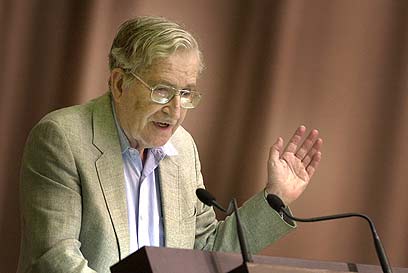
Won’t speak in Birzeit. Chomsky (Archive photo: AP)
Chomsky, a professor emeritus of linguistics at the Massachusetts Institute of Technology, is a fierce critic of the Jewish state. In March, Chomsky called on US citizens to confront Israel over its treatment of the Palestinians.
“Over time, the apparatus of Israeli control has become more sophisticated and effective in affecting Palestinian life,” said Chomsky, a noted author and Massachusetts Institute of Technology professor emeritus. Israel has finally begun to adopt the South African policy of what they call ‘indigenization of repression,’” he said.
Addressing the comparison between Israel and South Africa, Chomsky said, “It’s not exactly like the South African apartheid. In some respects it’s not as bad, but in some respects it’s worse.”
“For decades, Israel has been killing and kidnapping civilians in Lebanon…bringing them to Israel, imprisoning them, keeping them as hostages…but two Israel soldiers are captured at the border (and it) justifies a US invasion,” he said. “It’s a comment of us and what we go along with.”
Chomsky criticized US foreign policy toward Israel but stressed it could also use its power abroad to lessen the Israeli-Palestinian conflict.
“The world works like the mafia,” he said. “There is the don, or us (the United States), and when the don says not do something, you don’t do it.”
Anat Shalev and Shmulik Grossman contributed to this report
Wednesday, April 21, 2010
Chomsky: U.S. policies hurt Middle East relations
 The Brown Daily Herald
Noam Chomsky, the internationally renowned linguist and outspoken political activist, offered an analysis of the Israeli-Palestinian conflict, criticism of Israeli and U.S. policy and advice on student activism to a rowdy Salomon 101 audience that spilled over into Sayles Hall Tuesday evening.
“Thank you. Now we can go home,” said the Massachusetts Institute of Technology linguistics professor as he stepped on stage before the clamoring crowd.
Though most often cited in academia for his work on linguistic theory, cognitive science and philosophy, it was Chomsky the political activist who spoke last night. He began his lecture by recommending a column in Tuesday’s New York Times — a piece on public opinion of Israel by the Times’ Jerusalem correspondent, “someone I rarely praise,” he said — and segued into a discussion of the relationship between Israel, the U.S. and the United Nations.
Israel’s policies in Palestine are against international law, but “as long as the master agrees, it doesn’t matter what the law says,” he said.
And by “the master,” Chomsky largely meant the U.S. government, which continuously fails to utilize its persuasive power in the U.N. and international trade to end injustice, he said.
Chomsky compared the Obama administration’s support of the Israeli government to Ronald Reagan’s continued trade with South Africa under apartheid in the 1980s. “As long as they had that one vote, the world could be disregarded,” he said of the U.S.’s vote against sanctions on South Africa.
As long as the U.S. government backs Israel’s violations of the Geneva Convention, the Israeli-Palestinian conflict will not be resolved, he said.
Chomsky said the U.S. backs not only Israel, but also India and Pakistan — the two other countries that refused to sign the Nuclear Non-Proliferation Treaty. “The U.S. is not supported by the world on this,” he added.
If the U.S. overestimates the world’s approval of its foreign policy, it is because the phrase “international community” in American press often “refers to Washington and whoever else agrees,” he said — a category which excludes most Americans, who “agree with the world outside the international community.”
One way the U.S. could exert positive influence on the real international community, he said, is to support Egypt’s goal of creating a weapons-free zone in the Middle East, as discussed at a recent meeting in Tehran.
Chomsky also called for a termination of arms shipments to Israel.
During the question-and-answer session, Chomsky addressed foreign policy issues across the board. The misperceptions held by American politicians, press and public are all culprits of the ignorance surrounding oppressive policies in the Middle East and elsewhere, he said.
“They don’t hate us because they hate our freedoms. They hate us because they want their freedoms,” he said of Middle Eastern populations under U.S. “neocolonialism,” addressing George W. Bush’s confusion over their objections to the U.S. government.
But Chomsky did not let Obama off the hook either. He criticized the president’s opinion on Egypt’s authoritarian government: that he doesn’t want to label “folks.” When a politician uses the word “folks,” Chomsky said, “get ready for the next series of lies.”
Chomsky added that a country requires awareness to examine its own mistakes. “It’s pretty hard to look in the mirror, but it’s crucial if you want to understand the world,” he said.
He also emphasized that ending American support of corrupt regimes begins with groups like the students he spoke to. “Every step forward in history comes the same way,” he said. “People like you do something about it.” He suggested protesting, gathering information and spreading awareness. “The task of those of us who care,” he said, is to “let people know.”
When asked what he would change if he could go back to his own early years of activism during the Vietnam War, Chomsky said, “My main regret is I was much too mild,” adding that his opponents would say just the opposite.
The student group Common Ground: Justice and Equality in Palestine/Israel sponsored Chomsky’s visit. Member Lucas Mason-Brown ’13 came up with the idea, he said, because Chomsky “voices an opinion, which is absent from mainstream discourse.”
But this was not Chomsky’s only recent interaction with the Brown community. On April 18, he wrote a letter to Brown Students for Justice in Palestine endorsing its campaign for the University’s divestment from corporations benefitting “criminal and brutal actions.”
“It is hard to imagine a more defensible stance,” he wrote.
Lindsay Goss GS, a member of Brown Students for Justice in Palestine, said she valued Chomsky’s take on “some of the ways the conflict gets talked about” that “don’t reflect the reality of the situation.”
Ruhan Nagra ’10 said she appreciated “Chomsky’s support for student activism throughout the country.”
Associate Dean of the College for Science Education David Targan, who posed a question at the lecture about student involvement, said he hopes Chomsky helped Brown students recognize their influence in the political process. “You have access to people that can really effect change,” he said, referring to state representatives. “You can see them from the Rock.”
Subscribe to:
Posts (Atom)


