Richard Falk is the present United Nations Special Rapporteur for the Palestinian Territories. His job is to monitor the human rights situation in the territories, with particular reference to international law, and report back to both the U.N. General Assembly and the United Nations Human Rights Council. He is professor emeritus of international law at Princeton University and well qualified for his United Nations post.
Professor Falk was appointed in 2008 to a six year term in his present position. That means he has been telling the unsettling truth about Israeli behavior for four years now, with another two to go. Repeatedly he has documented Israeli violations of international law and its relentless disregard for Palestinian human rights. For instance:
– In his 2008 report Falk documented the “desperate plight of civilians in Gaza.”
– In his 2009 report Falk described Israel’s assault on the Gaza Strip as a “war crime of the greatest magnitude.”
– In his 2010 report Falk documented Israel’s array of apartheid policies.
– In his 2011 report Falk documented Israeli policies in Jerusalem and labelled them “ethnic cleansing.”
– And finally, in this latest report for the year 2012, Falk has concentrated on two subjects:
First, Israel’s treatment of Palestinian prisoners which, he concludes, is so bad as to warrant investigation by the International Court of Justice (ICJ). It should be noted that Israel does not recognize the jurisdiction of the ICJ. However, condemnation by this organization would, within the context of growing awareness of Zionist crimes, help further educate public opinion.
Second, Falk documents the assistance given Israel’s expansion of colonies on the Palestinian West Bank by a number of multinational corporations, including Motorola, Hewlett-Packard and Caterpillar Inc. This assistance may be profitable, but it is also manifestly illegal. The CEOs and board members of these companies stand in violation of international laws including provisions of the Geneva Conventions. Since no nation, nor the UN itself, seems ready to prosecute them, Professor Falk has recommended a boycott of the guilty firms “in an effort to take infractions of international law seriously.”
Reactions
In a sane world this work would make Richard Falk a universally acclaimed defender of justice. But ours is not a sane world. And so you get the following sort of responses from both Israel and its supporters:
Karaen Peretz, the spokeswomen for the Israeli Mission at the United Nations, found Professor Falk’s latest report “grossly biased.” This is a sort of response used by someone who cannot dispute the evidence and so must resort to attacking the character of the one presenting the evidence. Peretz also asserted that “Israel is deeply committed to advancing human rights and firmly believes that this cause will be better served without Falk and his distasteful sideshow. While he spends pages attacking Israel, Falk fails to mention even once the horrific human rights violations and ongoing terrorist attacks by Hamas.”
- not a single quote from anyone who supports the boycott
- not a single mention of what is motivating the boycott: Israel's human rights abuses, theft of land, oppression of Palestinians, and so on
- not a single statement of comparative contextual history, e.g., grassroots boycotts of South Africa that successfully contributed to the end of Apartheid policies
Instead of of neutrality, impartiality, facts, and context, what do we get? A megaphone for hateful, delusional scaremongering:
“I think it has nothing to do with the food,” Mayor Bloomberg said of the boycott. “The issue is there are people who want Israel to be torn apart and everybody to be massacred, and America is not going to let that happen.”
Excuse me? Supporters of nonviolent boycott want Israelis to be massacred?
Excellent point made in the comments section on MondoWeiss by Phan Nguyen:
This is the second time Waskow has argued against BDS in a debate on Democracy Now. He did so two years earlier against Omar Barghouti.
His arguments are specious, but here I just want to point out his false suggestion that Martin Luther King would never support a boycott against an entire country:
Even when Dr. King clearly, publicly, vigorously opposed the Vietnam War, he did not call for a boycott of all American products and producers. He didn’t do that in Europe or in the United States. He targeted where he was aiming. And I think BDS, as presently framed, doesn’t target.
In reality, MLK supported full boycott, divestment and sanctions against Apartheid South Africa as early as 1962:
From a joint statement by MLK and Chief Albert J. Lutuli, dated 9 October 1962 and again on 10 December 1962, addressed to the international community:
Urge your Government to support economic sanctions;
Don’t buy South Africa’s products;
Don’t trade or invest in South Africa;
Translate public opinion into public action by explaining facts to all peoples, to groups to which you belong, and to countries of which you are citizens until AN EFFECTIVE INTERNATIONAL QUARANTINE OF APARTHEID IS ESTABLISHED.
From a speech in London, December 1964, en route to Oslo to receive the Nobel Peace Prize:
Our responsibility presents us with a unique opportunity. We can join in the one form of non-violent action that could bring freedom and justice to South Africa—the action which African leaders have appealed for—in a massive movement for economic sanctions.
In a world living under the appalling shadow of nuclear weapons do we not recognize the need to perfect the use of economic pressures? Why is trade regarded by all nations and all ideologies as sacred? Why does our Government, and your Government in Britain, refuse to intervene effectively now, as if only when there is a bloodbath in South Africa—or a Korea, or a Vietnam—will they recognise the crisis?
If the United Kingdom and the United States decided tomorrow morning not to buy South African goods, not to buy South African gold, to put an embargo on oil; if our investors and capitalists would withdraw their support for that racial tyranny, then apartheid would be brought to an end. Then the majority of South Africans of all races could at last build the shared society they desire.
From a speech in New York for Human Rights Day, 10 December 1965:
Today, in our opulent society, our reliance on trade with South Africa is infinitesimal significance. No real national interest impels us to be cautious, gentle, or a good customer of a nation that offends the world’s conscience…
The time has come to utilize non-violence fully through a massive international boycott which would involve the USSR, Great Britain, France, the United States, Germany and Japan. Millions of people can personally give expression to their abhorrence of the world’s worst racism through such a far-flung boycott. No nation professing a concern for man’s dignity could avoid assuming its obligations if people of all States and races were to adopt a firm stand. Nor need we confine an international boycott to South Africa. The time has come for an international alliance of peoples of all nations against racism.
Jen Nessel, CCR, (212) 614-6449, press@ccrjustice.orgThis e-mail address is being protected from spambots. You need JavaScript enabled to view it
Jayne Kaszynski, Olympia Food Co-op, 360-357-1106 x11, publicrelations@olympiafood.coopThis e-mail address is being protected from spambots. You need JavaScript enabled to view it
Judge Dismisses Lawsuit Filed Over Boycott of Israeli Goods
Court Finds Suit Is Effort to Chill Boycotters’ Public Statements On Issue of Public Concern
February 27, 2012, Olympia, WA and New York, NY – Today, in a lawsuit brought against current and former members of the Olympia Food Co-op board of directors for their decision to boycott Israeli goods, a Washington State court dismissed the case, calling it a SLAPP – Strategic Litigation Against Public Participation – and said that it would award the defendants attorneys’ fees, costs, and sanctions. The judge also upheld the constitutionality of Washington’s anti-SLAPP law, which the plaintiffs had challenged.
In a court hearing last Thursday, lawyers from the Center for Constitutional Rights (CCR) and Davis Wright Tremaine LLP argued that the court should grant the defendants’ Special Motion to Strike and dismiss the case because it targeted the constitutional rights of free speech and petition in connection with an issue of public concern.
“We are pleased the Court found this case to be what it is – an attempt to chill free speech on a matter of public concern. This sends a message to those trying to silence support of Palestinian human rights to think twice before they bring a lawsuit,” said Maria LaHood, a senior staff attorney with the Center for Constitutional Rights.
On Thursday, the courtroom was filled with interested observers, and boycott supporters held a rally outside the courthouse. Today, the courtroom was filled to overflowing and many co-op supporters spilled into the hallway.
OSLO, Norway (AP) — A Norwegian who dressed as a police officer to gun down summer campers killed at least 80 people at an island retreat, horrified police said early Saturday.
...
The motive was unknown, but both attacks were in areas connected to the ruling Labor Party government. The youth camp, about 20 miles (35 kilometers) northwest of Oslo, is organized by the party's youth wing, and the prime minister had been scheduled to speak there Saturday.
According to TV2's sources, the arrested belong to the right-extremist groups in eastern Norway, and the man must have registered two weapons on their name - an automatic weapon and a pistol of the type of Glock. ... Breivik listed in their Facebook profile as a conservative and Christian, and he may have a connection to the extreme right environment.
The rightwing Norwegian Progress Party and its surrounding allotment of rightwing groups are historic fascistic, pro-apartheid and today very much in support of a likudnik Israel.
Via Newshoggers a report from a Norwegian TV site on the activities in the Labour Party youth camp may explain the killer's motive.
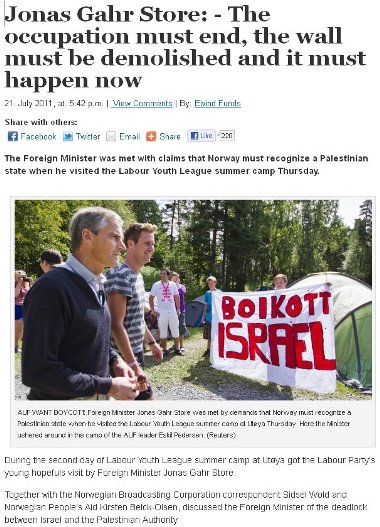
Jonas Gahr Store: - The occupation must end, the wall must be demolished and it must happen now
Header:
The Foreign Minister was met with claims that Norway must recognize a Palestinian state when he visited the Labour Youth League summer camp Thursday.
Picturetext:
AUF WANT BOYCOTT: Foreign Minister Jonas Gahr Store was met by demands that Norway must recognize a Palestinian state when he visited the Labour Youth League summer camp at Utøya Thursday. Here the Minister ushered around in the camp of the AUF leader Eskil Pedersen. (Reuters)
Text:
During the second day of Labour Youth League summer camp at Utøya got the Labour Party's young hopefuls visit by Foreign Minister Jonas Gahr Store.
Together with the Norwegian Broadcasting Corporation correspondent Sidsel Wold and Norwegian People's Aid Kirsten Belck-Olsen, discussed the Foreign Minister of the deadlock between Israel and the Palestinian Authority.
As foreign minister arrived Utøya he was met with a demand from the AUF that Norway must recognize a Palestinian state.
- The Palestinians must have their own state, the occupation must end, the wall must be demolished and it must happen now, said the Foreign Minister to cheers from the audience
- Norway is prepared to recognize
Earlier this week, when Palestinian President Mahmoud Abbas visited Norway, the Minister said to TV 2 news channel that Norway stands ready to recognize a Palestinian state . This he repeated during the debate on Utøya.
- We are ready to recognize a Palestinian state. I await the actual resolution text Palestinians will promote the UN General Assembly in September, said the Minister.
In autumn it is expected that Palestinian President Mahmoud Abbas will bring the matter to the UN. Where will he ask for UN membership and recognition of a Palestinian state within the borders before the 1967 war, with East Jerusalem as its capital.
Wednesday said AUF leader Eskil Pedersen that the AUF want a unilateral economic embargo of Israel from the Norwegian side.
- Labour Youth will have a more activist Middle East policy and we have to recognize Palestine. NOK NOK's, now we have to get the peace process into a new track, said Pedersen.
The foreign minister admitted that the situation is untenable, but believes that the boycott is the wrong tool.
- Boycott will be to move from dialogue to monologue. It is difficult to open the door the day we will talk with Israel, said the Minister.
Prime minister Binyamin Netanyahu defends controversial measure but legal experts, including some rightwingers, say it damages freedom of expression
Israel's new law effectively banning political boycotts is unconstitutional and does grievous harm to freedom of expression and protest, three dozen eminent Israeli law professors have said in a petition.
The move followed prime minister Binyamin Netanyahu's robust defence of the law in the Knesset (parliament) on Wednesday in which he said he was "against boycotts aimed at the Jewish state".
The petition, sent to attorney-general Yehuda Weinstein, was signed by the deans of many of Israel's law schools, including some associated with the political right.
"This law is a classic case of the tyranny of the majority," said Alon Harel of Hebrew University, one of the instigators of the petition. "The majority aims at silencing, persecuting and threatening the minority. It conflicts directly with the principles established in Israel in the 1990s that entrench the right to freedom of speech in the legal system. It is the most cherished right in the Israeli legal system."
Under the Law for Prevention of Damage to the State of Israel through Boycott, an individual or organisation proposing a boycott may be sued for compensation by any individual or institution facing possible damage as a result. Evidence of actual damage will not be required.
It bans consumer boycotts of goods and services produced in West Bank settlements and the blacklisting of cultural and academic institutions in settlements. It also bars the government from doing business with companies that comply with boycotts.
Boycotts were a standard form of protest in Israel, Harel said. But the new law was a "non-neutral restriction".
"Speech or action which promotes one viewpoint is protected and sanctioned, yet speech which promotes another viewpoint is prohibited," he said.
Boycotts by ultra-orthodox Jews against the Israeli national airline El Al over flying on the sabbath or by Israeli tourists against Turkey following last year's flotilla had not been targeted, he said.
Harel said the new law had to be seen within a wider context: "Basically, Israel is still a lively democracy. But this is part of a campaign to win the political struggle not through free elections and political discourse but through silencing certain sections of society."
Another bill is to be brought before the Knesset next week which allows the investigation of the funding of human and civil rights groups in Israel. Many groups say this is unnecessary as their funding is totally transparent and they claim it is part of a wider campaign of harassment and an attempt to restrict their actions.
The bill would allow anyone who called for an academic, consumer or cultural boycott to be sued for compensation
The Israeli parliament is preparing to pass a law that would in effect ban citizens from calling for academic, consumer or cultural boycotts of Israel in a move that has been denounced by its opponents as anti-democratic.
The boycott bill is expected to win majority backing, despite strong opposition and an attempt to filibuster Monday night's debate. Under its terms, any individual or organisation proposing a boycott could be sued for compensation by any individual or institution claiming that it could be damaged by such a call. Proof of actual damage would not be required.
The bill seeks to protect individuals and institutions in Israel and the Palestinian territory it has occupied, illegally under international law, since 1967. If the law is passed, it would in effect ban calls for consumer boycotts of goods produced in West Bank settlements, or of cultural or academic institutions in settlements. It would also prevent the government doing business with companies that comply with boycotts.
As debate on the bill opened in the Knesset, the Israeli parliament's legal adviser presented an opinion that parts of the proposed law were "borderline illegal". "The broad definition of a boycott on the state of Israel is a violation of the core tenet of freedom of political expression and elements in the proposed bill are borderline illegal," Eyal Yinon said.
Among the bill's opponents are dozens of Israeli intellectuals, including the celebrated author Amos Oz, who described the proposed law as the "worst of the anti-democratic bills in the Knesset. The bill will turn law-abiding citizens into criminals."
According to the Association of Civil Rights in Israel, the bill constitutes "a direct violation of freedom of expression". Its executive director, Hagai El-Ad, said: "The boycott bill represents the current unfortunate crest in a wave of anti-democratic legislation that is gradually drowning Israel's democratic foundations."
Israeli attempts to paint flotilla activists as a violent threat to the national security of the state has only brought the efforts of these Jews more exposure. The flotilla may have been stopped from physically sailing to Gaza, but the damage it has inflicted on Israel’s position as the vanguard of Jewish identity has added dramatic new layers to a painful internal discussion already in motion.
Over the past two weeks, American activists aboard the US boat to Gaza, dubbed the Audacity of Hope, have been engaged in nonviolence training, holding preparation meetings and speaking to the media about their mission to Gaza. Yesterday, their mission officially ended. The Greek government acting on the behest of Israel, stopped their boat, arrested their captain and ended their mission. Confident that they still won the public relations war, the emotional withdrawal from such an event will leave a lasting mark on many of the passengers. For the Jewish passengers on the Audacity of Hope, their convoluted relationship with Israel will continue to play a major role in their lives when they return to the United States.
The exhaustion of two anxious weeks of preparation was clear on the face of 74 year old Sante Fe resident Ken Myers as he talked about his Jewish background while on the lower deck of the Audacity of Hope, snacking on a freshly prepared Greek salad the night before the boat set sail. “For the most part, my family including my Israeli family have been supportive of my participation in this mission to Gaza.” He remarked as passenger chefs announced that everyone must take second portions of the salad since there is not enough storage space on board for leftovers. “I grew up in an extremely Jewish neighbourhood on the south shore of Long Island but my parents never forced Zionism on me even though my friends were all in Zionist youth groups.” Taking his last bits before handing over his plastic dish to the chefs he said, “I have come to understand that Zionism is simply incompatible with my version of Judaism.”
The Israeli government announced that it would seek a 10 year travel ban for all passengers participating in the Gaza flotilla for ‘illegally entering Israel’. Myers, visibly upset at the prospect of being banned from a country claiming to be his homeland questioned the rationale of the decision. “I am not traveling to Israel on this boat. I am traveling to Gaza and if Israel takes over the boat en route and claims that I illegally entered Israel despite the facts, well, banishment is the price I am willing to pay.”
As the Audacity of Hope left port on Friday afternoon, passengers embraced one and other triumphantly. Despite that the fact that they had not entered international waters and would surely be stopped by the Greek coast guard, many felt that their mission to confront Israel had succeeded when the boat left port. When Greek coast guard officials approached, their nonviolent trainers went into action, informing passengers to take positions around the wheelhouse in order to protect the captain.
The initial excitement of the confrontation with the Greeks wore off as the evening approached. The passenger chefs prepared a dinner of pesto pasta as the defeat of their mission to Gaza set in. Some passengers remained upbeat even after it was clear that the boat would not travel to Gaza. Steve Fake, a writer and activist from New Orleans, remarked under the setting Athenian sun as the boat approached a military port, “just getting this boat to sea, even if it has only been for an hour, is proof that our mission of awareness has been successful.”
Editor's Note: Article makes the claim that 9/11 was a 100% MOSSAD operation despite overwhelming evidence of additional participation and facilitation by the United States, the ISI, MI-5/6 and Turkish intelligence. Text is a translation:
In connection with eos e-mail I received from a reader synellina, which I expressed wonder "why do not Israeli agents arrested on 9 / 11 in the U.S." ...., We quote the complete list of the agents of Mossad, who arrested by U.S. authorities for their involvement in the spectacular terrorist attack of 9 / 11 and proved they were agents of Mossad ...! In my hand I have an additional list of Israeli (with around 140 names) but they ultimately did not prove that it acted on behalf of Mossad, but synepikourousan agents of Mossad ways ...!
Note that the Mayor of Jerusalem Ehud Olmert intervened twice through good friend Zionist Mayor Rudolph Giuliani of New York to release the Israeli agents of 9 / 11. These are the 5 Israeli agents who were dressed as Arabs in the roof of a building against the World Trade Center and the building NO. 7, photographed, recorded with cameras that fact and who were jumping for joy when the aircraft ran into the twin towers. They were also together military-style handheld radios and most likely were those fired and explosives were placed inside buildings ...
The following list of Israeli agents issued by the DEA and most of them were military and intelligence experience ... However, the whole issue in both the U.S. and Greece received little publicity. Finally, I should mention that in this list does not include the dozens of Mossad agents were arrested for spying and involvement in 9 / 11 in Canada and Mexico.
Hizbollah chief Hassan Nasrallah on Friday announced that members of his militant movement had confessed to being CIA agents and accused arch-foe Israel of turning to the US spy agency when it failed to infiltrate his Iran-backed party.
In the first such acknowledgement of infiltration since the group's founding in the 1980s, Nasrallah refused to disclose the identities of the two party members but said a third case was under investigation, slamming the US embassy in Lebanon as a "den of spies."
"When the Israeli enemy failed to infiltrate Hizbollah, it turned to the most powerful intelligence agency," Nasrallah said in a television speech broadcast in Lebanon, referring to the Central Intelligence Agency.
"Our investigation has found that ... intelligence officers (in the CIA) have recruited two of our members separately, whom we shall not name out of respect for the privacy of their families," he added.
"The first confessed he was recruited five months ago ... while the second confessed he had been recruited even before that," he said, adding that the recruiters were CIA agents posing as diplomats at the US embassy east of Beirut.
Unlike most young Jews that visit Israel to ‘seek out their roots’ or to study, Lucas Koerner came here to express his feelings against the Occupation. His bravery lead to his being beaten by Israeli police and his subsequent arrest.
*
In his own words…. “My government is responsible and I’m here to say not in my name and not in the name of US citizens.”
*
Below, he speaks to the Electronic Intifada about his nightmare in Jerusalem….
US citizen in Jerusalem arrest video speaks to EI
Maureen Clare Murphy*
American Jewish activist and university student Lucas Koerner was arrested in Jerusalem on 1 June — when thousands of right-wing Israelis, including settlers, marked “Jerusalem Day” by provocatively marching through Palestinian East Jerusalem to celebrate the “unification” of the city.
Koerner’s violent arrest by Israeli police was captured on video and has been viewed by a quarter of a million persons at the time of publication.
In the video, Koerner, wearing a the traditional checkered Palestinian kuffiyeh scarf and a Jewish kippah (skullcap) with a small Palestinian flag pin, identifies himself as a Jewish American and displays his US passport. “My government is responsible and I’m here to say not in my name and not in the name of US citizens,” he says.
The video then shows him being pulled from a crowd and violently arrested by Israeli police, who push him to the ground. One officer is seen putting his knee on Koerner’s neck. He is then roughly forced into a police truck.
Koerner recounts his arrest on his blog, Stronger Than Slavery, where he writes: “Throughout the whole affair, the only thing audible coming from the policemen was a constant stream of curses words, ‘motherfucker,’ ‘piece of shit,’ etc., which was to me a ringing confirmation of how infuriated and threatened they were by a 19-year-old wearing a kippah and a keffiyeh standing with the Palestinians.”
The Electronic Intifada editor Maureen Clare Murphy, who blogged about Koerner’s arrest last week, interviewed the young American activist upon his return to the United States and shortly after his release from Israeli detention. Koerner discusses his activism and what happened after his arrest. When asked whether he would pursue legal measures to protest his arrest, Koerner said that his family are considering their options.
Maureen Clare Murphy: What brought you to Palestine?
Lucas Koerner: I’ve been an activist on a number of fronts for a long time and in particular Palestine solidarity for past three years or so. And for the past three or four years I’ve always wanted to go, I’ve never had the opportunity, it never came together. Finally someone told me about Interfaith Peace Builders, I applied for a scholarship, they gave me a scholarship and then I decided to go [on one of their delegations]. My main motivation was that being an activist, you can know all the facts, you can have all the graphs, all the tables, all the presentations, but when it comes down to it, none of that is a substitution for first-hand empirical experience of actually going and seeing it for yourself. That was the primary motivation.
I was there for eleven days, however I was supposed to stay for five weeks.
MCM: Have you been active in the solidarity movement in the US?
LK: I live in Philadelphia during the summer but I go to school in Boston. When I was in high school in Philadelphia I was involved with American Jews for Just Peace – Philadelphia. In my high school I started something of a Palestinian solidarity-type group or anti-war group. It wasn’t much of a group but we tried our best to show films, try to do whatever we could. I was also in touch with the US Campaign to End the Israeli Occupation.
MCM: How did you get involved in solidarity with Palestine?
LK: I’ve been involved tenuously in anti-war activism around Iraq and Afghanistan since I was in 9th grade, since I was 15; I went to my first demonstration with my dad … [Palestine has] always been a fixture my political consciousness but it was really Operation Cast Lead, the Gaza massacre of late ‘08 early ‘09, that prompted me and compelled me beyond anything else to take on this work as my primary calling. I just couldn’t stay silent any longer.
MCM: Why were you protesting the day you were arrested?
LK: It wasn’t originally a protest at all or demonstration. Initially my friends and I, or my fellow delegates on our trip, were going down to watch the march and basically we were just holding up peace signs, we had our kuffiyehs on. We basically tried to make a statement as Americans that in the aftermath of Netanyahu’s speech before Congress and Obama’s speech before AIPAC, that we do not endorse Israel’s occupation and all of the concomitant violations of international law and injustices that go with it.
We had just came back from Hebron [in the occupied West Bank] earlier that day. It was really what we saw in Hebron — the utter segregation that the city has fallen under with the occupation, the division of the city into basically two zones — the center of the city is basically off limits to the [Palestinian] residents of the city. It’s ground zero of the occupation as many regard it, particularly in terms of settler brutality, and the absolute complicity of the IDF [Israeli military]. But seeing that and returning on Jerusalem Day to our hotel in East Jerusalem, and seeing these miles and miles of white and blue and all of these people jubilantly celebrating the conquest of East Jerusalem, celebrating the occupation in East Jerusalem, the chutzpah of all, that really affected us all and that is what prompted us to do what we did.
MCM: What was it like in Israeli detention?
LK: I was detained for almost two days. I was taken to a police station right afterwards, where I was held for about four hours before I saw a lawyer. I was threatened numerous times with being tased and being put to sleep by various weapons they had. I continually demanded my lawyer and for my persistence they threatened me numerous times. I was then taken to prison where I spent the night in the ER; the doctor determined I had to go there because of my injures, though it was nothing serious beyond superficial wounds. The next day I was taken to court where I was put under house arrest. However the prosecution appealed that decision within the hour and the district court judge stayed the decision, so I had to stay the night in the Russian Compound, the Israeli jail.
What struck me most about my time in prison is that it is a reflection of the rest of Israeli society in that it’s completely segregated. I was placed against my will in the Jewish cell. I asked to be put in the Arab cell. The Jewish cell conditions weren’t bad at all; it was still jail, but it was bearable. I did see the Arab cell or at least one of the Arab cells and the conditions there were absolutely abominable. … We had furniture, we had beds of some sort, we had a clean bathroom. They had nothing. Just a bench and an open toilet. The conditions were horrible. That’s what struck me most.
MCM: Did you get any support from the US consulate?
I received no support from the US consulate. My friends and family had contacted them and, from what I heard, they basically said that this happens a lot and there’s nothing [they] can do. They didn’t even come to my trials.
[The trials were] all done in Hebrew. It was lucky that I had a local activist there who could translate for me. The Israeli judicial system is very strange in that you can’t have a lawyer while being questioned. I was not allowed to have a lawyer present while being questioned and there are no laws within Israel that prevent you from being almost indefinitely detained before being charged. I was never formally charged but I was detained for two days.
Certainly my situation pales in comparison to that faced by Palestinian activists who face administrative detention — which is six months or more, as many as 18 months often — without being charged with anything. This is the legal structure of occupation and I had a very small dose of it. In my trial I was given house arrest, though the police wanted to hold me for a week without charging me with everything — and that was certainly a possibility, and why I had to come home.
MCM: What kind of reaction have you seen since you’ve been arrested?
LK: The reaction that I’ve received so far from the volume of Facebook messages and messages to my blog have been overwhelmingly positive, just great displays of love and solidarity which I greatly appreciate, though there’s hate mail starting to trickle in. The video has reached such a wide audience primarily because of my privileged position as an American Jew. I think that this kind of injustice which was perpetrated against me would make headlines and provoke such a visceral response. But my treatment, again, was moderate by the standards faced by Israeli and Palestinian activists in [the occupied East Jerusalem neighborhood] Sheikh Jarrah and in a weekly basis in [the West Bank villages] Biln or Nilin, and their videos are only seen by a few hundred people. It’s the fact that I’m an American Jew that [the video] has seen such a wide audience.
MCM: What are your next plans for your solidarity work?
LK: I’m planning on doing some activism with some outfits in Philadelphia — American Jews for Just Peace, other groups. When I return to Boston in the fall I will continue my work as a leader of Tufts Students of Justice in Palestine and we do a lot of work with other SJP chapters throughout the city and CODEPINK and American Jews for Peace – Boston. I just hope to be able to share my experiences, not just my arrest, but everything else I saw prior to my arrest, in as wide a forum as I can.
*Maureen Clare Murphy is managing editor of The Electronic Intifada and an activist based in Chicago.
Rep. Steve Chabot (R-Ohio) introduced a resolution calling for the withholding of U.N. funding if the General Assembly recognizes a Palestinian state.
Chabot said Tuesday that he hopes to dissuade any effort by the Palestinians to circumvent peace negotiations by going directly to the United Nations for statehood recognition when the General Assembly convenes in September. Chabot is chairman of the U.S. House of Representatives Foreign Affairs Subcommittee on the Middle East and South Asia.
“I felt it was important to set down a marker to be very clear that there are those of us in Congress who are very concerned about this,” Chabot told JTA.
The non-binding resolution is a call for U.S. funding to the U.N. General Assembly to be withheld if the General Assembly adopts any resolution recognizing a Palestinian state outside formal negotiations between Israel and the Palestinians.
“You wouldn’t truly have a state, you’d just have one more irritant, one more thing that’s going to cause disruption in that important part of the world,” Chabot said. “The goal is to not have to take this measure by having the Palestinians backing down or the General Assembly indicating they don’t want to take the risk of having U.S. dollars cut off.”
The measure does not currently have any co-sponsors, but Chabot said he feels confident he’ll be able to recruit support among his colleagues when Congress is back in session next week.
“I have no concern that we won’t be able to attain a significant number,” Chabot said.
It might help to understand how Iran's leaders perceive threats from America and its Western allies
To the surprise of few, new Iran sanctions legislation was recently introduced in the House and Senate, shortly before this year's AIPAC conference commenced. In what has become a game of domestic political one-upsmanship, some members of Congress are now supporting Iran-related legislation that would effectively seek to impose an oil embargo on the Islamic Republic -- irrespective of the economic costs to the U.S. or the humanitarian costs to the Iranian people -- and reduce President Obama's waiver authority on sanctions that run counter to U.S. national interests (read: China).
Ostensibly, sanctions are devised as a multi-level (unilateral and multilateral) strategy to sharpen Iran's choices, and build tough-minded international recognition of Iran's failure to adhere to its international obligations. In practice, political constraints at home and abroad inhibit America's ability to move beyond tactics centered on sanctions, and instead toward a strategy that deconstructs the U.S.-Iran institutionalized enmity through sustained diplomacy. Sanctions are a tool that American policymakers know -- they know how to add them, change them, intensify them, push them through Congress, and negotiate them bilaterally and at the U.N. Lesser known is how Iran perceives this paradigm that seemingly traps U.S. policy. Indeed, the logic of some in Congress (and the Obama administration) regarding what sanctions can achieve is largely misguided.
For decision-makers in Tehran, the heart of the matter is how they perceive that the West will (and will not) react to its foreign policy posturing in general and the nuclear question in particular. The Iranian narrative can be summarized as follows: Former President Mohammad Khatami's détente failed, so Iran must now deal with the West from a position of strength. To that end, when Mahmoud Ahmadinejad assumed the presidency in 2005, the Islamic Republic analyzed the finite scenarios surrounding the nuclear impasse, observed the inherent limitations of sanctions as panacea and perceived a reasonable degree of strategic flexibility over the short to medium term.
It was no secret to Tehran, or anyone else for that matter, that the U.S. would spend significant political capital to transfer Iran's nuclear file from the IAEA (a technical body) to the U.N. Security Council (a political body). Iran's familiarity with the politics of the Security Council prepared it for a referral and subsequent sanctions resolution, despite its preference to the contrary. More specifically, Iranian decision-makers knew that if Russia was on board -- which was likely, given Moscow's reputation in the Security Council for setting a price and selling to the highest bidder -- China would likely follow suit.
Security Council resolutions, like all sanctions, are not negligible for Iran. But several key factors make them manageable. The Islamic Republic knows that its nuclear activities are legally permissible -- despie Western claims that Iran no longer enjoys its rights under the Nuclear Non-Proliferation Treaty because it was found in noncompliance by the IAEA. Thus, Iran perceives the West as unable to sell "crippling" sanctions based on its activities thus far, because there is no "smoking gun." With that in mind, the Iranian government views sanctions through two prisms.
Internally, both U.N.-endorsed and U.S.-led "coalition of the willing" sanctions do limit Iran's access to Western markets and technologies, and in turn decelerate economic development. Nevertheless, Iran continues its shift toward emerging powers China, Turkey, India and Brazil as trade partners. Overall, both multilateral and unilateral sanctions exacerbate an already challenging economic forecast for Tehran, which is compounded by its own mismanagement and corruption. But loopholes -- whether black-market or oil-for-food programs -- inherently allow oil-based economies (and the governments that control them) to be carried by their massive energy resources.
Externally, Tehran perceives a Western bloc that is in a bind -- none of their options are intuitively good ones, but those nations cannot afford to allow Iran to keep defying them. One the one hand, nations of the West cannot implement painful oil and gas sanctions because prices would skyrocket beyond a tolerable threshold (the idea is to hurt Iran, not themselves). On the other hand, Iranian decision-makers perceive Western powers that are legitimately worried about their reaction to sanctions: If Iran withdraws from the NPT, the West is faced with confrontation at a level that it does not have the bandwidth for, particularly at a time of widespread regional unrest.
Overall, the Islamic Republic perceives a credibility gap in the West that it repeatedly seeks to leverage. After the flawed reporting and intelligence on Iraq's alleged WMD program, Western powers will be hard-pressed to use the same arguments to push for confrontational action on Iran. For that reason, Russia and China are unlikely to support punitive measures beyond the status quo.
This is the inherent flaw in America's sanctions-based approach to Iran: Since its inception, the Islamic Republic has faced a steady stream of sanctions, isolation and conflict -- and Iranian hardliners perceive this as the environment in which they thrive. To that end, they have defied sanctions for over 30 years, take a certain pride in doing so, and are likely to continue doing both. Iran's ruling elite sees sanctions as the West resorting to a pressure-based formula that history has proved ineffective due to the lack of viable policy alternatives. This reinforces Tehran's self-perception of increasing strength, leverage and power vis-à-vis the West.
Historical precedent has shown Iran that Western powers tend to accept the status of a "regional power" when that power becomes formidable. China, India and Brazil are often cited as examples. The Islamic Republic is counting on such an eventual acceptance. The key virtue from Iran's perspective has been patience. Decision-makers in Tehran know that the cost of this strategy is high -- sanctions, isolation and conflict abound -- but they are insistent that Iran must assume the role of an accepted regional power. And if the U.S. maintains the objective of making Iran yield on the nuclear issue through pressure, Iranian strategy will continue to be predicated on patience and knowing that it can eventually achieve its status as an accepted regional power by playing the long game.
Reza Marashi is Director of Research at the National Iranian American Council (NIAC) and a former Iran Desk Officer at the U.S.
The University of London Union (ULU) has voted 10-1 to institute and campaign for Boycott, Divestment and Sanctions (BDS) against the Israeli regime and in support of Palestine.
The motion clinched on Wednesday, May 18 called for “thorough research into ULU investments and contracts” with companies guilty of “violating Palestinian human rights” as set out by the Palestinian Boycott National Committee (BNC).
“We have precedents for boycotting campaigns at ULU, especially with South Africa and the boycott campaign over Barclays bank that supported the Apartheid regime. We are now responding to the Palestinian call for civil action in support of their fight against racism”, said Ashok Kumar, Senate member for LSE, speaking in favour of the motion.
The motion also called on other students' unions to join in the campaign for Palestinian human rights.
ULU is the largest students' union in Europe with over 120,000 members from colleges across London. ULU senate consists of the presidents from the 20 students unions representing every University of London University.
“We are delighted that this motion has passed, and with such a clear vote as well. We have seen throughout history that boycotts are a crucial nonviolent tactic in achieving freedom, and target institutions, not individuals”, said James Haywood, President-elect at Goldsmiths Students' Union.
London, (Pal Telegraph) - First Minister Alex Salmond supported economic sanctions against Israel. He described Israel’s massacre of nine Mavi Marmara passengers as an “atrocity on the high seas” and put Israel firmly beyond the pale. “This has implications for example in trading relationships—you can’t have normal relationships if you believe another country has been involved in what Israel has been involved in.”
Scotland’s elections shattered political mould – SNP triumphant. The pro-war and pro-Israel Labour, Tory and Lib Dem parties punished SNP Leader Alex Salmond tried to impeach Tony Blair for war crimes in Iraq. Scottish Government offered open access to Scottish hospitals for Palestinian victims of Operation Cast Lead. Nationalist government must be pressured to match deeds with words
Scotland’s elections have shattered the political mould, battered every political party other than the SNP (Scottish National Party) and given us a nationalist majority in the Edinburgh Parliament. The voting system was expressly designed to prevent such an outcome. Unlike Palestinians, though, we do not expect to be punished severely for voting in a way that London disapproves of.
The Labour, Tory and Lib Dem parties that are attacking living standards have been punished and the SNP has reaped the benefits of being seen to oppose the cuts to living standards, services and jobs .
We should also remember that the SNP leader, Alex Salmond, has steered his party over the years to oppose many of the core militarist policies of the other parties: he launched an initiative in 2004 to impeach Tony Blair for war crimes in Iraq, and the SNP opposes the Trident nuclear weapons system.
Salmond, far and away Scotland’s most popular and effective politician, has also been harshly and publicly critical of Israeli crimes. Following Israel’s abuse of British passports to murder a Hamas official in a Dubai hotel room in March 2010, First Minister Salmond supported the idea of economic sanctions against Israel. He dismissed the London Government’s expulsion of a low level Israeli Embassy official when he told a BBC Question Time audience that Israel’s unceasing crimes merited more than a “diplomatic dance” over passport mis-use.
Salmond labelled Israel’s massacre of nine Mavi Marmara passengers as an “atrocity on the high seas”. No UK Government officials would condemn Israel for the killings and David Miliband said he was “seeking clarification” from Israeli Foreign Minister Lieberman. Alex Salmond, in contrast, put Israel firmly beyond the pale. “This has implications for example in trading relationships—you can’t have normal relationships if you believe another country has been involved in what Israel has been involved in”.
One newly elected MSP, Humza Yousef, correctly pointed out in a letter to SPSC that there have
“been actions also, hundreds of thousands of pounds have been released in aid to Gaza , and opening our hospitals to treat those who were injured in the horrific assault in 2009 (this was an appeal you made at the time directly to the Scot Gov’t).”
Alex Salmond has also opposed those who seek to conflate political criticism or opposition to Israeli crimes with hostility to the Jewish Community. Addressing a Glasgow Jewish community meeting in May 2010, he was asked “to do what he could to halt” BDS actions outside Glasgow supermarkets. Salmond responded with an elementary distinction:
“I don’t think we should accept as a community that your position in Scottish society should be judged or affected by the policies of Israel. The Jewish community is not liable for those policies. It is possible to be critical of Israel without being anti-Semitic. The Jewish community should not be judged on whether people approve or disapprove of the actions of Israel.”
He also dismissed claims by some Zionists that anti-Semitism was driving Jews out of Scotland, an unfounded claim that serves the Zionist programme to have Jews move to Israel:
“I don’t share the analysis that the Jewish community is suffering a wave of persecution or that anti-Semitism in Scotland is rapidly growing and such a severe problem that it is jeopardising this community..I don’t believe that the Jewish community is under siege nor do I believe that it feels itself to be under siege…Scotland has never had to introduce any laws to deal with anti-Semitism”.
Salmond’s positions have been in sharp contrast to the London Government, which attacked and invaded Iraq and Afghanistan and endorsed every Israeli crime. David Miliband, for example, refused to condemn the Israeli attacks on boats to Gaza with humanitarian aid and David Cameron described himself as “a proud Zionist” supporting Israel, which acted with “great restraint” against Lebanese or Palestinian “terrorists”.
But the Israeli violations of international law, and the ongoing killings, mass imprisonment and dispossession of the Palestinian people, mean that we have to go beyond humanitarian aid and words to support the Palestinian appeal for BDS, boycott, divestment and sanctions against Israel until Palestinians gain their freedom.
That means that we must pressure the newly-mandated Scottish Government to live up to First Minister Alex Salmond’s words that Israel’s behaviour merits trade sanctions. That must include the rescinding of the £200,000 Scottish Enterprise grant to Eden Springs, the Israeli water cooler company involved in serious human rights violations in the Golan, Syrian territory held by the British Government to be illegally occupied by Israel.
Help us to keep the pressure on the Government to act on First Minister Alex Salmond’s call for trade sanctions against Israel. Join and support the Scottish Palestine Solidarity Campaign.
Mick Napier
Chair, Scottish Palestine Solidarity Campaign
c/o Peace & Justice Centre
Princes Street
Edinburgh EH2 4BJ chair@scottishpsc.org.ukThis e-mail address is being protected from spambots. You need JavaScript enabled to view it
00 44 (0)131 620 0052 / 00 44 (0)795 800 2591
Following the recent direct action on the University of Arizona (UA) campus — in which an enormous mock wall was constructed to bring attention to Israel’s wall in the West Bank and the wall at the US-Mexico border — legendary intellectual and academic Dr. Cornel West formally called on the UA community to divest from corporations that profit from Israel’s illegal settlement policies and the occupation of Palestine as well as from “immigrant and indigenous suffering and youth cultural censorship in Arizona and nationwide.”
“Powerful social movements such as the one that helped end South African apartheid have shown that when world governments fail to enforce the rule of law, international civil community must arise to meet the challenge of upholding fundamental human rights and securing justice. Ethnic studies youth activists and groups like Jewish Voice for Peace are doing just that. As [South African Archbishop Desmond] Tutu and many others point out in the case of the Palestinians—as well as that of Latina/o immigrants and indigenous peoples in the U.S.—the tactic of Boycott, Divestment, and Sanctions (BDS) is an effectively nonviolent means of exerting moral and economic pressures to end unjust policies, from racial profiling to repressive laws, to foreign occupation and land settlement. Perhaps the most vulnerable right in these situations is the right of education, because of the endangered cultural future it represents. Those in the United States and Israel who hold the levers of power and influence over such policies must be beckoned to the negotiating table so that vulnerable peoples can anticipate a peaceful future through living a just and honorable peace.”
Identifying Caterpillar and Motorola, two US corporations that have entrenched contracts with the Israeli military, Dr. West said that such companies are responsible for the “treachery targeting our youth’s future” and praised the current campaign launched by JVP to urge giant pension fund TIAA-CREF to divest from such corporations.
Connecting the struggles between Palestine and Arizona (and other immigrant communities across the US) has been a powerful movement that keeps growing more and more vocal. Especially with the shocking presence of Arizona’s anti-immigrant “Minutemen” — whose members have been given the green light by state officials to shoot-to-kill undocumented immigrants crossing the US-Mexico border — the solidarity movements bridging Palestinian and American indigenous peoples have been intensifying. Elizabeth Dake, a student and ASUA Women’s Resource Center Health and Sexuality Chair, stated in the Arizona Daily Wildcat (UA’s on-campus newspaper) on 25 April that:
“Denying education to Palestinian students and eliminating ethnic studies in Arizona are necessary steps to maintain oppressive, pro-corporate policies. The UofA currently holds contracts with Motorola, Caterpillar…which support Israeli occupation of Palestine and anti-immigrant legislation in Arizona. Divestment is the strongest statement our university can make in support for worldwide human rights. We, as members of the university community, demand that our administration end our university’s contracts with these corporations and stand up for human rights around the world and at home.”
Dr. West’s endorsement of the Palestinian-led call for boycott, divestment and sanctions (BDS) comes amidst a time of severe attacks not only against Latin American immigrants, but of Ethnic Studies programs across Arizona campuses — a move that has sparked nationwide outrage and protest from students, academics and anti-racist activists. In a joint press release, No More Deaths (No Mas Muertes) and Jewish Voice for Peace (JVP) stated that:
West’s letter came on the heels of an Ethnic Studies youth movement that is shaking Arizona and the nation to its bones.
This past Tuesday night, when the Tucson Unified District School Board (TUSD) was to vote on a fateful measure that would effectively dismantle Ethnic Studies programs as core classes for students, the popular youth coalition UNIDOS (United Non-discriminatory Individuals Demanding Our Studies) and dozens of supporters occupied the TUSD headquarters. Minutes before the meeting was to begin, 9 UNIDOS activists rushed the Board platform and chained themselves to Board members’ chairs and dais, setting up a banner that read, “UNIDOS Presents the Youth School Board.” The Board was unable to hold their meeting and rescheduled for a later time. Asiya Mir, organizer with UNIDOS and founder of Tucson High School Students for Justice in Palestine, was one of the 9 activists who chained themselves to the board. Mir believes the TUSD board will not yield from selling out the students’ education. However, she said, “We stopped them from passing the vote tonight. For tonight, it’s a victory.”
Dr. West explained in his letter that Ethnic Studies programs:
“[are] about the quest for truth, from the standpoint of the weak and the vulnerable who are rising up to speak, to educate, to struggle and to build justice from the ground up … Bold Arizona youth who are fending off attacks on their cherished Ethnic Studies in an environment of racism and hostility; courageous Palestinian youth who aim to preserve and defend their own fragile Ethnic Studies from the violent, cultural destruction of a vicious, 44-year Israeli occupation—an occupation whose length continually represses the memory of a peaceful time … A decent education cannot be limited to tolerating youth accessing their ethnic and cultural history but must be about facilitating their right to do so, without the hindrance of state or corporate exploiters.”
West continued:
“Attacks on education are big business. Greed is amuck in Arizona and in occupied Palestine. U.S. corporations like Caterpillar and Motorola—and others especially in the prison-Industrial complex—continue to profit from the suffering of peoples who seek dignity and self-determination in Arizona. Similar corporations profit from the misery of occupied and distressed peoples in Palestine.”
Jerusalem - The number of antisemitic incidents world-wide dropped 46 per cent in 2010 compared with the year before, a report by an Institute of Tel Aviv University said Sunday.
The total of incidents as physical injuries, vandal acts and direct threats attributed to anti-semitic motives in 2010 was 614, while 1,129 were recorded in 2009.
The Stephen Roth Institute for the Study of Anti-Semitism published annual figures on worldwide anti-semitism on the eve of Israel's annual Holocaust Remembrance Day, which was to begin at sunset Sunday and end at sunset Monday.
The report explains the peak in 2009 as a direct consequence of Israel's war in Gaza between December 2008 and January 2009, when 1,400 Palestinians and 13 Israelis were killed. The Israeli offensive 'provoked unprecedented anti-Jewish activity worldwide,' the report says.
Britain, France and Canada were in 2010 the three countries with highest rates of anti-semitic incidents, mostly physical street assaults on people identified as Jews. They constituted near 60 per cent of all incidents worldwide.
Between the hundreds of examples, the report quotes the attack in February last year against a 14-year-old student wearing a skullcap in Paris. He was brutally punched by seven teenagers inthe head and the stomach and called a 'dirty Jew'.
Harassment of Jews by young Muslims in several cities in the Netherlands led Rabbi Benzion Evers, son of Amsterdam's chief rabbi, to say that he would emigrate because of growing antisemitism.
Jews in Holland hid their skullcaps and avoided wearing traditional clothing because they feared harassment or violence on the part of young Muslims, the report notes.
Australia was however the country with the biggest increase last year showing a growth of one-third of that in 2009, despite a rise in the amount of insults directed against Jews on their way to or from synagogue.
The second half of last year, after Israel boarded the Freedom Flotilla and killed 9 activists of Turkish origin, the attacks against Jews and Israelis increased in Latin America also, specially in Chile, where the Palestinian diaspora is the fourth largest in the world.
In Venezuela, the report says, the flotilla incident triggered a further rise of antisemitic non-violent allegations. Those kind of attacks 'became an integral part of the anti-Israel propaganda of governmental and pro-Chavez circles', the report continues.
'Have we learned the lessons of the Holocaust in the world? To our great regret, the answer is no. A renewed anti-Semitism is spreading,' Israeli Prime Minister Benjamin Netanyahu said Sunday in his cabinet meeting in the eve of the Holocaust Memorial day.
The same group that failed in a bid to place controversial ads alleging Israel "war crimes" on Metro buses is now losing billboards with a softer message decrying U.S. aid to Israel.
Clear Channel Outdoor initially reviewed and accepted the billboard ads but reversed course this week and said it will remove them, citing a company policy of avoiding messages that offend certain persons or organizations.
The ads were purchased by the Seattle Mideast Awareness Campaign. The group turned to the billboards after a judge allowed King County to reject the "war crimes" ads on buses, due to public-safety concerns.
The group bought four billboard ads, at about $1,400 apiece, which were supposed to run for four weeks. Three of the ads were in place. But Clear Channel Outdoor informed the group on Wednesday it would remove the ads — a move the Israel critics called censorship.
"We're trying to bring up a very serious human-rights issue that we're complicit with because our government supports these human-rights violations overseas," said Edward Mast, a spokesman for the group. "We're not being allowed to talk about it."
The ads show a Palestinian boy behind a fence and call for "Equal Rights for Palestinians" and for the U.S. to "stop funding the Israeli military."
In canceling the ads, Clear Channel did not object to those slogans. Instead, the company pointed to stronger language on the group's website, www.stop30billion-seattle.org, which was prominently promoted on the ads. That site calls Israel's Palestinian policies "war crimes" and "apartheid."
A Clear Channel executive said in a statement the company supports "community discussion of serious issues." But the company also wants to ensure any ads, including websites they promote, "are not offensive toward any business, group or individual," said Olivia Lippens, president of Clear Channel Outdoor Seattle, in an emailed statement.
Lippens said the Mideast Awareness Campaign's website is "not in keeping with those standards."
Mast said his group offered to delete or change language on its website but was told that wouldn't keep the billboard ads going.
Clear Channel did not identify which groups or individuals had objected to the billboards.
Some local pro-Israel groups that had protested the Israel critics' proposed Metro bus ads said they had not contacted Clear Channel about the new billboards.
Richard Fruchter, president and CEO of the Jewish Federation of Greater Seattle, said while his organization did not complain, it did mention the billboards on its website.
"We disagree with the message, but we agree with the right of free speech," said Fruchter. However, he said the "sensational" and "inflammatory" messages weren't contributing much to the public debate.
Clear Channel said it would refund the money paid for the ads.
The billboards with the ads were on Aurora Avenue at Republican, Elliot Avenue West near West Lee Street and Lake City Way Northeast near Northeast 104th Street.
Fatally Flawed: The Pursuit of Justice in a Suspicious Election
Voices of Opposition
Opposition to War, Racism and Oppression.
New Additions
All Items Produced In House
The World Reacts...
Click Picture
See Hillary Clinton Make Fun of Gaddafi's Murder
Here is Israel's Crap Treatment of an American Jew
People participate in movements when that particular movement
(1) meets their concrete and tangible needs, (2) offers individuals real experiences in the movement's outcome (3) provides a sense of community, (4) makes available ongoing education and skills training and (5) shows direct and effective ways for people to take further action.
A loose interpretation of a message sent on Sunday, October 4th, 2009 by the Program on Corporations, Law & Democracy
A worker walks out of a factory building outfitted with nets, installed to prevent workers from jumping to their deaths, at a Foxconn factory, in Langfang, Hebei Province August 3, 2010. There have been nearly a dozen suicides at Foxconn plants around China this year alone, prompting calls for investigations into poor working conditions at the plants that make parts for customers such as Apple, HP and Dell. (REUTERS/Jason Lee) #
You can't have peace for the sake of peace. Peace is a consequence of an equitable arrangement.
Welcome to 9-11 Movies
-
The idea behind this site is to present the most rudimentary, simplified,
common-sense information about the anomalies that fuel our doubts about the
offic...
Never forget and never give up.
-
Dear friends and colleagues,
Tomorrow is another anniversary of the 9/11 crimes. It's now 23 years!
I've been seeking the truth for 21 of those years and...
The Storm
-
VIA From The Trenches World Report
A storm is headed in our direction, and it’s going to shower Americans with
trauma, misery, and desperation. It’s all pa...
US’s Saudi Oil Deal from Win-Win to Mega-Lose
-
By F. William Engdahl Who would’ve thought it would come to this? Certainly
not the Obama Administration, and their brilliant geo-political think-tank
neo-...
FAREWELL …… BUT HOPEFULLY NOT FOREVER
-
Unfortunately WordPress has changed its format making it almost impossible
for me to continue posting on this Blog. Therefore, I am bidding farewell
to m...
10 Most Sought-After Bartering Items in Venezuela
-
10 Most Sought-After Bartering Items in Venezuela
By Maybell Nieves
October 14, 2019 08:13
About 50 years ago, Venezuela was one of the most stable cou...
Palestinian Women – One for All, All for One
-
Honouring All Palestinian Women by Honouring Three: Hanin Zoabi, Ahed
Tamimi, Samah Sabawi Vacy Vlazna “Palestinian women have always stood side
by side ...
#MorningMonarchy: October 16, 2026
-
Breaking badly, stepping into horror and maximum overdrive + this day in
history w/hustling up Trump dirt and our song of the day by George Harrison
on you...
My Farewell Announcement
-
Cancel PayPal Subscription To cancel your Newsbud membership recurring
subscription through PayPal, simply cancel your PayPal recurring payment
account and...
Essiac
-
Elaine Alexander: Dr. Brusch have you studied Essiac's effect on cancer
patients under controlled conditions at your clinic?
Dr. Brusch: Yes I have!
Elai...
THE PEOPLE VS THE STATE OF ILLUSION
-
The People Vs The State Of Illusion, by Austin Vickers, is a documentary,
much in the same style as films such as The Secret, What the Bleep Do We
Know, ...






 Posts
Posts


