Showing posts with label Tel Aviv. Show all posts

Monday, December 3, 2012

Israel Out of Control: Britain Considers Recalling Ambassador


WideShut

 
Britain and other allies are considering recalling diplomats from Tel Aviv, after Israel announced defiant plans to build 3,000 new settler homes on occupied Palestinian land. Like a spoiled child, mad-man Netanyahu made the decision in retaliation for Palestine being granted a measly non-member status at the UN last week.
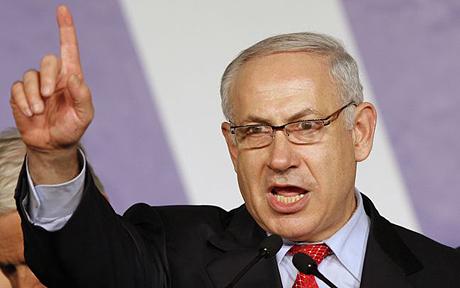


Daniel Taub, Israel’s ambassador to Britain, was “formally summoned” to the Foreign Office this morning to discuss the best way to proceed with Alistair Burt, the minister for the Middle East. If Britain’s envoy is pulled out of Israel it will be an unprecedented step, and a sign that even Zionist supporters are starting to think Netanyahu’s regime is going too far.

Mr Burt said a decision about whether Matthew Gould, the British ambassador to Israel would be withdrawn, can only be made following a round of talks: “Any decision about any other measures the UK might take will depend on the outcome of our discussions with the Israeli government and with international partners including the US and European Union.”[1]

A Foreign Office spokesman confirmed that Britain considers Israel’s decision to further breach international law deplorable. The move is being considered an act of defiance, especially after Britain sided with Israel over the recent escalation in Gaza.
Even the US are having second thoughts about supporting Israel’s crimes. White House spokesman Tommy Vietor spoke of America’s “opposition to the settlements and East Jerusalem construction and announcements.”[2]

Netanyahu plans to erect 3,000 new Jewish homes in the occupied West Bank and East Jerusalem, a flagrant breach of the Geneva Convention and international laws recognised by the UN, European Union and Arab League. If the building goes ahead it will effectively isolate East Jerusalem from the rest of the West Bank and divide northern and southern halves of the region. Strategically this will segment the Palestinian people, further extinguishing any hope they have for an autonomous state.

Furthermore Israel announced on Sunday that it would withhold £75 million in tax revenues from the Palestinian Authority, for no other reason than because they can. The Israeli finance minister, Yuval Steinitz, told Israel Radio: “I do not intend this month to transfer the funds to the Palestinians. In the coming period I intend to use the money to deduct debts the PA owes to the Israel Electric Corporation and other bodies.”[3]

Despite the public show of opposition, whether Israel will actually face repercussions is unlikely. The international community acknowledge that Israel are legally in the wrong for many of their actions, but the UN have never implemented measures to expel Jewish settlers nor prevent further encroachment of Palestinian land. Unlike peace-keeping missions and humanitarian interventions that support the expansion of the Anglo-American empire, “liberating” the Palestinians is not considered beneficial. So while Palestine is technically considered the victim, nobody actually bothers to do anything about it.

This hypocrisy has never been more apparent than with the voting of Palestine’s non-member status itself. The illustrious position grants Palestine the right to sit and watch what happens in the UN but not to actually take part, while Israel and it’s sister America bully the rest of the world.

In other words the international body that agrees Israel is breaking the law and Palestine are a victim, recognize the criminal as a member but not the victim. And the criminal leader Netanyahu has vowed to further break the law because the victim has been granted to the right to sit and watch from the sidelines.


Palestinian Authority Chairman Mahmoud Abbas said Palestine came to the UN “because it believes in peace and because its people, as proven in past days, are in desperate need of it.”[4]

Unless the UN act on their condemnation of Israel, the Palestinians will not get that peace.

Thursday, August 23, 2012

Israel's War Plans to Attack Iran "Before the US Elections"

Global Research
Michel Chossudovsky

Israel's Channel 10 suggests, in no uncertain terms, that Prime Minister Benjamin Netanyahu is "determined to attack Iran before the US elections" and that the "time for action is getting closer."

"Israel is now closer than ever to a strike designed to thwart Iran’s nuclear drive".

This timely report suggests that Netanyahu and Defense Minister Ehud Barak firmly believe that President Obama "would have no choice but to give backing for an Israeli attack" were it to be waged before the November presidential elections:

The TV station’s military reporter Alon Ben-David, who earlier this year was given extensive access to the Israel Air Force as it trained for a possible attack, reported that, since upgraded sanctions against Iran have failed to force a suspension of the Iranian nuclear program in the past two months, “from the prime minister’s point of view, the time for action is getting ever closer.”

Asked by the news anchor in the Hebrew-language TV report how close Israel now was to “a decision and perhaps an attack,” Ben-David said: “It appears that we are closer than ever.”

He said it seemed that Netanyahu was not waiting for a much-discussed possible meeting with US President Barack Obama, after the UN General Assembly gathering in New York late next month — indeed, “it’s not clear that there’ll be a meeting.” In any case, said Ben-David, “I doubt Obama could say anything that would convince Netanyahu to delay a possible attack.”

There is considerable opposition to an Israeli strike on Iran’s nuclear facilities, the report noted — with President Shimon Peres, the army’s chief of the General Staff and top generals, the intelligence community, opposition leader Shaul Mofaz, “and of course the Americans” all lined up against Israeli action at this stage.

But, noted Ben-David, it is the Israeli government that would have to take the decision, and there Netanyahu is “almost guaranteed” a majority. Other Hebrew media reports on Tuesday also said Netanyahu had dispatched a senior official, National Security Adviser Yaakov Amidror, to update the elderly spiritual leader of the Shas ultra-Orthodox coalition party, Rabbi Ovadia Yosef, on the status of the Iranian nuclear program, in order to try to win over Shas government ministers’ support for an attack. (Times of Israel, emphasis added)

In an earlier report, Richard Silverstein provides details of a leaked military document (translated from the Hebrew) which outlines the nature of Netanyahu's proposed "shock and awe attack" on Iran:

The Israeli attack will open with a coordinated strike, including an unprecedented cyber-attack which will totally paralyze the Iranian regime and its ability to know what is happening within its borders. The internet, telephones, radio and television, communications satellites, and fiber optic cables leading to and from critical installations—including underground missile bases at Khorramabad and Isfahan—will be taken out of action. The electrical grid throughout Iran will be paralyzed and transformer stations will absorb severe damage from carbon fiber munitions which are finer than a human hair, causing electrical short circuits whose repair requires their complete removal. This would be a Sisyphean task in light of cluster munitions which would be dropped, some time-delayed and some remote-activated through the use of a satellite signal.

A barrage of tens of ballistic missiles would be launched from Israel toward Iran. 300km ballistic missiles would be launched from Israeli submarines in the vicinity of the Persian Gulf. The missiles would not be armed with unconventional warheads [WMD], but rather with high-explosive ordnance equipped with reinforced tips designed specially to penetrate hardened targets.

The missiles will strike their targets—some exploding above ground like those striking the nuclear reactor at Arak–which is intended to produce plutonium and tritium—and the nearby heavy water production facility; the nuclear fuel production facilities at Isfahan and facilities for enriching uranium-hexaflouride. Others would explode under-ground, as at the Fordo facility.

Friday, August 5, 2011

New U.S. envoy in Israel to clear obstacles for Obama’s second term

Haaretz
Akiva Eldar

Dan Shapiro was not sent here to promote peace between Israeli and Palestinian leaders, but between Obama and American Jewish leaders.

Dan Shapiro and Shimon Peres
Dan Shapiro, the new American ambassador to Israel, submitted his credentials to President Shimon Peres on Wednesday. That same day, he submitted a declaration of support for Prime Minister Benjamin Netanyahu: In an interview with Channel 2 television, he downplayed the lack of trust between Netanyahu and U.S. President Barack Obama and the latter's rage and sense of insult over Netanyahu's appearance before Congress in May, treating their serial disputes as routine disagreements between friends. Shapiro noted that he was present at all the many meetings between Obama and Netanyahu. So who are we to cast doubt on a videotaped affidavit by an eyewitness?

The newly-arrived diplomat's decision to jump immediately into the media water and the friendly, almost fawning, content of his interview show that Shapiro was not sent here to promote peace between the Israeli leader and his Palestinian counterpart. Rather, his goal is to promote peace between the American president and American Jewish leaders. His main job will be to dismantle every Israeli land mine on his boss' road to a second term.

Obama didn't choose Shapiro because of the diplomatic experience the latter gained during his tenure as senior director for the Middle East and North Africa at the National Security Council; the diplomatic process has been presided over by Dennis Ross, who has no equal in his ability to tread water in the Israeli-Palestinian channel. Shapiro isn't here to try his luck in proximity talks between Netanyahu and Palestinian Authority President Mahmoud Abbas: He accompanied George Mitchell on all the latter's shuttle diplomacy between Jerusalem and Ramallah and knows quite well why that veteran mediator quit and returned his letter of appointment to Obama.

Rather, the qualifications that brought this energetic and likable young man to Tel Aviv 15 months before the American elections are his personal loyalty to Obama, his political experience, his deep Jewish roots (he comes from a traditional Jewish family ) and his fluent Hebrew (he also speaks some Arabic ).

Shapiro bet on Obama from the earliest days of the Democratic presidential primary race that began in 2007, at a time when most of his then-colleagues in the lobbying industry were predicting that Hillary Clinton would win. Supporting a black senator from Illinois was a natural choice for a young Jew raised (in Champaign, Illinois ) by liberal parents. And Obama's subsequent elevation of Shapiro to the top ranks of his Middle East team was also a natural choice: The Jewish adviser devoted a significant portion of his time and energy to countering the Jewish and Christian right's indefatigable attempts to portray Obama's peace efforts as proof of his alleged Muslim roots.

In 1993, after finishing his master's degree in Middle Eastern politics at Harvard University, Shapiro served on the staff of Lee Hamilton, then the chairman of the House Foreign Affairs Committee and a leading Democratic congressman. He cheered when Israel and the Palestinians signed the Oslo Accords and was a fervent admirer of then-Prime Minister Yitzhak Rabin.

After the Republicans captured both houses of Congress in 1994, Shapiro became Jewish senator Dianne Feinstein's senior foreign policy advisor. A year later, Feinstein refused to cosponsor a bill to move the American embassy from Tel Aviv to Jerusalem - one of the provocative initiatives the Israeli right and its supporters in Congress dreamed up in an effort to kill the nascent peace process.
Shapiro's first reports from the embassy on Tel Aviv's Hayarkon Street will presumably deal with the tent protests. Barring any surprises, next month he will report on the demise of the peace process, and perhaps also on a third intifada. When that happens, will Obama's campaign strategists still be asking him to tell us that the U.S-Israeli relationship is just as wonderful as it always was, and that the settlements are just a disagreement between friends?

Friday, July 29, 2011

Netanyahu's popularity reels as Israel protests take root

Global Post
Noga Tarnopolsky

TEL AVIV, Israel — Sebastian Engelbrecht, a German radio correspondent stationed in Israel, found himself on the wrong side of a microphone the other day in Tel Aviv.

Semi-amused, Razi Barkai, Israel’s top morning news maven was asking him “Are you covering this? Are Germans really that interested in social protests in Israel?”

Engelbrecht responded, “Not that interested so far, but this German is interested.”

“What are you finding so interesting in this situation?” replied Barkai, saddling up for a proper interview.

“After a year in Israel, my landlord decided to raise my rent by 100 percent,” Engelbrecht said. “One hundred percent! It’s outrageous! Where can you imagine such chutzpah?”

As a late-July heat wave rolls up Israel from the Sinai desert, the country has been seized by a different kind of Egyptian fever: massive and unrelenting social protests taking over almost every last inch of public space.

What started as two unrelated social actions over a month ago — a Facebook campaign against inflated cottage cheese prices (an Israeli staple) and a doctors’ strike — has blossomed into a nationwide, multipronged collective revolt unprecedented in recent Israeli history.

It has also caught the government of Prime Minister Benjamin Netanyahu unprepared as he faces what is turning out to be the first serious threat to his government’s stability.

Two weeks into the tenant’s revolt and after urban tent camps mushroomed across Israeli cities, a clearly discomfited Netanyahu hastily called a press conference. He announced the future construction of reasonably-priced rental units and (addressing the cottage cheese people) the reduction of raw milk prices by one and a half pennies per liter.

Arnon Oshry, chairman of the Israeli Dairy Association, articulated the collective response the next morning: “Is he joking?”

Netanyahu’s approval ratings, meanwhile, have plummeted to 30 percent.

The Arab Spring, it appears, is turning into a hot, hot Israeli summer.

Nachum Barnea, senior political analyst for the daily Yedioth Acharonoth, couldn’t hide the admiration in his voice when he said, “I don’t think this has anything to do with Syria or Libya, of course, but I can’t help but feel there is something of Tahrir Square in these protests, in the relentlessness of them and also in their lack of focus. People are simply fed up and unhappy, and they are taking to the streets until things change. Without specific demands for negotiation or anything. They just want change. And they are patient.”

Barnea thus elegantly revealed a truth few here have dared to utter: as revolts toppled Arab leaders this past spring and Israeli government officials raced to sow the fear of regional instability among the population, regular Israelis sipping tea in cafés and chatting with friends at work could not restrain their esteem for what their neighbors had peacefully wrought.

“This is for our brave brothers in Egypt,” boomed a jazz singer at Jerusalem’s popular Israel Festival, in June.

The day following Netanyahu’s press conference, opposition leader Tsippi Livni got up at 6 a.m. and marched with striking doctors on their way from Tel Aviv to Israel’s parliament in Jerusalem.

“I hope and think these protests will bring about a change of government. The earlier, the better,” she said, uttering a sentiment unthinkable only days earlier.

Netanyahu’s own interior minister, Eli Yishai, a member of the religious Shas party that has historically identified itself as fighting for the poor, told Israel Radio he would “be out there on the streets with these people if I wasn’t part of the government.”

Jumping with some delay into the fray, Ofer Eini, chairman of the Histadrut Labor Union, called for talks about tenants’ rights with the government.

Israel’s citizenry seems to have collectively blown a fuse. The first unlikely indication this took place was six weeks ago, when Israelis returning from early summer weekends abroad began to notice that the same Israeli-made cottage cheese they bought abroad, particularly in Sofia, Berlin and London, cost more than double in their local supermarkets.

Friday, July 22, 2011

Israel PM guards tell reporters to remove bras

Herald Sun

FOREIGN journalists today spoke of their distress after being asked to remove their bras for a security check before being allowed into the offices of Israel's prime minister. 

The three women were told by security personnel to undress and take off their bras for x-ray in two separate incidents at the Jerusalem offices of Prime Minister Benjamin Netanyahu earlier this week.

All three complied with the request, despite the distress it caused, in an incident denounced by the Foreign Press Association (FPA) as "unnecessary, humiliating and counterproductive."

Each of the women was taken behind a curtain in the lobby of the entrance hall and patted down before being told to undress, then their bras were passed out in full view of male and female colleagues and security personnel, to be put through an x-ray machine.

Their personal effects were also emptied out in public view and put through the machine.

"The Foreign Press Association strongly condemns the continued harassment of journalists attending media events at the prime minister's office," a statement from the Tel-Aviv based group said.
"This type of treatment is unnecessary, humiliating and counterproductive."

Sara Hussein, who works for Agence France-Presse (AFP), described the incident as utterly humiliating.

Monday, July 11, 2011

Palestine’s ‘last village’ faces the bulldozers

Global Research
Jonathon Cook

Lifta to make way for Jewish vacation homes

On a rocky slope dropping steeply away from the busy main road at the entrance to West Jerusalem is to be found a scattering of ancient stone houses, empty and clinging precariously to terraces hewn from the hillside centuries ago.

Although most Israeli drivers barely notice the buildings, this small ghost town -- neglected for the past six decades -- is at the centre of a legal battle fuelling nationalist sentiments on both sides of the Israeli-Palestinian divide.

Picking his way through the cluster of 55 surviving houses, their stone walls invaded by weeds and shrubs, Yacoub Odeh, 71, slipped easily into reminiscences about the halcyon days in Lifta.

He was only eight years old in January 1948 when the advancing Jewish forces put his family and the 3,000 other Palestinian villagers to flight.

Over the coming months, as the Jewish state was born, they would be joined by 750,000 others forced into exile in an event that is known by Palestinians as the “nakba”, or catastrophe.

Despite the passage of time, Lifta’s chief landmarks are still clear to Mr Odeh: the remains of his own family’s home, an olive press, the village oven, a spring, the mosque, the cemetery and the courtyard where the villagers once congregated.

“Life was wonderful for a small child here,” he said, closing his eyes. “We were like one large family. We played in the spring’s waters, we picked the delicious strawberries growing next to the pool.

“I can still remember the taste of the bread freshly baked by my mother and coated with olive oil and thyme.”

The village not only occupies a unique place in Mr Odeh’s affections. It has also come to symbolise a hope of eventual return for many of the nearly five million Palestinian refugees around the world.

In the words of Ghada Karmi, a British academic whose own family was forced from their home close by, in the Jerusalem suburb of Katamon, Lifta “remains a physical memorial of injustice and survival”.

The reason is that Lifta is the last deserted village from 1948 still standing in modern-day Israel.

More than 400 other villages seized by Israel war were razed during and after the war of 1948 in what historians have described as a systematic plan to make sure the refugees had no homes to return to.

Ilan Pappe, an Israeli historian who examined the 1948 war in his book the Ethnic Cleansing of Palestine, has termed the villages’ destruction an act of “memoricide” -- erasing for Israelis all troubling reminders of an earlier Palestinian presence.

The destroyed villages’ lands were used by the new state either to build communities for Jewish immigrants or to plant national forests, said Eitan Bronstein, spokesman for Zochrot, an Israeli group dedicated to teaching Israelis about the nakba.

A handful of other Palestinian communities, such as the old city of Jaffa and Ein Hod near Haifa, survived the wave of demolitions but were quickly passed on to new Jewish owners to be reinvented as artists’ colonies.

Only Lifta was neither destroyed nor reinhabited, its homes standing as a solitary, silent testament to a vanished way of life, said Mr Bronstein.

But even that small legacy is under imminent threat from the bulldozers.

In January the Israel Lands Authority, a government body responsible for Lifta’s lands, announced a plan to build a luxury housing project over the village, including more than 200 apartments, a hotel and shops.

The project, said Meir Margalit, a Jerusalem city councillor, would be targeted at wealthy foreign Jews, mainly from the United States and France, looking for summer vacation homes in Israel.

The developers have promised to incorporate some of the old buildings into the complex, although most observers -- including leading architects -- say that little of the orginal Palestinian village will be recognisable after the project is completed.

Instead, according to Mr Bronstein, Lifta will belatedly suffer the same fate as the hundreds of villages destroyed by Israel decades ago. “The message is that we are finishing what we started in 1948,” he said.

Esther Zandberg, a commentator on architecture for the Israeli Haaretz daily, agreed: “Although it is termed a preservation effort, it is in effect, paradoxically, an erasure of all memory of the original village.”

Critics have been joined by Shmuel Groag, one of the project’s original architects, who has accused the developers of failing to respect the basic rules of conservation in their treatment of Lifta.

Friday, July 8, 2011

Israel uses Facebook to blacklist, detain or deport Tel Aviv-bound travellers

Toronto Star
Jeremy Last

TEL AVIV, ISRAEL—Aided by Facebook, Israel on Friday prevented scores of pro-Palestinian activists from boarding Tel Aviv-bound flights in Europe, questioned dozens more upon arrival at its main airport and denied entry to 69, disrupting their attempts to reach the West Bank on a solidarity mission with the Palestinians.

Israel had tracked the activists on social media sites, compiled a blacklist of more than 300 names and asked airlines to keep those on the list off flights to Israel. On Friday, 310 of the activists who managed to land in Tel Aviv were detained for questioning, said Interior Ministry spokeswoman Sabine Hadad. Of those, four were immediately put on return flights and 65 were being held until flights home could be arranged for them, she said. The rest were permitted entry, she said.

At one point during the operation, two planes from Geneva and Rome were diverted to a secluded area of the airport upon landing and boarded by security.

Organizers of the “Welcome to Palestine” campaign accused Israel of overreacting to what they said is a peaceful mission to draw attention to life under Israeli occupation, including travel restrictions. Israel controls all access to the West Bank.

“This was never about demonstrations at airports. We are on a fact-finding mission. We want to understand what’s going on,” said Pippa Bartolotti, a 57-year-old British activist from Wales.

She said she was the only member of a 40-member group on a flight from Britain who managed to enter Israel. “Unfortunately everybody else is in a holding bay and expected to be deported,” she said. “There are people from Belgium, France and the U.K.”

Israel has been jittery about the arrival of foreign activists since a deadly naval raid on an international flotilla that tried to break Israel’s blockade of the Gaza Strip last year. The incident, in which nine Turkish activists died in clashes with naval commandos, drew heavy international criticism and forced Israel to ease the blockade.

Israel took a series of measures to prevent clashes this time, most notably by barring protesters from the country altogether. Hundreds of police were also deployed at the already heavily fortified Ben-Gurion International Airport.

Authorities forwarded a blacklist to foreign airlines, preventing scores from boarding their flights.
Yigal Palmor, a spokesman for Israel’s Foreign Ministry, said the list was compiled by following organizers’ preparations on social networks and websites. In all, about 300 people were identified as planning to create “provocations” upon arrival, he said.

“These people announced on their Internet sites that they planned to come here and cause disruptions, and told their friends. We were able to contact other foreign ministries and simply give them links,” Palmor said. Barring entrance in such cases is “accepted practice in any country,” he added.
Recent anti-Israel protests, including deadly clashes along the frontiers with Lebanon and Syria as well as another attempted flotilla last week, were organized on Facebook and other sites. Defence officials say Israel now closely follows organizer activities online.

Activists, meanwhile, were sending updates on their progress through Israeli border controls on Twitter.

Israeli police spokesman Micky Rosenfeld said some 200 people were prevented from boarding their flights at airports throughout Europe. “The companies did not allow them on the airplanes because we told them clearly they wouldn’t be able to enter Israel,” Rosenfeld said.

More arrivals were expected Saturday.

Saturday, May 28, 2011

In further case of censorship, the BBC deny Palestine’s right to exist

Jody McIntyre
The Independent


Untitled 171 300x292 In further case of censorship, the BBC deny Palestine’s right to existIt seems that the Mic Righteous controversy, in which the BBC censored the words ‘Free Palestine’ from his freestyle on 1Xtra radio, has opened a can of worms the BBC cannot ignore for much longer.  Just one day after they released an official response to the hundreds of complaints over the drowning out of the term ‘Free Palestine’, a further case of censorship has emerged.  On the very same radio segment, ‘Fire in the Booth’ with DJ Charlie Sloth, just a couple of months after the Mic Righteous freestyle, rapper Bigz made a guest appearance.  Over a commercial hip-hop beat, he rhymes:

“Come on Joe, who you know as hard as this?  Bringing more fire than the -”

And then silence.  The term he used at the end of the line, ‘Gaza Strip’, has been censored out.  Not a political statement, not a humanitarian statement, but the name of a geographical piece of land.  A simple description of a place that does exist.  The BBC’s seeming submission to the Zionist lobby has taken precedence over common sense.  The BBC seem intent on completely eradicating any recognition of Palestine’s right to exist from their radio broadcasts, but their actions have had the opposite effect.

In a strong show of solidarity with the Palestinian cause, the BBC 1Xtra Facebook and Twitter have been flooded with page upon page of comments protesting against the blatant censorship.  Every single time the radio station make any ‘status update’ online now, even if it’s content is completely unrelated, the floodgates are opened.  ‘Free Palestine!’  ‘Don’t Censor Palestine!’  Some comments are demanding the BBC re-broadcast the Mic Righteous freestyle, this time un-edited.  Many are demanding to hear Lowkey’s popular single ‘Long Live Palestine’ on radio; despite once reaching number one in the iTunes hip-hop chart, the song was consistently ignored by BBC radio.

In response to the outcry over the Mic Righteous censorship, the BBC have said “All BBC programmes have a responsibility to be impartial when dealing with controversial subjects and an edit was made to the artist’s freestyle to ensure that impartiality was maintained.”  Not only does the brevity of the statement seem slightly insulting, considering a lengthy response to complaints that an episode of ‘Family Guy’ was aired slightly later than usual, but also, in the case of the Bigz censorship, the explanation holds no water.

On the very same show, DJ Charlie Sloth played a Bigz track entitled ‘I Just Want The Paper’.  In the song he raps:

“Chilling on a beach… Tel Aviv”

Guess what, the words ‘Tel Aviv’ are not censored out.  If you were to propagate the ridiculous argument that you are censoring out the words ‘Gaza Strip’ in the name of impartiality, then why would the words ‘Tel Aviv’ not recieve the same treatment.  However, to target Charlie Sloth, the host of the show, would be to completely miss the point.  Ironically, most BBC hip-hop DJ’s will never face the wrath of the political censors, because they have already fallen into line.  Charlie Sloth is paying a service to hip-hop music, and to hip-hop culture, by stretching the boundaries of ‘acceptable dissent’.

Censoring out political messages or even, it seems, geographical locations, does not lie with a radio DJ, it goes right to the top.  Mark Thompson, Director-General of the BBC, has a lot to answer for.

Tuesday, May 24, 2011

Back to square one for Israel-Palestine talks


Israeli right wing activists protest outside the US embassy in Tel Aviv, Israel, Sunday, May 22, 2011

Wednesday, May 18, 2011

Mossad carries out daring London raid on Syrian official

Undercover agents tracked a Syrian official carrying nuclear secrets to London where they broke into his hotel room and stole the plans as part of a daring operation on foreign soil by Mossad, the Israeli secret service, it has been claimed.


The original plan was apparently to assassinate the official and Israel only averted what would have been a huge diplomatic rift with Britain, when they decided the target was more valuable alive than dead.

The operation involved at least 10 undercover agents on the streets of Britain and led directly to a controversial bombing raid into Syrian territory that destroyed a nuclear reactor that was under construction.

It closely mirrored the assassination of Mahmoud al-Mabhouh, a senior Hamas arms trader, who was killed in his hotel room in Dubai last year using agents disguised as tennis players.

The operation began when Israeli intelligence picked up an online booking for a senior Syrian nuclear official at a hotel in Kensington, west London, in late 2006, according to the Israeli authors of the book Israel vs Iran: the Shadow War.

Mossad then dispatched three undercover teams to Britain including a team of "spotters" who were sent to Heathrow airport to identify the official as he flew in from Damascus under a false name. A second team booked into his hotel, while a third monitored his movements and any visitors.

The agents included members of the Kidon [Spear] division, Mossad's hit squad, and the Neviot [Springs] division, which specialises in breaking into houses, embassies and hotel rooms to install bugging devices.

The first day of the official's trip was apparently devoted to a series of meetings at the Syrian embassy in Belgrave Square but the following day he went shopping before his return to the airport.

The Kidon team followed him closely from shop to shop while the Neviot agents broke into his room and found his laptop. A computer expert took 15 minutes to download the hard drive and install trojan software that allowed Israel to monitor every keystroke he made.

When the computer material was examined at Mossad headquarters in Tel Aviv, officials found photographs and blueprints for a plutonium reactor at Al Kibar near Deir el-Zor, a remote desert town 80 miles from Syria's border with Iraq.

According to one source quoted in the book, the discovery saved the life of the official, who would otherwise have been killed in Britain, causing a major diplomatic incident.

"His computer and its contents turned out to be his life insurance. If it weren't for that, he wouldn't have left Europe alive," the security official boasted.

In August 2007 Israel apparently sent a special forces team into Syria to collect soil samples near the reactor, then at around 1am on September 5 2007 Israeli fighter bombers attacked the facility in a raid into Syrian airspace that destroyed the plant.

Thursday, February 3, 2011

GIRALDI : HOW ABOUT A CLEAN BREAK – WITH ISRAEL?

My Catbird Seat
Philip Giraldi

That leading policymakers are afraid to challenge the billions of dollars flowing to Tel Aviv while US senators line up to sign on to a letter that opposes their own country’s interests is a tragedy of epic proportions.


Back in 1996, a group of leading neoconservatives led by Richard Perle drafted a memorandum for then (as now) Israeli Prime Minister Benjamin Netanyahu, recommending that Israel adopt a more aggressive and assertive policy towards its neighbors. They called it a “Clean Break” to suggest that it would be a major shift in policy. Today, as American foreign policy looks more like a shipwreck than a victory lap, there is perhaps a need for a Clean Break by Washington. As the relationship with Tel Aviv has an impact far beyond Israel’s size and importance it should, ironically, be the first element in the foreign policy disaster that is examined.

Many Americans who indulge in the mainstream media believe that Israel is a close friend and ally to the United States and that when it is criticized the complaints are often unfair and might even in some cases be motivated by anti-Semitism. Some Americans, mostly evangelical Christians, actually believe that Israel is a special nation either because it is the homeland of the Jewish people or anointed by God and that all other nations of the world should defer to it and protect it. Still other Americans realize that Israel is a nation with good and bad aspects but are intent on using American power and wealth to nurture it because they share either ethnic or religious ties with it.

Some Americans look beyond the bumper sticker definitions to recognize that Israel is indeed like many other countries in most respects but that it is also a special nation in that it has as its protector the most powerful and wealthiest nation on earth. Some think that role to be appropriate because the US has an obligation to guarantee Israeli security, while others would disagree. Those who disagree frequently do so because they find the Israeli influence over the United States to be a dark force, sometimes leading Washington and its elected officials to endorse policies that do not serve the interests of the American people. They would cite examples like the Iraq War, in which supporters of Israel played an enabling role, as well as the ongoing agitation to attack Iran, which would be a replay of Iraq only much much worse.

That Israel is able to control many aspects of America’s relationship with foreign nations is clear and the hubristic Israel Lobby makes virtually no effort to hide what it is doing. On January 18th, Senator Kirsten Gillibrand of the Senate Foreign Relations Committee wrote a letter to Secretary of State Hillary Clinton calling on the United States to veto any resolution in the United Nations condemning the Israeli settlements policy. The settlements are illegal under international law and the pending resolution in the UN carefully uses the precise language previously employed by US administrations to criticize their expansion in an attempt to create an acceptable document and avoid a veto, but the result is not good enough for Gillibrand. Joined by 15 other senators as cosignatories, Gillibrand maintains fatuously and falsely that any criticism of the settlements “hurts the prospects for a peace agreement and is not in the interest of the United States.” In reality, as she well knows, it is US acquiescence in the settlements that damages the US standing in the world.

The past ten days has also provided several other examples of how Israel exerts a strongly negative influence on American foreign policy. President Barack Obama’s State of the Union address urged support for democratic forces in Tunisia. But he did not provide similar support for the democratic forces in Egypt and for the new government in Lebanon, which are both nations currently experiencing political unrest. Why? Because both are frontline states with Israel, meaning that Washington can only consider its relationship to them in terms of whether their political developments are good for Israel or not. This has been excruciatingly clear in the numerous comments by US government spokesmen relating to developments in Cairo: Israel is almost invariably mentioned. The United States prefers to give Cairo billions in aid and covertly support the dictatorial rule of Egyptian President Hosni Mubarak because Egypt has kept the peace with Israel. Washington will likewise oppose any government in Lebanon that is beholden to Hezbollah, even if it does not threaten the US or American interests in any way, because Hezbollah is the enemy of Israel.

Looking at the Middle East region objectively, one has to question Washington’s actions. The US national interest is to have a peaceful resolution of the Israel-Palestine conflict, which would require an end to the Israeli settlement policy. It also mandates non-hostile relations with Lebanon and Egypt, nothing more. The Suez Canal is the only asset controlled by Egypt that has international significance and it is in Cairo’s interest, no matter what kind of government it has, to keep it open and bringing in revenue. Egypt, Palestine, and Lebanon produce nothing that the US needs to have and they are not important markets for American goods. None of them threatens any genuine American vital interest.

In another related development, last Wednesday newly elected senator Rand Paul said that he favors ending all foreign aid, including the aid given to Israel and Egypt, because the United States can no longer afford it. Rather than encouraging anyone to debate the issue on its merits, the Israel Lobby, Democratic politicians, and a representative from Paul’s own Republican Party immediately attacked him, saying the proposal was unthinkable. Well, think again. Israel gets billions of dollars yearly from the US for no good reason beyond its ability to manipulate Congress and the media. Paul’s opening the door to a serious discussion about ending that subsidy is long overdue.

Senator Gillibrand’s excursion into fantasy, Rand Paul’s experience in opening Pandora’s box, and the developing situation in Egypt together illustrate how Israel is a United States national security liability and always has been. The relationship narrows the options that US policymakers can pursue in dealing with problems relating to the Muslim world. Arguments that Israeli and American foreign policies are and need to be identical based on shared opposition to international terrorism and other such “values” are fallacious and are based on constructs that are essentially false.

Israel’s bad relationship with its Muslim neighbors has led to frequent wars and more limited military actions since the founding of the country. In a normal world, the onus would be on Israel to establish a modus vivendi with its neighbors, but it has regularly chosen to use the mailed fist as its first option. Since it is a small country lacking in resources, it has only been able to accomplish this by seeking out what might be described as a force multiplier. To that end it has opted to use its powerful lobby to shift US policy in its favor, relying on America as a source of funds and both political and military protection. Its leading politicians have even bragged about how the United States does its bidding. This has done extreme damage to the United States, which has initiated at least one war as a result, and has been engaged in what must be described as a nearly continuous and escalating conflict with the entire Muslim world on behalf of Israel. This has trashed America’s reputation and has come at a real cost of trillions of dollars and thousands of lives. The benefit to the American people has been zero.

In accomplishing its strategic objective of making the United States its permanent protector, Israel and its lobby have also corrupted both Congress and the White House and have created a permanent distortion in how Washington sees the world and responds to it. Israel’s enemies, even if they do not threaten the United States in any way, have become America’s enemies. This has made the US in the eyes of much of the world the enabler of Israeli actions and has in turn made Americans the targets of international terrorism. Osama bin Laden was very clear on the subject, stating that the United States is a partner in the Israeli oppression of the Palestinians. The Israel relationship is a recruiting tool for those who seek to do harm to the United States. Without the Israeli nexus, there would have been no 9/11 and there would be no hysteria about the danger from terrorists driving growth in government and the development of the anti-libertarian security state.

And the relationship is expensive. Israel seeks to militarily dominate its neighbors. It does so with American-provided weapons and maintains its edge through US coproduction agreements that essentially fund jobs in Israeli defense industries that compete directly with US companies that sell the same products. Even though Israel is one of the richest countries in the world, Washington gives it a vast array of advanced weaponry for free and also hands to it the technologies that enable it to eliminate American jobs. As Israeli companies can bid on defense contracts just as if they were American companies, they frequently also wind up getting the work that would go to Americans. Because of the high level of American direct aid plus unique tax breaks for American citizens who give money to Israel, Israelis have free medical care and university education, benefits that few Americans enjoy.

And, finally, Israel is not afraid to bite the hand that feeds it. It is annually rated by the FBI as the “friendly” country that is most aggressive in spying to obtain US defense secrets and advanced technology. The mainstream media is complicit in not featuring stories that relate to Israeli espionage, but the cases number in the hundreds. Several spies who have been caught in the act have received a slap on the wrist instead of real punishment. One, Ben-Ami Kadish, was even able to continue to receive his government pension after stealing and passing on defense secrets.

Now I will be the first to admit that my narrative presented above reveals my own biases in that I am appalled at what Israel and its supporters have done to my country. But I have to believe that by any objective standard, the relationship with Israel does nothing good for the United States and does, instead, a great deal of damage. That leading policymakers are afraid to challenge the billions of dollars flowing to Tel Aviv while US senators line up to sign on to a letter that opposes their own country’s interests is a tragedy of epic proportions. That Washington will define its own interests in the Middle East largely in terms of whether they are compatible with those of Israel is nothing short of betrayal of the Constitution, which established a national government that would benefit the American people and make them both safe and prosperous. One hesitates to borrow rhetoric from the neoconservatives, but sometimes even they get something right. It is indeed time for a clean break, but this time with Israel.