


 Posts
Posts


Welcome to 9-11 Movies
-
The idea behind this site is to present the most rudimentary, simplified,
common-sense information about the anomalies that fuel our doubts about the
offic...
Showing posts with label Globalism. Show all posts
Showing posts with label Globalism. Show all posts
Tuesday, August 14, 2012
Monday, November 21, 2011
Climate aid dispute 'would jeopardise Durban conference'
 |
| Luiz Alberto Figueiredo has raised fears about the upcoming Durban climate change conference. |
Brazil's climate negotiator, Luiz Alberto Figueiredo, issues warning to America and other industrialised countries
America and other industrialised countries are being warned they could prompt the collapse of next week's Durban climate talks if they to try to escape their commitments to a $100bn climate aid fund.
The fund was supposed to be operating by 2013, but industrialised countries are accused of using the financial crisis and other differences over the fund as a pretext to avoid paying up.
"There is a crisis looming on the horizon and many countries in different areas of the world are, let's say, less ambitious in how they can support the fight against climate change," Brazil's climate negotiator, Luiz Alberto Figueiredo, told the Guardian.
"Some countries fear that due to the crisis some countries will rethink at least the rhythm of their contribution."
The fund was agreed at last year's climate summit in Cancun, with the goal of raising up to $100bn a year by 2020 to help the world's poorest countries cope with climate change. It is seen as a crucial component to an eventual climate deal – the pay-off for an agreement by emerging economies to move to less polluting growth. China, India, Brazil and other countries are projected to produce the majority of future greenhouse gas emissions.
But the two final rounds of climate fund negotiations before the Durban conference, in Panama and South Africa, were contentious. America and Saudi Arabia want the World Bank to manage the fund. Developing countries want the United Nations in charge.
Some officials fear industrial countries are so preoccupied with a dispute over the management of the fund, they will fail to mobilise the actual funds.
And that could wreck the Durban climate summit, Figueiredo warned. "We cannot have an empty shell," he said. "It is important to have the structure in place, but it is also important to have a clear commitment for funding." The United Nations secretary general, Ban-ki Moon, has expressed his own concern that industrialised countries are not finding ways to come up with the $100bn a year.
The two blocs have also failed to resolve their differences over the sources of funding. Industrialised countries say most of the fund must come from the private sector – and that countries such as China and India should also chip in. "It certainly makes sense for that to happen," the US state department climate envoy, Todd Stern, told reporters.
Developing countries, including Brazil, say poor countries need a more concrete level of commitment – from government, not just corporations.
The fund was supposed to be operating by 2013, but industrialised countries are accused of using the financial crisis and other differences over the fund as a pretext to avoid paying up.
"There is a crisis looming on the horizon and many countries in different areas of the world are, let's say, less ambitious in how they can support the fight against climate change," Brazil's climate negotiator, Luiz Alberto Figueiredo, told the Guardian.
"Some countries fear that due to the crisis some countries will rethink at least the rhythm of their contribution."
The fund was agreed at last year's climate summit in Cancun, with the goal of raising up to $100bn a year by 2020 to help the world's poorest countries cope with climate change. It is seen as a crucial component to an eventual climate deal – the pay-off for an agreement by emerging economies to move to less polluting growth. China, India, Brazil and other countries are projected to produce the majority of future greenhouse gas emissions.
But the two final rounds of climate fund negotiations before the Durban conference, in Panama and South Africa, were contentious. America and Saudi Arabia want the World Bank to manage the fund. Developing countries want the United Nations in charge.
Some officials fear industrial countries are so preoccupied with a dispute over the management of the fund, they will fail to mobilise the actual funds.
And that could wreck the Durban climate summit, Figueiredo warned. "We cannot have an empty shell," he said. "It is important to have the structure in place, but it is also important to have a clear commitment for funding." The United Nations secretary general, Ban-ki Moon, has expressed his own concern that industrialised countries are not finding ways to come up with the $100bn a year.
The two blocs have also failed to resolve their differences over the sources of funding. Industrialised countries say most of the fund must come from the private sector – and that countries such as China and India should also chip in. "It certainly makes sense for that to happen," the US state department climate envoy, Todd Stern, told reporters.
Developing countries, including Brazil, say poor countries need a more concrete level of commitment – from government, not just corporations.
Sunday, October 9, 2011
IRS sharing taxpayers' personal info with foreign nations
The Examiner
Jim Kouri
Few Americans are aware that their personal and financial information is being given to foreign nations by the U.S. Internal Revenue Service in the name of "getting Americans to pay their fair share." And the globalists in the U.S. government are happy to share Americans' confidential information.
With trillions of dollars in cross-border financial activity, U.S. tax authorities and others around the world exchange information with each other to administer and enforce compliance with the tax laws of their respective countries. In many cases, these information exchanges are similar to that which is exchanged in criminal cases.
Sadly, in dealing with taxpayers information, no warrants are necessary and the process disregards the U.S. system of jurisprudence that recognizes the time-honored "innocent until proven guilty."
Recently the U.S. Congress requested its investigative arm, the Government Accountability Office, to identify and describe all income tax treaties and other such agreements between the United States and other countries as well as describe the volume of exchange activity, types of information exchanged between the United States and its treaty partners, and request processing times.
In addition, the GAO was asked to identify opportunities to improve the effectiveness of current U.S. information exchange processes and procedures. GAO analyzed the international agreement documents, IRS data on information exchanges, and analysts interviewed program officials and the users of the exchanged information.
Treaties and other agreements authorizing information exchange provide tax authorities in the United States and abroad with a useful tax law enforcement tool. As of April 30, 2011, the United States had such agreements in force with 90 foreign jurisdictions, according to the GAO analysis. While such information sharing can be rationalized when dealing with transnational organized crime gangs, drug cartels and terrorist groups, many who discover this information-sharing are suspicious when it relates to law-abiding citizens who pay the taxes that pays the salaries of IRS managers and enforcers.
IRS-international agreements have many similar features, but the bounds within which information can be exchanged are unique to the legal and administrative arrangements agreed to by the United States and each partner.
Between 2006 and 2010, 5,111 requests for information to or from the United States and 75 foreign jurisdictions were completed; 4,217 were incoming requests for information such as tax returns or corporate records and 894 were outgoing requests from the United States.
IRS's enforcement presence also relies on several other methods to obtain relevant information, including a mechanism which yields about 2.1 million records annually from treaty partners. GAO estimates that most requests close about 50 to 200 days after being opened, but some take much longer. The time it takes to close requests can be influenced by factors such as the complexity of the requested information and the legal system of the treaty partner.
Jim Kouri
 |
| Not only does the IRS treat Americans' wealth as if it's their own, they also treat taxpayers personal data as if they were files from a criminal investigation. |
With trillions of dollars in cross-border financial activity, U.S. tax authorities and others around the world exchange information with each other to administer and enforce compliance with the tax laws of their respective countries. In many cases, these information exchanges are similar to that which is exchanged in criminal cases.
Sadly, in dealing with taxpayers information, no warrants are necessary and the process disregards the U.S. system of jurisprudence that recognizes the time-honored "innocent until proven guilty."
Recently the U.S. Congress requested its investigative arm, the Government Accountability Office, to identify and describe all income tax treaties and other such agreements between the United States and other countries as well as describe the volume of exchange activity, types of information exchanged between the United States and its treaty partners, and request processing times.
In addition, the GAO was asked to identify opportunities to improve the effectiveness of current U.S. information exchange processes and procedures. GAO analyzed the international agreement documents, IRS data on information exchanges, and analysts interviewed program officials and the users of the exchanged information.
Treaties and other agreements authorizing information exchange provide tax authorities in the United States and abroad with a useful tax law enforcement tool. As of April 30, 2011, the United States had such agreements in force with 90 foreign jurisdictions, according to the GAO analysis. While such information sharing can be rationalized when dealing with transnational organized crime gangs, drug cartels and terrorist groups, many who discover this information-sharing are suspicious when it relates to law-abiding citizens who pay the taxes that pays the salaries of IRS managers and enforcers.
IRS-international agreements have many similar features, but the bounds within which information can be exchanged are unique to the legal and administrative arrangements agreed to by the United States and each partner.
Between 2006 and 2010, 5,111 requests for information to or from the United States and 75 foreign jurisdictions were completed; 4,217 were incoming requests for information such as tax returns or corporate records and 894 were outgoing requests from the United States.
IRS's enforcement presence also relies on several other methods to obtain relevant information, including a mechanism which yields about 2.1 million records annually from treaty partners. GAO estimates that most requests close about 50 to 200 days after being opened, but some take much longer. The time it takes to close requests can be influenced by factors such as the complexity of the requested information and the legal system of the treaty partner.
Friday, June 3, 2011
Unemployment During the Great Depression Has Been Overstated and Current Unemployment Understated (We've Now Got Depression-Level Unemployment)
George Washington's Blog
The commonly-accepted unemployment figures for the Great Depression are overstated.
Specifically, government workers were counted as unemployed by Stanley Lebergott (the BLS economist who put together the most widely used numbers) ... even though gainfully employed and receiving a pay check.
If we're trying to compare current unemployment figures with the Great Depression, the calculations of economists such as Michael Darby are more accurate.
Here is a comparison of Lebergott and Darby's unemployment figures:
(see Robert A. Margo's Employment and Unemployment in the 1930s.)
We've Got Depression-Level Unemployment
Unemployment is currently underreported. Even government officials admit that their "adjustments" to unemployment figures are inaccurate during recessions.
In addition, the most widely-cited statistics use the Department of Labor's Bureau of Labor Statistics' "U-3" methodology. But "U-6" figures are more accurate, because they include people who would like full-time work, but can only find part-time work, or people who have given up looking for work altogether. U-6 is also is closer to the way unemployment was measured during the Great Depression than U-3
Current levels of unemployment are Depression-level numbers, especially when compared to Darby's figures.
For example, economist John Williams puts current U-6 unemployment at 15.9%. That's higher than 9 out of 12 years charted by Darby.
And there are certainly Depression-level statistics in some states. For example, official Bureau of Labor Statistics numbers put U-6 above 20% in several states:
Youngstown State University's Center for Working Class Studies puts the "De Facto Unemployment Rate" at 28.76%. I'm not sure if that compares to methods used during the Great Depression, but it surpasses all 12 out of 12 years charted by Darby.
More People Are Unemployed than During the Great DepressionAs I noted in January 2009:
Given that the broader U-6 measure of unemployment is currently around 17% (ShadowStats.com puts the figure at 22%, and some put it even higher), the current numbers are that much worse.
Unemployment is Long-Term
USA Today reported in December:
60 Minutes - in a must-watch segment - notes that our current situation tops the Great Depression in one respect: never have we had a recession this deep with a recovery this flat. 60 Minutes points out that unemployment has been at 9.5% or above for 14 months.
Pulitzer Prize-winning historian David M. Kennedy notes in Freedom From Fear: The American People in Depression and War, 1929-1945 (Oxford, 1999) that - during Herbert Hoover's presidency, more than 13 million Americans lost their jobs. Of those, 62% found themselves out of work for longer than a year; 44% longer than two years; 24% longer than three years; and 11% longer than four years.Blytic calculated last year that the current average duration of unemployment is some 32 weeks, the median duration is around 20 weeks, and there are approximately 6 million people unemployed for 27 weeks or longer.
As Calculated Risk noted last month:
 Job Destruction is Permanent
Many leading economists say that America is suffering a permanent destruction of jobs.
While government officials talk a good game, government policy has actually not been geared towards fighting inflation, not creating more jobs.
Some Jobs Are Being Created ... But Mainly In the Military
127,000 jobs need to be created each month just to make sure that things aren't getting worse. (127,000 is the monthly population increase in the United States.)
But - according to ADP - last month only 38,000 jobs were created in the private sector.
There is fierce debate about how much the government has spent to create a few measly jobs. Some say that it is an insane amount, while others say the figure is lower. And see this .
But the truth is that there wasn't very much government stimulation aimed towards creating jobs at all ... other than in the military. As I pointed out in 2009, public sector spending - and mainly defense spending - has accounted for virtually all of the new job creation in the past 10 years:The U.S. has largely been financing job creation for ten years. Specifically, as the chief economist for BusinessWeek, Michael Mandel, points out, public spending has accounted for virtually all new job creation in the past 10 years:
Private sector job growth was almost non-existent over the past ten years. Take a look at this horrifying chart:

Between May 1999 and May 2009, employment in the private sector sector only rose by 1.1%, by far the lowest 10-year increase in the post-depression period.
It’s impossible to overstate how bad this is. Basically speaking, the private sector job machine has almost completely stalled over the past ten years. Take a look at this chart:

Over the past 10 years, the private sector has generated roughly 1.1 million additional jobs, or about 100K per year. The public sector created about 2.4 million jobs.
But even that gives the private sector too much credit. Remember that the private sector includes health care, social assistance, and education, all areas which receive a lot of government support.
Most of the industries which had positive job growth over the past ten years were in the HealthEdGov sector. In fact, financial job growth was nearly nonexistent once we take out the health insurers.
Let me finish with a final chart.

Without a decade of growing government support from rising health and education spending and soaring budget deficits, the labor market would have been flat on its back.
Indeed, Robert Reich lamented last year:
[Click here to view full image.]
So we're running up our debt (which will eventually decrease economic growth), but the only jobs we're creating are military and other public sector jobs.
This might be okay from a strictly economic (as opposed to moral) perspective if defense jobs reduced unemployment. But, as many economists point out, the fact is that massive military spending actually increases unemployment in the long-run.
For example, PhD economist Dean Baker notes that America's massive military spending on unnecessary and unpopular wars lowers economic growth and increases unemployment:
Government policy has largely caused the current unemployment crisis. And until Washington and Wall Street are forced to change course, things will not meaningfully and significantly improve for a long time.
The commonly-accepted unemployment figures for the Great Depression are overstated.
Specifically, government workers were counted as unemployed by Stanley Lebergott (the BLS economist who put together the most widely used numbers) ... even though gainfully employed and receiving a pay check.
If we're trying to compare current unemployment figures with the Great Depression, the calculations of economists such as Michael Darby are more accurate.
Here is a comparison of Lebergott and Darby's unemployment figures:
| Year | Lebergott | Darby | |
| 1929 | 3.2% | 3.2% | |
| 1930 | 8.7% | 8.7% | |
| 1931 | 15.9% | 15.3% | |
| 1932 | 23.6% | 22.9% | |
| 1933 | 24.9% | 20.6% | |
| 1934 | 21.7% | 16.0% | |
| 1935 | 20.1% | 14.2% | |
| 1936 | 16.9% | 9.9% | |
| 1937 | 14.3% | 9.1% | |
| 1938 | 19.0% | 12.5% | |
| 1939 | 17.2% | 11.3% | |
| 1940 | 14.6% | 9.5% |
(see Robert A. Margo's Employment and Unemployment in the 1930s.)
We've Got Depression-Level Unemployment
Unemployment is currently underreported. Even government officials admit that their "adjustments" to unemployment figures are inaccurate during recessions.
In addition, the most widely-cited statistics use the Department of Labor's Bureau of Labor Statistics' "U-3" methodology. But "U-6" figures are more accurate, because they include people who would like full-time work, but can only find part-time work, or people who have given up looking for work altogether. U-6 is also is closer to the way unemployment was measured during the Great Depression than U-3
Current levels of unemployment are Depression-level numbers, especially when compared to Darby's figures.
For example, economist John Williams puts current U-6 unemployment at 15.9%. That's higher than 9 out of 12 years charted by Darby.
And there are certainly Depression-level statistics in some states. For example, official Bureau of Labor Statistics numbers put U-6 above 20% in several states:
- California: 22.0
- Nevada: 23.7
- Michigan 20.3
- (and Los Angeles County has 24.1% unemployment, higher than any of the Depression years as reported by Darby)
Youngstown State University's Center for Working Class Studies puts the "De Facto Unemployment Rate" at 28.76%. I'm not sure if that compares to methods used during the Great Depression, but it surpasses all 12 out of 12 years charted by Darby.
More People Are Unemployed than During the Great DepressionAs I noted in January 2009:
In 1930, there were 123 million Americans.
At the height of the Depression in 1933, 24.9% of the total work force or 11,385,000 people, were unemployed.
Will unemployment reach 25% during this current crisis?
I don't know. But the number of people unemployed will be higher than during the Depression.
Specifically, there are currently some 300 million Americans, 154.4 million of whom are in the work force.
Unemployment is expected to exceed 10% by many economists, and Obama "has warned that the unemployment rate will explode to at least 10% in 2009".
10 percent of 154 million is 15 million people out of work - more than during the Great Depression.
Given that the broader U-6 measure of unemployment is currently around 17% (ShadowStats.com puts the figure at 22%, and some put it even higher), the current numbers are that much worse.
Unemployment is Long-Term
USA Today reported in December:
So many Americans have been jobless for so long that the government is changing how it records long-term unemployment.The Wall Street Journal noted in July 2009:
Citing what it calls "an unprecedented rise" in long-term unemployment, the federal Bureau of Labor Statistics (BLS), beginning Saturday, will raise from two years to five years the upper limit on how long someone can be listed as having been jobless.
***
The change is a sign that bureau officials "are afraid that a cap of two years may be 'understating the true average duration' — but they won't know by how much until they raise the upper limit," says Linda Barrington, an economist who directs the Institute for Compensation Studies at Cornell University's School of Industrial and Labor Relations.
***
"The BLS doesn't make such changes lightly," Barrington says. Stacey Standish, a bureau assistant press officer, says the two-year limit has been used for 33 years.
***
Although "this feels like something we've not experienced" since the Great Depression, she says, economists need more information to be sure.
The average length of unemployment is higher than it's been since government began tracking the data in 1948.The Christian Science Monitor wrote an article in June entitled, "Length of unemployment reaches Great Depression levels".
***
The job losses are also now equal to the net job gains over the previous nine years, making this the only recession since the Great Depression to wipe out all job growth from the previous expansion.
60 Minutes - in a must-watch segment - notes that our current situation tops the Great Depression in one respect: never have we had a recession this deep with a recovery this flat. 60 Minutes points out that unemployment has been at 9.5% or above for 14 months.
Pulitzer Prize-winning historian David M. Kennedy notes in Freedom From Fear: The American People in Depression and War, 1929-1945 (Oxford, 1999) that - during Herbert Hoover's presidency, more than 13 million Americans lost their jobs. Of those, 62% found themselves out of work for longer than a year; 44% longer than two years; 24% longer than three years; and 11% longer than four years.Blytic calculated last year that the current average duration of unemployment is some 32 weeks, the median duration is around 20 weeks, and there are approximately 6 million people unemployed for 27 weeks or longer.
As Calculated Risk noted last month:
According to the BLS, there are 5.839 million workers who have been unemployed for more than 26 weeks and still want a job. This was down from 6.122 million in March. This remains very high, and is one of the defining features of this employment recession.

Many leading economists say that America is suffering a permanent destruction of jobs.
Despite What the Government Says, Reducing Unemployment Is a Very Low PriorityFor example, JPMorgan Chase’s Chief Economist Bruce Kasman told Bloomberg:[We've had a] permanent destruction of hundreds of thousands of jobs in industries from housing to finance.The chief economists for Wells Fargo Securities, John Silvia, says:
Companies “really have diminished their willingness to hire labor for any production level,” Silvia said. “It’s really a strategic change,” where companies will be keeping fewer employees for any particular level of sales, in good times and bad, he said.And former Merrill Lynch chief economist David Rosenberg writes:
The number of people not on temporary layoff surged 220,000 in August and the level continues to reach new highs, now at 8.1 million. This accounts for 53.9% of the unemployed — again a record high — and this is a proxy for permanent job loss, in other words, these jobs are not coming back. Against that backdrop, the number of people who have been looking for a job for at least six months with no success rose a further half-percent in August, to stand at 5 million — the long-term unemployed now represent a record 33% of the total pool of joblessness.And see this.
While government officials talk a good game, government policy has actually not been geared towards fighting inflation, not creating more jobs.
Some Jobs Are Being Created ... But Mainly In the Military
127,000 jobs need to be created each month just to make sure that things aren't getting worse. (127,000 is the monthly population increase in the United States.)
But - according to ADP - last month only 38,000 jobs were created in the private sector.
There is fierce debate about how much the government has spent to create a few measly jobs. Some say that it is an insane amount, while others say the figure is lower. And see this .
But the truth is that there wasn't very much government stimulation aimed towards creating jobs at all ... other than in the military. As I pointed out in 2009, public sector spending - and mainly defense spending - has accounted for virtually all of the new job creation in the past 10 years:The U.S. has largely been financing job creation for ten years. Specifically, as the chief economist for BusinessWeek, Michael Mandel, points out, public spending has accounted for virtually all new job creation in the past 10 years:
Private sector job growth was almost non-existent over the past ten years. Take a look at this horrifying chart:
Between May 1999 and May 2009, employment in the private sector sector only rose by 1.1%, by far the lowest 10-year increase in the post-depression period.
It’s impossible to overstate how bad this is. Basically speaking, the private sector job machine has almost completely stalled over the past ten years. Take a look at this chart:
Over the past 10 years, the private sector has generated roughly 1.1 million additional jobs, or about 100K per year. The public sector created about 2.4 million jobs.
But even that gives the private sector too much credit. Remember that the private sector includes health care, social assistance, and education, all areas which receive a lot of government support.
***
Let me finish with a final chart.
Without a decade of growing government support from rising health and education spending and soaring budget deficits, the labor market would have been flat on its back.
Indeed, Robert Reich lamented last year:
America’s biggest — and only major — jobs program is the U.S. military.Raw Story argues that the U.S. is building a largely military economy:
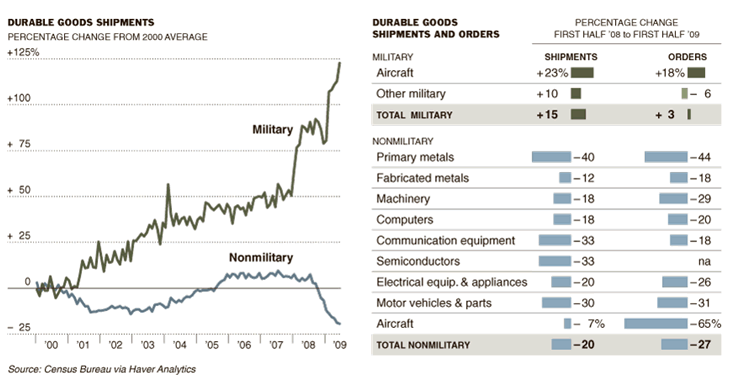
The use of the military-industrial complex as a quick, if dubious, way of jump-starting the economy is nothing new, but what is amazing is the divergence between the military economy and the civilian economy, as shown by this New York Times chart.
In the past nine years, non-industrial production in the US has declined by some 19 percent. It took about four years for manufacturing to return to levels seen before the 2001 recession -- and all those gains were wiped out in the current recession.
By contrast, military manufacturing is now 123 percent greater than it was in 2000 -- it has more than doubled while the rest of the manufacturing sector has been shrinking...So most of the job creation has been by the public sector. But because the job creation has been financed with loans from China and private banks, trillions in unnecessary interest charges have been incurred by the U.S. And this shows military versus non-military durable goods shipments:
It's important to note the trajectory -- the military economy is nearly three times as large, proportionally to the rest of the economy, as it was at the beginning of the Bush administration. And it is the only manufacturing sector showing any growth. Extrapolate that trend, and what do you get?
The change in leadership in Washington does not appear to be abating that trend...
[Click here to view full image.]
So we're running up our debt (which will eventually decrease economic growth), but the only jobs we're creating are military and other public sector jobs.
This might be okay from a strictly economic (as opposed to moral) perspective if defense jobs reduced unemployment. But, as many economists point out, the fact is that massive military spending actually increases unemployment in the long-run.
For example, PhD economist Dean Baker notes that America's massive military spending on unnecessary and unpopular wars lowers economic growth and increases unemployment:
Defense spending means that the government is pulling away resources from the uses determined by the market and instead using them to buy weapons and supplies and to pay for soldiers and other military personnel. In standard economic models, defense spending is a direct drain on the economy, reducing efficiency, slowing growth and costing jobs.
A few years ago, the Center for Economic and Policy Research commissioned Global Insight, one of the leading economic modeling firms, to project the impact of a sustained increase in defense spending equal to 1.0 percentage point of GDP. This was roughly equal to the cost of the Iraq War.And the Political Economy Research Institute at the University of Massachusetts, Amherst has also shown that non-military spending creates more jobs than military spending.
Global Insight’s model projected that after 20 years the economy would be about 0.6 percentage points smaller as a result of the additional defense spending. Slower growth would imply a loss of almost 700,000 jobs compared to a situation in which defense spending had not been increased. Construction and manufacturing were especially big job losers in the projections, losing 210,000 and 90,000 jobs, respectively.
The scenario we asked Global Insight [recognized as the most consistently accurate forecasting company in the world] to model turned out to have vastly underestimated the increase in defense spending associated with current policy. In the most recent quarter, defense spending was equal to 5.6 percent of GDP. By comparison, before the September 11th attacks, the Congressional Budget Office projected that defense spending in 2009 would be equal to just 2.4 percent of GDP. Our post-September 11th build-up was equal to 3.2 percentage points of GDP compared to the pre-attack baseline. This means that the Global Insight projections of job loss are far too low...
The projected job loss from this increase in defense spending would be close to 2 million. In other words, the standard economic models that project job loss from efforts to stem global warming also project that the increase in defense spending since 2000 will cost the economy close to 2 million jobs in the long run.
Government policy has largely caused the current unemployment crisis. And until Washington and Wall Street are forced to change course, things will not meaningfully and significantly improve for a long time.
Global food crisis: China land deal causes unease in Argentina
The Guardian
 A Chinese agribusiness firm is to buy a large swath of land in Patagonia. Critics fear it will bring heavy agrochemical use and ecological degradation, and strain the region's water resources
The attraction to the Chinese of access to an area of land in Patagonia larger than Cornwall is obvious. As China's economy grows and its population becomes more urbanised, diets are changing rapidly. People are eating more industrially produced meat and dairy products, and buying more processed foods.
Soya is the feedstock for this revolution, but demand for it can no longer be met within China. So the Chinese state-owned agribusiness company Beidahuang has joined the global scramble for land and water that has accelerated since food prices spiked in 2008.
Last year it was confirmed that the company had signed an agreement, with the government of Patagonia's Río Negro province, which provides the framework for it to acquire up to 320,000 hectares (790,000 acres) of privately owned farmland, along with irrigation rights and a concession on the San Antonio port.
Details of the deal, alleged to have been kept quiet, have been emerging in recent weeks as Chinese technicians have started work.
Beidahuang has also reported a 2008 deal on 200,000 ha in the Philippines, and says it plans to buy palm oil plantations and grain terminals this year as it pursues the Chinese government's policy of securing food supply lines from abroad.
Beidahuang, based in the north-eastern province of Heilongjiang, is the leading soya producer in China and one of the country's five largest soya processors. It also raises more than 600,000 cows, 1.3m pigs and more than 6m chickens at any one time.
The company believes its expertise in large-scale farming can be transferred to Argentina, according to Juan Manuel Accatino, the region's deputy secretary for agriculture in Río Negro, who was close to the deal. The arrangement made good economic sense, Accatino said. "We can foresee global shortages of land, water and energy, and Río Negro can offer all three."
Argentinian environmental groups and constitutional experts are outraged. Eduardo Barcesat is a top constitutional lawyer who has been helping the federal government of the Argentinian president, Cristina Kirchner, draft legislation that would restrict foreign ownership of Argentinian land. The laws would also provide, for the first time, a full register of all landholding so that authorities can keep track of who owns what.
"Chinese and Indian people have been coming to Argentina over the last five years and would be happy to buy all our land, whatever the price. American businesses have been buying access to our water," Barcesat said. "We need our own people to eat well first, and after that we can feed the rest of the world. We want more small and middle-sized owners, we don't like the excessive concentration, and we want farmers who will be careful with the land, not exploit it."
Research from the International Land Coalition, and Oxfam Novib, the Netherlands affiliate of Oxfam International, has identified more than 1,200 international land deals covering more than 80m hectares since 2000 – the vast majority of them after 2007. More than 60% of the land targeted was in Africa.
The Río Negro region is famous for its fruit orchards, which produce 70% of the country's apples and pears, exports eaten in northern Europe when the fruit season in that continent ends.
Environmentalists in Río Negro say the Chinese arrival will mean heavy use of agrochemicals, ecological degradation and severe strain on the region's water resources. Some of the land in question is virgin forest that would be deforested.
Dams have already cut the flow of the Negro river, they say, and Chinese plans to invest $20m (£12m) immediately to build irrigation infrastructure would strain resources further. The campaigners say that since soya cultivation is highly mechanised it will prompt unemployment in the area, as it has elsewhere in the country where many rural communities have seen an increase in deep poverty as jobs are lost.
Elvio Mendioroz, president of Uñopatún, an agro-ecoclogical group that opposes the Chinese deal, said the agreement had been kept secret. "China has run out of land to feed its people, and is suffering drought and soil erosion, so they come here.
"But it will create the same problems for us. There has been no consultation, yet it's already signed."
Accatino thinks the deal has been misunderstood. Río Negro's provincial government was merely acting as a facilitator for the Chinese, he said, who would have to negotiate with the private owners of land to buy sections. The port concession, reported as being for 50 years, would depend on an evaluation of its feasibility.
Accatino said: "We will take into account the environmental concern about further expansion of soya and dependency of this monoculture. We would never endanger the Negro river."
The attraction to the Chinese of access to an area of land in Patagonia larger than Cornwall is obvious. As China's economy grows and its population becomes more urbanised, diets are changing rapidly. People are eating more industrially produced meat and dairy products, and buying more processed foods.
Soya is the feedstock for this revolution, but demand for it can no longer be met within China. So the Chinese state-owned agribusiness company Beidahuang has joined the global scramble for land and water that has accelerated since food prices spiked in 2008.
Last year it was confirmed that the company had signed an agreement, with the government of Patagonia's Río Negro province, which provides the framework for it to acquire up to 320,000 hectares (790,000 acres) of privately owned farmland, along with irrigation rights and a concession on the San Antonio port.
Details of the deal, alleged to have been kept quiet, have been emerging in recent weeks as Chinese technicians have started work.
Beidahuang has also reported a 2008 deal on 200,000 ha in the Philippines, and says it plans to buy palm oil plantations and grain terminals this year as it pursues the Chinese government's policy of securing food supply lines from abroad.
Beidahuang, based in the north-eastern province of Heilongjiang, is the leading soya producer in China and one of the country's five largest soya processors. It also raises more than 600,000 cows, 1.3m pigs and more than 6m chickens at any one time.
The company believes its expertise in large-scale farming can be transferred to Argentina, according to Juan Manuel Accatino, the region's deputy secretary for agriculture in Río Negro, who was close to the deal. The arrangement made good economic sense, Accatino said. "We can foresee global shortages of land, water and energy, and Río Negro can offer all three."
Argentinian environmental groups and constitutional experts are outraged. Eduardo Barcesat is a top constitutional lawyer who has been helping the federal government of the Argentinian president, Cristina Kirchner, draft legislation that would restrict foreign ownership of Argentinian land. The laws would also provide, for the first time, a full register of all landholding so that authorities can keep track of who owns what.
"Chinese and Indian people have been coming to Argentina over the last five years and would be happy to buy all our land, whatever the price. American businesses have been buying access to our water," Barcesat said. "We need our own people to eat well first, and after that we can feed the rest of the world. We want more small and middle-sized owners, we don't like the excessive concentration, and we want farmers who will be careful with the land, not exploit it."
Research from the International Land Coalition, and Oxfam Novib, the Netherlands affiliate of Oxfam International, has identified more than 1,200 international land deals covering more than 80m hectares since 2000 – the vast majority of them after 2007. More than 60% of the land targeted was in Africa.
The Río Negro region is famous for its fruit orchards, which produce 70% of the country's apples and pears, exports eaten in northern Europe when the fruit season in that continent ends.
Environmentalists in Río Negro say the Chinese arrival will mean heavy use of agrochemicals, ecological degradation and severe strain on the region's water resources. Some of the land in question is virgin forest that would be deforested.
Dams have already cut the flow of the Negro river, they say, and Chinese plans to invest $20m (£12m) immediately to build irrigation infrastructure would strain resources further. The campaigners say that since soya cultivation is highly mechanised it will prompt unemployment in the area, as it has elsewhere in the country where many rural communities have seen an increase in deep poverty as jobs are lost.
Elvio Mendioroz, president of Uñopatún, an agro-ecoclogical group that opposes the Chinese deal, said the agreement had been kept secret. "China has run out of land to feed its people, and is suffering drought and soil erosion, so they come here.
"But it will create the same problems for us. There has been no consultation, yet it's already signed."
Accatino thinks the deal has been misunderstood. Río Negro's provincial government was merely acting as a facilitator for the Chinese, he said, who would have to negotiate with the private owners of land to buy sections. The port concession, reported as being for 50 years, would depend on an evaluation of its feasibility.
Accatino said: "We will take into account the environmental concern about further expansion of soya and dependency of this monoculture. We would never endanger the Negro river."
Subscribe to:
Posts (Atom)


