


 Posts
Posts


Welcome to 9-11 Movies
-
The idea behind this site is to present the most rudimentary, simplified,
common-sense information about the anomalies that fuel our doubts about the
offic...
Showing posts with label unemployment. Show all posts
Showing posts with label unemployment. Show all posts
Thursday, September 6, 2012
Monday, August 13, 2012
Saving the Post Office: Letter Carriers Consider Bringing Back Banking Services
WebofDebt

Ellen Brown
On July 27, 2012, the National Association of Letter Carriers adopted a resolution at their National Convention in Minneapolis to investigate establishing a postal banking system. The resolution noted that expanding postal services and developing new sources of revenue are important to the effort to save the public Post Office and preserve living-wage jobs; that many countries have a successful history of postal banking, including Germany, France, Italy, Japan, and the United States itself; and that postal banks could serve the 9 million people who don’t have bank accounts and the 21 million who use usurious check cashers, giving low-income people access to a safe banking system. “A USPS bank would offer a ‘public option’ for banking,” concluded the resolution, “providing basic checking and savings – and no complex financial wheeling and dealing.”
The USPS has been declared insolvent, but it is not because it is inefficient (it has been self-funded throughout its history). It is because in 2006, Congress required it to prefund postal retiree health benefits for 75 years into the future, an onerous burden no other public or private company is required to carry. The USPS has evidently been targeted by a plutocratic Congress bent on destroying the most powerful unions and privatizing all public services, including education. Britain’s 150-year-old postal service is also on the privatization chopping block, and its postal workers have also vowed to fight. Adding banking services is an internationally proven way to maintain post office solvency and profitability.
Serving an Underserved Market, Without Going Broke
Many countries operate postal savings systems through their post offices, providing people without access to banks a safe, convenient way to save. Great Britain first offered this arrangement in 1861. It was wildly popular, attracting over 600,000 accounts and £8.2 million in deposits in its first five years. By 1927, there were twelve million accounts—one in four Britons—with £283 million on deposit.
Other postal banks followed. They were popular because they serviced a huge untapped market—the unbanked and underbanked. According to a Discussion Paperof the United Nations Department of Economic and Social Affairs:
The essential characteristic distinguishing postal financial services from the private banking sector is the obligation and capacity of the postal system to serve the entire spectrum of the national population, unlike conventional private banks which allocate their institutional resources to service the sectors of the population they deem most profitable.
Serving the unbanked and underbanked may sound like a losing proposition, but numerous precedents show that postal savings banks serving low-income and rural populations can be quite profitable. (See below.) In many countries, according to the UN Paper, banking revenues are actually crucial to maintaining the profitability of their postal network. Letter delivery generates losses and often requires cross-subsidies from other activities to maintain its network. One effective solution has been to create or expand postal financial services.
Public postal banks are profitable because their market is large and their costs are low: the infrastructure is already built and available, advertising costs are minimal, and government-owned banks do not award their management extravagant bonuses or commissions that drain profits away. Profits return to the government and the people.
Profits return to the government in another way: money that comes out from under mattresses and gets deposited in savings accounts can be used to purchase government bonds. Japan Post Bank, for example, holds 20% of Japan’s national debt. The government has its own captive public lender, servicing the debt at low interest without risking the vagaries of the international bond market. Fully 95% of Japan’s national debt is held domestically in one way or another. That helps explain how Japan can have the worst debt-to-GDP ratio of any major country and still maintain its standing as the world’s largest creditor.
Some Examples of Successful Public Postal Banks
Kiwibank:
New Zealand’s profitable postal bank had a return on equity of 11.7% in the second half of 2011, with net profits almost trebling. It is the only New Zealand bank able to compete with the big four Australian banks that dominate the New Zealand financial sector.
In fact, it was set up for that purpose. By 2001, Australian mega-banks controlled some 80% of New Zealand’s retail banking. Profits went abroad and were maximized by closing less profitable branches, especially in rural areas. The New Zealand government decided to launch a state-owned bank that would compete with the Aussie banks. To keep costs low while still providing services throughout New Zealand, the planning team opened bank branches in post offices.
In an early version of the “move your money” campaign, 500,000 customers transferred their deposits to public postal banks in Kiwibank’s first five years—this in a country of only 4 million people. Kiwibank consistently earns the nation’s highest customer satisfaction ratings, forcing the Australia-owned banks to improve their service to compete.
China’s Postal Savings Bureau:
With the assistance of the People’s Bank of China, China’s Postal Savings Bureau was re-established in 1986 after a 34-year lapse. As in New Zealand, savings deposits flooded in, growing at over 50% annually in the first half of the 1990s and over 24% in the second half. By 1998, postal savings accounted for 47% of China Post’s operating revenues; and 80% of China’s post offices provided postal savings services. The Postal Savings Bureau has served as a vital link in mobilizing income and profits from the private sector, providing credit for local development. In 2007, thePostal Savings Bank of China was set up from the Postal Savings Bureau as a state-owned limited company that provides postal banking services.
Japan Post Bank:
By 2007, Japan Post was the largest holder of personal savings in the world, boasting combined assets for its savings bank and insurance arms of more than ¥380 trillion ($3.2 trillion). It was also the largest employer in Japan. As in China, Japan Post recaptures and mobilizes income from the private sector, funding the government at low interest rates and protecting the nation’s debt from speculative raids.
Switzerland’s Swiss Post:
Postal financial services are by far the most profitable activity of Swiss Post, which suffers heavy losses from its parcel delivery and only marginal profits from letter delivery operations.
India’s Post Office Savings Bank (POSB):
POSB is India’s largest banking institution and its oldest, having been established in the latter half of the 19th century following the success of the postal savings system in England. Operated by the government of India, it provides small savings banking and financial services. The Department of Posts is now seeking to expand these services by creating a full-fledged bank that would offer full lending and investing services.
Russia’s PochtaBank:
Russia, too, is seeking to expand its post office services. The head of the highly successful state-owned Sberbank has stepped down to take on the task of revitalizing the Russian post office and create a post office bank. PochtaBank will operate in the Russian Post’s 40,000 local post offices. The post office will function as a banking institution and compete on equal footing not only with private banks but with Sberbank itself.
Brazil’s ECT:
Brazil instituted a postal banking system in 2002 on a public/private model, with the national postal service (ECT) forming a partnership with the nation’s largest private bank (Bradesco) to provide financial services at post offices. The current partnership is with Bank of Brazil. ECT (also known as Correios) is one of the largest state-owned companies in Latin America, with an international service network reaching more than 220 countries worldwide.
The U.S. Postal Savings System:
The now-defunct U.S. Postal Savings System was also quite successful in its day. It was set up in 1911 to get money out of hiding, attract the savings of immigrants, provide safe depositories for people who had lost confidence in private banks, and furnish depositories with longer hours that were convenient for working people. The minimum deposit was $1 and the maximum was $2,500. The postal system paid two percent interest on deposits annually. It issued U.S. Postal Savings Bonds that paid annual interest, as well as Postal Savings Certificates and domestic money orders. Postal savings peaked in 1947 at almost $3.4 billion.
The U.S. Postal Savings System was shut down in 1967, not because it was inefficient but because it became unnecessary after its profitability became apparent. Private banks then captured the market, raising their interest rates and offering the same governmental guarantees that the postal savings system had.
Time to Revive the U.S. Postal Savings System?
Today, the market of the underbanked has grown again, including about one in four U.S. households according to a 2009 FDIC survey. Without access to conventional financial services, people turn to an alternative banking market of bill pay, prepaid debit cards and check cashing services, and payday loans. They pay excessive fees for basic financial services and are susceptible to high-cost predatory lenders. On average, a payday borrower pays back $800 for a $300 loan, with $500 going just toward interest. Low-income adults in the U.S spend over 5 billion dollars paying off fees and debt associated with predatory loans annually.
Another underserviced market is the rural population. In May 2012, a move to shutter 3,700 low-revenue post offices was halted only by months of dissent from rural states and their lawmakers. Banking services are also more limited for farmers following the 2008 financial crisis. With shrinking resources for obtaining credit, farmers are finding it increasingly difficult to stay in their homes.
It is clear that there is a market for postal banking. Countries such as Russia and India are exploring full-fledged lending services through their post offices; but if lending to the underbanked seems too risky, a U.S. postal bank could follow the lead of Japan Post and use the credit generated from its deposits to buy safe and liquid government bonds. That could still make the bank a win-win-win, providing income for the post office, safe and inexpensive depository and checking services for the underbanked, and a reliable source of public funding for the government.
__________________
Ellen Brown is an attorney and president of the Public Banking Institute,http://PublicBankingInstitute.org. In Web of Debt, her latest of eleven books, she shows how a private cartel has usurped the power to create money from the people themselves, and how we the people can get it back. Her websites arehttp://WebofDebt.com and http://EllenBrown.com.

Exclusive 2-camera presentation
by Ellen Brown. In this lecture,
Brown explains in detail how
economies can overcome the likes of
the IMF, World Bank and the
Federal Reserve.
Includes Qn'A session.
Approx. 90 minutes.
$20.00
Friday, August 3, 2012
The 86 million invisible unemployed
CNN
Annalyn Censky

Annalyn Censky

As a result, the labor force is now at its smallest size since the 1980s when compared to the broader working age population.
"We've been getting some job growth and it's been significant, but it hasn't yet been strong enough that you start to get people re-engaging in the labor market," said Keith Hall, a senior research fellow at the Mercatus Center and former commissioner of the Bureau of Labor Statistics.
Job market dropouts
A person is counted as part of the labor force if they have a job or have looked for one in the last four weeks. As of April, only 63.6% of Americans over the age of 16 fell into that category, according to the Labor Department. That's the lowest labor force participation rate since 1981.
It's a worrisome sign for the economy and partly explains why theunemployment rate has been falling recently. Only people looking for work are considered officially unemployed.
Jason Everett, for example, wouldn't be counted.
Out of work for nearly three years now, Everett has given up his job search altogether.
Instead, the unemployed plumber and Air Force veteran takes a few community college courses and looks after his two children while his wife is the primary breadwinner.
"I'm not even totally convinced the college degree is really going to help at this point, but I figure at least I'll be doing something," he said
staying home with children or other relatives. Some may have gone back to school or retraining programs. Others could be disabled and unable to work, and some may have retired early.
"Even in the best of times, there are millions of people who don't want to work for a variety for reasons," Hall said.
But he suspects the number of "disengaged" Americans, like Everett, is higher than usual as a direct result of the recession.
About six million people claim they want a job, even though they haven't looked for one in the last four weeks. If they were to all start applying for work again, the unemployment rate would suddenly shoot up above 11%.
NEW YORK (CNNMoney) -- There are far more jobless people in the United States than you might think.
While it's true that the unemployment rate is falling, that doesn't include the millions of nonworking adults who aren't even looking for a job anymore. And hiring isn't strong enough to keep up with population growth.
"At this point, the labor market is worse than people realize because people are discouraged. Certainly, a large number of workers have given up on the job market," Hall said.
That said, the decline in labor force participation is not a new problem. After peaking at 67.3% in early 2000, the rate has been falling ever since.
Researchers at the Chicago Federal Reserve attribute a large part of the decline to the recent recession and lackluster recovery, but the other half to long-term demographic trends.
For example, as more women entered the labor force between the 1960s and 1990s, the participation rate rose rapidly. That effect may have plateaued since then.
Meanwhile, as Baby Boomers entered their prime working years, they also drove the participation rate higher. Once they started hitting their 50s and 60s though, many started transitioning into retirement.
Finally, teenage jobs have been on the decline and college enrollment picked up in the last decade, leading more young people to not be counted in the labor force.
As these trends continue, the Chicago Fed expects the labor force participation rate will keep falling, hitting 62.4% by 2020.
That poses a problem for a variety of reasons.
It hits tax revenue and makes it harder to fund social safety nets like Social Security. Not to mention, it's likely to increase income inequality.
Most importantly though, it makes the U.S. economy less productive and weighs on growth. 
Sunday, June 3, 2012
US Military Spending: Where are the Jobs?
Military spending creates 11,200 jobs for each billion dollars spent
Global Research
Global Research
Greg Guma
In recent Vermont debate about the impacts of bedding F-35A fighter jets at the Burlington International Airport the arguments in support often come down to balancing noise and other impacts against economic necessities and benefits. Whatever the outcome it has raised renewed questions about the economic impacts of military spending. A new study finds that money spent on clean energy, health care, and education would create many more jobs than if the same money is spent on defense.
In recent Vermont debate about the impacts of bedding F-35A fighter jets at the Burlington International Airport the arguments in support often come down to balancing noise and other impacts against economic necessities and benefits. Whatever the outcome it has raised renewed questions about the economic impacts of military spending. A new study finds that money spent on clean energy, health care, and education would create many more jobs than if the same money is spent on defense.
 |
| Sen. Pat Leahy has fought to save an alternate F-35 engine that would mean jobs at a Rutland GE plant. |
Dire warnings that thousands of Vermont jobs are at risk due to looming defense cuts and related changes in Air Force priorities may turn out to be overstated, or at least premature.
In March, a report commissioned by the Aerospace Industries Association (AIA) predicted that Vermont would lose upwards of 2,100 jobs if automatic defense cuts were triggered by the failure of Congress to reach a budget deal. Vermont Air National Guard jobs were reportedly also on the line. Under the Pentagon’s initial budget the Air Guard could see a loss of 9,900 jobs nationally over the next five years, including 3,900 active duty personnel and 900 members of the Air Force reserve.
Two months later such outcomes look less likely. Research meanwhile indicates that funding for clean energy, health care, and education would create substantially more jobs.
The AIA study, conducted for the aerospace industry in 2011 by Dr. Stephen Fuller of George Mason University, projects that more than a million jobs could be lost nationwide if sequestration leads to a projected $600 billion cut in the defense budget. The Pentagon and other analysts forecast more conservatively that $1 trillion in cuts over a decade would add one percentage point to the unemployment rate.
"The data speaks for itself, America's aerospace and defense industry is a sector that punches far above its weight," claims AIA President Marion Blakey. "And it's not just the numbers, which are impressive by themselves— it's how this industry makes a difference in the lives of all Americans."
On the other hand, he predicts that cuts brought on by sequestration will “devastate our industry's contributions to America's bottom line.”
Similar arguments were made during the recent Air Force public hearing on stationing F-35As with the Air Guard at Burlington International Airport. Gov. Peter Shumlin is one of several Vermont officials who have endorsed bedding 18 to 25 of the pricey, long-awaited aircraft at the airport in Burlington based on jobs and economic factors. In a statement he argued that drawbacks such as increased noise “are outweighed by the extraordinary benefits that this opportunity presents our communities and our state.”
Friday, June 1, 2012
Thursday, May 17, 2012
This Uber-Wealthy Venture Capitalist Gave A TED Talk Saying Rich People Don't Create Jobs — And TED Is Refusing To Post It
Business Insider
Grace Wyler
 As the war over income inequality wages on, super-rich Seattle entrepreneur Nick Hanauer has been raising the hackles of his fellow 1-percenters, espousing the contrarian argument that rich people don't actually create jobs.
The position is controversial — so much so that TED is refusing to post a talk that Hanauer gave on the subject.
National Journal reports today that TED officials decided not to put Hanauer's March 1 speech up online after deeming his remarks "too politically controversial" for the site.
In an email obtained by the National Journal, TED curator Chris Anderson told his colleagues that Hanauer's speech “probably ranks as one of the most politically controversial talks we've ever run, and we need to be really careful when” to post it. He added: “Next week ain't right. Confidentially, we already have Melinda Gates on contraception going out. Sorry for the mixed messages on this.”
TED regularly posts speeches about sensitive political issues, including global warming and contraception, so it's not clear why Hanauer's talk would be singled out for censorship.
We've emailed Hanauer to see what he thinks, but in the meantime, here's an excerpt for you to judge for yourself:
Grace Wyler

The position is controversial — so much so that TED is refusing to post a talk that Hanauer gave on the subject.
National Journal reports today that TED officials decided not to put Hanauer's March 1 speech up online after deeming his remarks "too politically controversial" for the site.
In an email obtained by the National Journal, TED curator Chris Anderson told his colleagues that Hanauer's speech “probably ranks as one of the most politically controversial talks we've ever run, and we need to be really careful when” to post it. He added: “Next week ain't right. Confidentially, we already have Melinda Gates on contraception going out. Sorry for the mixed messages on this.”
TED regularly posts speeches about sensitive political issues, including global warming and contraception, so it's not clear why Hanauer's talk would be singled out for censorship.
We've emailed Hanauer to see what he thinks, but in the meantime, here's an excerpt for you to judge for yourself:
I can say with confidence that rich people don't create jobs, nor do businesses, large or small. What does lead to more employment is a "circle of life" like feedback loop between customers and businesses. And only consumers can set in motion this virtuous cycle of increasing demand and hiring. In this sense, an ordinary middle-class consumer is far more of a job creator than a capitalist like me.
So when businesspeople take credit for creating jobs, it's a little like squirrels taking credit for creating evolution. In fact, it's the other way around.
Anyone who's ever run a business knows that hiring more people is a capitalists course of last resort, something we do only when increasing customer demand requires it. In this sense, calling ourselves job creators isn't just inaccurate, it's disingenuous.
That's why our current policies are so upside down. When you have a tax system in which most of the exemptions and the lowest rates benefit the richest, all in the name of job creation, all that happens is that the rich get richer.
Saturday, May 12, 2012
Predatory Capitalism Failed
Global Research
Stephan Lendman

Stephan Lendman
Independent observers knew it long ago. Today's global economic crisis provides added confirmation. In 2008, a staunch champion of the system expressed second thoughts. More on him below.
An ideology based on inequality, injustice, exploitation, militarism, and imperial wars eventually self-destructs or gets pushed.
Growing evidence in America and Europe show systemic unaddressed problems too grave to ignore. They remain so despite millions without jobs, savings, homes or futures.
Imagine nations governed by leaders letting crisis conditions fester. Imagine voters reelecting them despite demanding change. OWS aside, one day perhaps rage will replace apathy in America. The latest jobs report alone provides incentive enough to try and then some.
On May 4, the Labor Department reported 115,000 new jobs. It way overstated the true number. Official figures belie the dire state of things. At most, two-thirds the headline total were created. Even that's in doubt.
Most were low-pay, part-time, or temp positions with few or no benefits. Decades ago, workers would have avoided them. Today, there's no choice.
The report also showed economic decline. Expect much worse ahead. In 2008, Main Street Americans experienced Depression. It rages today. Poverty's at record levels. Real unemployment approaches 1930s numbers. Dire conditions are worsening.
Announced job cuts are increasing. Hiring plans are down. Compared to year ago levels, they're off 80%. Income is stagnant for those lucky to have work. The private diffusion index measuring growth fell sharply month-over-month.
The unemployment rate decline reflects discouraged workers dropping out. They want jobs but can't find them. The Labor Department considers them non-persons. They're not counted to make official figures look better.
Moreover, the broad based Household Survey showed employment dropping 169,000. It was the second consecutive monthly decline. The Labor Department uses a "population and payroll concept adjusted" calculation. Doing so tries to compare monthly payroll and household figures.
Monday, May 7, 2012
There Are 100 Million Working Age Americans That Do Not Have Jobs
9/11 Inside Job
 There Are 100 Million Working Age Americans That Do Not Have Jobs
The unemployment crisis in America is much worse than you are being told. Did you know that there are 100 million working age Americans that do not get up in the morning and go to work? No wonder why it seems like there are so many people that do not have jobs! According to the federal government, there are 12.6 million working age Americans that are considered to be "officially" unemployed, but there are another 87.8 million working age Americans that are not working either. The federal government considers those Americans to be "not in the labor force" so they are not included in the unemployment rate. In fact, this is one of the key ways that the government manipulates the unemployment numbers. The Obama administration would have us believe that the unemployment rate is going down and that that since the start of the last recession about as many Americans have left the labor force as we saw during the entire decades of the 1980s and 1990s combined. Of course that is a bunch of nonsense, but that is what the Obama administration would have us believe. The truth is that the percentage of working age Americans that are employed is just about the same right now as it was two years ago. It was incredibly difficult to get a job back then and it is incredibly difficult to get a job right now. So don't believe the hype that things are getting much better. If you still do have a good job, you might want to hold on to it tightly, because there is not much hope that things are going to improve significantly any time soon.
The first chart that I have posted below shows the total number of "officially" unemployed workers in America. According to the Federal Reserve, that number is currently 12,673,000. This chart makes it look like the employment picture in America is getting significantly better....
But if you dig deeper into the numbers you quickly see that this is not true. A lot of those workers that were formerly classified as "unemployed" have now been moved into the "not in labor force" category. Since the start of the last recession, the number of Americans not in the labor force has risen by more than 8 million according to the Obama administration. The total number of working age Americans not in the labor force now stands at 87,897,000....
So when you add 12,673,000 and 87,897,000, you get a total of 100,570,000 working age Americans that do not have jobs.
Yes, there are certainly millions upon millions of working age Americans that do not have jobs and that do not want jobs.
But you have to be delusional to believe that there are nearly 88 million working age Americans that do not have jobs and that do not want jobs.
The unemployment crisis in America is much worse than you are being told. Did you know that there are 100 million working age Americans that do not get up in the morning and go to work? No wonder why it seems like there are so many people that do not have jobs! According to the federal government, there are 12.6 million working age Americans that are considered to be "officially" unemployed, but there are another 87.8 million working age Americans that are not working either. The federal government considers those Americans to be "not in the labor force" so they are not included in the unemployment rate. In fact, this is one of the key ways that the government manipulates the unemployment numbers. The Obama administration would have us believe that the unemployment rate is going down and that that since the start of the last recession about as many Americans have left the labor force as we saw during the entire decades of the 1980s and 1990s combined. Of course that is a bunch of nonsense, but that is what the Obama administration would have us believe. The truth is that the percentage of working age Americans that are employed is just about the same right now as it was two years ago. It was incredibly difficult to get a job back then and it is incredibly difficult to get a job right now. So don't believe the hype that things are getting much better. If you still do have a good job, you might want to hold on to it tightly, because there is not much hope that things are going to improve significantly any time soon.
The first chart that I have posted below shows the total number of "officially" unemployed workers in America. According to the Federal Reserve, that number is currently 12,673,000. This chart makes it look like the employment picture in America is getting significantly better....
But if you dig deeper into the numbers you quickly see that this is not true. A lot of those workers that were formerly classified as "unemployed" have now been moved into the "not in labor force" category. Since the start of the last recession, the number of Americans not in the labor force has risen by more than 8 million according to the Obama administration. The total number of working age Americans not in the labor force now stands at 87,897,000....
So when you add 12,673,000 and 87,897,000, you get a total of 100,570,000 working age Americans that do not have jobs.
Yes, there are certainly millions upon millions of working age Americans that do not have jobs and that do not want jobs.
But you have to be delusional to believe that there are nearly 88 million working age Americans that do not have jobs and that do not want jobs.
Wednesday, November 9, 2011
Jobless and Clueless: America's Delusional Democracy
Global Research
Joel S. Hirschhorn
 When Americans who are the most victimized by our cruel economy still believe in something that is demonstrably no longer true, they are deeply delusional. They desperately want to believe in something once great about American society. The reality is that upward economic mobility has been destroyed, replaced by widely observable downward mobility. Some of the mostly younger jobless that have embraced the Occupy Wall Street and related Occupy efforts know the truth.
Consider the results of a new survey of unemployed adults this month:
“More than half of those polled said that they had experienced emotional or mental health problems like anxiety or depression because of their lack of work, and nearly half said that they had felt embarrassed or ashamed not to have jobs.”
“More than a third said that they had had more conflicts or arguments with family and friends because of being jobless.”
“Threats of foreclosure or eviction were reported by a fifth of the unemployed, and one in eight said that they had moved in with relatives or friends.”
“More than half said that they lacked health insurance.”
“A fifth said that they had received food from a nonprofit organization.”
“Nearly two-thirds said they would probably not have enough money to live comfortably during retirement. More than half said that they had taken money out of savings or retirement accounts.”
“7 in 10 of those receiving unemployment benefits said that they feared their benefits would run out before they could find new jobs.”
So far, all those results paint an unsurprising profile of unemployed, suffering Americans.
Now, consider the result that blew my mind, the reason I am writing this, because more people need to understand something critical about delusional thinking that ultimately makes getting deep, sorely needed reforms of our government and political system extremely difficult. Without that our economy will stay awful, unfair, promoting even more economic inequality.
“Two-thirds of those surveyed said that they still believed it was possible to start out poor in this country, work hard and become rich — only a little lower than the three-quarters of all Americans” not in the unemployed category who held the same view and were surveyed at the same time. In fact, considerable research in recent years has consistently found that upward mobility in the US is no longer a hallmark of the society. Indeed, there is more upward mobility in Canada and a number of European countries than in the US . Moreover, the jobless more than most should be able to comprehend the ugly reality that downward economic mobility is now a large part of American society.
Joel S. Hirschhorn
Consider the results of a new survey of unemployed adults this month:
“More than half of those polled said that they had experienced emotional or mental health problems like anxiety or depression because of their lack of work, and nearly half said that they had felt embarrassed or ashamed not to have jobs.”
“More than a third said that they had had more conflicts or arguments with family and friends because of being jobless.”
“Threats of foreclosure or eviction were reported by a fifth of the unemployed, and one in eight said that they had moved in with relatives or friends.”
“More than half said that they lacked health insurance.”
“A fifth said that they had received food from a nonprofit organization.”
“Nearly two-thirds said they would probably not have enough money to live comfortably during retirement. More than half said that they had taken money out of savings or retirement accounts.”
“7 in 10 of those receiving unemployment benefits said that they feared their benefits would run out before they could find new jobs.”
So far, all those results paint an unsurprising profile of unemployed, suffering Americans.
Now, consider the result that blew my mind, the reason I am writing this, because more people need to understand something critical about delusional thinking that ultimately makes getting deep, sorely needed reforms of our government and political system extremely difficult. Without that our economy will stay awful, unfair, promoting even more economic inequality.
“Two-thirds of those surveyed said that they still believed it was possible to start out poor in this country, work hard and become rich — only a little lower than the three-quarters of all Americans” not in the unemployed category who held the same view and were surveyed at the same time. In fact, considerable research in recent years has consistently found that upward mobility in the US is no longer a hallmark of the society. Indeed, there is more upward mobility in Canada and a number of European countries than in the US . Moreover, the jobless more than most should be able to comprehend the ugly reality that downward economic mobility is now a large part of American society.
Tuesday, September 20, 2011
The Triumph of Capitalism: Jobless Nations
Global Research
 By Prof. John Kozy
The Obama administration is intent on applying supply side principles to get the American economy out of the present recession, but supply side principles are based on the belief that if the government cuts taxes on the wealthy, they will invest their savings in new factories, that newly hired workers will increase employment, and that more output will increase tax receipts. But there is no way to make sure the wealthy actually invest their wealth in productive enterprises, especially in the U.S.
This entire theory is based on the mere pop-psychological belief that if you give a person money, s/he will invest it in productive ways. But nothing forces wealthy people to do that, and they haven't, worse, never really have, since creating jobs is not an essential business function, only making money is, and getting financial incentives from government is merely another way of making money, Giving money to businesses will not end recessions or depressions. In fact, it is likely to prolong them, since businesses will not create jobs until it is evident that those jobs will result in profits.
During the California Gold Rust, merchants went to the camps only after gold was discovered, and they left when the lode petered out. They did not use the capital they acquired from the miners to open productive businesses to provide jobs to the now jobless prospectors. In capitalist economies, capital is not acquired to be spent; it is acquired to be accumulated. Businesses do not exist to create jobs. Jobs are created by businesses only when it suits their purposes.
Beliefs in conventional wisdom are always dangerous. More often than not, conventional wisdom is wrong. But there are two kinds of conventional wisdom—the pro and the con. Every bit on conventional wisdom has its naysayers, and just as conventional wisdom can amount to nothing more than mere beliefs, so can the beliefs of naysayers. For instance, that today's economy is failing is rather evident, but many critics of it seem to believe that the problems with today's economy are of recent origin. But that's false. The economy today is little different in essence than it was is the 1600s when the colonists brought it with them from England. The horrors of England's 17th Century economy then are exactly its horrors today. Wealth held in the hands of a few and poverty experienced by the many. High levels of crime infused throughout society. Widespread unemployment, underemployment, and degrading employment. The destruction of human dignity. Homelessness, hunger, and frequent wars fought by common people for the benefit of the merchant class. Prevalent discrimination of various kinds. Government which governs for the wealthy and not for the people in general. And although there have been short-lived periods when the people were led to believe that their prospects were improving, these periods have regularly ended in economic collapses that wiped out any gains the common people had acquired.
The universal features of this economy are exemplified in the following historical vignette.
On January 24, 1848, gold was discovered by James W. Marshall at Sutter's Mill in Coloma, California.
When people learned about the discovery, hundreds of thousands rushed to California. Wherever gold was discovered, miners collaborated to put up a camp and stake claims. Rough and Ready, Hangtown, and Portuguese Flat, among many others, sprang up, and merchants flocked to them, set up business in hastily built buildings, lean-tos, tents, and anywhere else serviceable to sell everything imaginable. Miners lived in tents, shanties, and deck cabins removed from abandoned ships. Each camp often had its own saloon and gambling house. Women of various ethnicities played various roles including that of prostitute and single entrepreneurs.
At first, the gold was simply "free for the taking." Disputes were often handled personally and violently. When gold became increasingly difficult to retrieve, Americans began to drive out foreigners. The State Legislature passed a foreign miners tax of twenty dollars per month, and American prospectors began organized attacks on foreigners, particularly Latin Americans and Chinese. In addition, the huge numbers of newcomers drove Native Americans out of their traditional hunting, fishing and gathering areas. Some responded by attacking miners. This provoked counter-attacks. The natives were often slaughtered. Those who escaped were unable to survive and starved to death. Natives succumbed to smallpox, influenza, and measles in large numbers. The Act for the Government and Protection of Indians, passed by the California Legislature, allowed settlers to capture and use natives as bonded workers and traffic in Native American labor, particularly that of young women and children, which was carried on as a legal business enterprise. Native American villages were regularly raided to supply the demand, and young women and children were carried off to be sold. The toll on the American immigrants could be severe as well: one in twelve forty-niners perished, as the death and crime rates during the Gold Rush were extraordinarily high, and the resulting vigilantism also took its toll.
Hydraulicking as a means of extracting the gold became prevalent. A byproduct of this was that large amounts of gravel, silt, heavy metals, and other pollutants went into streams and rivers. Many areas still bear the scars of hydraulic mining since the resulting exposed earth and downstream gravel deposits are unable to support plant life.
The merchants made far more money than the miners. The wealthiest man in California during the early years of the Gold Rush was Samuel Brannan, the tireless self-promoter, shopkeeper and newspaper publisher. About half the prospectors made a modest profit. Most, however, made little or wound up losing money. By 1855, the economic climate had changed dramatically. Gold could be retrieved profitably from the goldfields only by medium to large groups of workers, either in partnerships or as employees. By the mid-1850s, it was the owners of these gold-mining companies who made the money. When the lode petered-out, the merchants abandoned the sites faster than the miners. The gold rush was over.
I have, in the past, written about many of these horrid features of Capitalist economies, especially its abject immorality. Today I want to discuss an obvious falsehood that still gets repeated especially by right wing politicians and their counterparts in the economics profession and the business community, that is, businesses, not governments, create jobs.
This generic claim is, of course, obviously false and its generality makes it grossly ambiguous. What precisely does it mean, especially since the politicians who utter it spend piles of money and time trying to get jobs that are not created by any business? No business created the jobs of Congressman or President, so what sense does it make for such a person to claim that businesses, not government, creates jobs? The claim is utterly stupid.

The Obama administration is intent on applying supply side principles to get the American economy out of the present recession, but supply side principles are based on the belief that if the government cuts taxes on the wealthy, they will invest their savings in new factories, that newly hired workers will increase employment, and that more output will increase tax receipts. But there is no way to make sure the wealthy actually invest their wealth in productive enterprises, especially in the U.S.
This entire theory is based on the mere pop-psychological belief that if you give a person money, s/he will invest it in productive ways. But nothing forces wealthy people to do that, and they haven't, worse, never really have, since creating jobs is not an essential business function, only making money is, and getting financial incentives from government is merely another way of making money, Giving money to businesses will not end recessions or depressions. In fact, it is likely to prolong them, since businesses will not create jobs until it is evident that those jobs will result in profits.
During the California Gold Rust, merchants went to the camps only after gold was discovered, and they left when the lode petered out. They did not use the capital they acquired from the miners to open productive businesses to provide jobs to the now jobless prospectors. In capitalist economies, capital is not acquired to be spent; it is acquired to be accumulated. Businesses do not exist to create jobs. Jobs are created by businesses only when it suits their purposes.
Beliefs in conventional wisdom are always dangerous. More often than not, conventional wisdom is wrong. But there are two kinds of conventional wisdom—the pro and the con. Every bit on conventional wisdom has its naysayers, and just as conventional wisdom can amount to nothing more than mere beliefs, so can the beliefs of naysayers. For instance, that today's economy is failing is rather evident, but many critics of it seem to believe that the problems with today's economy are of recent origin. But that's false. The economy today is little different in essence than it was is the 1600s when the colonists brought it with them from England. The horrors of England's 17th Century economy then are exactly its horrors today. Wealth held in the hands of a few and poverty experienced by the many. High levels of crime infused throughout society. Widespread unemployment, underemployment, and degrading employment. The destruction of human dignity. Homelessness, hunger, and frequent wars fought by common people for the benefit of the merchant class. Prevalent discrimination of various kinds. Government which governs for the wealthy and not for the people in general. And although there have been short-lived periods when the people were led to believe that their prospects were improving, these periods have regularly ended in economic collapses that wiped out any gains the common people had acquired.
The universal features of this economy are exemplified in the following historical vignette.
On January 24, 1848, gold was discovered by James W. Marshall at Sutter's Mill in Coloma, California.
When people learned about the discovery, hundreds of thousands rushed to California. Wherever gold was discovered, miners collaborated to put up a camp and stake claims. Rough and Ready, Hangtown, and Portuguese Flat, among many others, sprang up, and merchants flocked to them, set up business in hastily built buildings, lean-tos, tents, and anywhere else serviceable to sell everything imaginable. Miners lived in tents, shanties, and deck cabins removed from abandoned ships. Each camp often had its own saloon and gambling house. Women of various ethnicities played various roles including that of prostitute and single entrepreneurs.
At first, the gold was simply "free for the taking." Disputes were often handled personally and violently. When gold became increasingly difficult to retrieve, Americans began to drive out foreigners. The State Legislature passed a foreign miners tax of twenty dollars per month, and American prospectors began organized attacks on foreigners, particularly Latin Americans and Chinese. In addition, the huge numbers of newcomers drove Native Americans out of their traditional hunting, fishing and gathering areas. Some responded by attacking miners. This provoked counter-attacks. The natives were often slaughtered. Those who escaped were unable to survive and starved to death. Natives succumbed to smallpox, influenza, and measles in large numbers. The Act for the Government and Protection of Indians, passed by the California Legislature, allowed settlers to capture and use natives as bonded workers and traffic in Native American labor, particularly that of young women and children, which was carried on as a legal business enterprise. Native American villages were regularly raided to supply the demand, and young women and children were carried off to be sold. The toll on the American immigrants could be severe as well: one in twelve forty-niners perished, as the death and crime rates during the Gold Rush were extraordinarily high, and the resulting vigilantism also took its toll.
Hydraulicking as a means of extracting the gold became prevalent. A byproduct of this was that large amounts of gravel, silt, heavy metals, and other pollutants went into streams and rivers. Many areas still bear the scars of hydraulic mining since the resulting exposed earth and downstream gravel deposits are unable to support plant life.
The merchants made far more money than the miners. The wealthiest man in California during the early years of the Gold Rush was Samuel Brannan, the tireless self-promoter, shopkeeper and newspaper publisher. About half the prospectors made a modest profit. Most, however, made little or wound up losing money. By 1855, the economic climate had changed dramatically. Gold could be retrieved profitably from the goldfields only by medium to large groups of workers, either in partnerships or as employees. By the mid-1850s, it was the owners of these gold-mining companies who made the money. When the lode petered-out, the merchants abandoned the sites faster than the miners. The gold rush was over.
I have, in the past, written about many of these horrid features of Capitalist economies, especially its abject immorality. Today I want to discuss an obvious falsehood that still gets repeated especially by right wing politicians and their counterparts in the economics profession and the business community, that is, businesses, not governments, create jobs.
This generic claim is, of course, obviously false and its generality makes it grossly ambiguous. What precisely does it mean, especially since the politicians who utter it spend piles of money and time trying to get jobs that are not created by any business? No business created the jobs of Congressman or President, so what sense does it make for such a person to claim that businesses, not government, creates jobs? The claim is utterly stupid.
Wednesday, September 7, 2011
In financial crisis, Post office turns to Congress
Guardian
Randolph E. Schid
 WASHINGTON (AP) — Postmaster General Patrick Donahoe warned that the Postal Service is on "the brink of default" as he battles to keep his agency solvent. Without legislation by Sept. 30, the agency "will default on a mandated $5.5 billion payment to the Treasury," Donahoe told the Senate Homeland Security and Governmental Affairs Committee on Tuesday.
And with no congressional action, a year from now, next August or September, the post office could run out of money to pay salaries and contractors, hampering its ability to operate, Donahoe said.
"We do not want taxpayer money," Donahoe said, "We have got to get our finances in order."
Committee Chairman Joe Lieberman, I-Conn., said: "We must act quickly. The U.S. Postal Service is not an 18th century relic, it is a 21st century national asset, but times are changing rapidly now and so too must the post office."
Sen. Susan Collins, R-Maine, noted that the post office supports a $1.1 trillion mailing industry employing more than 8 million people in direct mail, periodicals, catalogs, financial services and other businesses.
Sen. Tom Carper, D-Del., noted several proposals have been put forward to improve postal operations and said that Congress needs to work on areas where agreement can be found. Both Carper and Collins have introduced bills to reform postal operations, and measures have also been introduced in the House.
Donahoe and his predecessor John Potter have warned for months that without changes in the law governing postal operations the Postal Service will be unable to make advance payments to cover future retiree medical benefits.
Staggered by the economic downturn and the massive shift from first-class mail to email, the post office lost more than $8 billion last year and is facing losses at least that large this year, despite having cut 110,000 jobs over the last four years and making other changes, including closing smaller, local post offices.
The Postal Service, which does not receive tax money for its operations, is not seeking federal funds.
Instead, postal officials want changes in the way they operate, including relief from the requirement that it prefund medical costs. No other federal agency has to prefund retiree health benefits, but because of the way the federal budget is organized the money counts as income to the government, so eliminating it would make the federal deficit appear larger.
Also, the post office wants to reduce mail delivery to five days-a-week; close 3,700 offices; further cut workforce by up to 220,000; to withdraw from federal retire systems and set up its own and it seeks the return of $6.9 billion overpaid into retirement funds.
Contracts with its employee unions currently strictly limit layoffs and closing post offices riles local communities who complain to their members of Congress.
Randolph E. Schid
And with no congressional action, a year from now, next August or September, the post office could run out of money to pay salaries and contractors, hampering its ability to operate, Donahoe said.
"We do not want taxpayer money," Donahoe said, "We have got to get our finances in order."
Committee Chairman Joe Lieberman, I-Conn., said: "We must act quickly. The U.S. Postal Service is not an 18th century relic, it is a 21st century national asset, but times are changing rapidly now and so too must the post office."
Sen. Susan Collins, R-Maine, noted that the post office supports a $1.1 trillion mailing industry employing more than 8 million people in direct mail, periodicals, catalogs, financial services and other businesses.
Sen. Tom Carper, D-Del., noted several proposals have been put forward to improve postal operations and said that Congress needs to work on areas where agreement can be found. Both Carper and Collins have introduced bills to reform postal operations, and measures have also been introduced in the House.
Donahoe and his predecessor John Potter have warned for months that without changes in the law governing postal operations the Postal Service will be unable to make advance payments to cover future retiree medical benefits.
Staggered by the economic downturn and the massive shift from first-class mail to email, the post office lost more than $8 billion last year and is facing losses at least that large this year, despite having cut 110,000 jobs over the last four years and making other changes, including closing smaller, local post offices.
The Postal Service, which does not receive tax money for its operations, is not seeking federal funds.
Instead, postal officials want changes in the way they operate, including relief from the requirement that it prefund medical costs. No other federal agency has to prefund retiree health benefits, but because of the way the federal budget is organized the money counts as income to the government, so eliminating it would make the federal deficit appear larger.
Also, the post office wants to reduce mail delivery to five days-a-week; close 3,700 offices; further cut workforce by up to 220,000; to withdraw from federal retire systems and set up its own and it seeks the return of $6.9 billion overpaid into retirement funds.
Contracts with its employee unions currently strictly limit layoffs and closing post offices riles local communities who complain to their members of Congress.
Friday, August 19, 2011
Capitalism Is The Crisis: Radical Politics in the Age of Austerity
 In a September 20, 1912 article in the New York Times titled “The Age of the Superlative,” a writer admired the fact that a French aviator had achieved an altitude of 18,635 feet and that the new Equitable Life Insurance building, erected on the spot where the old one had just burned down, “is sure to be the biggest in the world.” Nothing could be done about the vast amounts of wealth dedicated to breaking such records. “We know well that there are better kinds of glory,” the writer soberly concluded, “but the age of the superlative must take its course.”
We live in an age of the superlatives as well, ironically being touted as the Age of Austerity by the state-capitalist oligarchs. But the superlative qualities of our age mark a world in decline. Consider some of our superlative achievements:
Notice a trend?
The world is dying, and capitalists are making record profits as it dies. There are more slaves and billionaires than ever before. The military-industrial complex is the largest it has ever been.
In this context, poor and working people have been asked—well, told—to reduce their expectations for the future and for their quality of life in the present. The word of the year for 2010 was “austerity.”
The systemic fraud of 2008—a comma in the run-on sentence of capitalist exploitation—for which the poor are being asked to pony-up was not some hiccup in the benevolent functioning of capitalism: it was fraud, in an economic system predicated on fraud and massive exploitation. They stole trillions from the global poor, in particular from racialized people in the US. Now they want us to pay for their crisis.
I decided to make a documentary film about austerity, about a year and half ago, because I was perplexed by the absence of a mass rebellion against capitalism in North America, especially in the aftermath of 2008, and because I believe if we don’t stop the austerity agenda we will collectively be
That may sound like hyperbole, but consider the trends in the statistics above and the near-complete control corporatism has over the existing political institutions.
In the US, several states have begun to repeal workers’ rights (or what’s left of them) and pass laws allowing state governments to default on state pension plans, plans already made venerable by their investments in the same marketplace now trying to destroy them.
President Obama, hailed by some liberals as the progenitor of change, has continued the same policies of economic and military imperialism as his predecessor. His top advisers upon taking office were a collection of silk-suited thugs from the very same investment-banking coterie that pulled off the heist in 2008.
One of the objectives of the capitalist Age of Austerity is to break what remains (and that’s not saying much) of organized labour, most of which exists in public sector unions. In Canada, Harper’s hostile treatment of the postal workers’ union indicates an embrace of the austerity agenda: workers’ rights, such as they are, will not be respected. Recent layoffs at Environment Canada, and the regressive agenda of Toronto Mayor Rob Ford, suggest a massive evisceration of public services in Canada is on its way. Some union heads estimate as many as 30,000 civil servants may be axed.
The bankers and finance capitalists caused the crisis. Now public services such as education, health care, environmental protections, and essential infrastructure are going to pay for it. Unless, of course, we fight back.
I asked academics, activists and authors to define “austerity” and to suggest how we might fight back. The result is Capitalism Is The Crisis: Radical Politics in the Age of Austerity, a feature documentary that examines the nature of capitalist crisis, and some of the places where people have confronted capitalism including Greece, the G20 summit protest in Toronto, and the exhibition of mass solidarity in Madison, Wisconsin.
In the film, Chris Hedges (author of Death of the Liberal Class) and Derrick Jensen (author of Endgame) discuss the pathological character of capitalism. Hedges describes the BP executives as “executioners” at the helm of a system that will “kill most of us” if it is not stopped. I held a conversation with the unlikely pair back in July 2010, during the BP oil spill.
York University political scientists David McNally and Leo Panitch discuss the context for the current crisis of capitalism, which Panitch calls the “first great depression of the 21st century.” McNally suggests the Age of Austerity may last for “a generation.”
I talked to a variety of radicals. Michael Hardt, the Duke University professor who co-authored Empire, Multitude, and Commonwealth with Tony Negri, discusses an autonomist Marxist reading of the Great Depression and FDR. In some sense, we have to see ourselves as the crisis. We have to acknowledge that we have agency, that we can determine the outcome of this ongoing social war.
Max Haiven, a professor from Halifax, talks about the social ways in which debt narrows the radical imagination, leading to a mass forgetting of anti-capitalist movements of the past, and produces gestural and ineffective forms of resistance.
Ajamu Nangwaya, a graduate student at the University of Toronto and a former VP of CUPE Ontario, warns us not to be confused by the apparent resurgence of Keynesian economics in mainstream media discussions. The ruling class, he says, will do whatever it takes to preserve the system. The embrace of Keynesian economics by some capitalists is not an endorsement of socialism.
Queen’s University professor Richard J.F. Day talks about the long history of capitalist accumulation. He also comments on Harper’s probable agenda at the G20 summit crackdown.
I don’t want to give away the entire film here. Actually, I do (below). But I hope you will watch it and join the fight against austerity. This is not a fight that can be won through electoral politics. It requires a mass social movement, and it requires that capitalism be erased from the face of the earth forever.
Now is not the time to “restore the middle class,” the message from Big Labour; now is the time to restore human dignity and prevent the current crisis from being our last, by building an alternative to capitalism. We need a revolution, not a reformation.
It may be their crisis, but it’s our problem.

We live in an age of the superlatives as well, ironically being touted as the Age of Austerity by the state-capitalist oligarchs. But the superlative qualities of our age mark a world in decline. Consider some of our superlative achievements:
- Scientists have renamed this era the Anthropocene, to denote the unprecedented impact humans are having on the planet, an impact that is driving the sixth mass extinction in the history of the planet.
- The US financial “crisis” of 2008 was the largest private sector theft of public money in history, an estimated $16 trillion, followed by an aggressive global “austerity” push that targets the poor, the middle class, and people of colour to pay for the systemic fraud that caused the crisis.
- The US income disparity gap between rich and poor is the greatest of any industrialized country.
- For the first time in US history, student debt exceeds consumer debt. Never has a young generation of Americans seen this much debt, and consequently they await a life of serfdom in the capitalist order.
- The global 2011 Billionaires List recorded a record number of billionaires and combined wealth.
- There are more slaves today than at any time in human history.
- Worldwide military spending reached a record high in 2011.
Notice a trend?
The world is dying, and capitalists are making record profits as it dies. There are more slaves and billionaires than ever before. The military-industrial complex is the largest it has ever been.
In this context, poor and working people have been asked—well, told—to reduce their expectations for the future and for their quality of life in the present. The word of the year for 2010 was “austerity.”
The systemic fraud of 2008—a comma in the run-on sentence of capitalist exploitation—for which the poor are being asked to pony-up was not some hiccup in the benevolent functioning of capitalism: it was fraud, in an economic system predicated on fraud and massive exploitation. They stole trillions from the global poor, in particular from racialized people in the US. Now they want us to pay for their crisis.
I decided to make a documentary film about austerity, about a year and half ago, because I was perplexed by the absence of a mass rebellion against capitalism in North America, especially in the aftermath of 2008, and because I believe if we don’t stop the austerity agenda we will collectively be
That may sound like hyperbole, but consider the trends in the statistics above and the near-complete control corporatism has over the existing political institutions.
In the US, several states have begun to repeal workers’ rights (or what’s left of them) and pass laws allowing state governments to default on state pension plans, plans already made venerable by their investments in the same marketplace now trying to destroy them.
President Obama, hailed by some liberals as the progenitor of change, has continued the same policies of economic and military imperialism as his predecessor. His top advisers upon taking office were a collection of silk-suited thugs from the very same investment-banking coterie that pulled off the heist in 2008.
One of the objectives of the capitalist Age of Austerity is to break what remains (and that’s not saying much) of organized labour, most of which exists in public sector unions. In Canada, Harper’s hostile treatment of the postal workers’ union indicates an embrace of the austerity agenda: workers’ rights, such as they are, will not be respected. Recent layoffs at Environment Canada, and the regressive agenda of Toronto Mayor Rob Ford, suggest a massive evisceration of public services in Canada is on its way. Some union heads estimate as many as 30,000 civil servants may be axed.
The bankers and finance capitalists caused the crisis. Now public services such as education, health care, environmental protections, and essential infrastructure are going to pay for it. Unless, of course, we fight back.
I asked academics, activists and authors to define “austerity” and to suggest how we might fight back. The result is Capitalism Is The Crisis: Radical Politics in the Age of Austerity, a feature documentary that examines the nature of capitalist crisis, and some of the places where people have confronted capitalism including Greece, the G20 summit protest in Toronto, and the exhibition of mass solidarity in Madison, Wisconsin.
In the film, Chris Hedges (author of Death of the Liberal Class) and Derrick Jensen (author of Endgame) discuss the pathological character of capitalism. Hedges describes the BP executives as “executioners” at the helm of a system that will “kill most of us” if it is not stopped. I held a conversation with the unlikely pair back in July 2010, during the BP oil spill.
York University political scientists David McNally and Leo Panitch discuss the context for the current crisis of capitalism, which Panitch calls the “first great depression of the 21st century.” McNally suggests the Age of Austerity may last for “a generation.”
I talked to a variety of radicals. Michael Hardt, the Duke University professor who co-authored Empire, Multitude, and Commonwealth with Tony Negri, discusses an autonomist Marxist reading of the Great Depression and FDR. In some sense, we have to see ourselves as the crisis. We have to acknowledge that we have agency, that we can determine the outcome of this ongoing social war.
Max Haiven, a professor from Halifax, talks about the social ways in which debt narrows the radical imagination, leading to a mass forgetting of anti-capitalist movements of the past, and produces gestural and ineffective forms of resistance.
Ajamu Nangwaya, a graduate student at the University of Toronto and a former VP of CUPE Ontario, warns us not to be confused by the apparent resurgence of Keynesian economics in mainstream media discussions. The ruling class, he says, will do whatever it takes to preserve the system. The embrace of Keynesian economics by some capitalists is not an endorsement of socialism.
Queen’s University professor Richard J.F. Day talks about the long history of capitalist accumulation. He also comments on Harper’s probable agenda at the G20 summit crackdown.
I don’t want to give away the entire film here. Actually, I do (below). But I hope you will watch it and join the fight against austerity. This is not a fight that can be won through electoral politics. It requires a mass social movement, and it requires that capitalism be erased from the face of the earth forever.
Now is not the time to “restore the middle class,” the message from Big Labour; now is the time to restore human dignity and prevent the current crisis from being our last, by building an alternative to capitalism. We need a revolution, not a reformation.
It may be their crisis, but it’s our problem.
Help Us Transmit This Story
Friday, June 3, 2011
Unemployment During the Great Depression Has Been Overstated and Current Unemployment Understated (We've Now Got Depression-Level Unemployment)
George Washington's Blog
The commonly-accepted unemployment figures for the Great Depression are overstated.
Specifically, government workers were counted as unemployed by Stanley Lebergott (the BLS economist who put together the most widely used numbers) ... even though gainfully employed and receiving a pay check.
If we're trying to compare current unemployment figures with the Great Depression, the calculations of economists such as Michael Darby are more accurate.
Here is a comparison of Lebergott and Darby's unemployment figures:
(see Robert A. Margo's Employment and Unemployment in the 1930s.)
We've Got Depression-Level Unemployment
Unemployment is currently underreported. Even government officials admit that their "adjustments" to unemployment figures are inaccurate during recessions.
In addition, the most widely-cited statistics use the Department of Labor's Bureau of Labor Statistics' "U-3" methodology. But "U-6" figures are more accurate, because they include people who would like full-time work, but can only find part-time work, or people who have given up looking for work altogether. U-6 is also is closer to the way unemployment was measured during the Great Depression than U-3
Current levels of unemployment are Depression-level numbers, especially when compared to Darby's figures.
For example, economist John Williams puts current U-6 unemployment at 15.9%. That's higher than 9 out of 12 years charted by Darby.
And there are certainly Depression-level statistics in some states. For example, official Bureau of Labor Statistics numbers put U-6 above 20% in several states:
Youngstown State University's Center for Working Class Studies puts the "De Facto Unemployment Rate" at 28.76%. I'm not sure if that compares to methods used during the Great Depression, but it surpasses all 12 out of 12 years charted by Darby.
More People Are Unemployed than During the Great DepressionAs I noted in January 2009:
Given that the broader U-6 measure of unemployment is currently around 17% (ShadowStats.com puts the figure at 22%, and some put it even higher), the current numbers are that much worse.
Unemployment is Long-Term
USA Today reported in December:
60 Minutes - in a must-watch segment - notes that our current situation tops the Great Depression in one respect: never have we had a recession this deep with a recovery this flat. 60 Minutes points out that unemployment has been at 9.5% or above for 14 months.
Pulitzer Prize-winning historian David M. Kennedy notes in Freedom From Fear: The American People in Depression and War, 1929-1945 (Oxford, 1999) that - during Herbert Hoover's presidency, more than 13 million Americans lost their jobs. Of those, 62% found themselves out of work for longer than a year; 44% longer than two years; 24% longer than three years; and 11% longer than four years.Blytic calculated last year that the current average duration of unemployment is some 32 weeks, the median duration is around 20 weeks, and there are approximately 6 million people unemployed for 27 weeks or longer.
As Calculated Risk noted last month:
 Job Destruction is Permanent
Many leading economists say that America is suffering a permanent destruction of jobs.
While government officials talk a good game, government policy has actually not been geared towards fighting inflation, not creating more jobs.
Some Jobs Are Being Created ... But Mainly In the Military
127,000 jobs need to be created each month just to make sure that things aren't getting worse. (127,000 is the monthly population increase in the United States.)
But - according to ADP - last month only 38,000 jobs were created in the private sector.
There is fierce debate about how much the government has spent to create a few measly jobs. Some say that it is an insane amount, while others say the figure is lower. And see this .
But the truth is that there wasn't very much government stimulation aimed towards creating jobs at all ... other than in the military. As I pointed out in 2009, public sector spending - and mainly defense spending - has accounted for virtually all of the new job creation in the past 10 years:The U.S. has largely been financing job creation for ten years. Specifically, as the chief economist for BusinessWeek, Michael Mandel, points out, public spending has accounted for virtually all new job creation in the past 10 years:
Private sector job growth was almost non-existent over the past ten years. Take a look at this horrifying chart:

Between May 1999 and May 2009, employment in the private sector sector only rose by 1.1%, by far the lowest 10-year increase in the post-depression period.
It’s impossible to overstate how bad this is. Basically speaking, the private sector job machine has almost completely stalled over the past ten years. Take a look at this chart:

Over the past 10 years, the private sector has generated roughly 1.1 million additional jobs, or about 100K per year. The public sector created about 2.4 million jobs.
But even that gives the private sector too much credit. Remember that the private sector includes health care, social assistance, and education, all areas which receive a lot of government support.
Most of the industries which had positive job growth over the past ten years were in the HealthEdGov sector. In fact, financial job growth was nearly nonexistent once we take out the health insurers.
Let me finish with a final chart.

Without a decade of growing government support from rising health and education spending and soaring budget deficits, the labor market would have been flat on its back.
Indeed, Robert Reich lamented last year:
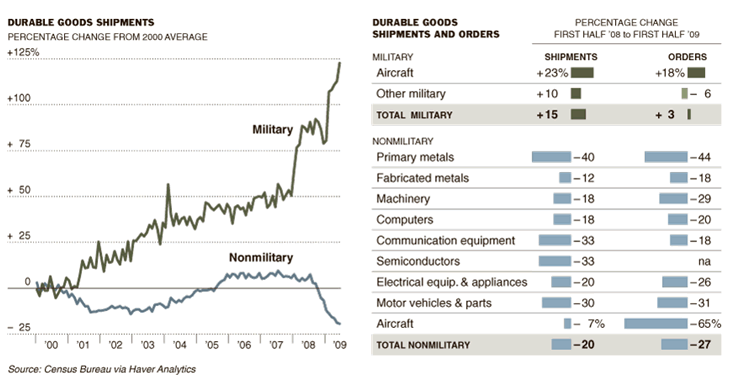
[Click here to view full image.]
So we're running up our debt (which will eventually decrease economic growth), but the only jobs we're creating are military and other public sector jobs.
This might be okay from a strictly economic (as opposed to moral) perspective if defense jobs reduced unemployment. But, as many economists point out, the fact is that massive military spending actually increases unemployment in the long-run.
For example, PhD economist Dean Baker notes that America's massive military spending on unnecessary and unpopular wars lowers economic growth and increases unemployment:
Government policy has largely caused the current unemployment crisis. And until Washington and Wall Street are forced to change course, things will not meaningfully and significantly improve for a long time.
The commonly-accepted unemployment figures for the Great Depression are overstated.
Specifically, government workers were counted as unemployed by Stanley Lebergott (the BLS economist who put together the most widely used numbers) ... even though gainfully employed and receiving a pay check.
If we're trying to compare current unemployment figures with the Great Depression, the calculations of economists such as Michael Darby are more accurate.
Here is a comparison of Lebergott and Darby's unemployment figures:
| Year | Lebergott | Darby | |
| 1929 | 3.2% | 3.2% | |
| 1930 | 8.7% | 8.7% | |
| 1931 | 15.9% | 15.3% | |
| 1932 | 23.6% | 22.9% | |
| 1933 | 24.9% | 20.6% | |
| 1934 | 21.7% | 16.0% | |
| 1935 | 20.1% | 14.2% | |
| 1936 | 16.9% | 9.9% | |
| 1937 | 14.3% | 9.1% | |
| 1938 | 19.0% | 12.5% | |
| 1939 | 17.2% | 11.3% | |
| 1940 | 14.6% | 9.5% |
(see Robert A. Margo's Employment and Unemployment in the 1930s.)
We've Got Depression-Level Unemployment
Unemployment is currently underreported. Even government officials admit that their "adjustments" to unemployment figures are inaccurate during recessions.
In addition, the most widely-cited statistics use the Department of Labor's Bureau of Labor Statistics' "U-3" methodology. But "U-6" figures are more accurate, because they include people who would like full-time work, but can only find part-time work, or people who have given up looking for work altogether. U-6 is also is closer to the way unemployment was measured during the Great Depression than U-3
Current levels of unemployment are Depression-level numbers, especially when compared to Darby's figures.
For example, economist John Williams puts current U-6 unemployment at 15.9%. That's higher than 9 out of 12 years charted by Darby.
And there are certainly Depression-level statistics in some states. For example, official Bureau of Labor Statistics numbers put U-6 above 20% in several states:
- California: 22.0
- Nevada: 23.7
- Michigan 20.3
- (and Los Angeles County has 24.1% unemployment, higher than any of the Depression years as reported by Darby)
Youngstown State University's Center for Working Class Studies puts the "De Facto Unemployment Rate" at 28.76%. I'm not sure if that compares to methods used during the Great Depression, but it surpasses all 12 out of 12 years charted by Darby.
More People Are Unemployed than During the Great DepressionAs I noted in January 2009:
In 1930, there were 123 million Americans.
At the height of the Depression in 1933, 24.9% of the total work force or 11,385,000 people, were unemployed.
Will unemployment reach 25% during this current crisis?
I don't know. But the number of people unemployed will be higher than during the Depression.
Specifically, there are currently some 300 million Americans, 154.4 million of whom are in the work force.
Unemployment is expected to exceed 10% by many economists, and Obama "has warned that the unemployment rate will explode to at least 10% in 2009".
10 percent of 154 million is 15 million people out of work - more than during the Great Depression.
Given that the broader U-6 measure of unemployment is currently around 17% (ShadowStats.com puts the figure at 22%, and some put it even higher), the current numbers are that much worse.
Unemployment is Long-Term
USA Today reported in December:
So many Americans have been jobless for so long that the government is changing how it records long-term unemployment.The Wall Street Journal noted in July 2009:
Citing what it calls "an unprecedented rise" in long-term unemployment, the federal Bureau of Labor Statistics (BLS), beginning Saturday, will raise from two years to five years the upper limit on how long someone can be listed as having been jobless.
***
The change is a sign that bureau officials "are afraid that a cap of two years may be 'understating the true average duration' — but they won't know by how much until they raise the upper limit," says Linda Barrington, an economist who directs the Institute for Compensation Studies at Cornell University's School of Industrial and Labor Relations.
***
"The BLS doesn't make such changes lightly," Barrington says. Stacey Standish, a bureau assistant press officer, says the two-year limit has been used for 33 years.
***
Although "this feels like something we've not experienced" since the Great Depression, she says, economists need more information to be sure.
The average length of unemployment is higher than it's been since government began tracking the data in 1948.The Christian Science Monitor wrote an article in June entitled, "Length of unemployment reaches Great Depression levels".
***
The job losses are also now equal to the net job gains over the previous nine years, making this the only recession since the Great Depression to wipe out all job growth from the previous expansion.
60 Minutes - in a must-watch segment - notes that our current situation tops the Great Depression in one respect: never have we had a recession this deep with a recovery this flat. 60 Minutes points out that unemployment has been at 9.5% or above for 14 months.
Pulitzer Prize-winning historian David M. Kennedy notes in Freedom From Fear: The American People in Depression and War, 1929-1945 (Oxford, 1999) that - during Herbert Hoover's presidency, more than 13 million Americans lost their jobs. Of those, 62% found themselves out of work for longer than a year; 44% longer than two years; 24% longer than three years; and 11% longer than four years.Blytic calculated last year that the current average duration of unemployment is some 32 weeks, the median duration is around 20 weeks, and there are approximately 6 million people unemployed for 27 weeks or longer.
As Calculated Risk noted last month:
According to the BLS, there are 5.839 million workers who have been unemployed for more than 26 weeks and still want a job. This was down from 6.122 million in March. This remains very high, and is one of the defining features of this employment recession.

Many leading economists say that America is suffering a permanent destruction of jobs.
Despite What the Government Says, Reducing Unemployment Is a Very Low PriorityFor example, JPMorgan Chase’s Chief Economist Bruce Kasman told Bloomberg:[We've had a] permanent destruction of hundreds of thousands of jobs in industries from housing to finance.The chief economists for Wells Fargo Securities, John Silvia, says:
Companies “really have diminished their willingness to hire labor for any production level,” Silvia said. “It’s really a strategic change,” where companies will be keeping fewer employees for any particular level of sales, in good times and bad, he said.And former Merrill Lynch chief economist David Rosenberg writes:
The number of people not on temporary layoff surged 220,000 in August and the level continues to reach new highs, now at 8.1 million. This accounts for 53.9% of the unemployed — again a record high — and this is a proxy for permanent job loss, in other words, these jobs are not coming back. Against that backdrop, the number of people who have been looking for a job for at least six months with no success rose a further half-percent in August, to stand at 5 million — the long-term unemployed now represent a record 33% of the total pool of joblessness.And see this.
While government officials talk a good game, government policy has actually not been geared towards fighting inflation, not creating more jobs.
Some Jobs Are Being Created ... But Mainly In the Military
127,000 jobs need to be created each month just to make sure that things aren't getting worse. (127,000 is the monthly population increase in the United States.)
But - according to ADP - last month only 38,000 jobs were created in the private sector.
There is fierce debate about how much the government has spent to create a few measly jobs. Some say that it is an insane amount, while others say the figure is lower. And see this .
But the truth is that there wasn't very much government stimulation aimed towards creating jobs at all ... other than in the military. As I pointed out in 2009, public sector spending - and mainly defense spending - has accounted for virtually all of the new job creation in the past 10 years:The U.S. has largely been financing job creation for ten years. Specifically, as the chief economist for BusinessWeek, Michael Mandel, points out, public spending has accounted for virtually all new job creation in the past 10 years:
Private sector job growth was almost non-existent over the past ten years. Take a look at this horrifying chart:
Between May 1999 and May 2009, employment in the private sector sector only rose by 1.1%, by far the lowest 10-year increase in the post-depression period.
It’s impossible to overstate how bad this is. Basically speaking, the private sector job machine has almost completely stalled over the past ten years. Take a look at this chart:
Over the past 10 years, the private sector has generated roughly 1.1 million additional jobs, or about 100K per year. The public sector created about 2.4 million jobs.
But even that gives the private sector too much credit. Remember that the private sector includes health care, social assistance, and education, all areas which receive a lot of government support.
***
Let me finish with a final chart.
Without a decade of growing government support from rising health and education spending and soaring budget deficits, the labor market would have been flat on its back.
Indeed, Robert Reich lamented last year:
America’s biggest — and only major — jobs program is the U.S. military.Raw Story argues that the U.S. is building a largely military economy:
The use of the military-industrial complex as a quick, if dubious, way of jump-starting the economy is nothing new, but what is amazing is the divergence between the military economy and the civilian economy, as shown by this New York Times chart.
In the past nine years, non-industrial production in the US has declined by some 19 percent. It took about four years for manufacturing to return to levels seen before the 2001 recession -- and all those gains were wiped out in the current recession.
By contrast, military manufacturing is now 123 percent greater than it was in 2000 -- it has more than doubled while the rest of the manufacturing sector has been shrinking...So most of the job creation has been by the public sector. But because the job creation has been financed with loans from China and private banks, trillions in unnecessary interest charges have been incurred by the U.S. And this shows military versus non-military durable goods shipments:
It's important to note the trajectory -- the military economy is nearly three times as large, proportionally to the rest of the economy, as it was at the beginning of the Bush administration. And it is the only manufacturing sector showing any growth. Extrapolate that trend, and what do you get?
The change in leadership in Washington does not appear to be abating that trend...
[Click here to view full image.]
So we're running up our debt (which will eventually decrease economic growth), but the only jobs we're creating are military and other public sector jobs.
This might be okay from a strictly economic (as opposed to moral) perspective if defense jobs reduced unemployment. But, as many economists point out, the fact is that massive military spending actually increases unemployment in the long-run.
For example, PhD economist Dean Baker notes that America's massive military spending on unnecessary and unpopular wars lowers economic growth and increases unemployment:
Defense spending means that the government is pulling away resources from the uses determined by the market and instead using them to buy weapons and supplies and to pay for soldiers and other military personnel. In standard economic models, defense spending is a direct drain on the economy, reducing efficiency, slowing growth and costing jobs.
A few years ago, the Center for Economic and Policy Research commissioned Global Insight, one of the leading economic modeling firms, to project the impact of a sustained increase in defense spending equal to 1.0 percentage point of GDP. This was roughly equal to the cost of the Iraq War.And the Political Economy Research Institute at the University of Massachusetts, Amherst has also shown that non-military spending creates more jobs than military spending.
Global Insight’s model projected that after 20 years the economy would be about 0.6 percentage points smaller as a result of the additional defense spending. Slower growth would imply a loss of almost 700,000 jobs compared to a situation in which defense spending had not been increased. Construction and manufacturing were especially big job losers in the projections, losing 210,000 and 90,000 jobs, respectively.
The scenario we asked Global Insight [recognized as the most consistently accurate forecasting company in the world] to model turned out to have vastly underestimated the increase in defense spending associated with current policy. In the most recent quarter, defense spending was equal to 5.6 percent of GDP. By comparison, before the September 11th attacks, the Congressional Budget Office projected that defense spending in 2009 would be equal to just 2.4 percent of GDP. Our post-September 11th build-up was equal to 3.2 percentage points of GDP compared to the pre-attack baseline. This means that the Global Insight projections of job loss are far too low...
The projected job loss from this increase in defense spending would be close to 2 million. In other words, the standard economic models that project job loss from efforts to stem global warming also project that the increase in defense spending since 2000 will cost the economy close to 2 million jobs in the long run.
Government policy has largely caused the current unemployment crisis. And until Washington and Wall Street are forced to change course, things will not meaningfully and significantly improve for a long time.
Thursday, April 28, 2011
Student Loan Debt Hell: 21 Statistics That Will Make You Think Twice About Going To College

by Michael Snyder
Is going to college a worthwhile investment? Is the education that our young people are receiving at our colleges and universities really worth all of the time, money and effort that is required? Decades ago, a college education was quite inexpensive and it was almost an automatic ticket to the middle class. But today all of that has changed. At this point, college education is a big business. There are currently more than 18 million students enrolled at the nearly 5,000 colleges and universities currently in operation throughout the United States. There are quite a few "institutions of higher learning" that now charge $40,000 or even $50,000 a year for tuition. That does not even count room and board and other living expenses.
Meanwhile, as you will see from the statistics posted below, the quality of education at our colleges and universities has deteriorated badly. When graduation finally arrives, many of our college students have actually learned very little, they find themselves unable to get good jobs and yet they end up trapped in student loan debt hell for essentially the rest of their lives.
Across America today, "guidance counselors" are pushing millions of high school students to go to the very best colleges that they can get into, but they rarely warn them about how much it is going to cost or about the sad reality that they could end up being burdened by massive debt loads for decades to come.
Yes, college is a ton of fun and it is a really unique experience. If you can get someone else to pay for it then you should definitely consider going.
There are also many careers which absolutely require a college degree. Depending on your career goals, you may not have much of a choice of whether to go to college or not.
But that doesn't mean that you have to go to student loan debt hell.
You don't have to go to the most expensive school that you can get into.
You don't have to take out huge student loans.
There is no shame in picking a school based on affordability.
The truth is that pretty much wherever you go to school the quality of the education is going to be rather pathetic. A highly trained cat could pass most college courses in the United States today.
Personally, I have had the chance to spend quite a number of years on college campuses. I enjoyed my time and I have some pretty pieces of parchment to put up on the wall. I have seen with my own eyes what goes on at our institutions of higher learning. In a previous article, I described what life is like for most "average students" enrolled in our colleges and universities today....
The vast majority of college students in America spend two to four hours a day in the classroom and maybe an hour or two outside the classroom studying. The remainder of the time these "students" are out drinking beer, partying, chasing after sex partners, going to sporting events, playing video games, hanging out with friends, chatting on Facebook or getting into trouble. When they say that college is the most fun that most people will ever have in their lives they mean it. It is basically one huge party.
If you are a parent and you are shelling out tens of thousands of dollars every year to pay for college you need to know the truth.
You are being ripped off.
Sadly, a college education just is not that good of an investment anymore. Tuition costs have absolutely skyrocketed even as the quality of education has plummeted.
A college education is not worth getting locked into crippling student loan payments for the next 30 years.
Even many university professors are now acknowledging that student loan debt has become a horrific societal problem. Just check out what one professor was quoted as saying in a recent article in The Huffington Post....
“Thirty years ago, college was a wise, modest investment,” says Fabio Rojas, a professor of sociology at Indiana University. He studies the politics of higher education. “Now, it’s a lifetime lock-in, an albatross you can’t escape.”
Anyone that is thinking of going to college needs to do a cost/benefit analysis.
Is it really going to be worth it?
For some people the answer will be "yes" and for some people the answer will be "no".
But sadly, hardly anyone that goes to college these days gets a "good" education.
To get an idea of just how "dumbed down" we have become as a nation, just check out this Harvard entrance exam from 1869.
I wouldn't have a prayer of passing that exam.
What about you?
We really do need to rethink our approach to higher education in this country.
Posted below are 21 statistics about college tuition, student loan debt and the quality of college education in the United States....
#1 Since 1978, the cost of college tuition in the United States has gone up by over 900 percent.
#2 In 2010, the average college graduate had accumulated approximately $25,000 in student loan debt by graduation day.
#3 Approximately two-thirds of all college students graduate with student loans.
#4 Americans have accumulated well over $900 billion in student loan debt. That figure is higher than the total amount of credit card debt in the United States.
#5 The typical U.S. college student spends less than 30 hours a week on academics.
#6 According to very extensive research detailed in a new book entitled "Academically Adrift: Limited Learning on College Campuses", 45 percent of U.S. college students exhibit "no significant gains in learning" after two years in college.
#7 Today, college students spend approximately 50% less time studying than U.S. college students did just a few decades ago.
#8 35% of U.S. college students spend 5 hours or less studying per week.
#9 50% of U.S. college students have never taken a class where they had to write more than 20 pages.
#10 32% of U.S. college students have never taken a class where they had to read more than 40 pages in a week.
#11 U.S. college students spend 24% of their time sleeping, 51% of their time socializing and 7% of their time studying.
#12 Federal statistics reveal that only 36 percent of the full-time students who began college in 2001 received a bachelor's degree within four years.
#13 Nearly half of all the graduate science students enrolled at colleges and universities in the United States are foreigners.
#14 According to the Economic Policy Institute, the unemployment rate for college graduates younger than 25 years old was 9.3 percent in 2010.
#15 One-third of all college graduates end up taking jobs that don't even require college degrees.
#16 In the United States today, over 18,000 parking lot attendants have college degrees.
#17 In the United States today, 317,000 waiters and waitresses have college degrees.
#18 In the United States today, approximately 365,000 cashiers have college degrees.
#19 In the United States today, 24.5 percent of all retail salespersons have a college degree.
#20 Once they get out into the "real world", 70% of college graduates wish that they had spent more time preparing for the "real world" while they were still in school.
#21 Approximately 14 percent of all students that graduate with student loan debt end up defaulting within 3 years of making their first student loan payment.
There are millions of young college graduates running around out there that are wondering where all of the "good jobs" are. All of their lives they were promised that if they worked really hard and got good grades that the system would reward them.
Sometimes when you do everything right you still can't get a job. A while back The Huffington Post featured the story of Kyle Daley - a highly qualified UCLA graduate who had been unemployed for 19 months at the time....
I spent my time at UCLA preparing for the outside world. I had internships in congressional offices, political action committees, non-profits and even as a personal intern to a successful venture capitalist. These weren't the run-of-the-mill office internships; I worked in marketing, press relations, research and analysis. Additionally, the mayor and city council of my hometown appointed me to serve on two citywide governing bodies, the planning commission and the open government commission. I used to think that given my experience, finding work after graduation would be easy.
At this point, however, looking for a job is my job. I recently counted the number of job applications I have sent out over the past year -- it amounts to several hundred. I have tried to find part-time work at local stores or restaurants, only to be turned away. Apparently, having a college degree implies that I might bail out quickly when a better opportunity comes along.
The sad truth is that a college degree is not an automatic ticket to the middle class any longer.
But for millions of young Americans a college degree is an automatic ticket to student loan debt hell.
Student loan debt is one of the most insidious forms of debt. You can't get away from student loan debt no matter what you do. Federal bankruptcy law makes it nearly impossible to discharge student loan debts, and many recent grads end up with loan payments that absolutely devastate them financially at a time when they are struggling to get on their feet and make something of themselves.
So are you still sure that you want to go to college?
Another open secret is that most of our colleges and universities are little more than indoctrination centers. Most people would be absolutely shocked at how much unfiltered propaganda is being pounded into the heads of our young people.
At most colleges and universities, when it comes to the "big questions" there is a "right answer" and there is virtually no discussion of any other alternatives.
In most fields there is an "orthodoxy" that you had better adhere to if you want to get good grades.
Let's just say that "independent thought" and "critical thinking" are not really encouraged at most of our institutions of higher learning.
Am I bitter because I didn't do well? No, I actually did extremely well in school. I have seen the system from the inside. I know how it works.
It is a giant fraud.
If you want to go to college because you want to have a good time or because it will help you get your career started then by all means go for it.
Just realize what you are signing up for.
Subscribe to:
Posts (Atom)


